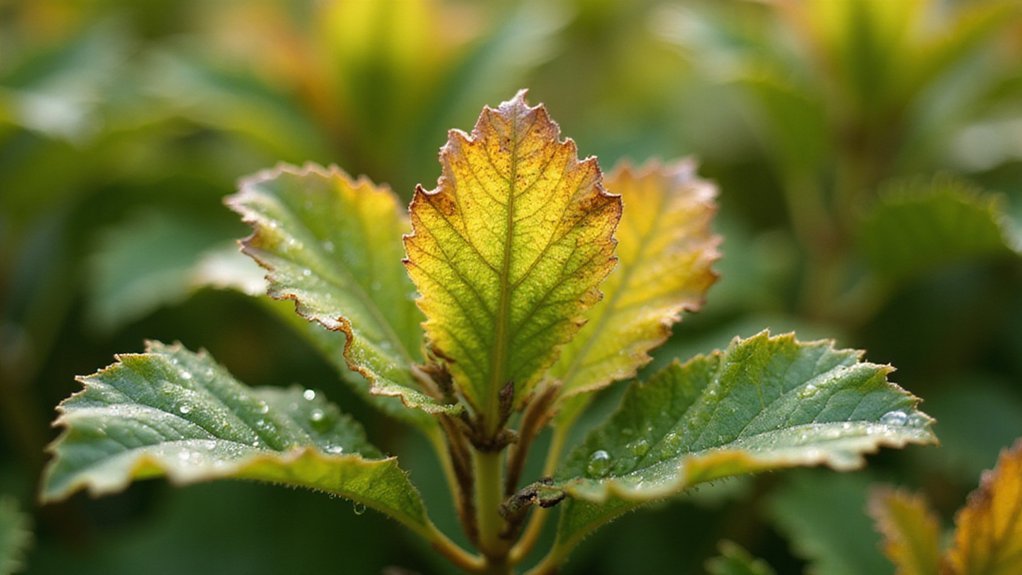
Your money tree’s leaves are practically screaming for help when they turn yellow. You’ll need to investigate several possible culprits—from overwatering that suffocates roots to inadequate light that weakens your plant—but don’t worry; most problems are fixable. By examining your plant’s soil moisture, drainage system, and growing conditions, you can identify what’s gone wrong and restore those vibrant green leaves, though the exact cause might surprise you.
Is It Really Yellowing? Diagnosing Money Tree Problems
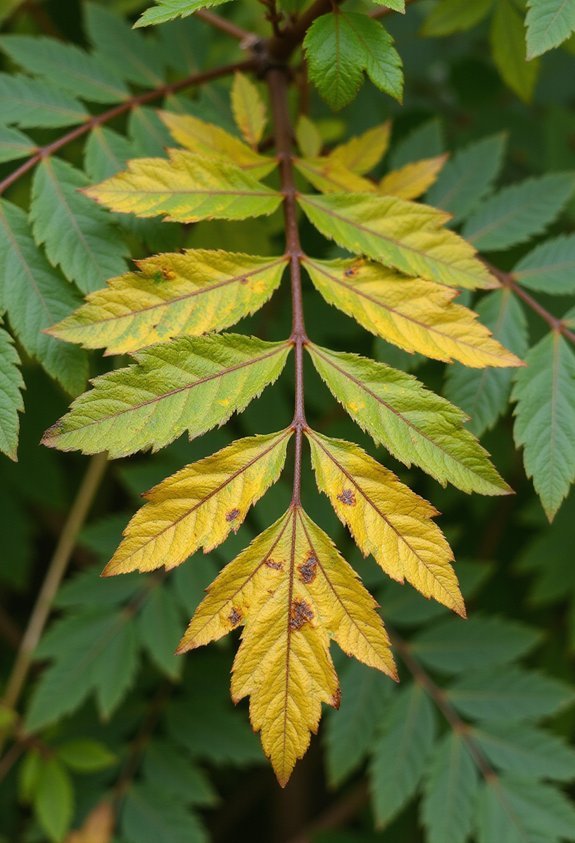
Before you jump to conclusions about your money tree’s health, you’ll want to rule out whether the leaves are actually turning yellow or if what you’re seeing is simply a natural part of the plant’s growth cycle. Examine the affected leaves closely under good lighting, as some older leaves naturally fade to yellow before dropping off, which is completely normal. Check whether the yellowing appears uniformly across the plant or concentrates in specific areas, since this distinction helps identify the underlying cause. Look at the leaf texture and any accompanying symptoms like spots, wilting, or leaf drop, as these details provide essential diagnostic information. Compare your observations against photos of healthy money trees to confirm you’re actually dealing with yellowing rather than natural color variation.
Also read: 5 Winter Things Killing Your Houseplants
Overwatering: Why It’s the #1 Money Tree Killer
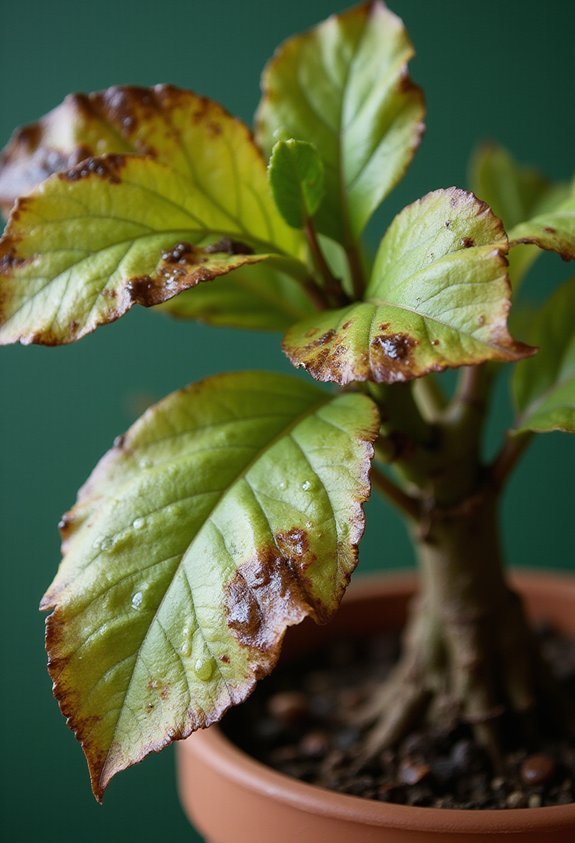
Since money trees thrive in their natural tropical habitat where soil drains quickly after rainfall, they’ve adapted to prefer drier conditions than most plant owners realize, and this fundamental difference in water needs makes overwatering the leading cause of yellowing leaves and plant decline. When you water too frequently, the soil remains constantly wet, which suffocates the roots by blocking oxygen absorption. This oxygen deprivation triggers root rot, a serious condition where roots decay and can’t transport water or nutrients to the leaves. As roots deteriorate, yellowing spreads throughout the foliage. You should allow the soil to dry out between waterings, checking moisture levels by inserting your finger two inches into the soil before watering again.
Checking Soil Moisture: Your First Diagnostic Step
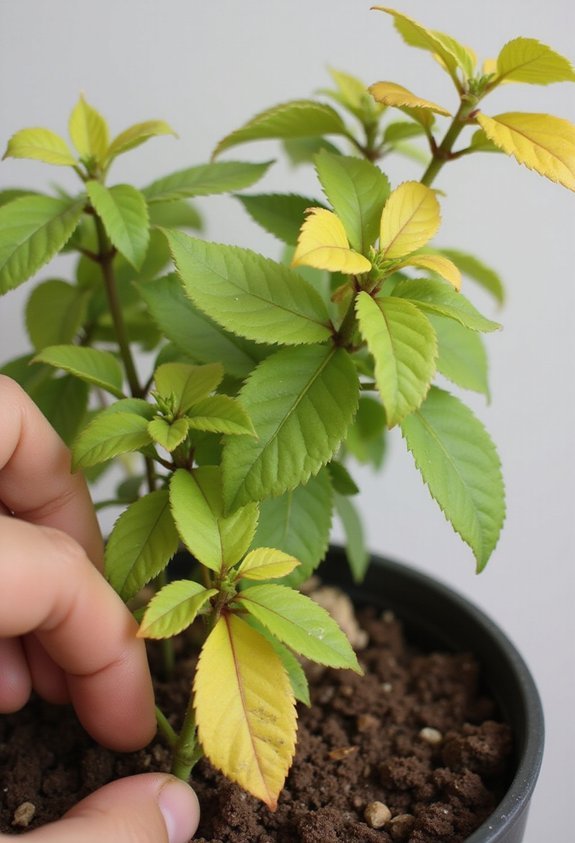
When you’re trying to figure out why your money tree’s leaves are turning yellow, the soil moisture check should be your starting point because it’s quick, reliable, and gives you immediate answers about whether overwatering is the culprit. Insert your finger about two inches into the soil near the plant’s base, then assess what you feel. If the soil feels soggy or waterlogged, you’ve likely overwatered your plant. Money trees prefer soil that’s moist but not wet, so the ideal texture should resemble a wrung-out sponge. If you’re uncertain about moisture levels, you can also use a soil moisture meter, which provides precise readings. This diagnostic step eliminates guesswork and directs you toward the correct solution for your yellowing leaves.
Poor Drainage and Container Problems
Even if your soil moisture checks reveal that you’re watering correctly, the problem might not lie with how much water you’re giving your money tree but rather with how that water moves through and out of the soil. Poor drainage occurs when water doesn’t flow freely through your potting medium, causing root rot and yellowing leaves. You’re likely facing drainage issues if your container lacks drainage holes or if you’re using dense, compacted soil that holds moisture excessively. Check that your pot has adequate drainage holes on the bottom, and guarantee you’re using well-draining potting mix specifically formulated for houseplants. If your container doesn’t drain properly, repot your money tree into one with proper drainage holes and fresh, appropriate soil to restore your plant’s health.
Light Levels and Pale, Yellowing Leaves
Another common culprit behind your money tree’s yellowing leaves is improper light exposure, which directly affects the plant’s ability to produce the chlorophyll it needs for healthy green foliage. Your money tree thrives in bright, indirect light, and when it doesn’t receive adequate illumination, its leaves become pale and yellowed as the plant struggles to manufacture nutrients. If you’re keeping your money tree in a dimly lit corner or far from windows, you’re likely depriving it of essential light energy. To fix this issue, relocate your plant closer to a bright window where it’ll receive filtered, indirect sunlight for several hours daily. Avoid placing it in direct sun, which can scorch delicate leaves, but guarantee it gets enough light to maintain vibrant green coloring.
Humidity: Why Tropical Plants Need Moisture in the Air
Beyond light conditions, the moisture level in your home’s air plays a significant role in keeping your money tree’s leaves from yellowing and dropping off. Money trees originate from tropical environments where humidity levels remain consistently high, and they’ve adapted to thrive in such conditions. When you place your money tree in a dry indoor environment, particularly during winter months when heating systems run continuously, the plant struggles to absorb adequate moisture through its leaves. You can increase humidity by misting your plant regularly with water, placing it on a pebble tray filled with water, or running a humidifier nearby. These methods help recreate the tropical moisture your money tree needs to maintain healthy, vibrant foliage and prevent the yellowing that signals stress from insufficient humidity.
Nutrient Gaps: Fertilizing Money Trees Correctly
Just as humidity and light support your money tree’s health, the plant also requires a steady supply of essential nutrients to maintain vibrant green leaves and prevent yellowing caused by nutrient deficiencies. During the growing season from spring through summer, you should fertilize your money tree every four weeks using a balanced, water-soluble fertilizer diluted to half strength. This approach prevents nutrient burn while providing nitrogen, phosphorus, and potassium your plant needs. Reduce fertilizing in fall and winter when growth slows considerably. If you notice yellowing despite proper watering and lighting, nutrient deficiency is likely the culprit. Always follow package instructions carefully, and flush the soil occasionally with distilled water to remove salt buildup that can inhibit nutrient absorption and damage your money tree’s roots.
Spider Mites and Mealybugs: Identifying Pest Damage
While nutrient deficiencies and environmental factors account for many cases of yellowing leaves, pest infestations can also cause your money tree’s foliage to deteriorate rapidly and develop that telltale yellow discoloration. Spider mites, which are tiny arachnids that feed on plant sap, create fine webbing on leaves and stems while leaving stippled, yellowed patches. You’ll notice affected foliage becomes bronzed and eventually drops from the plant. Mealybugs, conversely, appear as small white cottony clusters on leaf joints and undersides, secreting a sticky substance called honeydew that promotes fungal growth. Both pests weaken your plant by extracting essential nutrients, causing widespread yellowing and leaf loss. Inspect your money tree regularly under strong light, checking leaf undersides thoroughly for these common culprits.
Temperature Stress: Cold Drafts and Heat Sources
Beyond addressing pest problems, you’ll want to examine your money tree’s environment, as temperature fluctuations can trigger the same yellowing symptoms you’d see from insect damage or nutrient issues. Money trees thrive in temperatures between 65-75°F, and they’re sensitive to extreme changes. Cold drafts from windows, doors, or air conditioning units shock your plant’s system, causing leaves to yellow and drop. Similarly, heat sources like radiators, heating vents, or direct sunlight through windows can scorch foliage and stress your tree. You should relocate your money tree away from these temperature extremes, positioning it in a stable, moderate location. Maintaining consistent warmth without sudden fluctuations guarantees your plant remains healthy and vibrant, preventing the environmental stress that leads to yellowing leaves.
How Long Does Recovery Take? A Realistic Timeline
Once you’ve identified and corrected the temperature stress affecting your money tree, you’re probably wondering how quickly your plant will bounce back to its healthy state. Recovery typically takes two to four weeks, depending on the severity of the damage and how consistently you maintain proper conditions. During this period, you’ll notice new growth emerging and existing yellowed leaves gradually fading, though damaged foliage won’t return to green. Remove severely yellowed leaves to redirect the plant’s energy toward producing healthy new growth. Continue providing stable temperatures between 65 and 75 degrees Fahrenheit, consistent watering, and bright indirect light. If your money tree shows no improvement after six weeks, reassess your care routine for additional stressors.
Conclusion
You’ve now navigated the diagnostic pathway to restore your money tree’s health. By systematically addressing overwatering, drainage issues, light conditions, nutrient levels, pests, and temperature stressors, you’re planting the seeds for recovery. Your plant won’t transform overnight; patience becomes your greatest tool as new growth emerges. Monitor consistently, adjust environmental factors methodically, and you’ll witness your money tree’s vibrant foliage return to its flourishing state.