
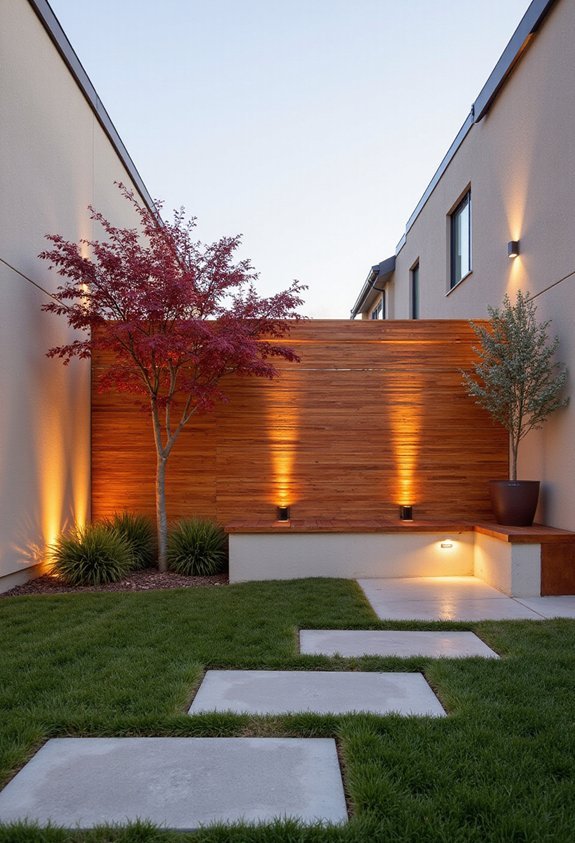
The smallest front yards often make the strongest design statements. By eliminating excess and focusing only on essential elements, tiny spaces achieve a refined clarity that larger yards struggle to accomplish. Every plant choice, every material selection, and every structural element carries weight and purpose. This restraint transforms limitations into advantages, creating front yards that feel curated and intentional rather than constrained. Simplicity becomes sophistication when executed with genuine design understanding. These twenty-two ideas embrace this principle, showing how disciplined choices and thoughtful curation create tiny front yards that radiate elegance and spaciousness through their essential nature.
Start With the Right Colors to Push Your Boundaries Back
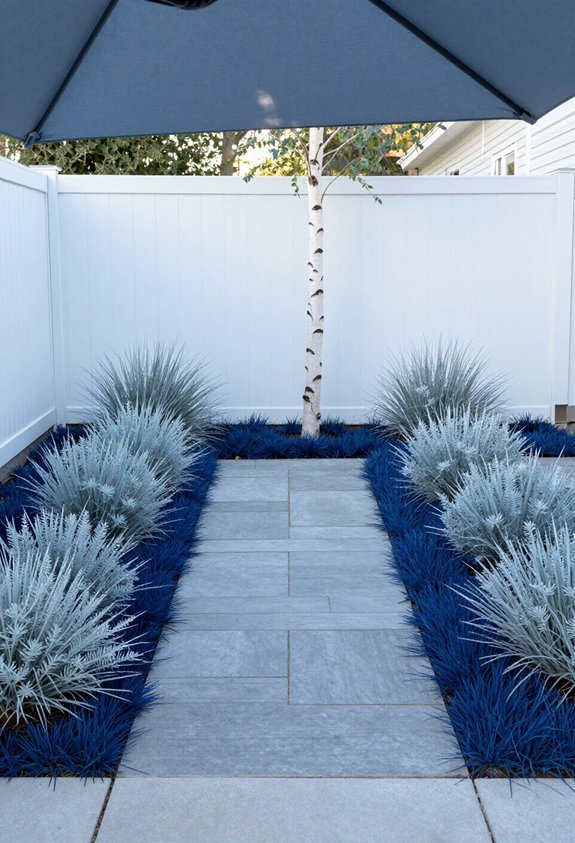
Because small front yards naturally draw the eye toward their edges, the colors chosen for walls, fences, and surrounding structures play a decisive role in how spacious the area feels to an observer. Dark, saturated tones on boundaries absorb light and visually recede, creating the illusion of greater depth beyond the physical space. Conversely, bright or warm colors on enclosing elements advance toward the viewer, compressing the perceived dimensions of the area. The application of muted, earthy hues on vertical surfaces establishes visual continuity with distant landscaping, effectively dissolving the boundary line. This chromatic strategy relies on principles of atmospheric perspective, where lighter, cooler values suggest increased distance. Homeowners should evaluate their existing architectural palette, selecting boundary colors that harmonize with neighboring structures while prioritizing low-light-absorption values to maximize spatial perception.
Also read: 22+ FRONT YARD MAKEOVER Ideas With Big Results!
Paint Your Fence a Cool Blue or Gray for Instant Depth
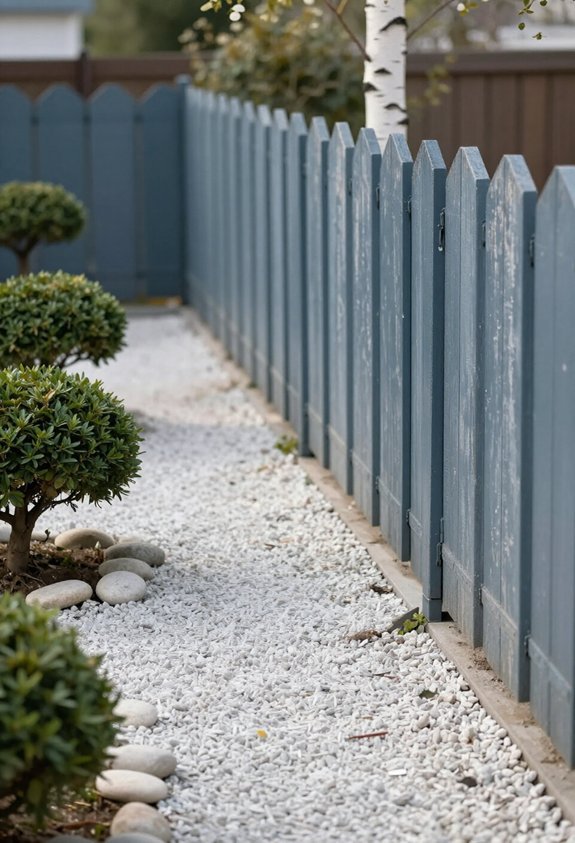
Although selecting fence colors may seem like a minor decision in landscape design, the choice between blue and gray tones carries significant implications for spatial perception in small front yards. Cool colors recede visually, causing boundaries to appear farther away than they physically are, which creates an immediate sense of expanded territory. Blue hues, particularly slate or dusty navy, evoke distant horizons and open sky, while gray tones suggest shadow and depth without the visual weight of darker neutrals. Application requires proper surface preparation, including cleaning and priming, to guarantee even coverage and longevity. Two coats of exterior-grade paint provide ideal saturation and weather resistance. Matte or eggshell finishes minimize glare and maintain the soft, receding effect essential to this spatial strategy.
Mirror One Wall to Literally Double Your Visual Space
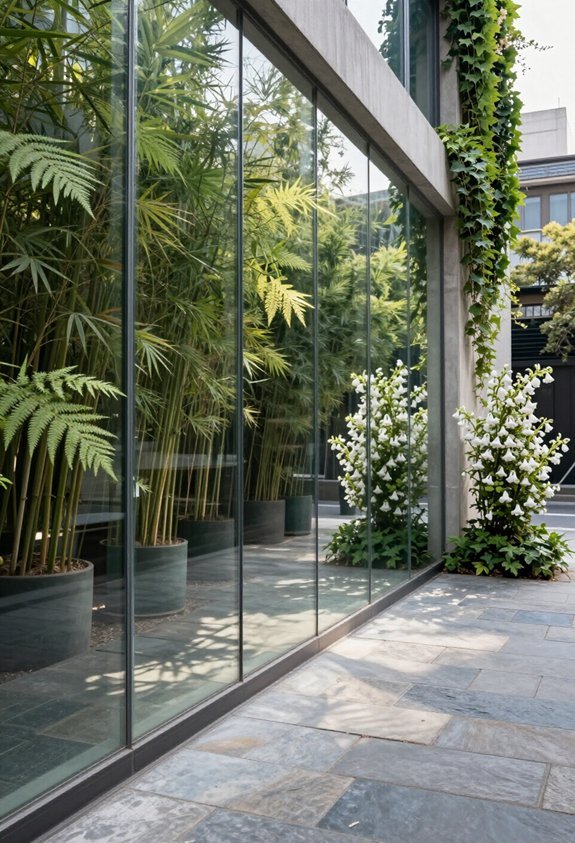
Paint manipulates perception through color alone, yet reflective surfaces achieve spatial expansion through direct physical duplication. A mirrored wall installed along one boundary creates an optical effect that effectively doubles apparent depth, reflecting sky, greenery, and architectural elements back into the viewer’s field of vision. Placement requires careful consideration: the mirror must face an attractive view worth repeating, not utility boxes or neighboring structures. Weather-resistant acrylic or glass panels with protective backing withstand outdoor conditions, while framing in dark metal or narrow wood prevents visual clutter. Angled slightly downward, the surface avoids glare and captures ground-level plantings rather than empty sky. Maintenance involves occasional cleaning to preserve clarity. This technique functions most effectively in narrow passages where lateral expansion matters more than vertical height, transforming compressed envelopes into seemingly continuous landscapes.
Swap Bulky Shrubs for Airy, Sculptural Grasses
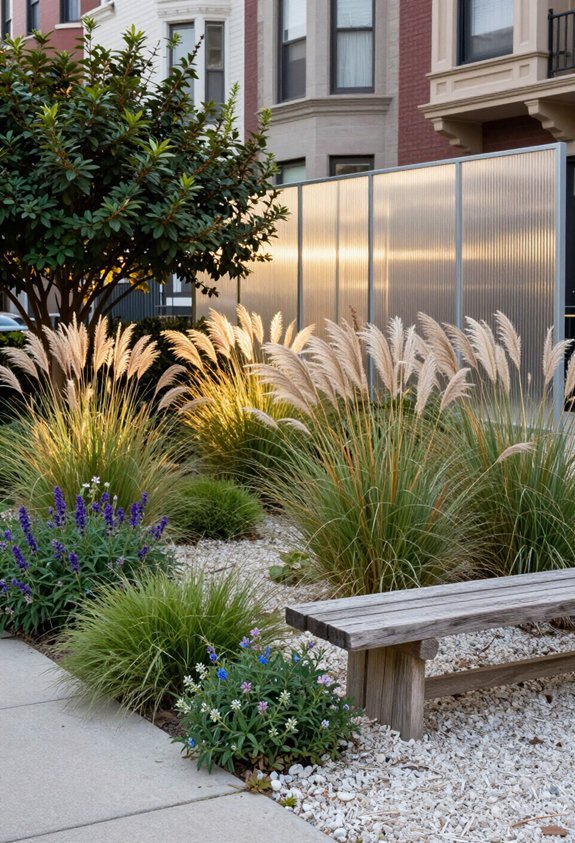
Replace dense, heavy shrubbery with graceful, swaying ornamental grasses to instantly expand visual breathing room in cramped front yard quarters. Unlike solid, opaque shrubs that block sightlines and cast deep shadows, ornamental grasses possess slender, vertical forms that allow light to filter through their fine blades, creating an illusion of depth and openness. Varieties such as feather reed grass, blue fescue, or Japanese forest grass establish architectural presence without consuming excessive ground area, their root systems remaining compact and manageable. These plants move with wind, generating subtle motion that draws the eye upward and outward rather than trapping attention at ground level. Maintenance demands decrease substantially, as grasses require minimal pruning compared to traditional hedges. Seasonal changes provide additional interest, with dried winter stalks offering textural contrast against snow or bare soil.
Plant One Perfect Small Tree for Immediate Height
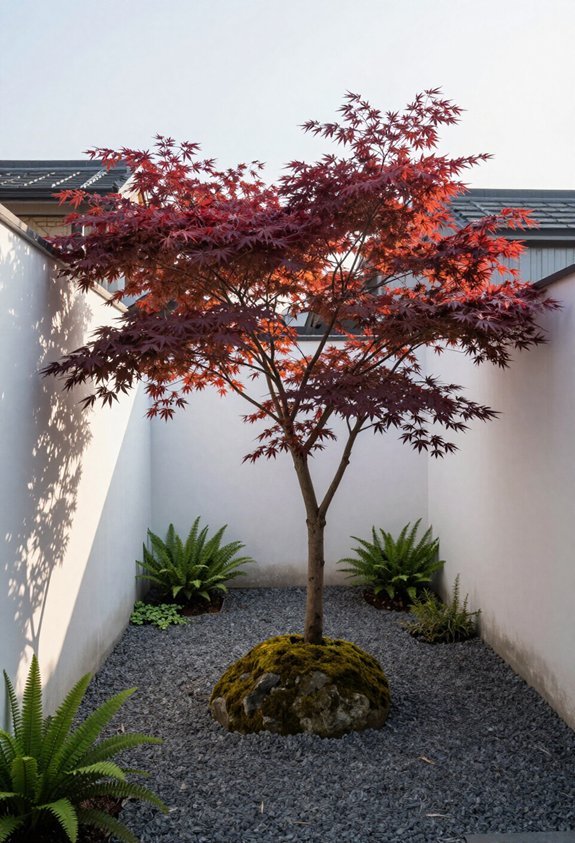
While grasses establish ground-level openness, vertical structure remains necessary to prevent a flat, unfinished appearance in compact front yards. A single small tree introduces immediate vertical interest without consuming excessive lateral space, drawing the eye upward rather than outward to create perceived depth. Species selection demands careful consideration of mature dimensions, with columnar cultivars and dwarf varieties proving most suitable for constrained sites. Japanese maples, crape myrtles, and serviceberries offer compact habits alongside seasonal ornamental value through foliage, bark texture, or flowering displays. Placement should anchor a corner or frame an entrance, establishing a focal point that organizes surrounding elements. Proper siting accounts for overhead utilities and foundation clearance, ensuring long-term structural integrity. The selected specimen requires adequate soil preparation and supplemental irrigation during establishment, after which minimal maintenance preserves its contribution to spatial definition.
Layer Plants Low, Medium, and Tall in Narrow Beds
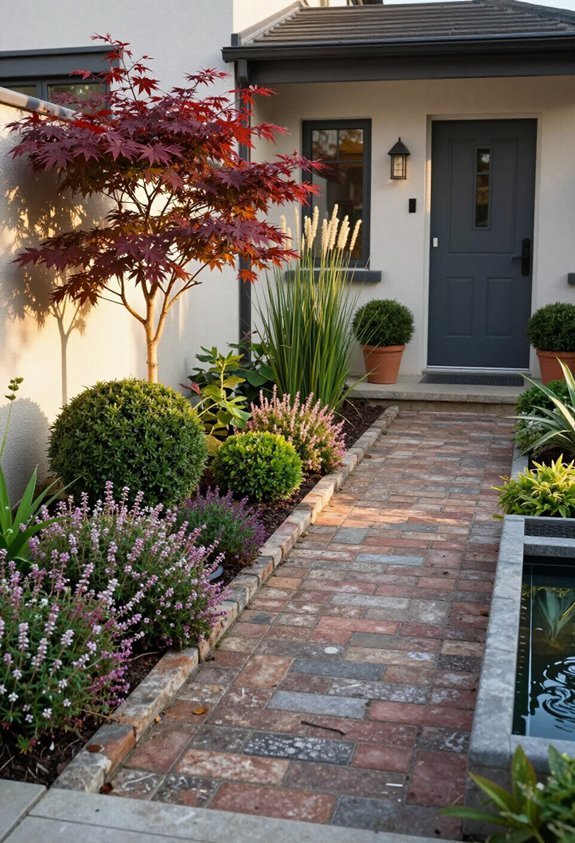
Because narrow planting beds present distinct spatial constraints, vertical layering offers an efficient strategy for maximizing visual density without requiring substantial ground area, allowing multiple species to occupy the same linear footprint through staggered height arrangements. The lowest tier typically incorporates groundcovers or compact perennials, measuring six to twelve inches, which establish a unified base layer. Medium-height plants, ranging from eighteen to thirty inches, form the central visual mass, often including ornamental grasses or leafy perennials. The tallest specimens, reaching three to six feet, anchor the rear of the bed against structures or pathways. This graduated structure creates depth perception, drawing the eye upward rather than outward. Selection requires attention to growth habits, ensuring lower plants tolerate shade cast by taller neighbors. Proper spacing prevents overcrowding while maintaining continuous coverage throughout seasons.
Install Transparent Fencing to Keep Sight Lines Open
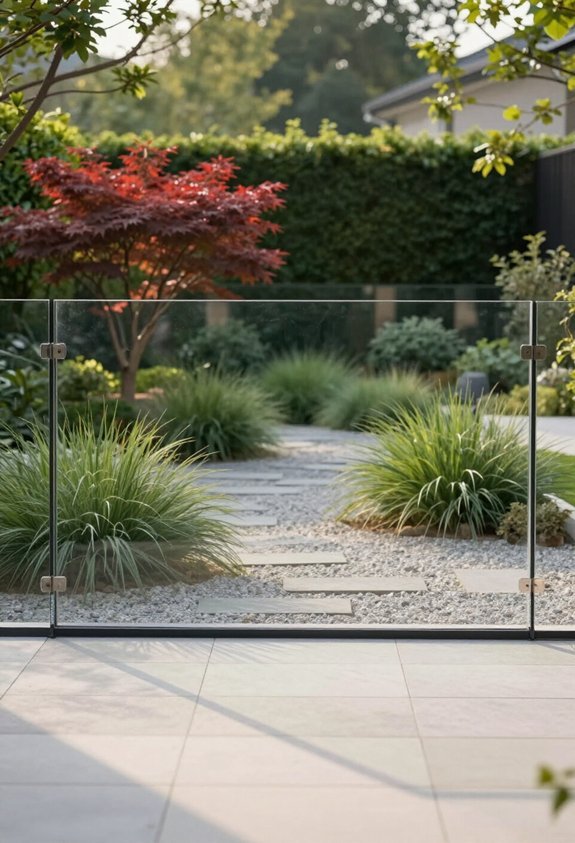
Several transparent fencing options preserve visual continuity across small front yards where opaque barriers would compress perceived boundaries and fragment spatial cohesion. Glass panels, acrylic sheets, and cable rail systems allow light to pass through while establishing clear property lines, effectively extending sight lines beyond the immediate space. Metal mesh or woven wire designs offer similar transparency with reduced material costs and simpler installation procedures. Homeowners should select hardware with minimal visual weight, such as thin metal posts or frameless mounting systems, to maintain unobstructed views. Height considerations matter: lower transparent barriers, typically thirty to forty inches, define space without blocking sight lines entirely. Proper installation requires secure anchoring to withstand wind loads, particularly for solid panels that catch gusts. Regular cleaning prevents mineral deposits and debris from compromising clarity. Strategic placement near property edges maximizes perceived depth, drawing the eye toward distant landscape elements rather than stopping it at a solid wall.
Build a Vertical Garden That Draws the Eye Upward
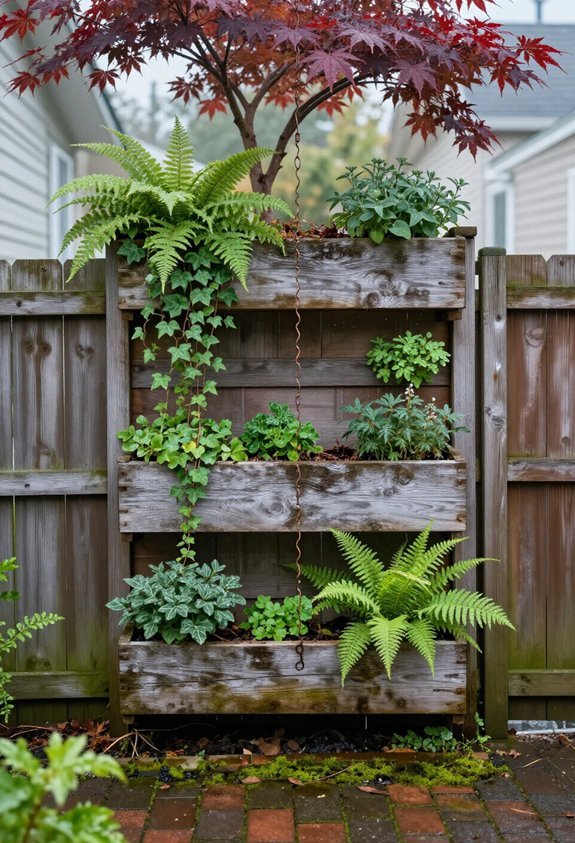
Vertical gardening transforms cramped front yards into layered displays by redirecting attention from limited ground area toward unused vertical surfaces, a technique that proves especially valuable in urban and suburban micro-plots where every square foot must serve multiple purposes. Install wall-mounted planters, trellises, or modular panels against fences, exterior walls, or purpose-built frames, selecting structures that complement existing architecture without overwhelming narrow spaces.
Choose trailing vines, compact herbs, or succulents with varying textures and heights to create visual depth, positioning larger specimens at lower levels and smaller plants above to establish natural progression. Incorporate staggered shelving or pocket systems to maximize planting density while maintaining air circulation between containers. Irrigation requires planning, with drip lines or self-watering reservoirs reducing maintenance demands. Proper anchoring guarantees stability against wind, while periodic rotation of seasonal plantings sustains year-round interest without ground-level consumption.
Angle Your Pavers to Stretch a Small Yard’s Length
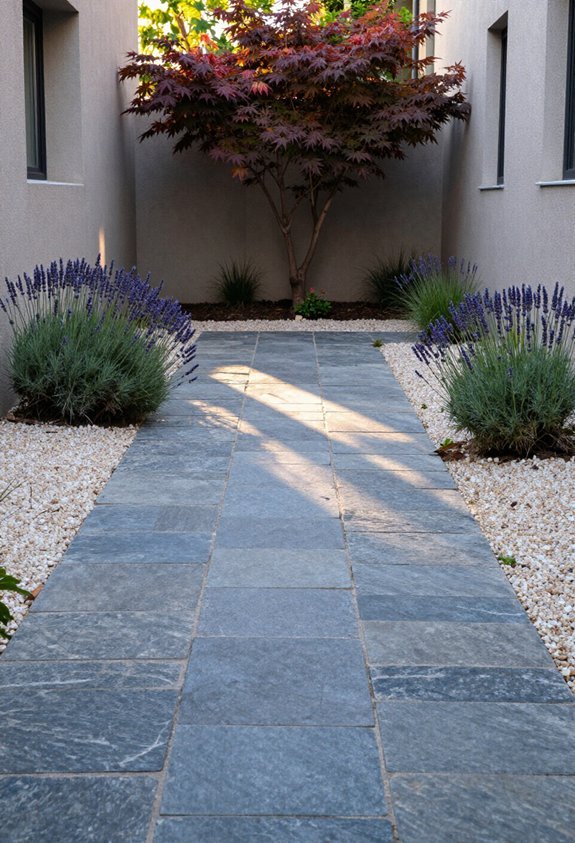
Laying pavers at a diagonal angle creates a visual illusion that extends the perceived boundaries of a compact front yard, a spatial manipulation technique that tricks the eye into reading narrow spaces as longer than their actual measurements. Perpendicular lines halt visual progression abruptly, whereas diagonal placement directs attention outward and forward simultaneously, effectively doubling the perceived depth through angular perspective. For ideal results, orient stones at forty-five degrees relative to the property line, ensuring consistent spacing between units. This method requires precise cutting at perimeter edges where pavers meet borders or structures, demanding additional material calculations of roughly fifteen percent beyond square footage estimates. The pattern works particularly effectively with rectangular units, whose elongated proportions amplify the stretching effect when positioned diagonally across narrow lots.
Choose One Bold Focal Point and Let It Breathe
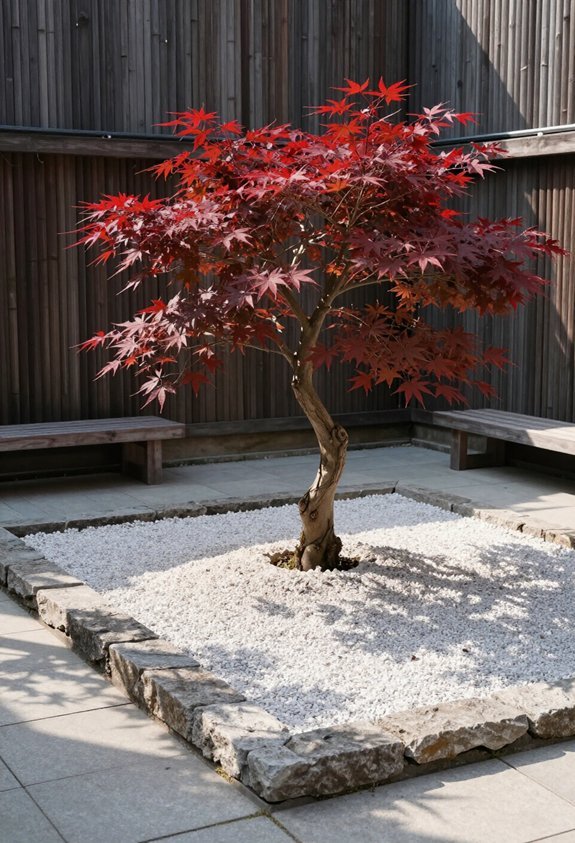
One well-chosen focal point anchors a small front yard more effectively than scattered decorations, giving the eye a single destination rather than a cluttered field of competing elements. A sculptural tree, an oversized planter, or a striking piece of garden art commands attention without overwhelming the limited space. Surround this centerpiece with generous, unplanted margins that allow it to stand apart, creating visual breathing room that reads as intentional spaciousness. Resist the urge to fill every corner with secondary accents, which fragments attention and shrinks the perceived area. Instead, select materials and colors that coordinate quietly with the focal piece, extending its influence through subtle repetition. This disciplined approach transforms constraint into clarity, proving that restraint amplifies impact more reliably than abundance in compact settings.
Grow a Living Arch Over Your Entry Walkway
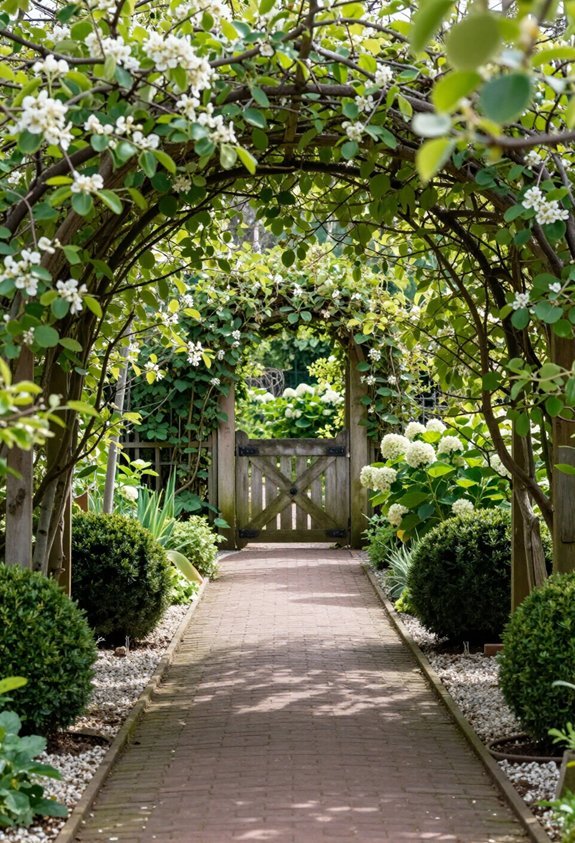
While reflective water features expand space horizontally through mirrored surfaces, vertical plantings draw the eye upward and establish a sense of arrival through architectural definition. A living arch constructed over the entry walkway achieves this through careful selection and training of climbing plants onto a metal or wooden framework positioned at the threshold. Suitable species include fragrant jasmine, robust climbing roses, or evergreen clematis, chosen for vigorous vertical growth and seasonal interest. Install posts approximately eighteen inches from the walkway edges, securing crossbeams overhead to create a tunnel effect measuring seven feet in height. As foliage matures, it forms a filtered canopy that elongates the perceived depth of the approach while occupying minimal ground area. Regular pruning maintains clear passage and promotes dense coverage, transforming a narrow entry into a deliberate, room-like passage.
Use Oversize Pavers With Minimal Grout Lines
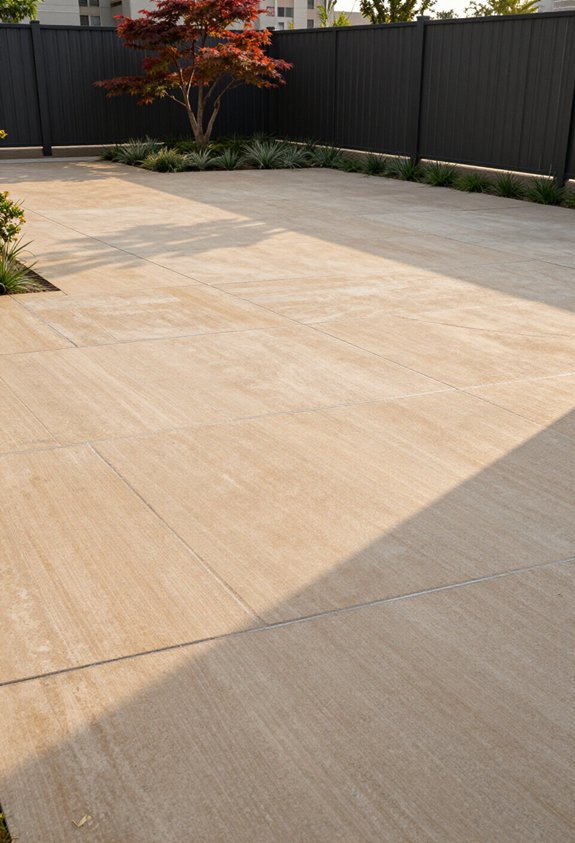
How do small ground covers visually expand limited surface areas? They do not. Small patterns create visual noise, fragmenting perception and making spaces feel confined. Large-format pavers operate on inverse principles, reducing segmentation to produce expansive, unified planes.
Oversize concrete or stone slabs, measuring twenty-four inches or greater, minimize grout lines to less than one-eighth inch. This configuration eliminates the grid-like interruptions typical of standard brick or cobble installations. Fewer breaks between surfaces allow the eye to travel uninterrupted across horizontal planes, creating perceptual continuity that extends apparent boundaries.
Installation requires precise substrate preparation, ensuring level drainage slopes of one percent minimum to prevent pooling. Contractors place pavers on compacted crushed stone bases, adjusting with rubber mallets rather than cutting multiple small pieces. Joint materials remain consistent in tone, matching paver color to further dissolve visual boundaries between units.
Light Your Path From Below to Expand the Ground
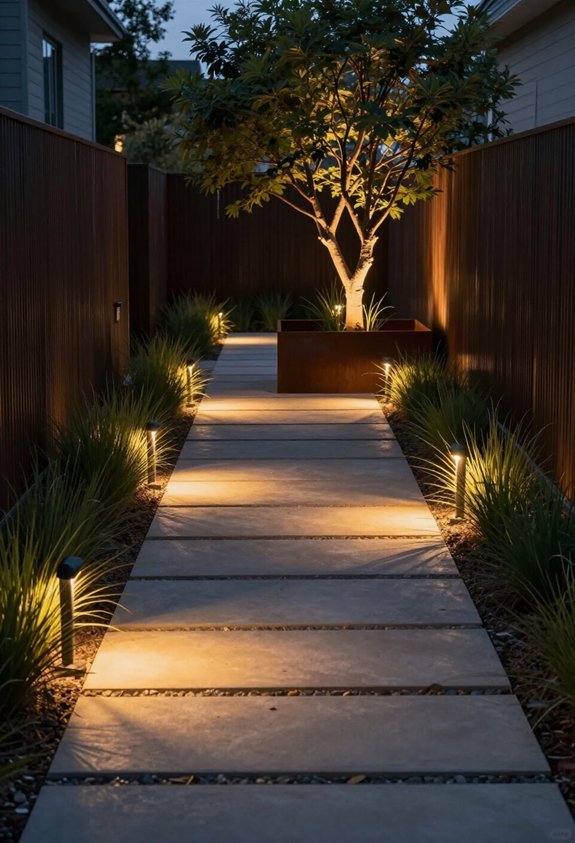
Ground-level illumination reconfigures spatial perception by eliminating the shadows that compress visual boundaries. Recessed fixtures embedded in walkways, steps, or patio edges cast light upward and outward, creating an even glow that flattens the visual plane and extends apparent depth. This technique removes the dark pools that typically collect at ground level in small spaces, which otherwise advance toward the viewer and shrink perceived territory. LED strip lighting concealed beneath coping stones or set into gravel beds produces a continuous, low-profile wash that defines edges without physical bulk. Fixtures should be spaced four to six feet apart along primary circulation routes, with wattage kept low to avoid harsh hotspots that segment space. The result reads as expanded square footage through uninterrupted luminosity.
Cluster Pots in Odd Numbers at Varied Heights
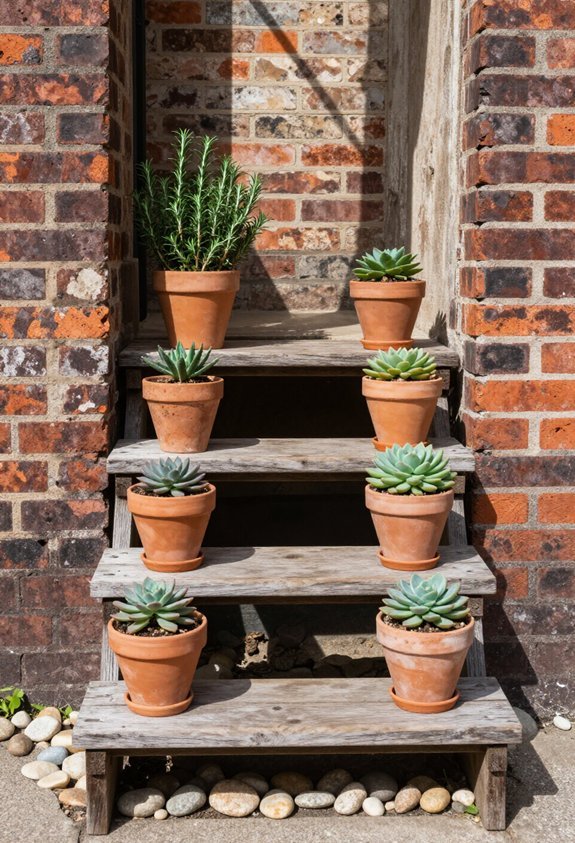
Vertical layering reclaims territory overhead when horizontal space cannot expand. Clustering containers in groupings of three, five, or seven pots establishes visual rhythm without rigid symmetry. Odd numbers compel the eye to travel between elements, creating movement that enlarges perceived boundaries. Heights must vary intentionally: position tall vessels rearward, medium containers centrally, and low planters forward. This tiered arrangement generates depth through overlapping planes, suggesting distance where none exists. Materials should differ—glazed ceramic, weathered concrete, woven fiber—to introduce texture variation that catches light at distinct angles. Plant selection reinforces the effect, with trailing specimens spilling from elevated positions and upright forms anchoring lower tiers. Groupings function as single sculptural units, consolidating fragmented ground into coherent focal points that draw attention upward and outward.
Hang a Statement Door in a Bold, Unexpected Color

Because the front door serves as the primary focal point in most small yards, its color selection carries disproportionate visual weight that can redefine spatial perception entirely. A door painted in an unexpected hue—such as deep teal, burnt orange, or chartreuse—draws the eye immediately, creating a deliberate destination that distracts from limited square footage. This technique exploits the psychological principle that vivid, saturated colors advance visually, making the entry feel closer and more substantial while pushing surrounding walls backward in perceived space.
For best effect, the chosen shade should contrast sharply with the home’s exterior siding, ensuring clear definition without competing patterns. Gloss finishes reflect light, adding dimension, while matte surfaces absorb it for depth. Hardware selection matters; brushed brass or matte black fixtures anchor the composition, preventing the color from overwhelming the narrow facade. The result transforms constraint into intentional design.
Match Window Boxes to Ground Plantings for Unity
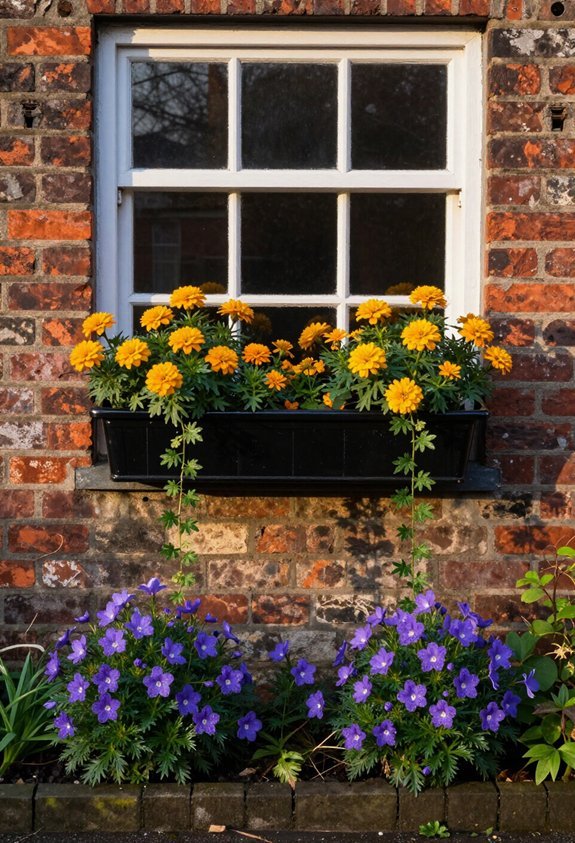
While a boldly colored door commands attention at eye level, the vertical planes of a small front yard demand equal consideration to prevent visual fragmentation. Coordinating window box plantings with ground-level arrangements establishes a continuous visual thread that unifies the facade, drawing the eye upward without jarring interruption. Select identical or complementary species—perhaps trailing ivy, compact geraniums, or dwarf lavender—so that color, texture, and scale remain consistent across elevations. This repetition creates rhythm and perceived depth, making narrow spaces feel intentionally designed rather than cramped. Maintenance requirements simplify when both zones share similar watering and sunlight needs. The effect reads as deliberate architecture rather than scattered decoration, allowing the modest footprint to present itself as a cohesive, thoughtfully composed environment where every element reinforces the whole.
Flank Your Walk With Mirrored, Symmetrical Plantings
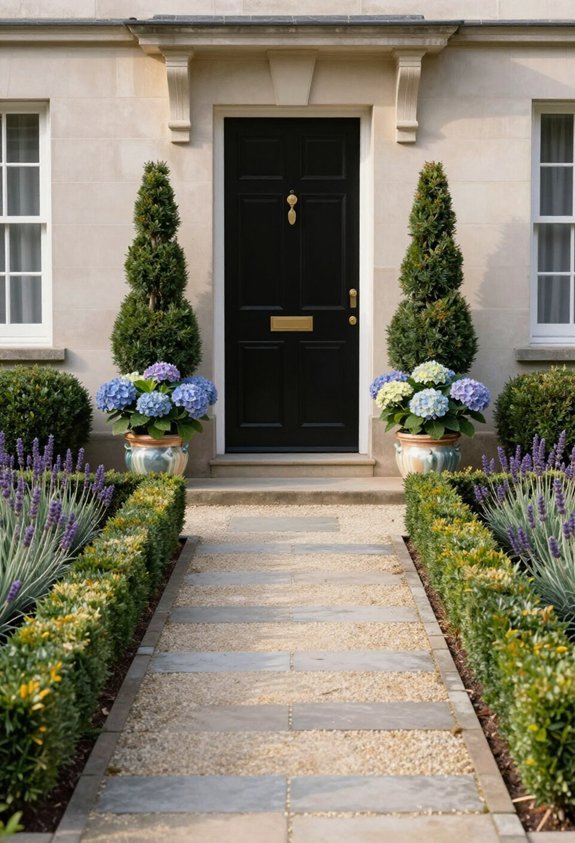
Anchor your walkway with identical plantings on each side to create an ordered, balanced approach that guides visitors toward the door with quiet precision. Select two matching shrubs, such as compact boxwoods or dwarf hydrangeas, placing one at each corner where the path meets the foundation. Repeat this mirrored arrangement at regular intervals along the walk’s edge, using plants of graduated heights that increase slightly as they near the entrance. For narrow paths, choose columnar varieties like sky pencil holly that maintain vertical lines without encroaching on foot traffic. Fill gaps between structural specimens with identical flowering perennials, such as lavender or salvia, ensuring bloom times coordinate for synchronized color displays. This deliberate duplication eliminates visual clutter, creating rhythm that lengthens the perceived depth of compact spaces while directing attention forward.
Squeeze In a Tiny Courtyard With Room to Sit
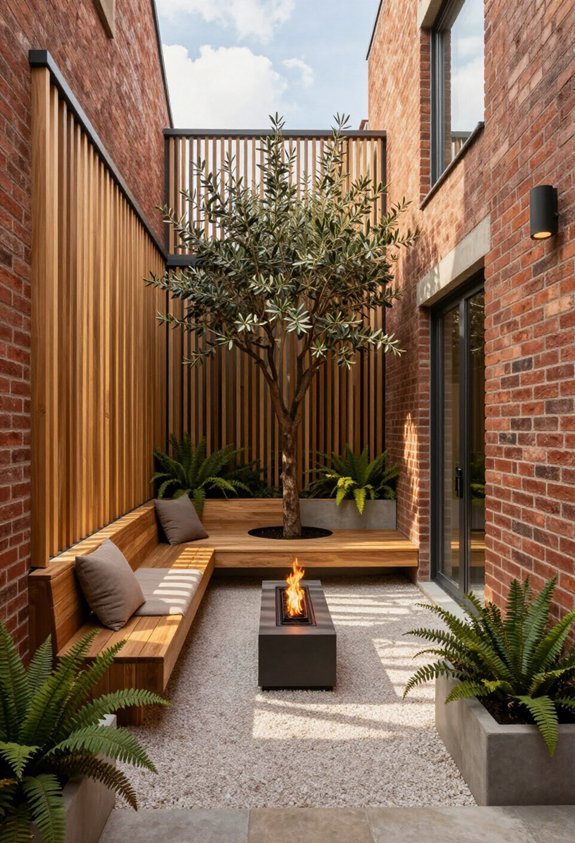
Symmetrical plantings guide the eye forward, yet a front yard can also serve as a place to pause rather than simply pass through. A compact courtyard, measuring as little as six by eight feet, introduces a deliberate destination within limited square footage. Low walls or hedges, positioned perpendicular to the entry path, carve out this semiprivate zone without obstructing sightlines to the door. The enclosure creates psychological separation from the sidewalk while maintaining visual connection to the street.
Built-in seating, such as a stone bench spanning one wall, eliminates the spatial demands of freestanding furniture. The surface should sit sixteen to eighteen inches high, with a depth of at least fifteen inches for comfort. A small central table, no wider than twenty inches, preserves circulation. Paving materials, set in a contrasting pattern from adjacent walkways, reinforce the courtyard’s distinct function as a threshold for rest.
Select Fine-Textured Plants That Read as Open Space
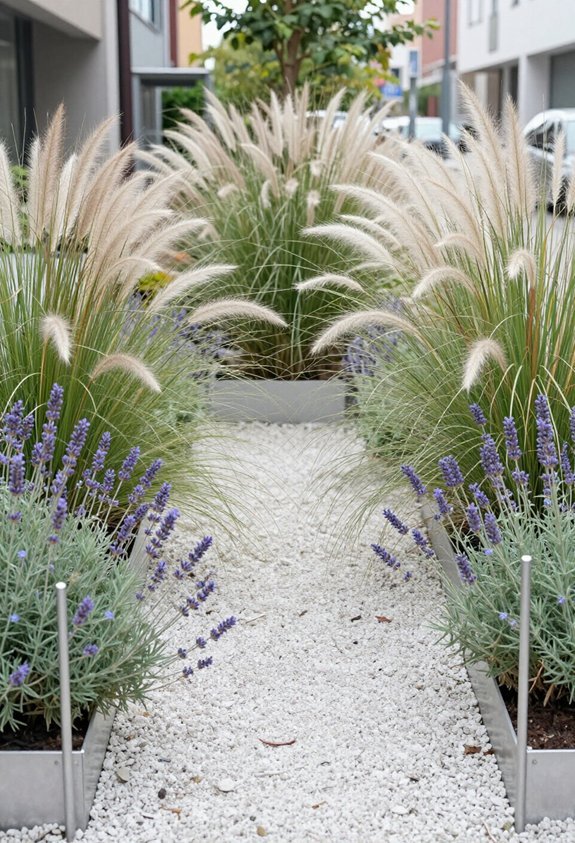
Three characteristics of fine-textured plants make them especially valuable in confined front yards: slender leaves, delicate branching patterns, and an overall airy growth habit. These visual qualities allow light to pass through foliage, creating an illusion of depth and openness that bulky plants cannot achieve. Ornamental grasses, ferns, and certain perennials like Russian sage or threadleaf coreopsis exemplify this effect, their wispy forms occupying minimal visual weight. When placed near boundaries, such plants soften edges without forming solid barriers that enclose space. Designers often position fine-textured specimens in foreground areas, where their transparency preserves sightlines to deeper garden layers. Combining several species with varying heights extends this spatial trick, as overlapping canopies build complexity without density. The result reads as expanded territory rather than crowded planting, an essential strategy for small-scale landscapes.
Unify Your Exterior in One Color From Siding to Trim

While fine-textured plants soften boundaries and create breathing room through visual transparency, the architecture surrounding them demands equal attention in small front yards. Painting siding, trim, doors, and shutters in a single color eliminates visual fragmentation that breaks surfaces into smaller, competing pieces. When the eye travels across one continuous hue, the structure recedes as a unified mass, allowing the yard itself to advance as the focal point. This technique works across materials, from wood clapboards to brick, provided the chosen shade covers every edge, corner, and frame. Lighter tones amplify the effect by reflecting daylight, though deep colors function similarly when applied consistently. The method requires careful preparation, as any unpainted element reintroduces the visual chopping that diminishes perceived spaciousness.
What to Avoid: 7 Mistakes That Shrink Small Yards
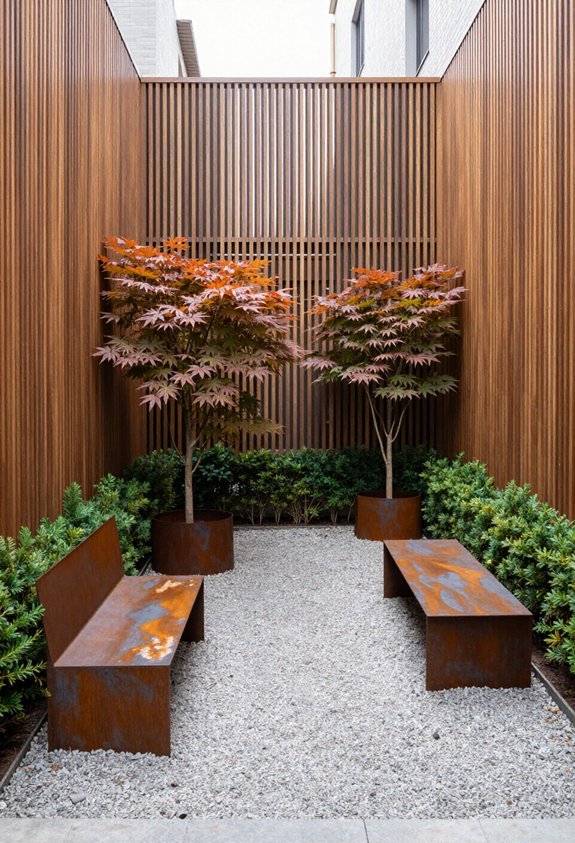
Several common design choices, made without full consideration of spatial perception, actively reduce the apparent size of small front yards rather than preserving or expanding them. Oversized furniture dominates limited ground area, blocking movement and creating visual heaviness that compresses spatial boundaries. Tall, solid fences eliminate sightlines beyond the property, removing the sense of continuity with neighboring spaces that otherwise extends perceived depth. Dark color schemes absorb light, causing surfaces to visually recede inward and shrink boundaries. Cluttered planting arrangements, with excessive variety and no unified structure, fragment the field of view into competing elements that feel chaotic and confined. Large-leafed plants positioned near entry points obscure architecture and reduce apparent scale. Multiple small ground materials create busy, broken surfaces that feel cramped. Finally, ignoring vertical space wastes opportunities to draw the eye upward, leaving the yard feeling flat and small.
Frequently Asked Questions
How Much Does Mirror Installation Cost?
Mirror installation typically costs $150 to $500 for standard bathroom mirrors. Large or custom mirrors range from $300 to $1,000+. Factors include size, mounting complexity, wall type, and whether framing or electrical work is required.
Which Grasses Survive Extreme Heat?
Buffalograss, Bermuda grass, and zoysia grass withstand extreme heat effectively. These drought-tolerant species require minimal watering and maintain color during intense temperatures. Native warm-season varieties prove most resilient in arid, high-temperature climates.
Are Raised Beds Better Than Ground-Level?
Raised beds offer superior drainage, warmer soil, and reduced weed invasion compared to ground-level planting. Ground-level beds retain moisture longer and accommodate deeper root systems. Selection depends on soil quality, climate, and specific crop requirements.
What’s the Best Tree for Shade?
Consider dwarf Japanese maple or crape myrtle, which provide dappled shade without overwhelming compact spaces. Columnar varieties like ‘Slender Silhouette’ sweetgum maximize vertical coverage with minimal footprint, suitable for narrow planting strips near structure foundations.
How Do You Maintain Water Features?
Water features require regular pump cleaning, debris removal, and water level monitoring. Algae control through partial shade or treatments proves essential. Seasonal draining prevents freeze damage. Filter maintenance and occasional water replacement sustain clarity and circulation.
Conclusion
Small front yards gain perceived spaciousness through deliberate design choices that manipulate visual perception. Cool colors on vertical planes recede spatial boundaries, while reflective surfaces create optical duplication of limited square footage. Fine-textured vegetation maintains openness compared to dense plantings, and unified color schemes eliminate visual fragmentation that compresses apparent scale. Diagonal paving patterns extend perceived depth, and singular focal points organize spatial hierarchy without clutter. Avoiding bulky shrubs, excessive variety, and dark tones prevents the enclosure effects that diminish apparent dimensions in constrained sites.