
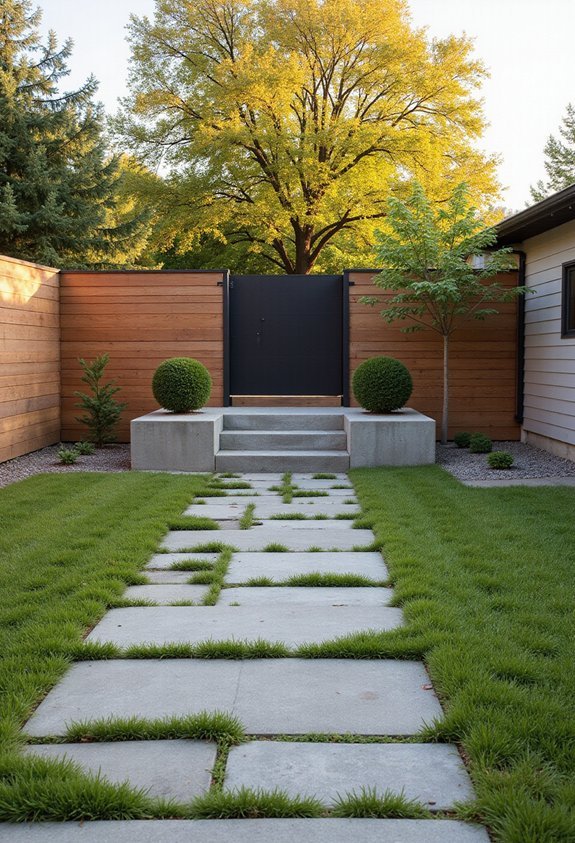
A minimalist front yard relies on restraint, not excess. Clean lines emerge from deliberate choices: crisp edges, unbroken surfaces, and material harmony. Each element must serve purpose—visual or functional—without competing for attention. The twenty ideas ahead demonstrate how subtraction creates impact. Readers will discover specific techniques for transforming ordinary space into coherent, low-maintenance landscapes through strategic material selection and precise spatial arrangement. The methods vary in cost and complexity, yet share a common principle: intentionality governs every decision. One question remains unanswered—which combination suits your particular constraints.
Start With a Minimalist Front Yard Design Plan
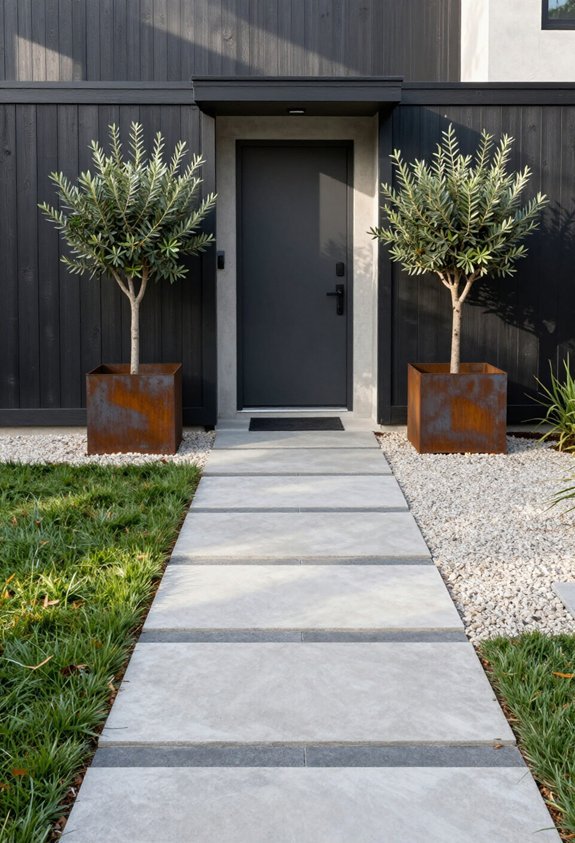
A well-conceived plan serves as the foundation upon which every successful minimalist front yard is built, requiring careful consideration of spatial relationships, functional requirements, and visual harmony before any physical work commences. The designer must first measure the entire area, noting existing features such as trees, slopes, and utilities that cannot be relocated. Next, one determines the primary purpose of the space, whether it serves as a welcoming entrance, a quiet viewing garden, or a practical pathway for daily use. Sketches or scaled drawings help visualize circulation patterns, making certain that movement through the yard feels natural and unobstructed. The plan should allocate zones for hard surfaces, planting areas, and open space, with each element proportioned to maintain balance. Finally, reviewing the design against maintenance capabilities guarantees long-term feasibility.
Also read: 22+ FRONT YARD MAKEOVER Ideas With Big Results!
Limit Your Materials to Two Complementary Textures
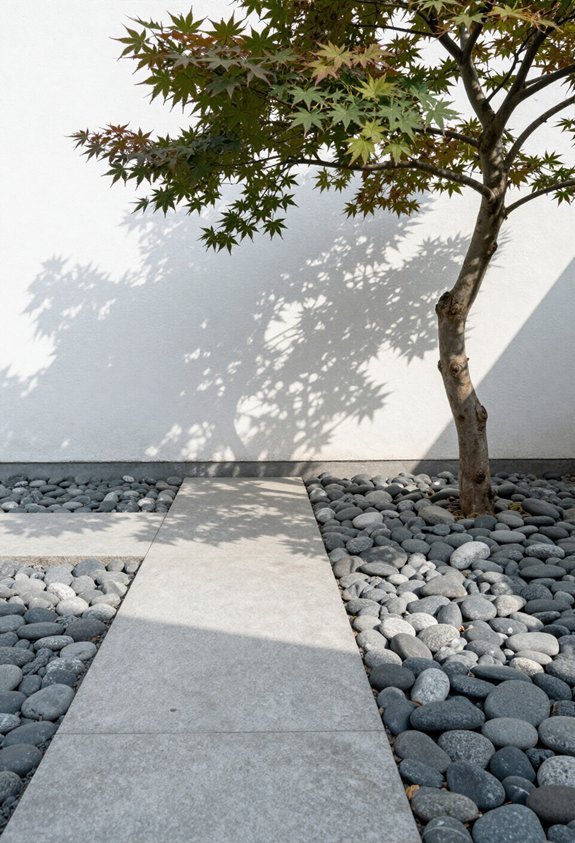
Once the plan establishes the spatial framework, material selection becomes the next consideration for achieving visual cohesion. Restriction to two complementary textures eliminates visual clutter and strengthens the minimalist aesthetic throughout the front yard.
One texture typically serves as the dominant surface, such as smooth concrete pavers for walkways and patios. The secondary texture provides contrast without competition, perhaps rough natural stone for accent borders or retaining walls. These textures must share tonal harmony—warm with warm, cool with cool—to maintain unity.
Scale matters greatly. Larger format materials reduce joint lines and create calmer surfaces. Joint patterns should align with architectural elements, drawing the eye horizontally or vertically depending on the home’s proportions. Surface finishes require practical evaluation: honed textures resist staining, while bush-hammered surfaces improve slip resistance. Installation demands consistent bedding depths and precise alignment to preserve the clean, intentional appearance fundamental to minimalist design.
Save With a Gravel Driveway and Permeable Grid
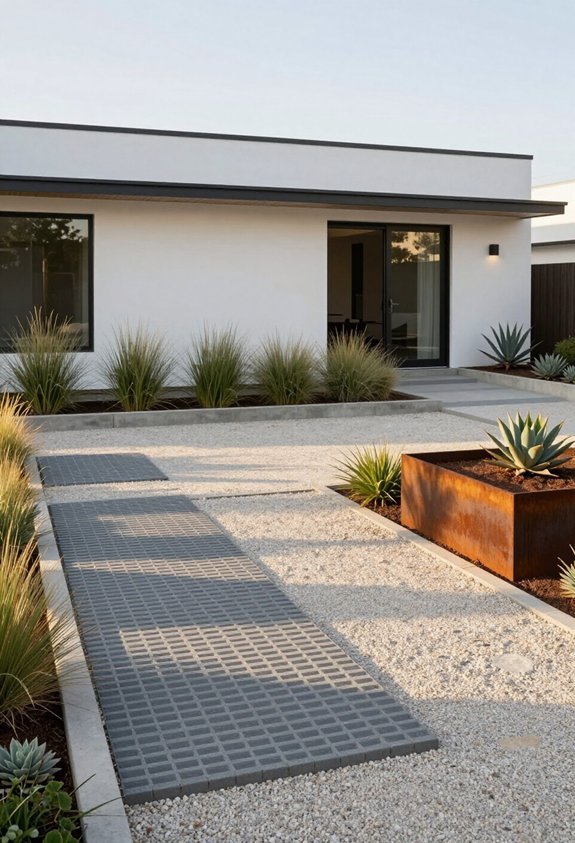
Several practical advantages emerge when homeowners replace conventional asphalt or concrete driveways with gravel supported by permeable grid systems. The initial installation costs remain considerably lower than traditional paving materials, reducing upfront expenses while delivering comparable structural integrity for vehicle traffic. Permeable plastic or concrete grids stabilize the gravel layer, preventing displacement and rutting that typically plague unstabilized loose stone surfaces. These interconnected cellular structures distribute weight evenly across the subgrade, extending surface longevity without requiring frequent replenishment of displaced aggregate. Water management improves substantially, as rainfall filters directly through the surface rather than generating runoff that strains municipal drainage infrastructure. Local regulations increasingly incentivize permeable installations through reduced stormwater fees or tax credits. Maintenance demands prove minimal, involving occasional raking to level settled material and infrequent weed suppression between grid cells.
Pave Your Driveway in Large-Format Porcelain Tiles
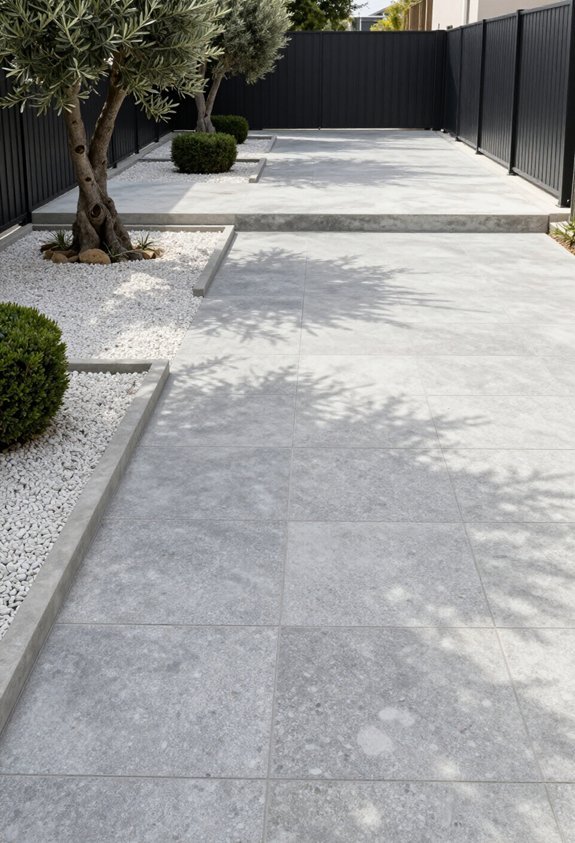
Many homeowners seeking refined aesthetics and exceptional durability now select large-format porcelain tiles as a premium driveway surface that transforms ordinary entry points into striking architectural statements. These tiles, typically measuring 24 by 24 inches or larger, create expansive visual planes with minimal grout lines, reinforcing the minimalist emphasis on uninterrupted surfaces.
Manufacturers engineer porcelain for substantial load-bearing capacity, often rating products for vehicular traffic exceeding 2,000 pounds per square inch. The material resists staining, frost damage, and UV degradation through vitrification, a high-temperature firing process that eliminates porosity. Installation requires compacted aggregate base layers, flexible mortar beds, and precise leveling to prevent cracking under dynamic loads.
Color options span neutral tones—warm greige, cool slate, and matte charcoal—that complement contemporary facades. Surface textures provide slip resistance without compromising the sleek appearance central to minimalist design principles.
Install a Single-Path Concrete Slab Walkway
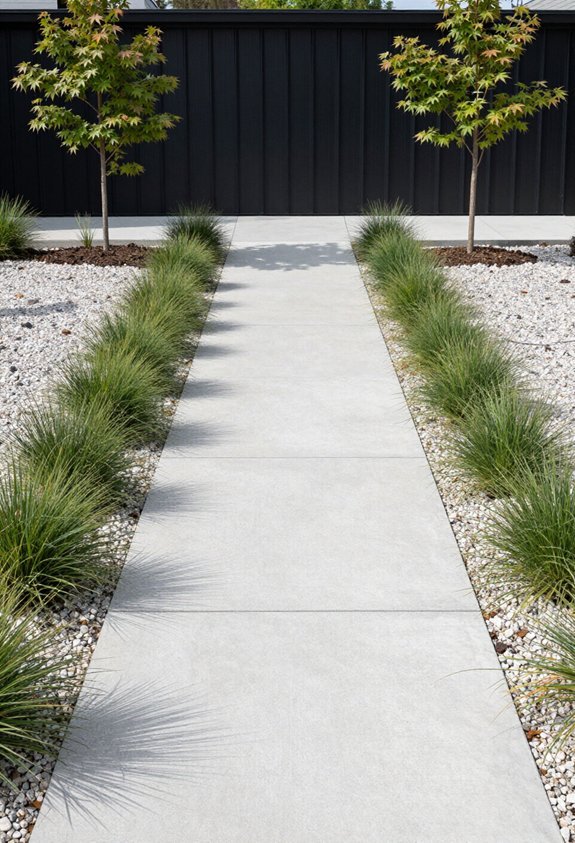
Driveways of porcelain tile establish the visual foundation of a minimalist front yard, yet the path that carries visitors toward the entrance demands equal attention to materials, proportion, and restraint.
A single-path concrete slab walkway answers this need through geometric simplicity and functional clarity. Contractors pour one continuous rectangular form, typically four to five feet in width, creating a direct route from sidewalk to door. The surface receives a broom finish for slip resistance, or a light polish for refined texture. Joints appear only where structural necessity demands, preserving uninterrupted visual flow.
Color selection remains limited to natural gray, soft charcoal, or warm white tones that complement rather than compete with adjacent architecture. Control joints align with door thresholds and window mullions, reinforcing deliberate spatial relationships. This approach eliminates decorative complexity, allowing material honesty and precise measurement to define the pedestrian experience.
Use Corten Steel Edging for Warm, Rusted Definition
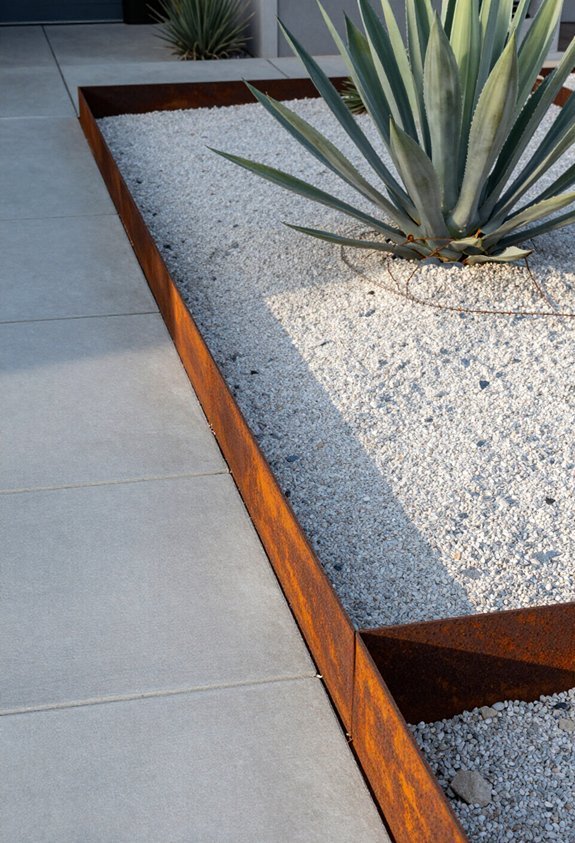
A single, unbroken line of weathered steel offers the minimalist front yard a boundary material that needs no ornament to command attention. Corten steel, an alloy designed to develop a stable rust patina, provides warm, earthy tones that contrast sharply against cool concrete, gravel, or living greenery. Installers set these thin metal plates vertically into soil, creating crisp edges between lawn and planting beds, or between driveway and walkway surfaces. The material resists further corrosion once the outer layer oxidizes, requiring no paint, sealant, or ongoing maintenance. Over months, the surface shifts from bright orange to deeper brown-red, integrating with natural surroundings while maintaining its geometric precision. Steel thicknesses range from one-eighth to one-quarter inch, with heights typically spanning four to eight inches above grade for visible definition.
Build a Floating Wood or Composite Deck Entrance
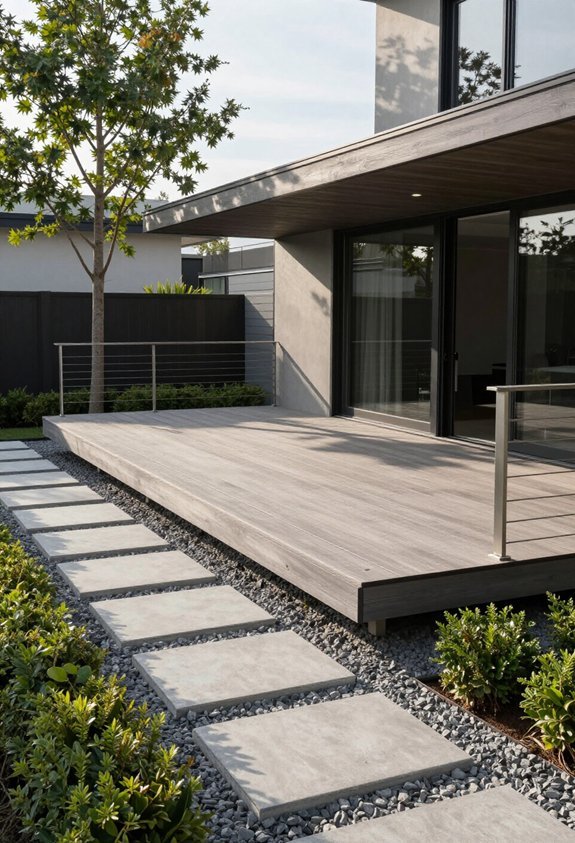
Install a floating deck at the threshold of the home to create a minimalist entrance that appears to hover slightly above the surrounding grade, eliminating the need for concrete foundations or intrusive support posts. This structural approach relies on a frame built from pressure-treated lumber or steel joists, supported by concrete deck blocks or helical piers spaced at calculated intervals according to load requirements. Builders select either natural hardwoods, such as ipe or cedar, or low-maintenance composite boards in muted, uniform tones that resist fading and moisture damage. The deck surface extends precisely to the door sill, creating a flush connection that removes visual interruption. Hidden fasteners secure the decking, leaving surfaces unbroken by visible screws. Perimeter edges receive fascia boards matching the deck material, concealing the structural frame and reinforcing the illusion of weightlessness.
Frame Your Entry With Precision-Trimmed Boxwood Hedges
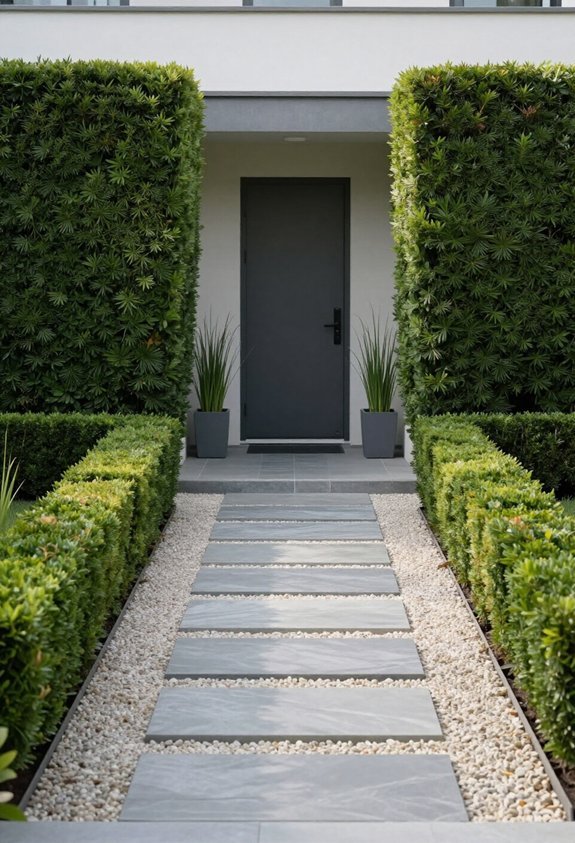
While a floating deck creates horizontal emphasis, vertical definition at the entry requires living elements that provide structure without visual heaviness, and boxwood hedges fulfill this purpose through their dense, evergreen foliage and tolerance for precise shaping. These slow-growing shrubs accept shearing into crisp geometric forms that guide the eye toward the doorway without competing for attention. Install matching specimens on both sides of the path, spacing them equidistant from the center line to establish mirror symmetry. Maintain heights between eighteen and thirty inches to remain below sight lines while still registering as deliberate boundaries. Trim twice yearly using sharp blades to preserve clean edges, removing no more than one-third of new growth each session. Select dwarf cultivars such as ‘Winter Gem’ or ‘Green Velvet’ to minimize long-term maintenance demands.
Plant Columnar Trees in a Single Vertical Row
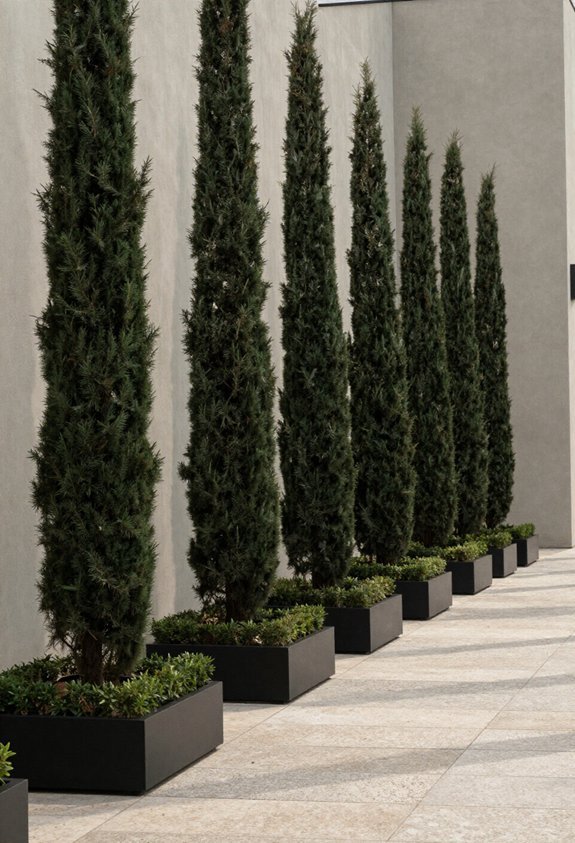
Once horizontal and ground-level elements have been established, upward visual movement becomes necessary to complete the spatial composition, and columnar trees serve this function by introducing height without horizontal spread, their narrow profiles maintaining the minimalist emphasis on clean lines and controlled forms. Species such as ‘Fastigiata’ European hornbeam, ‘Columnaris’ blue spruce, or ‘Slender Silhouette’ sweetgum work effectively, their vertical habit drawing the eye skyward while occupying minimal ground area. A single vertical row creates rhythm through repetition, spacing specimens at equal intervals to establish predictable pattern and measured progression along property edges or pathways. This linear arrangement reinforces geometric order, preventing visual clutter by restricting plant variety. Trunks remain visible, contributing additional vertical lines, while canopies form narrow green exclamation points against open sky. Maintenance demands remain minimal, requiring only occasional shaping to preserve ascending form and prevent width infringement.
Choose Ornamental Grasses for Soft, Structural Movement
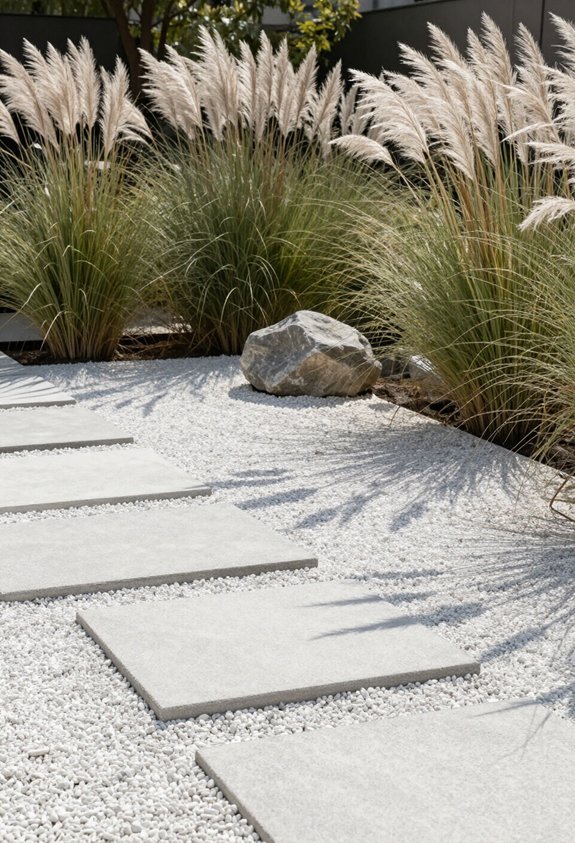
Ornamental grasses introduce an essential counterbalance to the rigid geometry of paved surfaces and architectural plantings, their slender blades responding to air currents with continuous, understated motion that animates otherwise static spaces without disrupting visual order. Species such as feather reed grass, blue fescue, and Japanese forest grass offer vertical accents ranging from twelve inches to six feet, allowing precise height calibration against adjacent structures. Their linear foliage maintains consistent form throughout growing seasons, requiring only annual cutting to remove spent growth. Planted in defined clusters or linear drifts, these grasses create rhythmic patterns that guide visual movement across the yard. The subtle color shifts, from blue-green through bronze and straw, provide tonal variation without chromatic excess. Drought tolerance reduces irrigation demands, aligning with low-maintenance principles.
Replace Your Lawn With Purposeful Empty Space
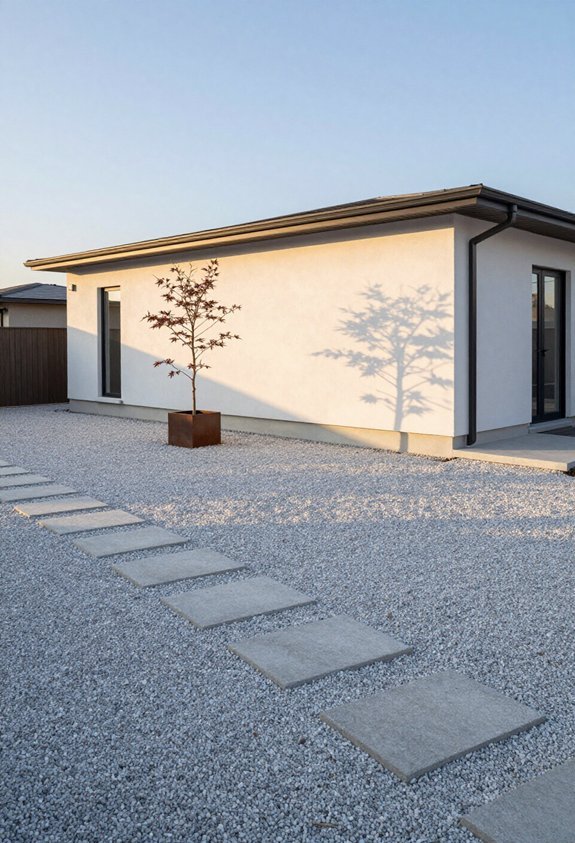
Eliminating expansive turf areas creates opportunities for intentional ground plane design that reduces maintenance demands while establishing calm, ordered spatial relationships. Decomposed granite, crushed gravel, or compacted sand replace conventional grass with uniform surfaces that require no watering, mowing, or fertilization.
Materials should extend across definable zones, bordered by continuous edging of steel, concrete, or stone to maintain visual containment. Color selection remains neutral—warm grays, taupes, or soft whites—to avoid competing with architectural elements or specimen plantings. Surface texture variation introduces subtle interest without disrupting overall cohesion.
Drainage requires advance planning, with subtle grading directing water flow away from structures. Expansion joints or permeable substrates prevent pooling during precipitation events.
Negative space becomes an active design element, framing circulation paths and highlighting sculptural vegetation or architectural features. The resulting composition prioritizes clarity, function, and reduced resource consumption.
Add a Geometric Rain Garden for Beauty and Function
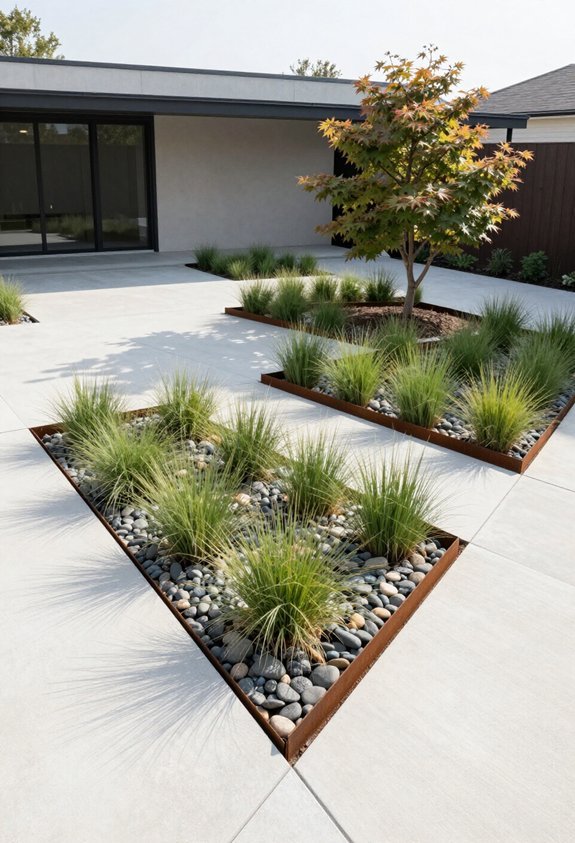
Shape a rain garden into precise geometric forms to capture stormwater runoff while creating structured visual interest that complements spare, minimalist surroundings. Select simple shapes such as rectangles, circles, or interconnected angles that align with clean architectural lines. Excavate the designated area to a depth of four to eight inches, sloping gently toward a central collection point where water naturally gathers. Line the basin with permeable soil mixes containing sand and compost to facilitate rapid drainage. Plant native grasses and deep-rooted perennials in ordered rows or uniform clusters that maintain visual discipline without appearing wild. Install subtle edging materials like steel strips or poured concrete to reinforce crisp boundaries between the garden and adjacent surfaces. This engineered landscape element reduces flooding, filters pollutants, and introduces calculated natural texture without compromising minimalist principles.
Add One Minimalist Sculpture or Geometric Planter
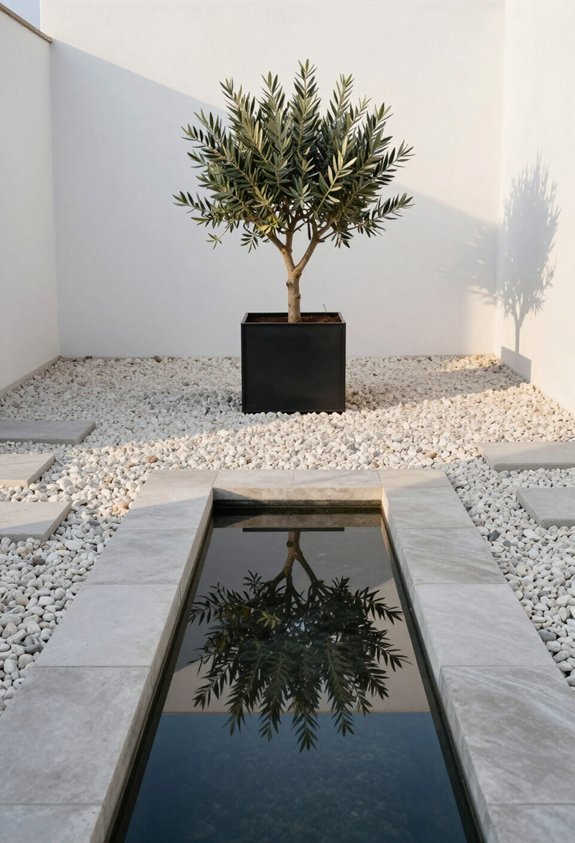
While the rain garden introduces living geometry through planted forms, a single sculptural element or geometric planter offers a more permanent, unchanging anchor for the minimalist front yard. Selection requires restraint, for one object carries significant visual weight in sparse environments. Materials such as corten steel, polished concrete, or matte black metal maintain consistent presence across seasons. Forms favor spheres, rectangular prisms, or intersecting planes that catch light differently throughout the day. Positioning demands careful consideration; placement along primary sightlines or within negative space maximizes impact without clutter. Scale must relate directly to architectural proportions, ensuring the element neither disappears nor dominates. Maintenance remains minimal, limited to occasional cleaning and structural inspection. This singular investment provides year-round focal definition.
Anchor Corners With Uniform Cube Planters
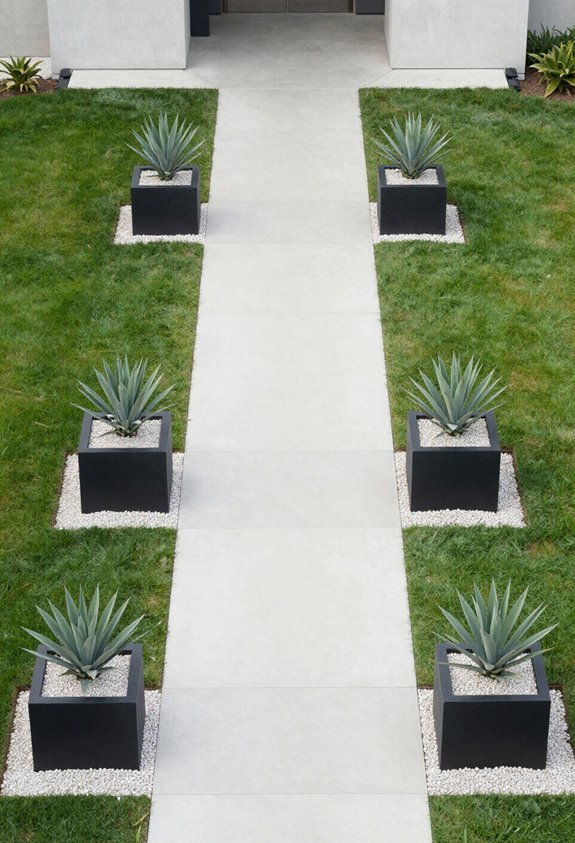
Four identical cube planters, positioned at the corners of a front yard, establish immediate spatial order through repetition and symmetry. This arrangement creates a visual frame that defines the property’s boundaries without requiring walls or fences, allowing the eye to travel smoothly across the landscape. The uniform dimensions of each cube guarantee consistency, while their placement at equal distances from pathways and property lines reinforces geometric precision. Materials such as concrete, corten steel, or painted fiberglass withstand weather exposure and maintain their structural integrity over time. The planters should match in height, typically sixteen to twenty inches, to avoid visual disruption. Drainage holes prevent water accumulation and root damage. When filled, these corner anchors ground the minimalist design, transforming empty lawn space into a composed, intentional environment.
Choose Sculptural Plants Suited to Your Climate

How does one select plants that maintain visual impact without overwhelming a restrained landscape? The answer lies in choosing specimens with strong, architectural forms that command attention through shape rather than excess.
Climate suitability determines long-term success. Native species adapted to local rainfall and temperature patterns require minimal intervention, preserving the clean aesthetic without supplemental watering or protective measures. Drought-tolerant succulents, such as agave or yucca, suit arid regions with their rigid, geometric rosettes. In temperate zones, columnar evergreens like Italian cypress provide vertical emphasis without horizontal spread. Grasses with upright habits, including feather reed grass, offer movement through narrow blades.
Placement follows deliberate spacing. Single specimens anchor focal points, while odd-numbered groupings of three or five create rhythm along sight lines. Mature dimensions must be calculated in advance to prevent future crowding. Each plant serves as a living sculpture, contributing form without visual noise.
Light Your Path With Recessed Ground-Level Fixtures
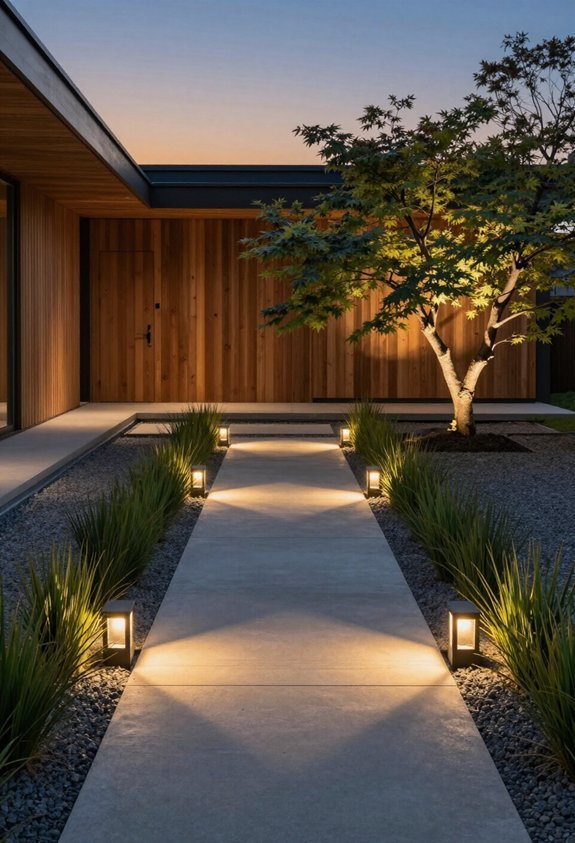
Several recessed fixtures positioned flush with the ground surface create pathways that appear to glow from within, preserving the uncluttered sight lines essential to minimalist design. These fixtures, typically circular or square in shape, sit at grade level with walkable lenses that withstand foot traffic while emitting soft, diffused light upward. Installation requires precise trenching at predetermined intervals, usually six to eight feet apart along path edges, with wiring buried beneath frost lines to prevent weather damage. LED lamps with color temperatures between 2700 and 3000 Kelvin produce warm illumination that guides movement without drawing attention to the source itself. The fixtures’ vanishing profile eliminates visual interruption, allowing paving materials and plant forms to remain dominant. Appropriate beam angle selection, generally between 30 and 60 degrees, guarantees adequate coverage without glare or spill light onto adjacent surfaces.
Bury Irrigation Lines for Uninterrupted Visual Flow
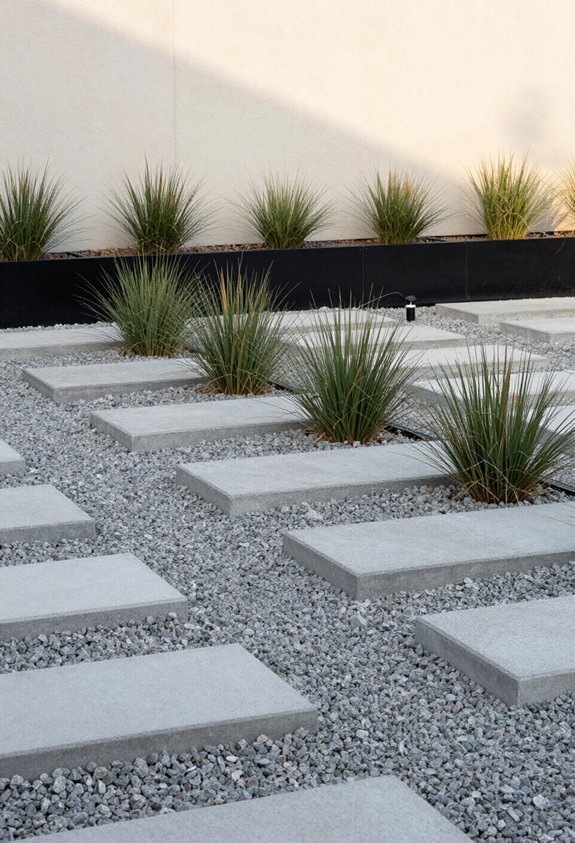
Surface-mounted irrigation equipment disrupts the clean planes and open sight lines that define minimalist front yards, making underground installation the preferred approach for maintaining visual cohesion. By routing water lines beneath the soil surface, designers eliminate visual clutter while preserving the uninterrupted expanse of gravel, concrete, or turf that characterizes these spaces.
Subsurface drip irrigation systems deliver water directly to root zones through perforated tubing embedded four to six inches below grade, reducing evaporation and preventing the staining of hardscape materials that above-ground sprinklers cause. Maintenance access requires strategic placement of valve boxes flush with surrounding surfaces, typically concealed within planting beds or along property edges where they minimize visual interruption. Installation demands careful mapping of utility paths before construction, ensuring that future repairs avoid damage to buried infrastructure. Proper pressure regulation prevents line ruptures, while filtration systems protect emitters from soil particulates that would compromise function over time.
Hide Utilities Behind a Slatted Horizontal Fence
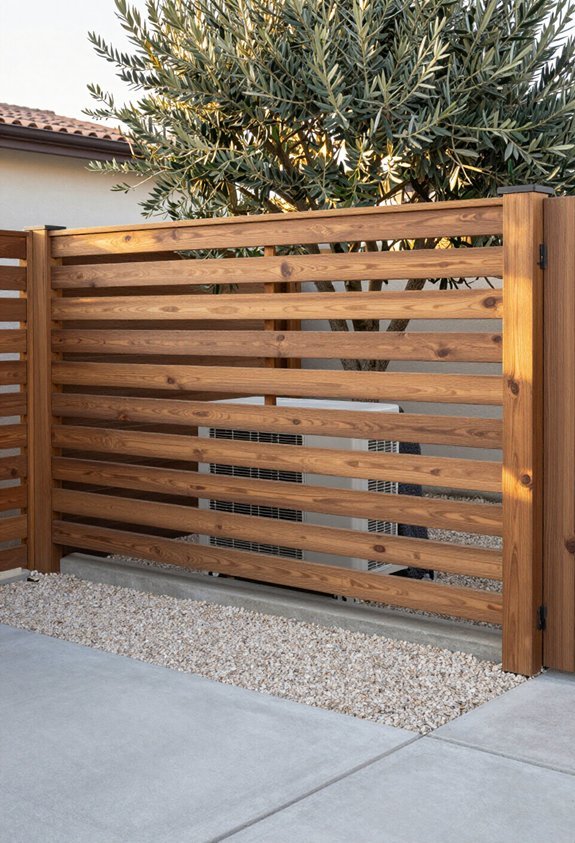
Even a single exposed utility box or air conditioning unit can fracture the restrained geometry that minimalist front yards demand, which is why the slatted horizontal fence has emerged as an essential screening device for concealing functional infrastructure. This architectural element employs evenly spaced, parallel boards that permit air circulation while obstructing direct sightlines, ensuring mechanical systems remain operable yet invisible.
Installers typically select weather-resistant hardwoods or composite materials, spacing slats between one-half and one inch apart to balance opacity with ventilation. The horizontal orientation emphasizes lateral continuity, extending visual planes rather than interrupting them with vertical breaches. Mounting these screens on slim metal posts or low concrete footings preserves ground-level openness, preventing the mass accumulation that solid barriers impose. Proper dimensioning requires measuring equipment clearances before construction, allowing service access without compromising the seamless visual field that defines minimalist design principles.
Build Bench Seating Into Your Retaining Walls
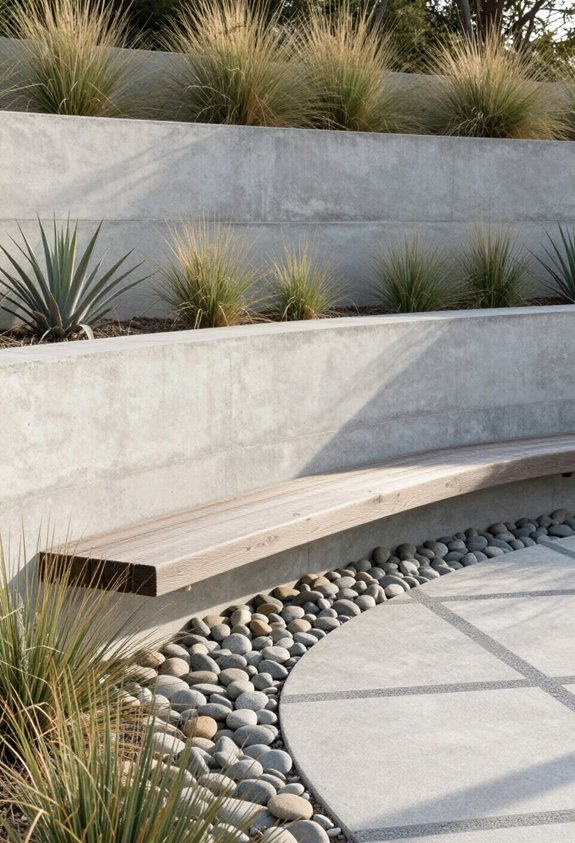
Integrating bench seating into retaining walls transforms structural necessity into functional amenity, offering a seamless solution for sloped terrain while preserving the clean lines that minimalist landscapes require. This approach eliminates the visual clutter of freestanding furniture while maximizing usable space in compact front yards.
Construction demands precise engineering to guarantee structural integrity and proper drainage behind the wall. Builders typically use poured concrete, natural stone, or modular block systems, extending the cap outward to create a cantilevered seat approximately eighteen inches deep. The finished height should measure sixteen to eighteen inches for comfortable sitting without cushions.
Material selection determines longevity and aesthetic cohesion. Smooth-finished concrete complements contemporary architecture, while honed limestone introduces subtle texture. Joints must align precisely with wall courses to maintain visual continuity. Integrated lighting beneath the seat overhang extends functionality into evening hours without disrupting the minimalist profile.
Install a Pivot Door for a Minimalist Entry Statement
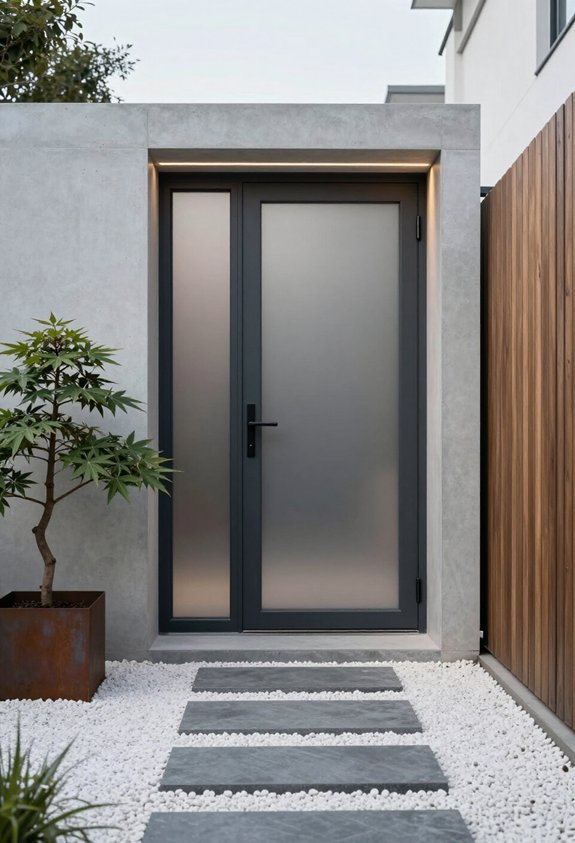
A pivot door redefines the threshold between public street and private sanctuary, rotating on a central axis rather than conventional side-mounted hinges to create a dramatic yet understated entry statement that aligns with minimalist design principles.
The absence of visible door jambs and frames allows the door panel to appear as a floating plane of material, uninterrupted by hardware that would break the visual field. Architects typically specify pivot systems with floor-mounted and ceiling-mounted pins, which bear the door’s weight through a vertical axis positioned inward from the leading edge, often at a ratio of one-third to two-thirds. This offset placement creates an asymmetrical swing pattern, where the larger portion moves inward while a narrower segment projects toward the exterior approach. Material selection reinforces minimalism: single-pane tempered glass, flush wood panels, or powder-coated aluminum sheets extend from floor to ceiling without subdivision, and integrated recessed pulls eliminate protruding handles. Proper specification requires coordination between structural engineers and door manufacturers to guarantee the pivot point location accommodates both the door’s mass and the desired clearance arcs.
Frequently Asked Questions
What Maintenance Does Corten Steel Edging Require Annually?
Corten steel edging requires minimal annual maintenance. One inspects for debris accumulation, removes vegetation growth along edges, checks for soil erosion exposure, and verifies structural stability. No sealing, painting, or rust prevention treatments prove necessary once the protective patina stabilizes.
How Deep Should Recessed Path Lights Be Installed?
Recessed path lights require installation depths of six to eight inches below grade, ensuring the fixture sits flush with surrounding surfaces while accommodating proper drainage and protecting electrical components from ground moisture and frost heave.
Which Columnar Trees Work Best in Hot, Dry Climates?
Italian cypress, ‘Skyrocket’ juniper, and columnar yucca thrive in arid heat. Quaking aspen and certain eucalyptus varieties tolerate drought, offering vertical structure with minimal water. Select species matched to specific hardiness zones and soil conditions for ideal establishment.
Do Permeable Gravel Driveways Work in Snowy Regions?
Permeable gravel driveways function adequately in snowy regions, though they require thicker base layers to prevent frost heave. Snow removal demands caution; metal blades displace stones. Heated subsurface systems may offset freeze-thaw complications in extreme climates.
What Wood Species Resist Rot for Floating Deck Entrances?
Cedar, redwood, and ipe naturally resist rot for floating deck entrances. Pressure-treated pine offers budget-friendly durability. Tropical hardwoods like cumaru perform exceptionally. All require proper sealing and elevation above ground moisture to maximize longevity in exterior applications.
Conclusion
Implementing minimalist front yard design requires careful planning, material restraint, and attention to visual continuity. Homeowners who select two complementary textures, incorporate permeable surfaces, and conceal functional elements achieve spaces that balance aesthetics with practicality. Clean lines emerge through deliberate choices: large-format paving, recessed lighting, and integrated seating. These methods transform ordinary front yards into cohesive, low-maintenance environments where every element serves a purpose, resulting in outdoor spaces that feel intentional, serene, and enduringly modern.