A garden in winter already holds most of what Christmas needs. The holly has its berries, the conifers are at their greenest, and the pinecones are lying around for free. These Christmas garden decor ideas put all of it to work outdoors, with real greenery hung, tied and tucked where you can see it from the house.
You’ll find a cedar and ivy garland over the garden arbor, a magnolia wreath on the greenhouse door, a boxwood kissing ball in a bare tree, and winterberry shrubs left standing as living decor. There’s also a tomato cage tree for the vegetable bed and a doorstep cluster for gardens that are mostly doorstep.
Most roundups show the greenery and stop there. These ideas also cover what to cut, how to condition it, and how to fasten it so it survives wind, rain and frost, plus where to find greens for free. If you like mixing in a few bought pieces, these outdoor Christmas decorations that look classic sit well alongside everything here.
QUICK GARDEN CHECK
What kind of garden are you decorating?
Start With What’s Already Growing
The best Christmas decorations from the garden start with a walk and a pair of pruners. Most yards have a shrub that needs shaping, a conifer with a few low branches, or ivy that has run too far, and every one of those cuttings can go into a display. Cut on a cool morning and get the stems into water the same day.
1. A Mixed Evergreen Garland Over the Garden Arbor
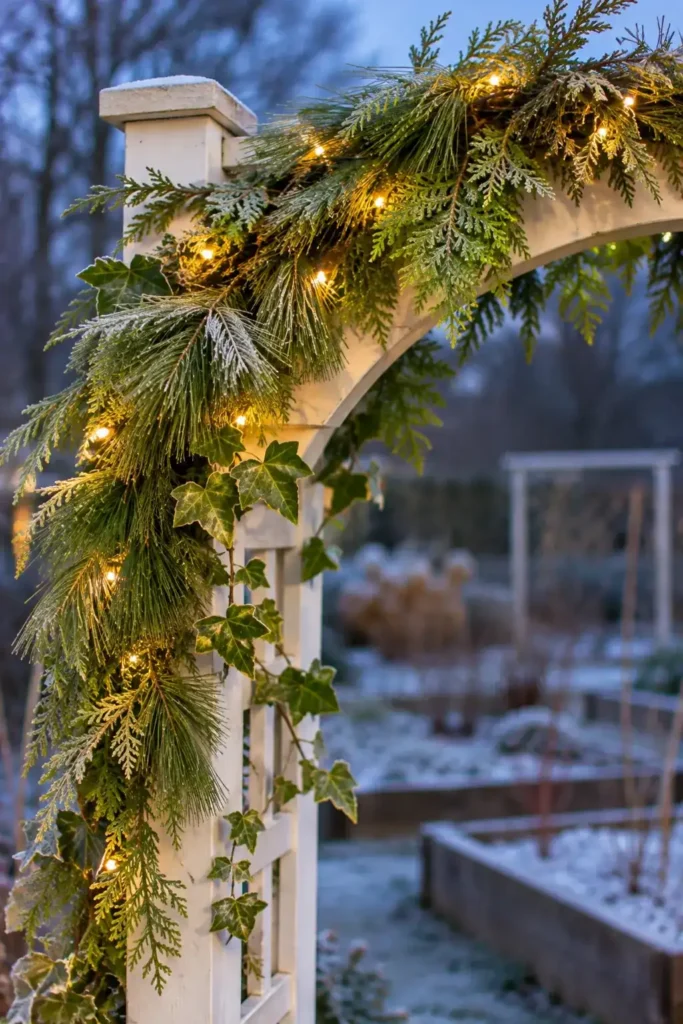
Cedar, pine and trailing ivy wound together over a white wooden garden arbor make the entrance to the vegetable garden the first thing you notice from the kitchen. Mix all three for a reason. Cedar drapes, pine adds long-needled texture, and ivy trails down the posts so the garland looks like it grew there.
Warm white fairy lights wound through the greens keep it glowing at blue hour, when the bare beds behind it disappear into the dusk.
Styling note: a fresh evergreen garland outdoors is far easier to manage in short lengths. Build it in two or three sections on jute twine, then zip tie each section to the arbor. If one section gets battered on a windy night, you swap that piece instead of rebuilding the whole thing. Plug the lights into an outdoor rated cord on a timer.
2. A Magnolia and Juniper Wreath on the Greenhouse Door
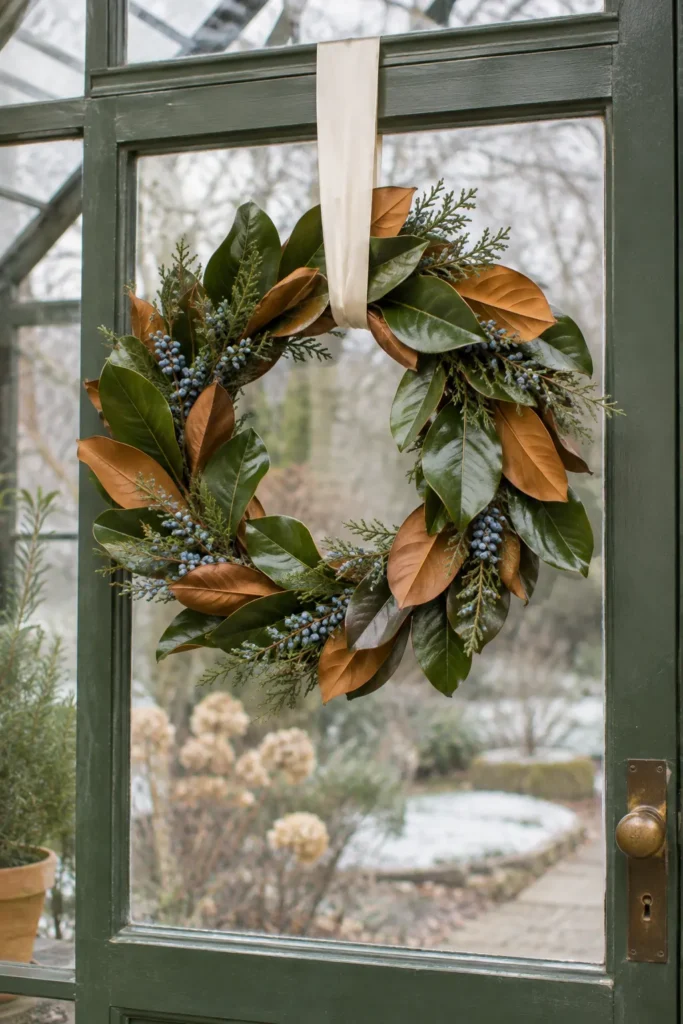
Start with the back of a magnolia leaf. That soft bronze underside is what makes a magnolia wreath worth making, so set leaves alternately face up and face down around a wire wreath frame. Tuck sprigs of blue-berried juniper between them. Then hang the finished wreath on the glass greenhouse door from a wide cream ribbon looped over the top of the frame.
Against the glass, the glossy green and bronze leaves read clearly from across the garden, and a summer-only building becomes a winter focal point. Magnolia’s thick, leathery leaves are also among the toughest outdoor Christmas greenery you can use, so the wreath holds its shape long after softer greens give up.
| Green | Outdoors in cold weather | Best for |
|---|---|---|
| Magnolia leaves | Tough and leathery, usually lasts for weeks | Wreaths, swags |
| Fir | Usually holds its needles well | Wreaths, bundles, path edging |
| Cedar | Drapes softly, fades faster in full sun | Garlands, swags |
| Pine | Sturdy, can shed if it dries out | Bundles, garland bases |
| Boxwood | Holds its color well in cool shade | Kissing balls, small wreaths |
| Holly | Leaves last, berries may shrivel in a hard freeze | Accents, containers |
3. A Living Spruce in the Border Dressed in Pinecones and Wood Slices
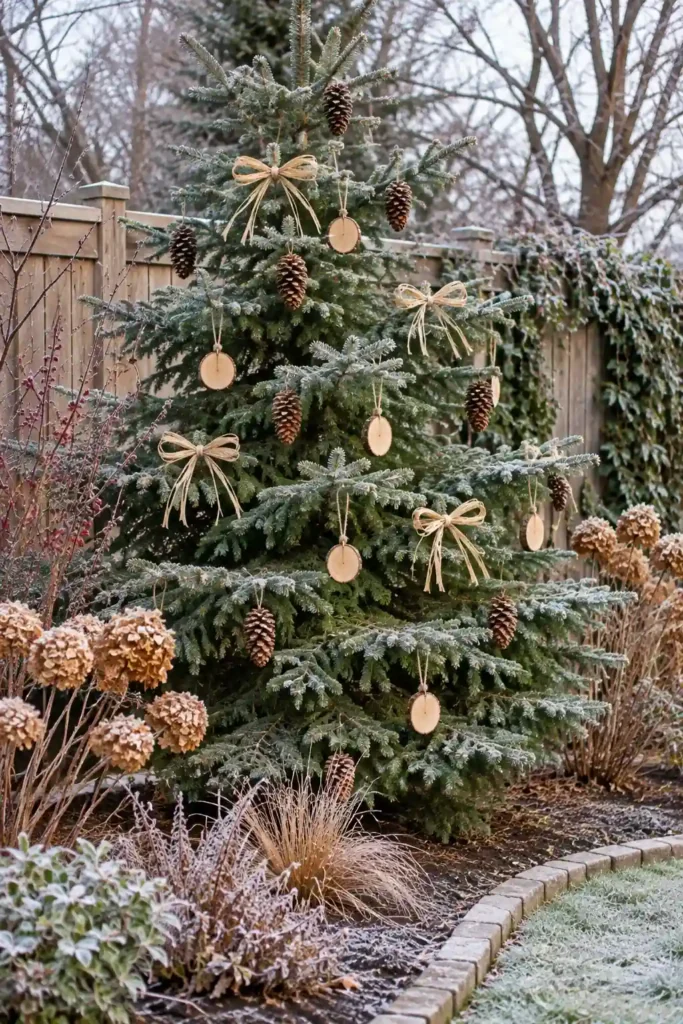
The best Christmas tree in the garden may already be growing in it. A young spruce at the back of the border needs no stand and no hauling, just ornaments that can handle the weather. Wire pinecones to the branch tips with green floral wire, hang wood slice ornaments on loops of jute, and tie a few raffia bows loosely around the sturdier limbs.
Nothing on the tree can shatter, which matters once the wind picks up or snow slides off a branch. The warm browns of cone, wood and raffia also sit naturally against the blue-green needles, so the tree looks dressed rather than costumed.
Garden note: snip the wire off every ornament after the holidays, because wire left on a growing branch can cut into it by summer. If the needles start to brown, check the signs your live Christmas tree is dying.
4. An Old Wheelbarrow Piled With Birch Logs, Fir Boughs, and Pinecones
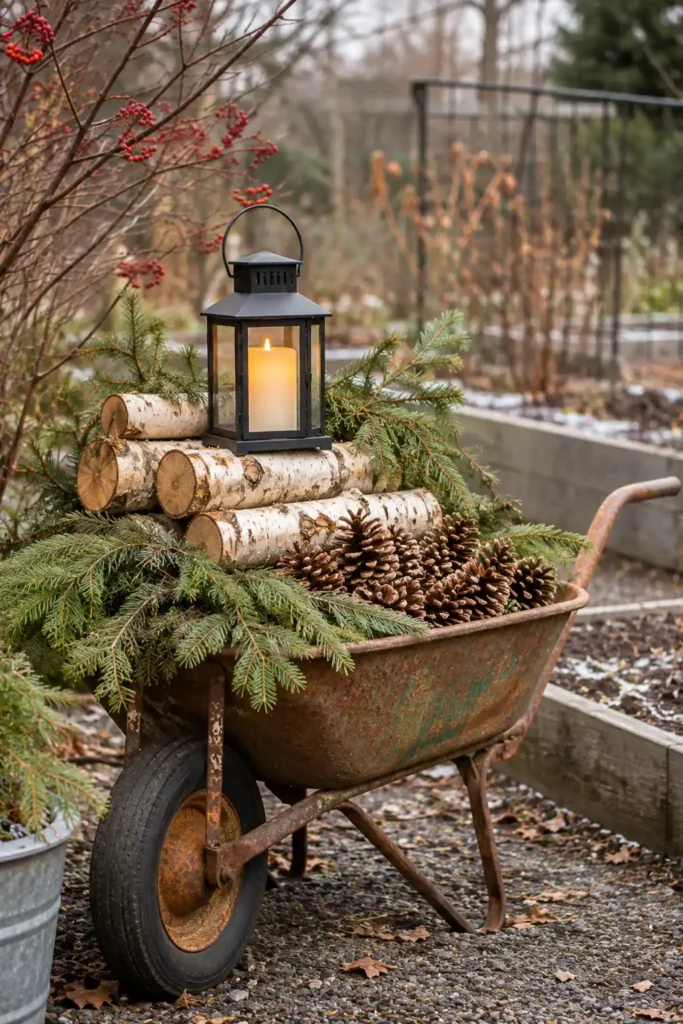
Park a rusty wheelbarrow at the end of the vegetable bed and fill it like a little woodland. Stack a few short birch logs at the back, push fir boughs in around them so the greens spill over the sides, and heap pinecones in the front. A black metal lantern with an LED candle sits on the top log.
The wheelbarrow does the composing for you. Its tipped-up handles and deep tray give the pile height and a frame, so a few logs and branches look arranged instead of dumped. It also says garden in a way a planter never quite does.
Get the look: an old wheelbarrow, birch logs, fir boughs, pinecones, a black metal lantern, an LED candle.
Check the tray after heavy rain. Standing water rots the bottom of the pile fast.
5. Evergreen Bundles Tied to a White Picket Fence
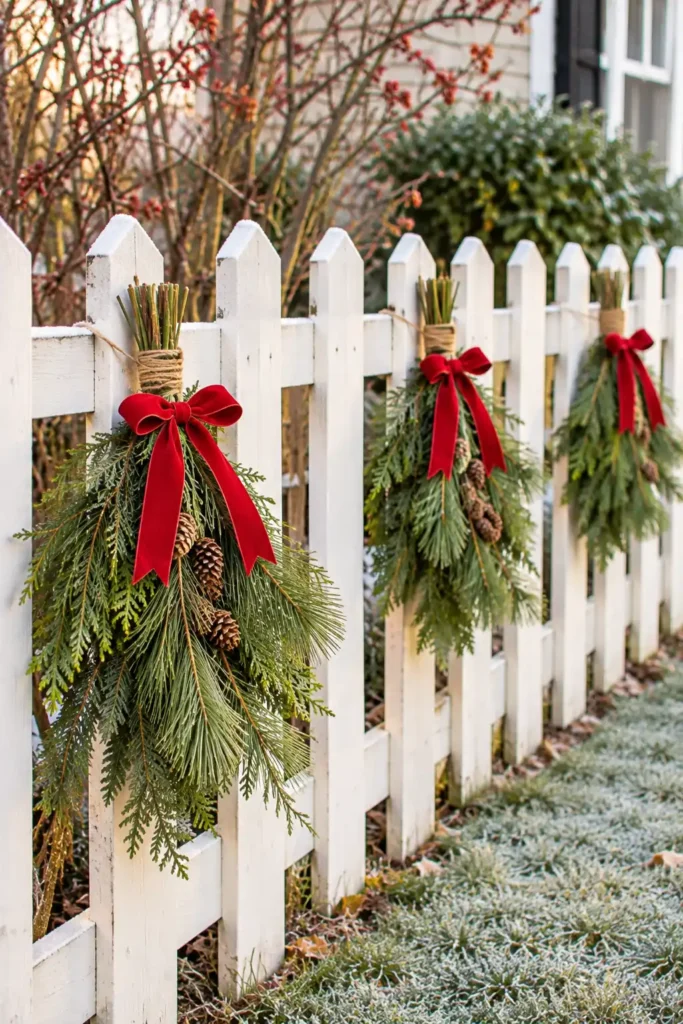
A ready-made garland draped along a picket fence sags between the posts by the second storm. Small bundles tied right onto the pickets stay put all season.
Gather three stems each of fir, pine and cedar into a fist-sized bundle and wrap the stems tight with jute twine. Tie each bundle to every third picket with the same twine, then finish it with a short red ribbon bow. The repetition gives the front garden a steady rhythm from the street, and the mixed greens keep each bundle full from every angle.
Twine leaves no nail holes in the paint, which matters on a fence you’ve just repainted. Snip the ties in January and the fence is plain white again in minutes.
6. A Doorstep Cluster of Potted Evergreens for Small Gardens
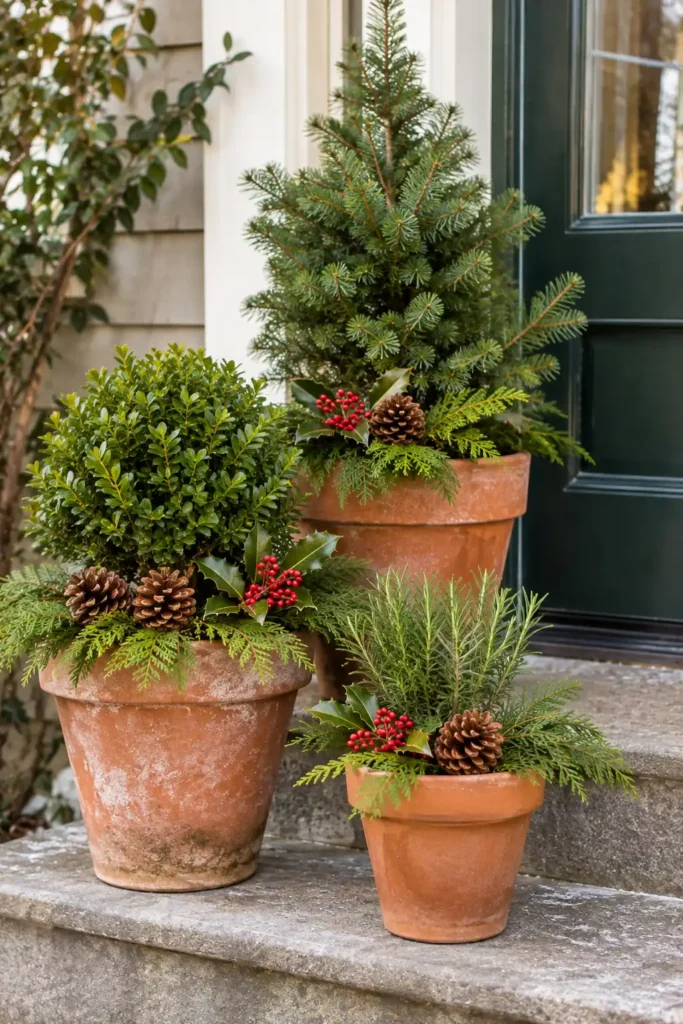
Even a garden the size of a doorstep has room for Christmas greenery, as long as the pieces stack up instead of spreading out. Group three terracotta pots in three heights by the front door: a dwarf conifer in the tallest, a round boxwood in the middle and a rosemary in the smallest.
Then tuck cut cedar and holly sprigs into the soil around each plant and set a few pinecones on top. The living plants give the cluster its shape, and the cut greens fill the gaps so it looks full from day one. Odd numbers and staggered heights keep three pots looking planned.
These outdoor Christmas planter ideas take the container idea further. Rosemary dislikes hard freezes, so carry its pot inside on the coldest nights.
7. A Galvanized Watering Can Bouquet of Evergreens and Red Berries
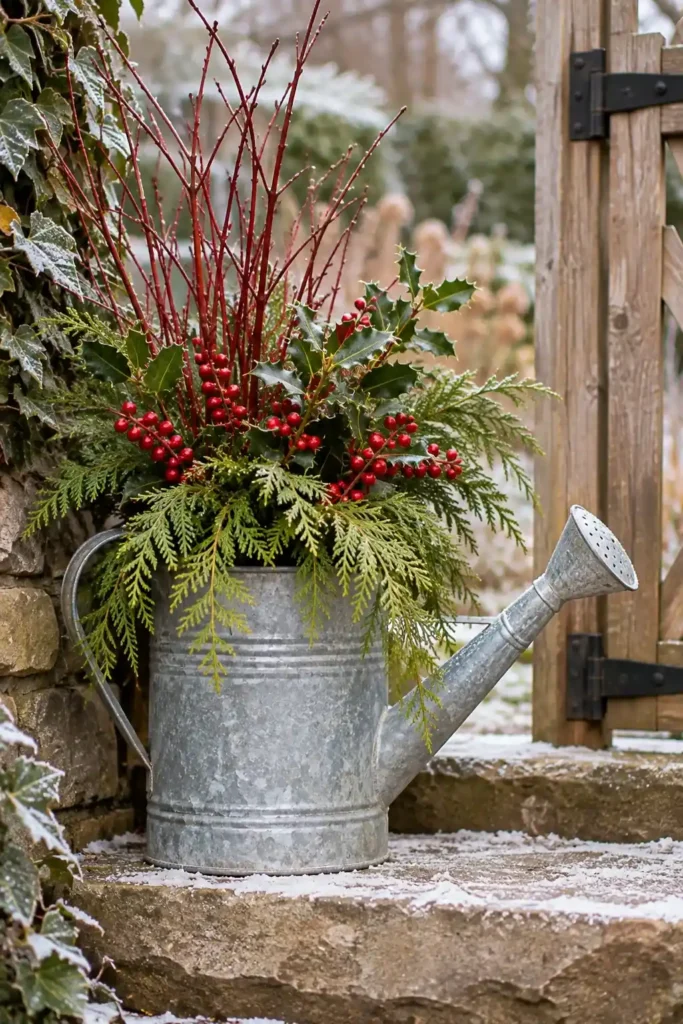
A galvanized watering can makes a better winter vase than most vases do. Fill one with water, then pack it with long cedar sprays and berried holly stems, with a few red twig dogwood stems standing tall at the back. Set it on the garden steps beside the gate, where it greets everyone coming in.
The dogwood gives the bouquet height and a second shade of red, so the holly berries don’t have to carry all the color alone. The water keeps the stems fresh until it freezes, and by then the cold is doing the same job.
You will need: a galvanized watering can, cedar sprays, berried holly stems, red twig dogwood stems.
If you have pets, check a reliable pet safety list before putting holly where they can reach it.
8. A Tomato Cage Christmas Tree Stuffed With Garden Clippings
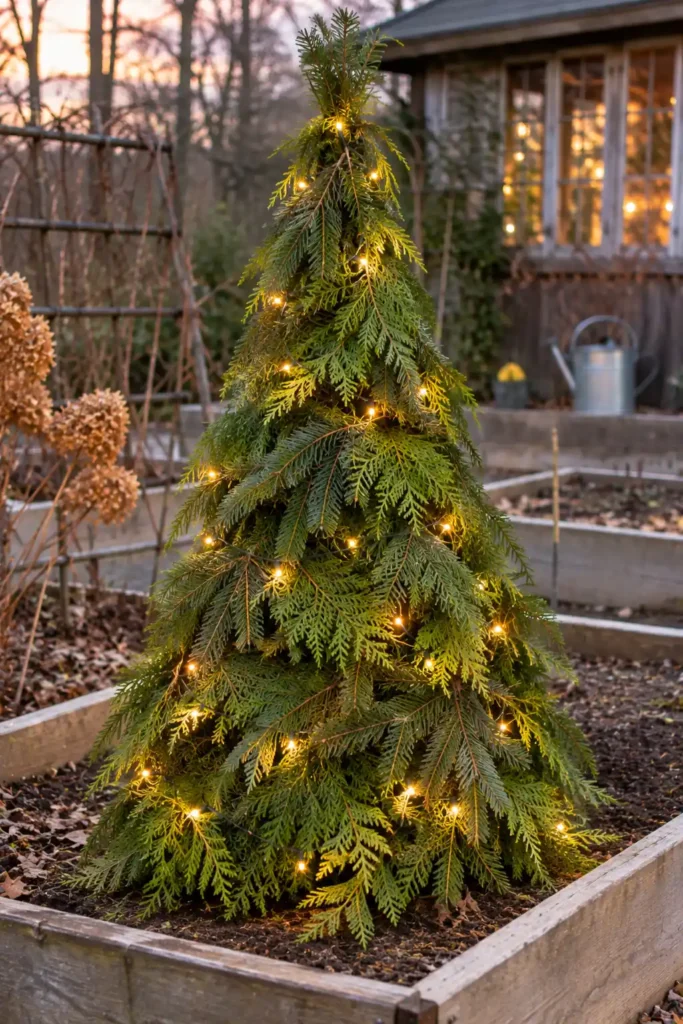
Every vegetable garden has a stack of tomato cages doing nothing in winter. Turn one upside down, pull the prongs together at the top and tie them with garden wire, so the cage becomes a cone. Weave fir and cedar clippings through the rings until no metal shows. Then wind battery fairy lights through the greens.
Push the wide bottom ring into the soil of the empty tomato bed. One lit tree in a bed of bare soil looks deliberate, as if the garden grew its own Christmas tree.
DIY note: start weaving at the bottom ring and work up. Each layer of clippings then overlaps the cut stems below and hides them. Battery lights also save you running a cord across the lawn.
9. A Lamp Post Swag Made From Free Tree Lot Trimmings
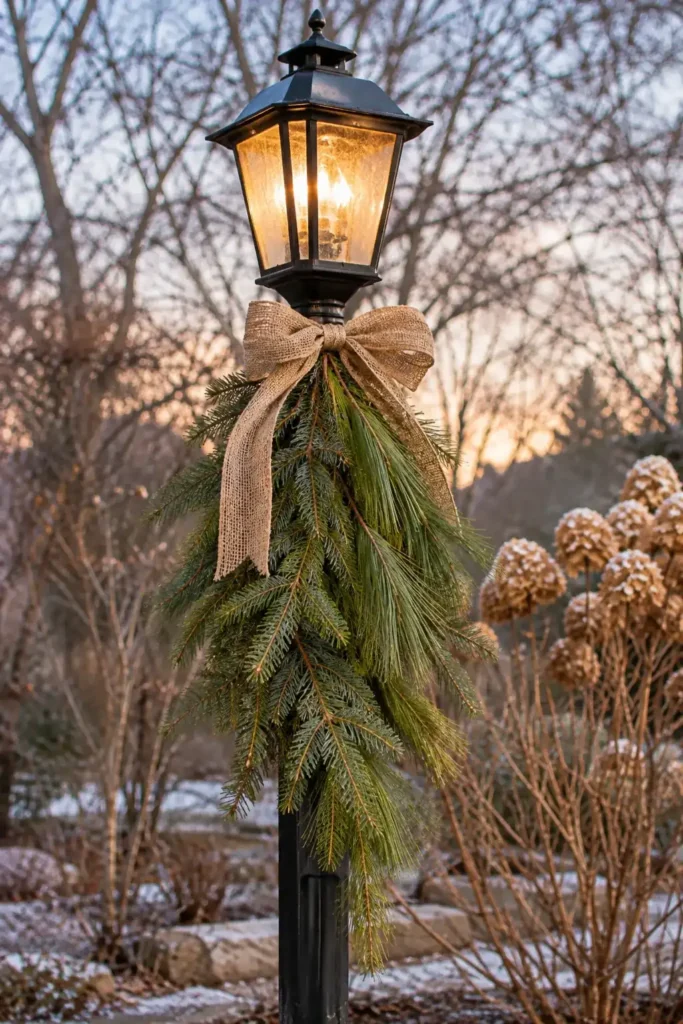
Store-bought garland adds up fast once you start decorating a whole garden. Christmas tree lots often trim the lower branches off the trees they sell, and they’ll usually hand you a bundle if you ask. Those trimmings make a full swag for a garden lamp post. Wire four or five long fir and pine branches together at the stems, wrap the join in burlap ribbon, and zip tie the swag to the post just under the lantern.
The long branches hang down the post and soften a hard black pole into something that belongs in a garden.
Conditioning tip: recut the stems and soak the trimmings overnight in a bucket of cool water before you build. Well-watered greens last longer outdoors, for the same reason as these tips on keeping your Christmas tree fresh all season.
10. Empty Hanging Baskets Refilled With Evergreen Sprays
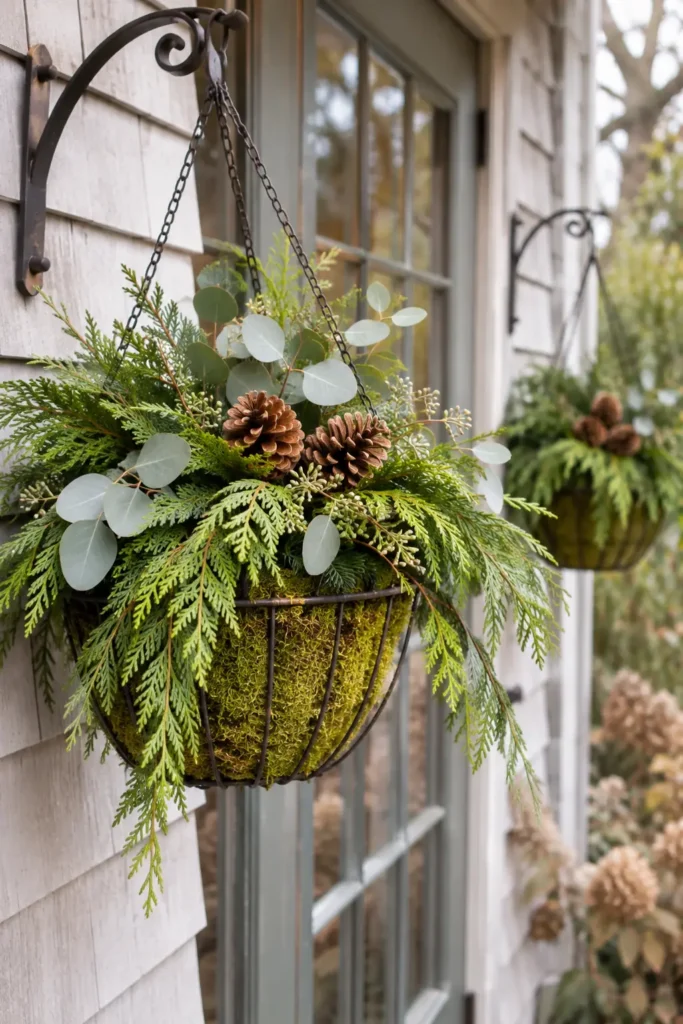
Summer hanging baskets come down in fall and usually sit empty until May. Hang them back up for Christmas instead. Line each wire basket with fresh sheet moss, then push cut cedar and eucalyptus into the old potting soil so the sprays fan out and down over the rim. Wire a few pinecones in at the top.
The old soil holds the stems upright and keeps them moist, which helps the greens stay fresh through the cold. Hang the baskets in a pair, one on each side of the garden door at about eye level, where the eucalyptus scent catches you on the way past. One basket alone can look forgotten, but two look intentional.
11. A Boxwood Kissing Ball Hung From a Tree Branch
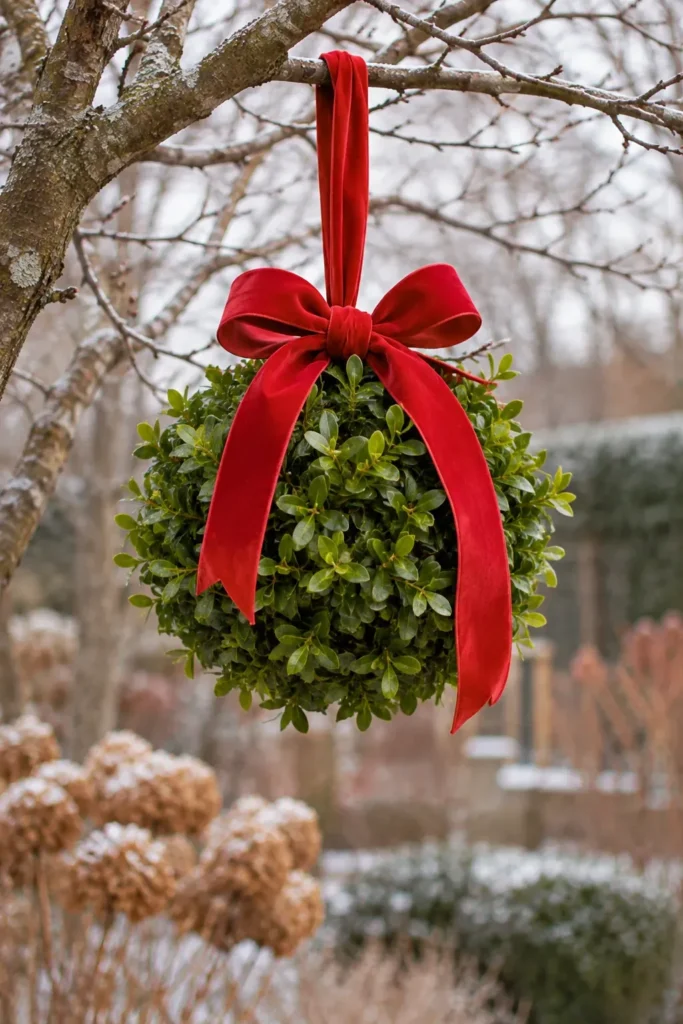
It’s the ribbon that makes a kissing ball show up from across the garden. Hang a round boxwood kissing ball from the lowest branch of a bare cherry tree on a long tail of wide red ribbon, so it floats at about eye level and turns slowly in the breeze.
To make one, wrap a ball of wet sheet moss in chicken wire and push short boxwood sprigs into it until it’s a solid green sphere. Boxwood is the classic choice because its small leaves pack tight and hold their color in cool weather. A single ball gives a bare tree a focal point, and the bare branches around it make the green look even greener.
It’s an easy weekend project, the kind of DIY outdoor Christmas decoration that costs little more than the ribbon.
12. A Birdbath Turned Into an Evergreen Centerpiece
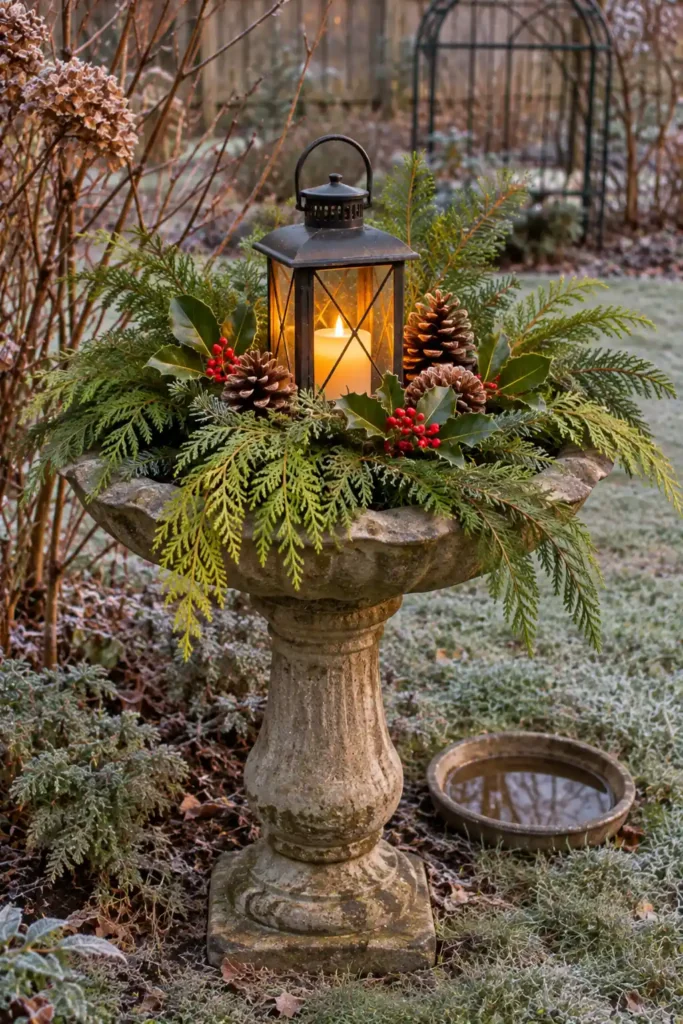
A birdbath sits empty and a little sad once the first hard frost hits. Instead of leaving the bowl bare, fill it with cut cedar boughs fanned out over the rim. Tuck in a few holly sprigs and pinecones, and set a small lantern with a battery candle in the center.
The birdbath already stands in the middle of the garden at a good height, so it’s a ready-made pedestal. The lantern draws the eye at dusk, and the cedar softens the hard stone edge.
Empty the water first, because water left in a stone or concrete birdbath can freeze and crack the bowl. Set a shallow dish of water nearby so the birds still have somewhere to drink.
13. A Garden Path Edged With Fir Boughs and Solar Lanterns
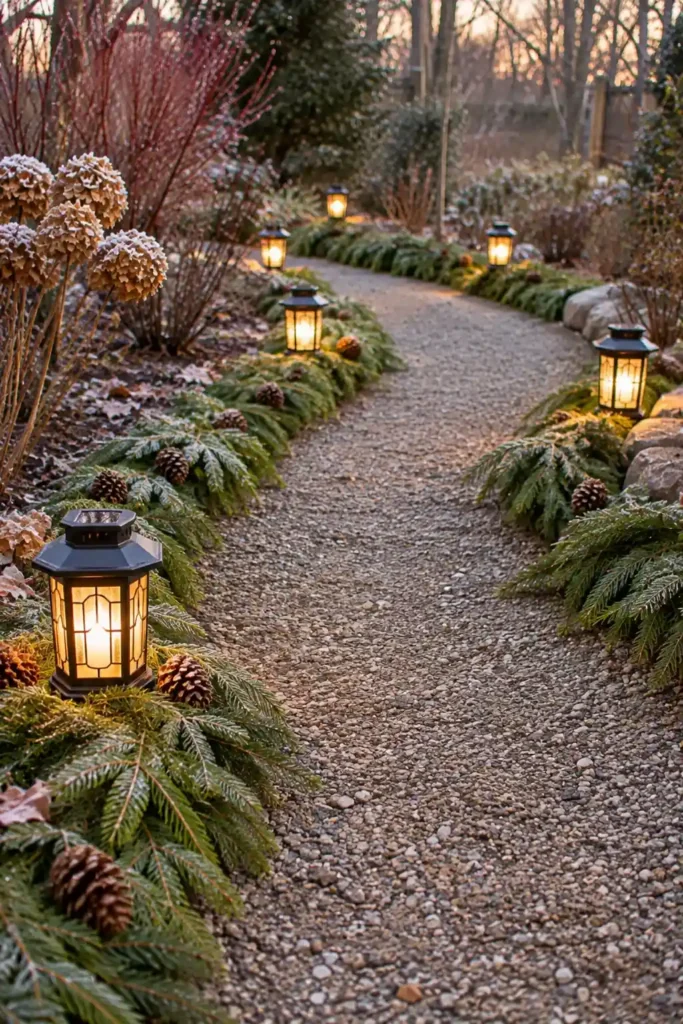
A gravel path with a bare edge disappears into the dark by late afternoon. Edge it with greenery and lanterns, and it becomes the route everyone takes to the bottom of the garden.
Lay fir boughs flat along both edges of the path, overlapping them end to end like shingles so the cut stems stay hidden. Tuck pinecones into the gaps, and set a solar lantern on the boughs every few steps. The flat greens mark the edge clearly in low light and the lanterns trace the curve, so nobody wanders into a sleeping bed.
Solar lanterns need daylight to charge, so move any that sit in deep shade to the sunniest stretch of the path.
14. A Cedar Swag Across the Back of a Garden Bench
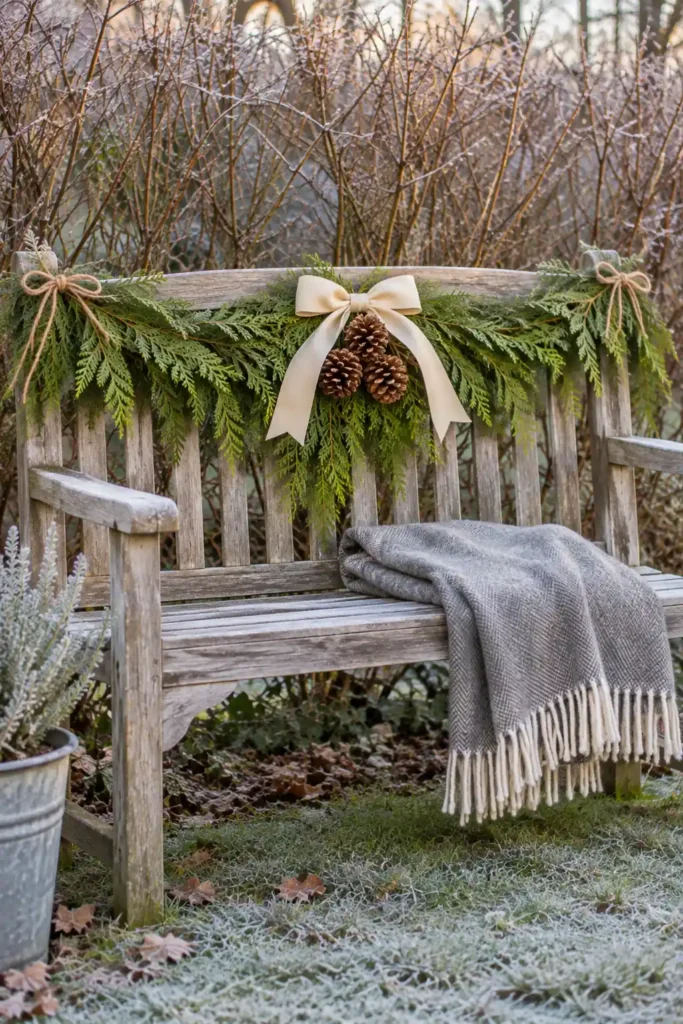
Garden benches are easy to forget in winter, which is exactly why one dressed for Christmas stops people. Tie a long cedar swag across the top rail of a weathered wooden bench with jute twine at each end. Wire a cluster of pinecones and a cream ribbon bow to the center, and fold a gray wool blanket on the seat.
Against the bare hedge behind it, the swag gives the bench a soft top line. The blanket makes it look as if someone might actually sit down with a coffee on a frosty morning. For seating you’ll use after dark, these backyard Christmas decorating ideas cover fire pits and outdoor sofas.
Get the look: a wooden garden bench, a cedar swag, jute twine, pinecones, a cream ribbon bow, a wool blanket.
Bring the blanket in at night and the bench is ready again by breakfast.
15. Winterberry Shrubs Left Standing as Living Decor
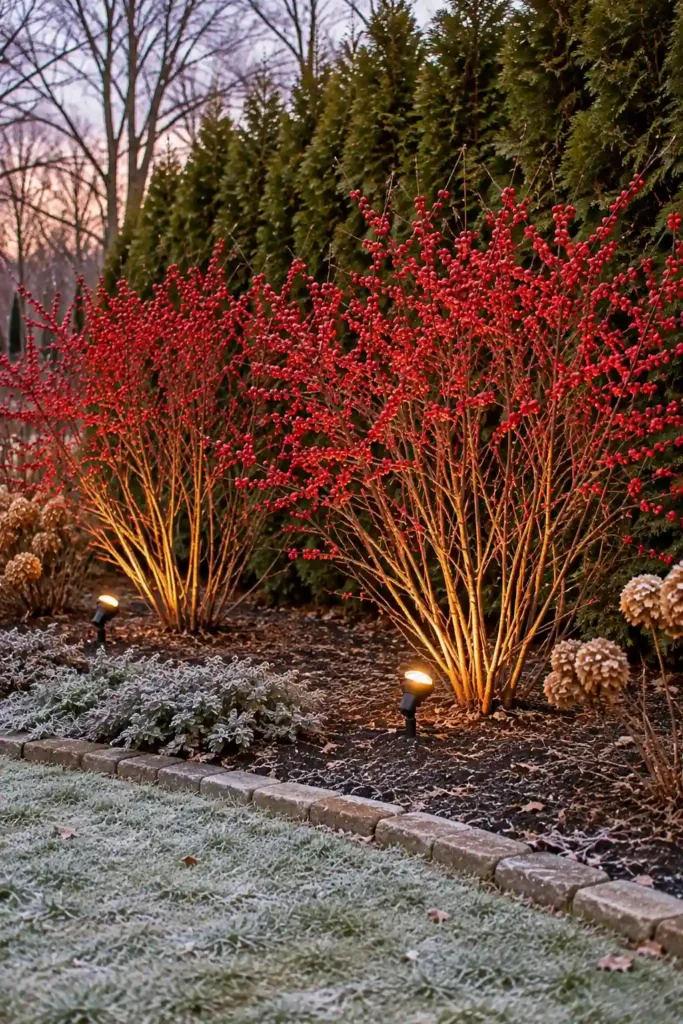
Bright red berries on bare stems are Christmas decor that grows itself. Winterberry is a deciduous holly that drops its leaves in fall and keeps its berries. It’s at its best from late fall into winter, especially in front of a dark wall of arborvitae. Leave the branches uncut and set two solar spotlights at the base, aimed up into the stems, so the shrubs glow red after dark.
Planted in a row, the berries carry color across the whole back of the garden without a single ornament. Later in winter the birds usually strip them, so the display feeds the garden too.
Winterberry needs a male plant nearby to set fruit, so plant one if your shrubs stay bare. If you have pets, check a reliable pet safety list before planting more berried shrubs.
How to Keep Outdoor Christmas Greenery Fresh All Season
Every idea on this list runs on the same routine.
- Cut greens on a cool morning, recut the stems, and soak them overnight in a bucket of cool water before you build anything.
- Use tough greens like fir, magnolia and boxwood in spots that get wind or sun, and save softer cedar for sheltered ones.
- Fasten everything with jute twine, floral wire or zip ties instead of nails, so nothing pulls loose in a storm.
- If you like, use an anti-desiccant spray from a garden center to slow moisture loss on needles and leaves. Follow the label.
- Check each display after a hard freeze or a windy night, and swap out any piece that has browned.
Christmas Garden Decor FAQ
How long does fresh greenery last outside?
In cold weather, fresh greenery usually lasts several weeks outdoors, often longer than it would in a warm house. Shade, steady cold and well-soaked stems help most. Sun, wind and warm spells dry it out fastest. Ideas 2 and 9 cover the toughest greens and how to condition them.
Can I use clippings from my own garden?
Yes. Lightly pruning evergreen shrubs and conifers in late fall gives you free greens for natural Christmas garden decorations like wreaths, swags and bundles. Take a little from several plants rather than a lot from one, and cut just above a side branch so each shrub keeps its shape. Ideas 5 and 8 run entirely on clippings.
Is it safe to decorate with holly and berries around pets?
It depends on the plant and the pet, so check a reliable pet safety list before you decorate with holly, winterberry, ivy or other berried stems. Keep berried pieces up high or out of reach, and sweep up fallen berries, especially by doorsteps where pets pass every day.
When should I take down outdoor Christmas greenery?
Take fresh greenery down once it turns brown or brittle, usually sometime in January. Compost the cuttings, or lay fir and pine boughs over tender perennials as a light winter mulch. Save the wire frames, lanterns, tomato cages and ribbons for next year.
Conclusion
The prettiest Christmas gardens rarely come from a store. They come from pruners, a bucket of water and a free afternoon spent turning what’s already growing into wreaths, swags and bundles. Start with one or two of these Christmas garden decor ideas, perhaps the arbor garland or the watering can bouquet, and add more as the clippings pile up. Keep the stems soaked, the ties snug, and the berries where the birds can find them later.
Save this for the next mild weekend when the pruners come out.