When you encounter a thorny plant, you’re witnessing an evolutionary strategy that’s far more sophisticated than simple protection. Plants don’t develop spines randomly; instead, they’ve adapted these sharp structures to address multiple survival challenges simultaneously. From defending against hungry herbivores to conserving precious water in harsh climates, spines serve purposes you might not have considered. Understanding how and why plants evolved these defenses requires examining the specific environmental pressures that shaped them.
Why Spines Protect Plants From Herbivores
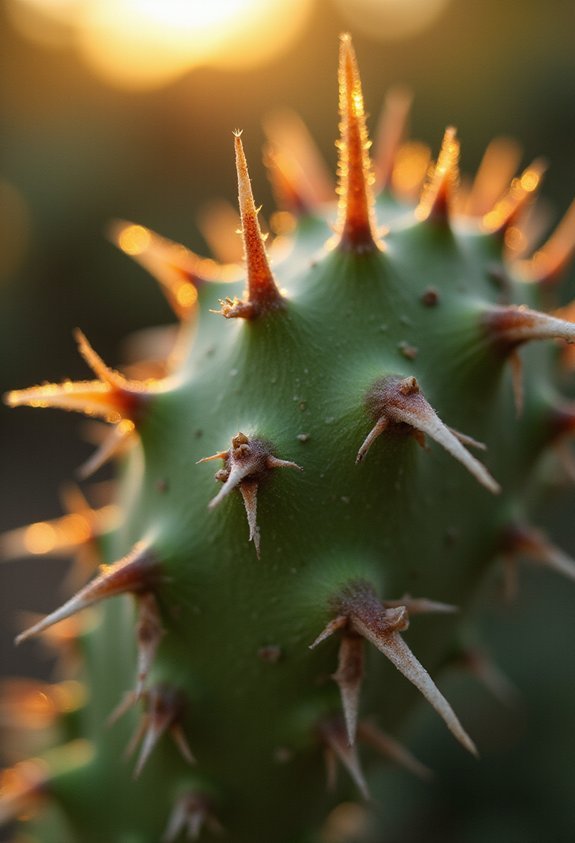
Since plants can’t move away from danger, they’ve developed physical defenses that discourage animals from eating them, and spines represent one of nature’s most effective protective strategies. When you consider how herbivores browse vegetation, you’ll understand why sharp spines create a significant barrier to feeding. These pointed structures inflict pain and injury on animals’ mouths and digestive systems, making plants armed with spines far less appealing as food sources. Herbivores naturally prefer easier meals without consequences, so they’ll typically move toward plants that don’t threaten them. Over time, this selective pressure allowed plants with stronger, sharper spines to survive and reproduce more successfully than their defenseless counterparts. Consequently, spines’ve become increasingly prominent in plant populations across harsh environments where herbivores present constant feeding threats.
Also read: 10 Pro Tips for Keeping Your Christmas Trees Fresh All Season Long
Water Conservation: The Desert Plant’s Secret

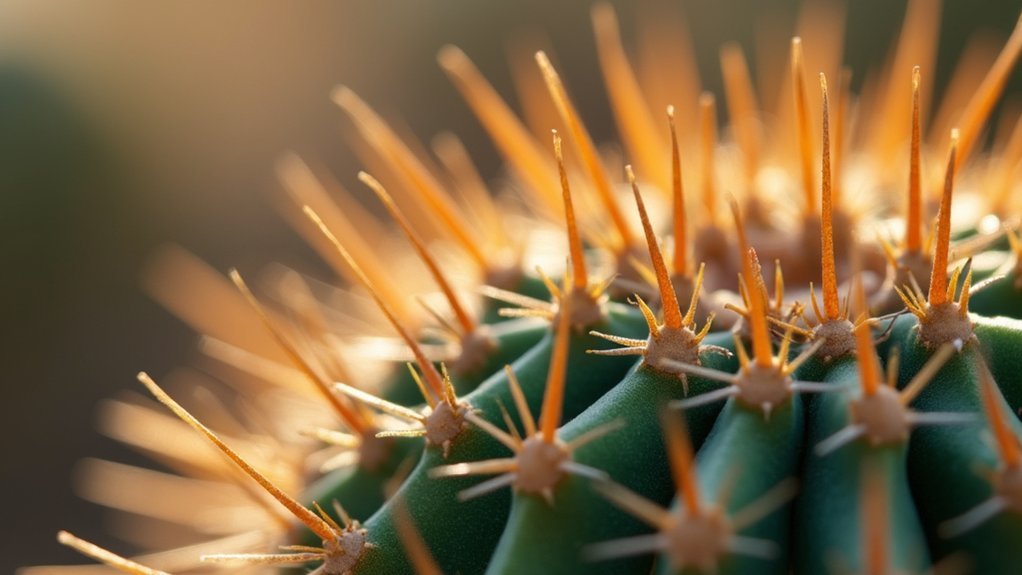
While spines serve as an effective defense mechanism against hungry herbivores, they’re also crucial for another survival strategy that’s especially important in arid climates: water conservation. You’ll find that desert plants have evolved spines instead of broad leaves, which reduces the plant’s overall surface area exposed to the sun. This adaptation minimizes water loss through evaporation, a pivotal advantage when rainfall is scarce. The smaller surface area means less water vapor escapes into the dry air. Additionally, spines create tiny pockets of shade around the plant’s stem, further reducing heat exposure and water loss. By converting leaves into protective spines, desert plants like cacti have developed an ingenious two-in-one solution that simultaneously defends against predators while preserving precious water reserves needed for survival.
How Different Plant Species Evolved Spines
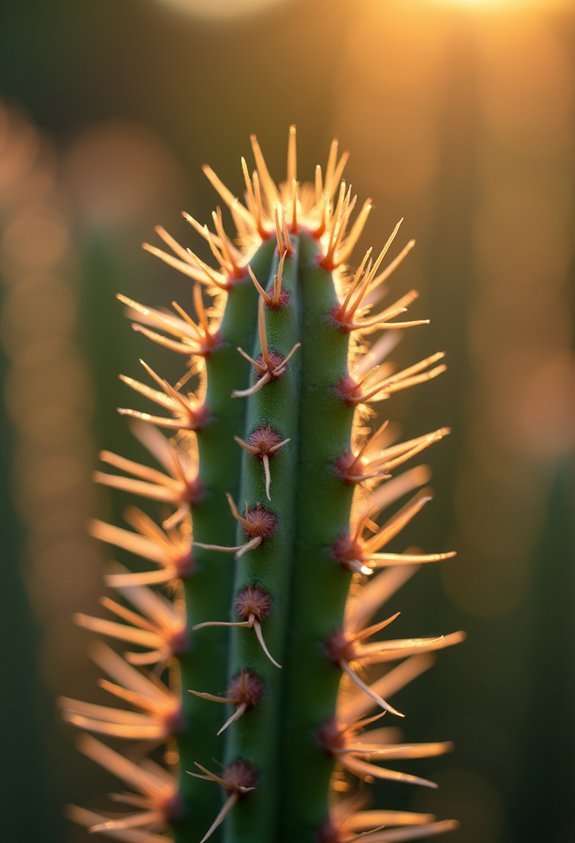
Evolution’s diverse toolkit has shaped the way different plant species developed spines as a response to their unique environments and survival challenges. You’ll find that cacti evolved spines from leaves over millions of years, creating sharp projections that protect against herbivores while reducing water loss. Roses and brambles, conversely, developed thorns from modified stems, which serve similar defensive purposes in woodland environments. Hawthorn species grew spines through stem modifications that increased their survival rates in temperate climates. Each adaptation reflects specific pressures—whether desert heat, predatory animals, or competition for resources. You can observe that plants in harsh conditions typically developed more pronounced spines, while those in sheltered habitats sometimes retained softer structures. This variation demonstrates how natural selection fine-tunes plant defenses to match environmental demands precisely.
Spines, Thorns, and Prickles: What’s the Difference?
Plant defensive structures aren’t all created equal, and understanding the differences between spines, thorns, and prickles will help you recognize how each plant has adapted its unique protection strategy. Spines are modified leaves that grow directly from the plant’s stem, making them an integral part of the plant’s structure. Thorns, by contrast, are modified branches that develop from the plant’s woody tissue. Prickles are the least integrated defensive structures, consisting of sharp projections that grow from the plant’s outer skin or epidermis. You’ll find spines on cacti, thorns on roses and hawthorns, and prickles on raspberries and blackberries. Each structure serves the same protective purpose, yet they’ve evolved differently depending on the plant’s environment and specific survival needs.
How Spines Aid in Seed Dispersal
Beyond their role as defensive structures, spines serve an equally important function in helping plants spread their seeds to new locations, which means these sharp projections contribute to a plant’s survival in ways that extend far beyond protection alone. When you observe animals moving through spiny plants, you’ll notice seeds attach to their fur or feathers through barbed spines, a process called zoochory. As the animal travels, it carries these seeds across distances the plant couldn’t naturally reach on its own. Once the animal moves to a new area, seeds detach and germinate in fresh soil, establishing new plant populations. You can see this dispersal strategy in plants like burdock and cockleburs, where hook-like spines easily catch onto passing creatures, making seed transportation remarkably efficient.
Why Growing Spines Is Expensive for Plants
While spines clearly benefit plants through defense and seed dispersal, they don’t come without a significant cost, because developing and maintaining these sharp structures requires plants to invest substantial amounts of energy and resources that they’d otherwise use for growth and reproduction. You should understand that producing spines demands minerals like calcium and silica, which plants must extract from soil through their roots. Additionally, the biological processes involved in forming and strengthening spine tissue consume considerable glucose and other nutrients that the plant manufactures through photosynthesis. In harsh environments where resources remain scarce, this expenditure represents a genuine trade-off, forcing plants to choose between allocating energy toward defensive structures or toward expanding root systems, developing additional leaves, or producing seeds.
When and Why Plants Grow Spines
Given the substantial energy cost of producing spines, you might wonder why plants bother growing them at all, and the answer lies in understanding that plants don’t grow spines constantly or indiscriminately, but rather develop them strategically in response to specific environmental pressures and threats. You’ll find that plants typically invest in spine production when herbivores pose a significant danger to their survival, or when they inhabit harsh desert environments where water-conserving adaptations become critical. For instance, cacti develop spines in arid climates where the reduced surface area helps minimize water loss, while simultaneously defending against thirsty animals seeking moisture. Additionally, plants growing in areas with heavy grazing pressure evolve spines more quickly as a defensive mechanism, demonstrating how environmental conditions directly determine whether plants allocate precious resources toward this expensive protection strategy.
Can Plants Lose Their Spines Over Time?
Plants don’t necessarily keep their spines permanently, and depending on their circumstances, they can actually lose them through a process called *spine reduction* or *spine loss*. When you remove a plant from its harsh environment and place it in safer conditions with abundant water and nutrients, it’ll gradually stop producing spines on new growth. This happens because the plant no longer needs defensive structures for survival. Over multiple growing seasons, you’ll notice that new leaves and stems emerge without the sharp protrusions that once covered older parts. Some species can even reabsorb spine tissue, redirecting that energy toward growth and reproduction instead. However, this process varies considerably among plant species, with some plants retaining spines regardless of environmental changes.
Conclusion
You now understand that spines represent a million-times worthwhile investment for plants, protecting them from herbivores while conserving water and dispersing seeds across vast distances. By evolving these sharp defenses, plants in harsh environments guarantee their survival and reproduction despite the significant energy costs involved. Whether you’re observing desert cacti or thorny shrubs, you’re witnessing nature’s elegant solution to environmental challenges and herbivory pressure.