The best backyard toy is often whatever a kid can rearrange, dig into or get wet. That’s good news, because kid friendly backyard ideas don’t have to start with an expensive playset. A sandbox with a lid, a mud kitchen built from a pallet, a water wall screwed to the fence and a swing set over a proper soft landing will keep kids outside far longer than another bin of plastic toys.
These 23 ideas cover every age, from toddlers pouring water to teens who just want a hammock and a movie screen. Along the way you’ll find the details most lists skip: what really belongs under a swing set, how to shade the play zone, where to put the parents’ chairs so you can actually sit down, and how to fit it all into a small yard. For even more backyard ideas worth copying, keep that list handy. Start with what your kids already love to do, and build from there.
👟 How old are the kids playing out there?
Plan the Play Yard From the Kitchen Window
Before you buy a swing set, stand at the kitchen window and the patio door and look out. The best spot for play is the one you can see from where you actually spend your time.
Sort play into three zones. Active play, like swings, climbing and ball games, needs open space and soft ground. Messy play, like sand, mud and water, needs drainage and a hose nearby. Quiet play, like hideouts, reading and art, likes shade and a little privacy.
Follow the sun. Note which spots stay shaded in the afternoon, and put sand and water play there.
Build for the years ahead, not just this summer. Kids grow fast. Choose pieces that can change jobs as they get older, like a playhouse that becomes a shed or a sandbox that becomes a garden bed.
Sort out those three things and the ideas below fall into place.
1. Wooden Swing Set Over a Deep Wood Chip Landing

A wooden swing set is still the backyard feature kids run to first, and the ground under it matters as much as the set. Grass looks soft, but by midsummer it wears into hard-packed dirt under the swings, so it isn’t a real cushion. Spread a deep layer of wood chips or playground mulch inside a timber border. Run it well past the swings in front and behind, since that’s where kids fly off. Keep the set several strides from fences, trees and the patio, so nothing sits in the landing path.
Play note: Rake the chips back under the swings every week or two, because kicking feet dig a trench right where kids land.
🛝 How big the soft landing should be
The CPSC’s Outdoor Home Playground Safety Handbook recommends cushioned surfacing at least six feet in every direction around play equipment. For swings, it should reach front and back twice the height of the top bar. The handbook also lists how deep each material needs to be for the height of your set, so check it before you order mulch.
2. A Playhouse With a Porch That Grows Up With Them

The little porch is what makes a playhouse last. Toddlers use it as a stage, and school-age kids turn it into a shop counter. A few years later, the same covered step is where a twelve-year-old reads with a flashlight. Choose a simple cedar playhouse with a real door, a window box and a porch deep enough to sit on. Paint it soft sage with cream trim, so it looks like a tiny garden shed instead of a plastic toy. That shed look is the smart long-term move, because once the kids outgrow it, it becomes storage for bikes, balls and garden tools.
3. Covered Sandbox With a Lid That Flips Into Benches

Sandboxes have two enemies: rain and neighborhood cats. A covered sandbox with a hinged lid solves both. The best versions fold open into two benches with backrests, so the cover becomes seating instead of something leaning against the fence. Fill it with clean play sand and close it every evening. Keep a lidded bin of buckets, scoops and molds beside it, so the toys have a home that isn’t the lawn. A spot with afternoon shade keeps the sand from getting too hot to touch.
Get the look: a cedar sandbox with a fold-out bench lid, clean play sand, a lidded toy bin, buckets and scoops.
4. A Pole Bean Teepee Hideaway
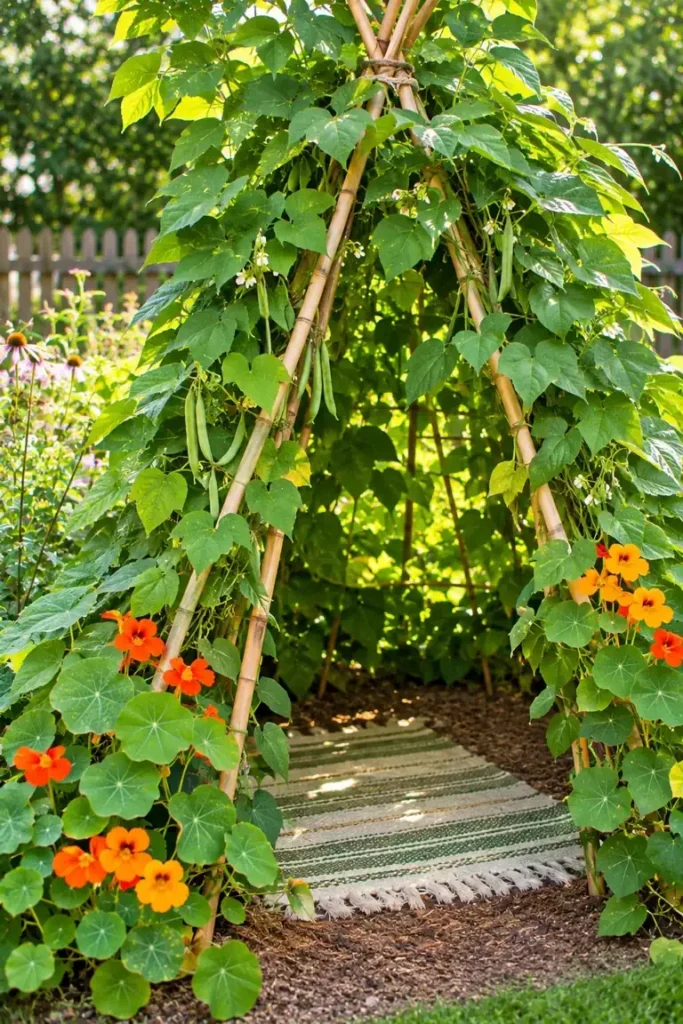
Buy a play tent and it lasts one summer. Grow one and it comes back bigger every year. Lash six tall bamboo poles together at the top into a cone, leaving a gap wide enough for a doorway, and plant pole beans at the base of each pole in spring. By midsummer, the vines close the walls into a shady green room for hiding, reading and picking. Lay a small outdoor rug inside for seating, and tuck orange nasturtiums around the door for color. It’s the cheapest hideout on this list, and the only one that grows dinner.
5. Pallet Mud Kitchen With Real Pots and Pans
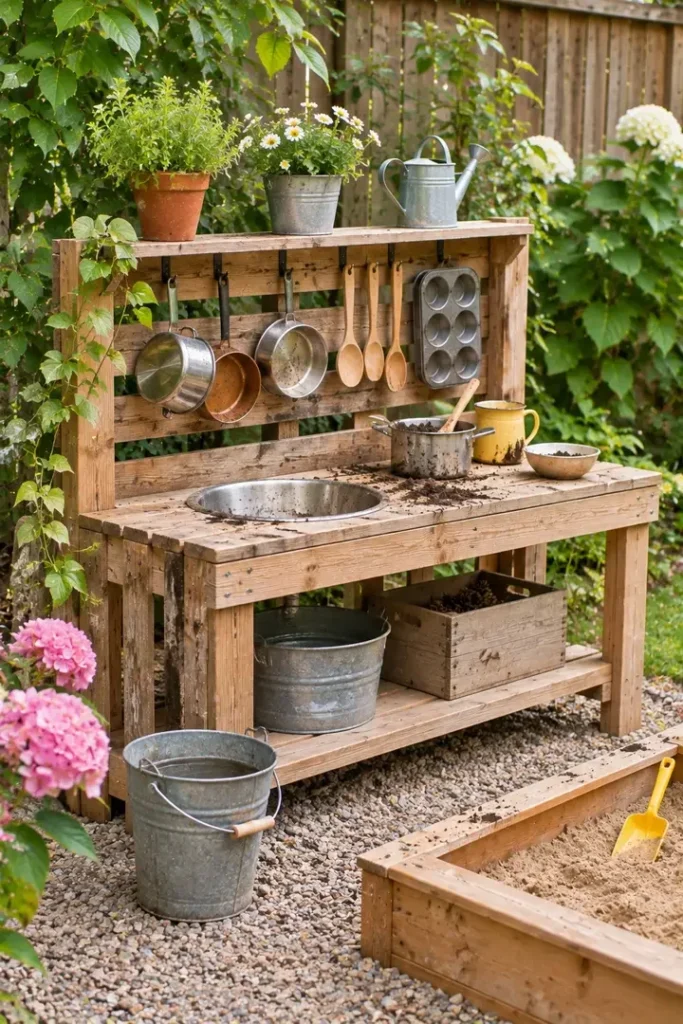
Mud is going to happen either way. A mud kitchen gives it a counter. Build a simple counter at kid height from reclaimed wood or a sanded pallet, and set a metal mixing bowl into a cutout as the sink. Hang thrift-store pots, pans, wooden spoons and a muffin tin from hooks. Put the kitchen next to the sandbox or a patch of garden soil so the ingredients are close, with a bucket of water nearby for cooking. Set it on a gravel pad so the mess drains instead of turning the lawn into a swamp. Sand every edge smooth, and use pallets stamped HT, which means heat treated, not chemically treated.
6. A Shade Sail Over the Play Zone
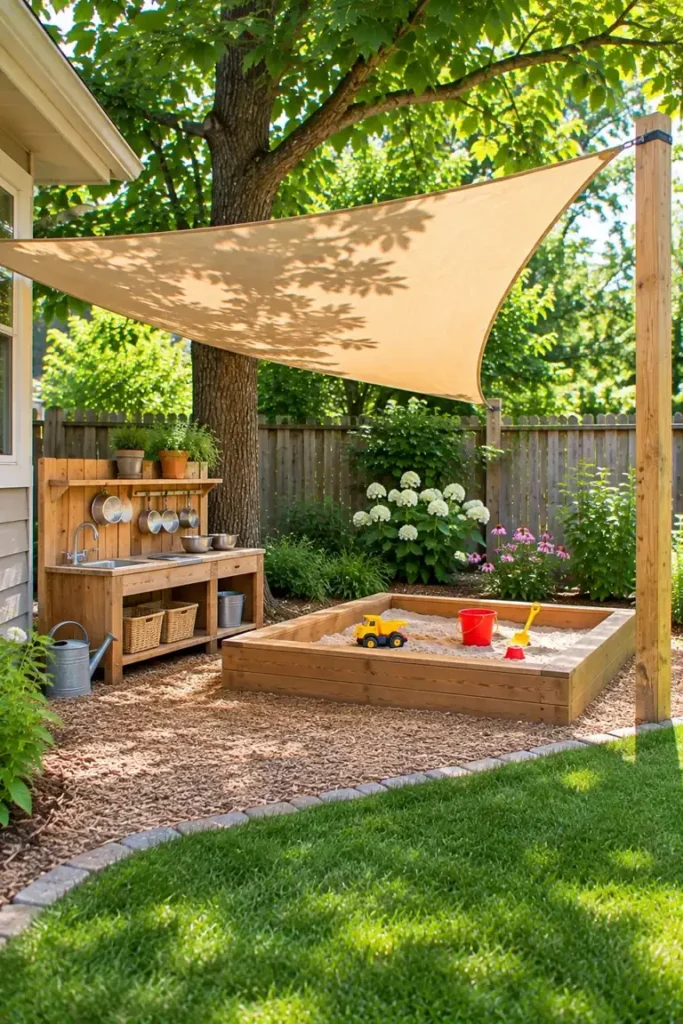
Most play areas get built in the sunniest spot in the yard and abandoned by noon. A shade sail fixes that. A large triangle of sand-colored fabric stretched between the house, a tree and a sturdy post shades the sandbox and mud kitchen through the hottest part of the day. That keeps the play zone usable well past breakfast. Angle it toward the afternoon sun, when the heat hits hardest.
Have a pro set the posts and anchors, because a sail pulls hard in the wind, and take it down before big storms. For something permanent, these gazebo ideas offer shade that works for the grown-ups too.
7. Low Traverse Climbing Wall on the Fence
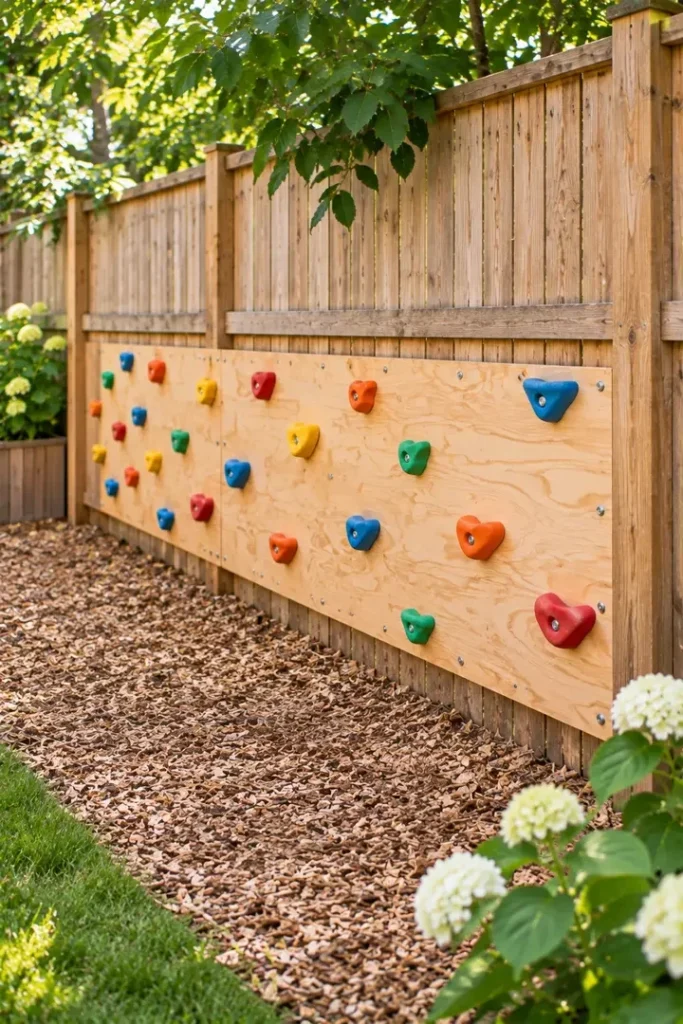
Most climbing walls go up, which is exactly where the fall risk is. A traverse wall goes sideways. Bolt colorful climbing holds to a plywood panel mounted on the inside of a sturdy fence. Keep the highest hold low enough that kids climb across instead of up, and spread a thick strip of wood chips along the base. Kids build the same grip and balance with far less height. Space the holds closer together at one end for little climbers and farther apart at the other for big kids.
Build note: Mount the panel to the fence posts, not just the boards, and check the bolts every season.
8. Gutter and Funnel Water Wall on a Fence Panel
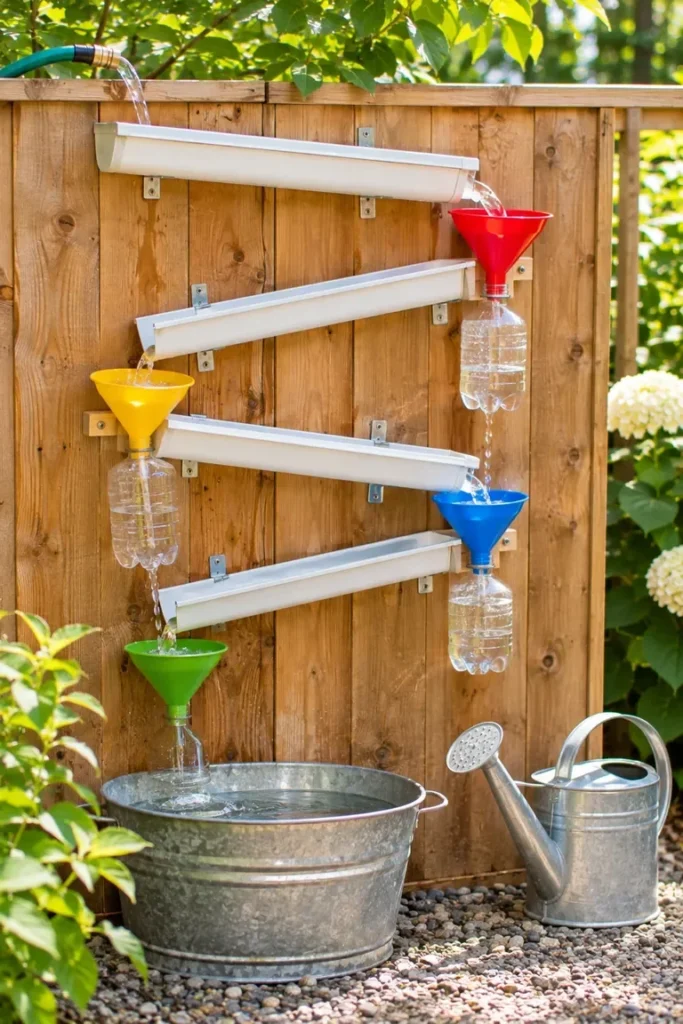
A water wall is plumbing for kids. Screw lengths of vinyl rain gutter, plastic funnels and cut-down bottles to a fence panel at different angles. Kids pour water in at the top and watch it zigzag down into a tub at the bottom. It’s cheap, quiet and endlessly rearrangeable. Set it over a gravel pad so spills drain away. Empty the tub when play ends, because young children can drown in very little water, and always stay close by.
Get the look: a cedar fence panel, white vinyl gutter pieces, colorful plastic funnels, a galvanized washtub, a watering can.
9. A Paver Ride-On Loop for Bikes and Scooters
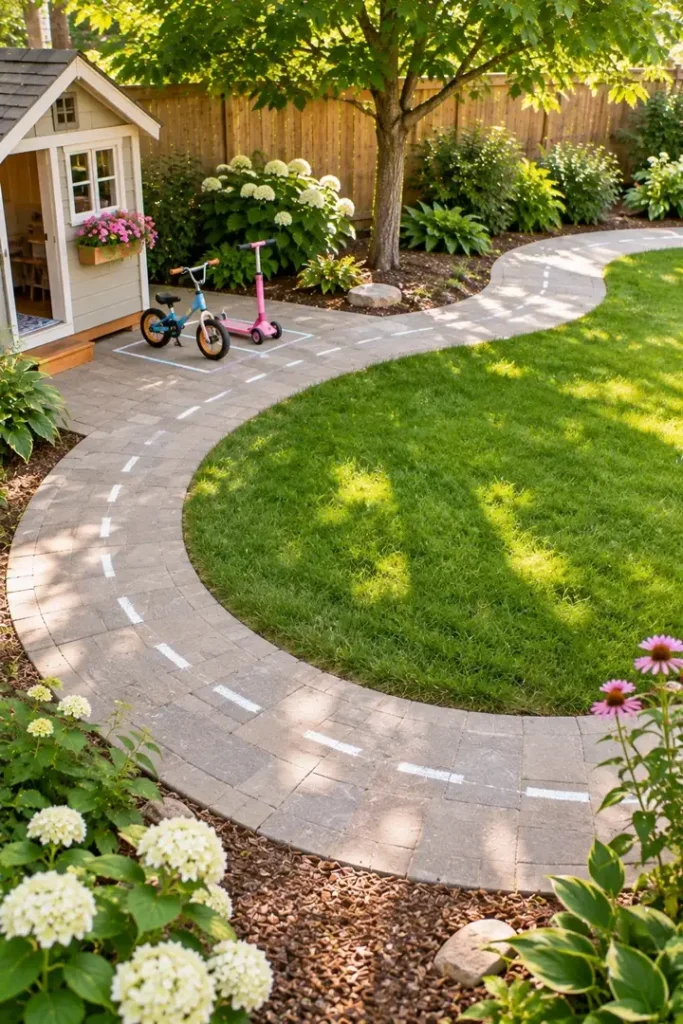
The rattle of plastic wheels on smooth stone is the sound of a good ride-on loop. Lay a wide, flat path of concrete pavers in a loop around the lawn, so tricycles, balance bikes and scooters get a racetrack that never leaves the yard. Keep the curves gentle and the surface level. Skip gravel, which stops small wheels dead. Chalk a center line and a parking spot by the playhouse. On muddy days the same loop doubles as a dry path to the back of the yard, which is the grown-up payoff.
10. A Parents’ Patio With a Clear View of the Play Zone

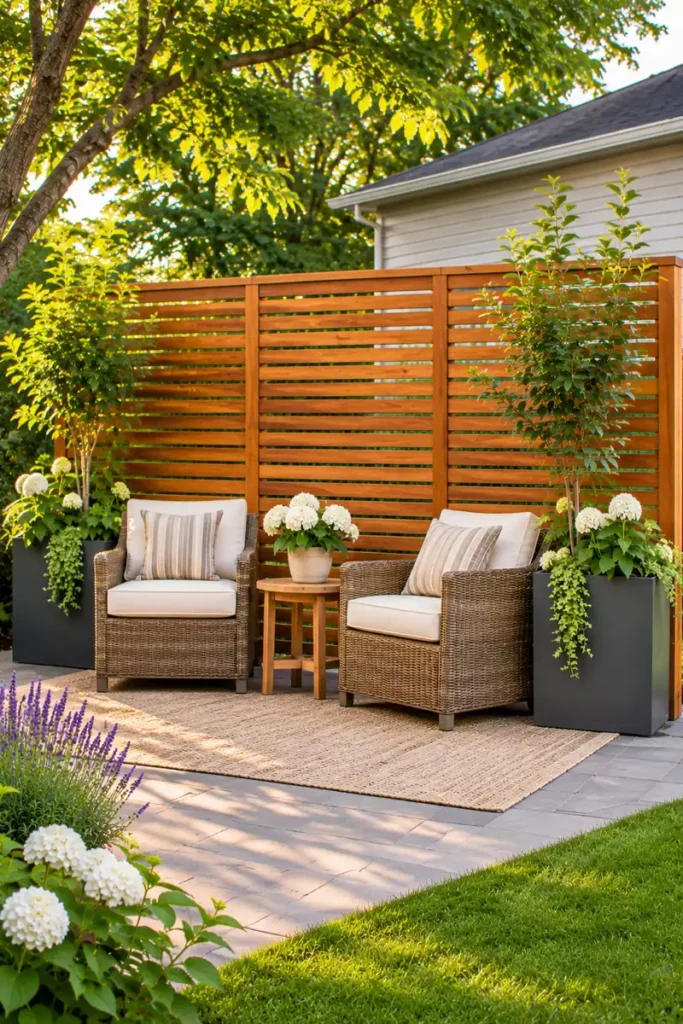
Put the play area behind the garage and you’ll spend every afternoon walking over to check on it. Put it in clear view of the patio and the kitchen window, and you can actually sit down. Turn a small paver patio with two lounge chairs and a side table toward the play zone. Keep the plants between them below knee height, so nothing blocks the view. Kids tend to stay outside longer when a grown-up is close by, and grown-ups stay longer when the seat is comfortable. These backyard patio ideas help with the layout.
11. A Kids’ Garden Bed With Fast, Easy Crops

Give kids their own raised bed instead of a corner of yours, and the garden becomes theirs to care about. Fill a low cedar raised bed with quick, forgiving crops. Radishes are ready in a few weeks, snap peas climb a small trellis, and cherry tomatoes and a row of strawberries are made for snacking. Let them plant a sunflower or two in the back row, because a flower taller than Dad is a big deal.
Keep a small watering can and kid-size gloves in a bin beside the bed, and plant it close to the hose. Older kids can handle the watering a couple of times a week on their own.
12. A Chalkboard Fence Panel for Outdoor Art
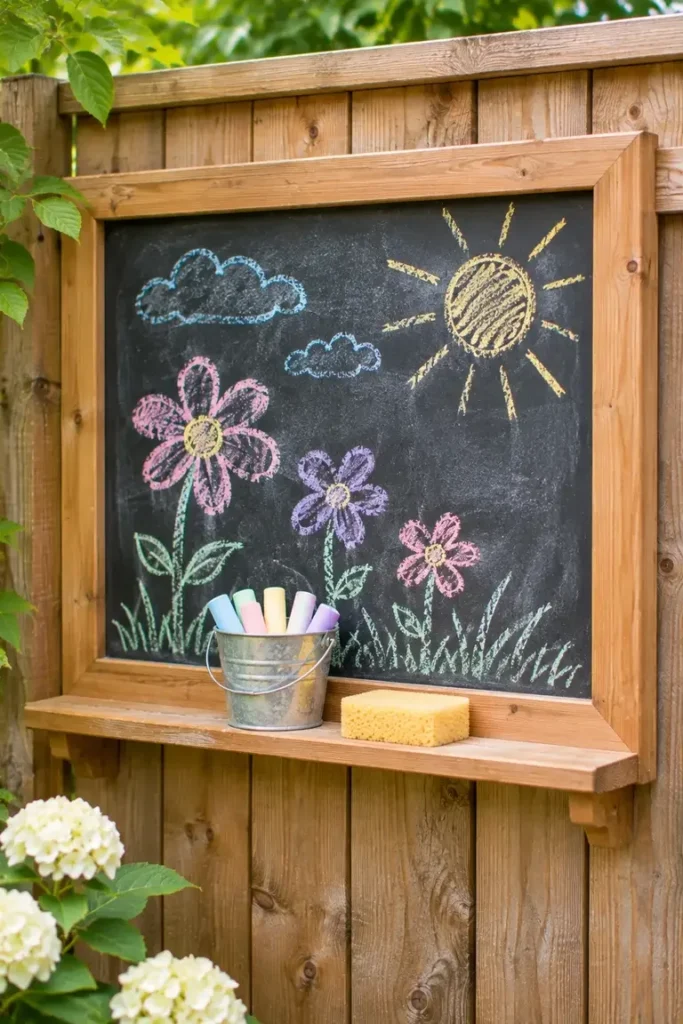
Chalk on the patio washes away in the first rain, but a chalkboard fence panel stays put. Paint a smooth plywood panel with exterior chalkboard paint, frame it in cedar trim, and screw it to the fence at kid height with a small ledge underneath for chalk. All summer it works as a scoreboard, a menu for the mud kitchen and a gallery wall. Wipe it down with a damp sponge between masterpieces.
Get the look: a framed chalkboard panel, a cedar chalk ledge, a tin bucket of chunky sidewalk chalk, a sponge.
13. A Splash Pad on Textured Pavers
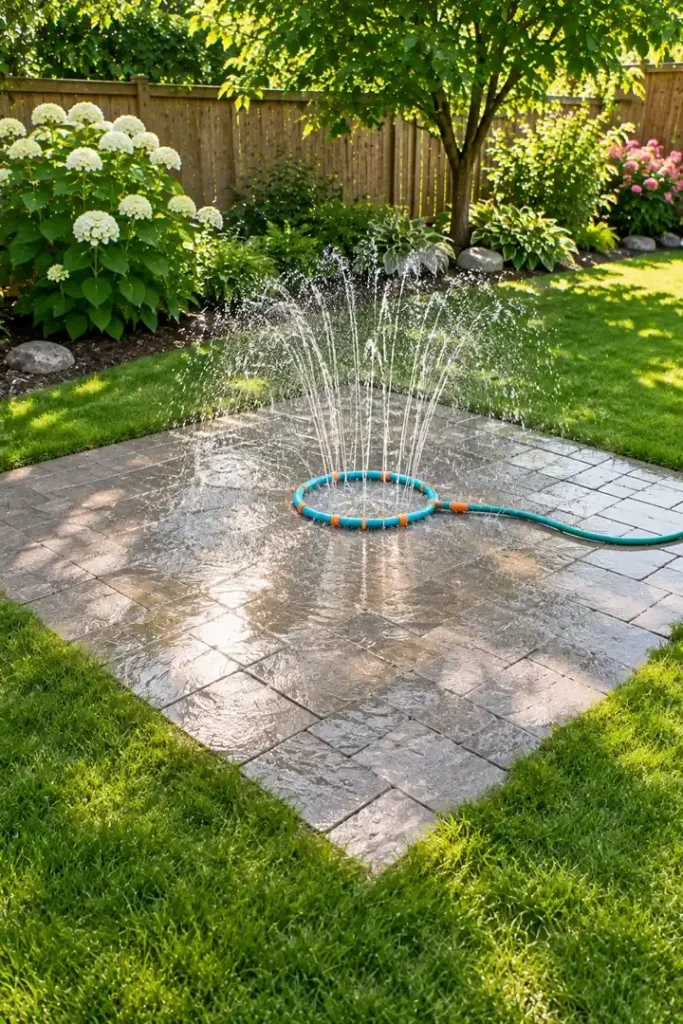
Kiddie pools need constant emptying and watching. A splash pad skips the standing water entirely. Lay a square of textured concrete pavers and set a hose-fed spray ring or a couple of ground sprinklers in the middle, so water sprays up and drains straight off. Textured pavers matter here, because smooth stone gets slick fast. Kids still need an adult watching, but there’s no pool to drain at the end of the day. If you’re dreaming bigger, these small backyard pools show what fits a modest yard.
14. A DIY Obstacle Course From Tires and Ropes

Kids invent obstacle courses on their own, and if you give them real pieces they’ll run one until dinner. Lay a row of old tires flat for high-knee stepping, and set short tree stumps at different heights for hopping. Hang a knotted climbing rope from a sturdy branch, and finish with a fabric crawl tunnel. Arrange it all in a loop on wood chips so the landings stay soft.
Course note: Drill drainage holes in the tires so they don’t hold rainwater, and scrub them clean before kids use them.
15. A Music Wall of Pots, Pans, and Wind Chimes
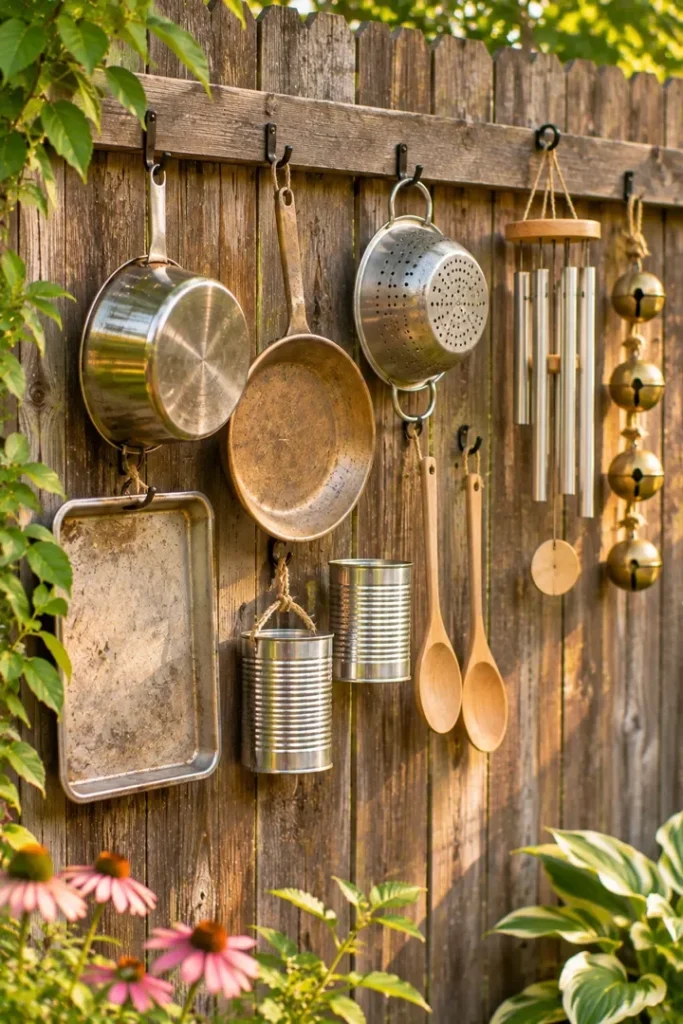
The first clang will make you wince. The hundredth will make you smile, mostly. A music wall turns old kitchen gear into a backyard instrument. Hang thrift-store pots, metal pans, a cookie sheet and a row of wind chimes from hooks on a fence panel. Tie a couple of wooden spoons on strings so they never go missing. Put it at the far end of the yard, away from the neighbors’ patio, which may be the kindest design decision on this list.
16. Vertical Play for a Small Backyard
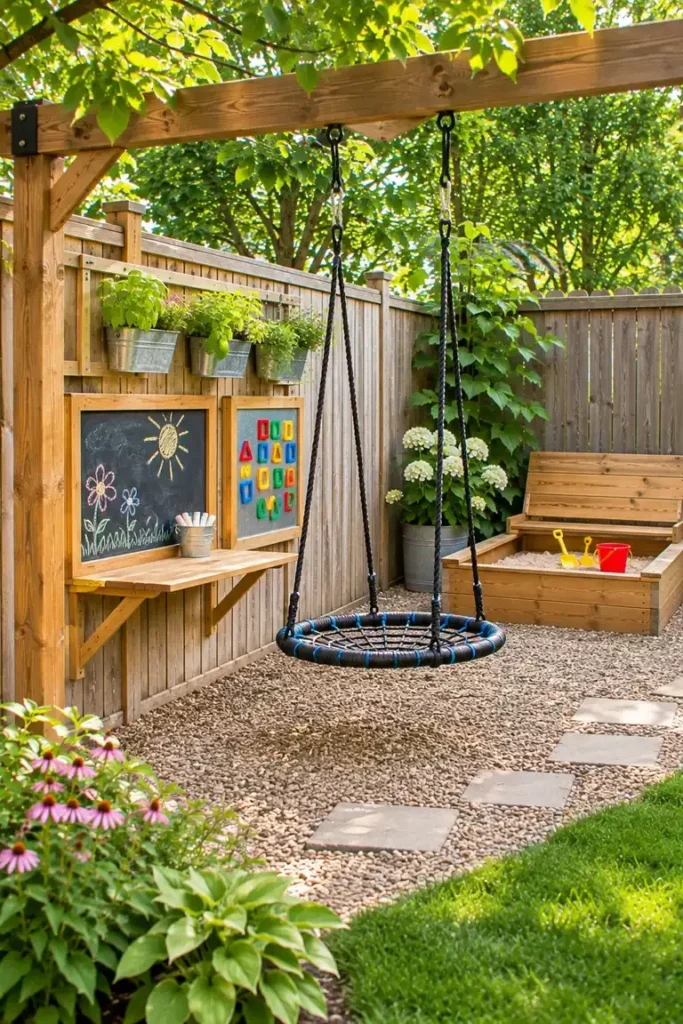
A small yard can’t hold a swing set, a sandbox and a lawn, so build up instead of out. On one fence, mount a fold-down wall table that works as a chalkboard, a magnetic play panel and a row of hanging herb planters. Hang a single rope saucer swing from a sturdy pergola beam, with the anchors installed by a pro. Choose a sandbox with a bench lid so it doubles as seating. Every piece earns its spot twice. These small backyard ideas have more layouts for tight spaces.
Get the look: a fold-down wall table, a magnetic play panel, a rope saucer swing, a sandbox bench, hanging herb planters.
17. An Outdoor Art Corner With an Easel and Wash Station
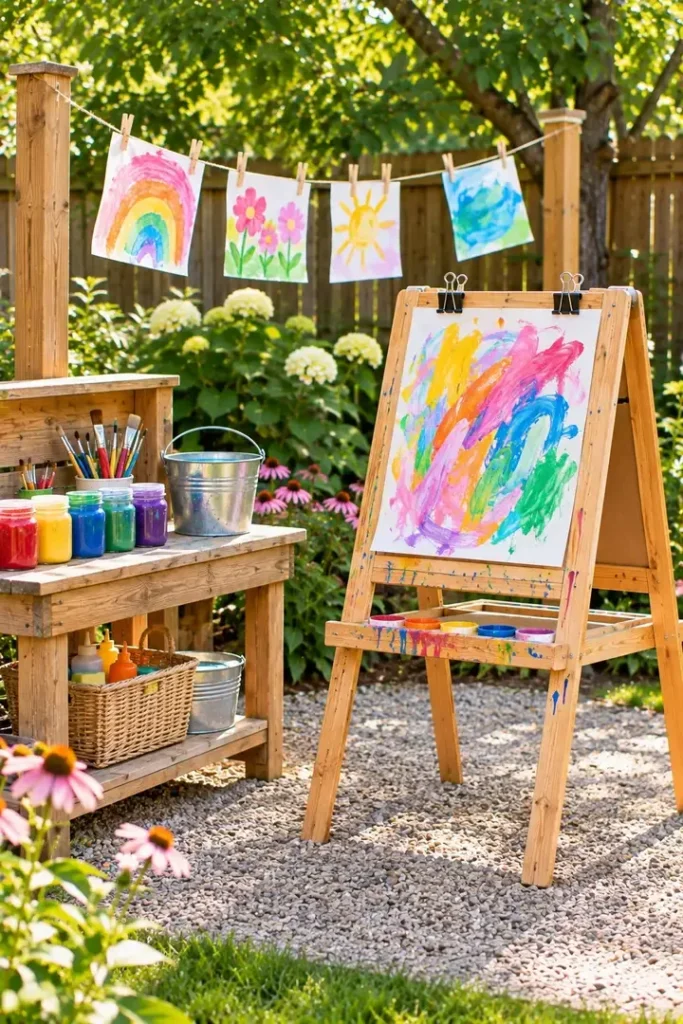
Paint indoors and you’re scrubbing the table afterward. Paint outside and the hose does the cleanup. Set a double-sided wooden easel on a gravel pad, with a small potting bench beside it holding jars of washable paint, brushes and a bucket of water. Clip paper to the easel with binder clips. String a line between two posts with clothespins, so finished paintings dry in the breeze. Washable paint and an old T-shirt as a smock keep the cleanup quick.
18. An Open Lawn Rectangle for Ball Games

Every yard full of play gear eventually runs out of room to throw a ball. Protect one simple rectangle of open lawn and leave it empty on purpose. A pair of pop-up soccer goals, a cornhole set and a few cones are all it needs, and they pack away in the playhouse when it’s time to mow. Choose a tough turf grass that handles foot traffic. Face the field so stray balls head toward the fence, not the windows. The empty space is the feature.
19. Soft, Sturdy Plants Along the Play Edges

Plants near play areas get grabbed, trampled and sat on, so pick ones that can take it. Silver lamb’s ear is soft enough to pet, fountain grass bounces back after a stray ball, and mounding lavender smells good every time someone brushes past. Keep thorny roses, spiky agaves and anything with sharp leaves away from paths and play zones.
Kids taste things, so before you buy, check plants with your local extension office or Poison Control (1-800-222-1222 in the US). If a dog shares the yard too, these dog friendly backyard landscaping ideas cover both.
20. A Bubble Station on an Old Potting Bench
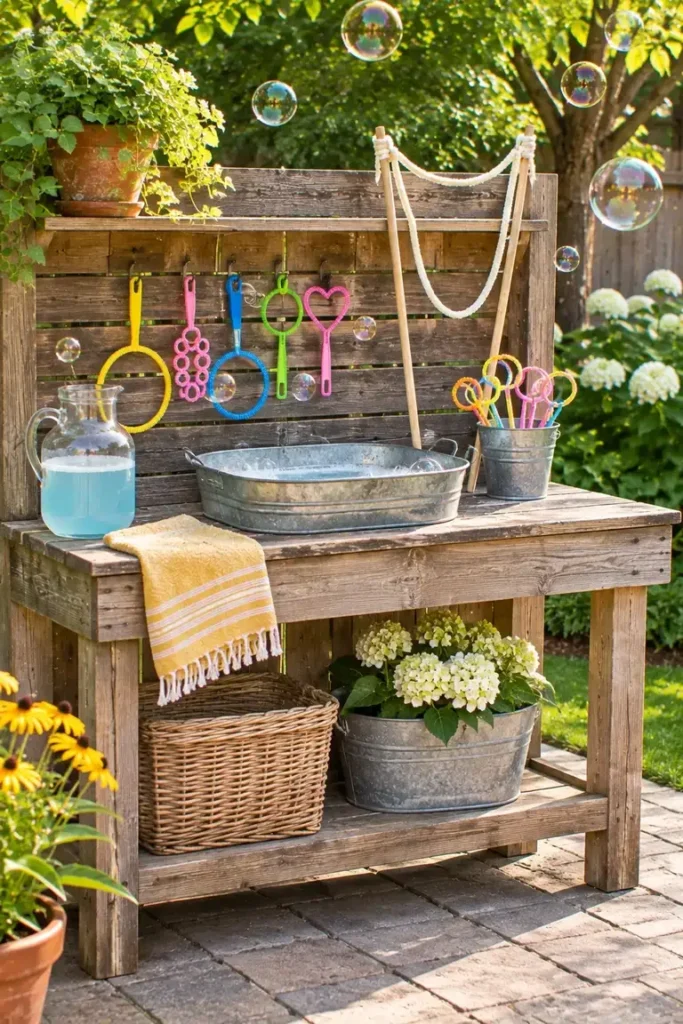
Bubbles are the cheapest magic in the backyard. Turn an old potting bench into a bubble station with a shallow tray of bubble solution, a row of wands in different sizes and a few giant wands made from sticks and string. Set it on the patio, where drips don’t matter and slick spots dry quickly. Little kids can stay busy there for an hour.
Get the look: a weathered potting bench, a shallow metal tray, bubble wands, stick-and-string giant wands, a jug of bubble solution.
21. A Platform Fort Built Around a Sturdy Tree
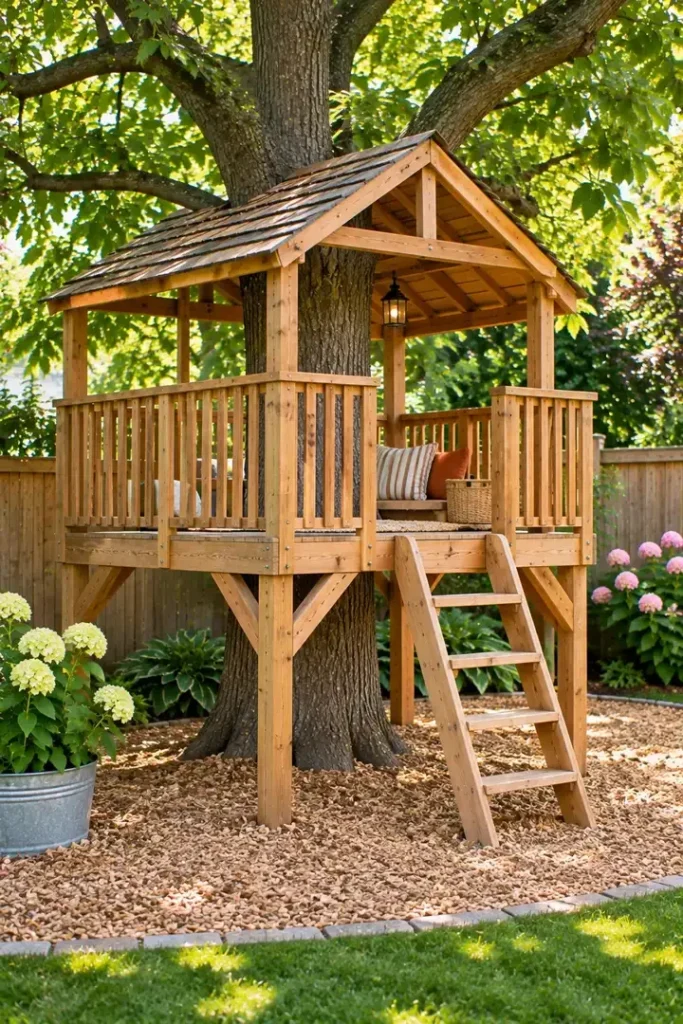
A real treehouse is the dream, but a low platform fort gets most of the magic with much less height to worry about. Build a deck a short climb off the ground around a healthy, mature tree, with railings on every side, a ladder and a small roof. If you don’t have a suitable tree, a freestanding fort on posts works just as well. Spread wood chips underneath and around the ladder.
Build note: Have a pro and an arborist check the tree and the structure, and never nail straight into a young tree. Check local rules before you build.
22. A Hammock Corner and Movie Night Screen for Teens

Teens don’t want a playhouse. They want a place to hang out where adults aren’t hovering. Two hammocks strung between sturdy posts, a few floor cushions and a portable outdoor movie screen on the lawn turn a back corner into the spot they actually invite friends to. String lights between the posts make it feel like a destination at night. Use an outdoor-rated extension cord for the projector, and run it along the fence instead of across a walkway. When movie night turns into a sleepover, these backyard party ideas help.
23. A Backyard Campout Clearing Under the Stars
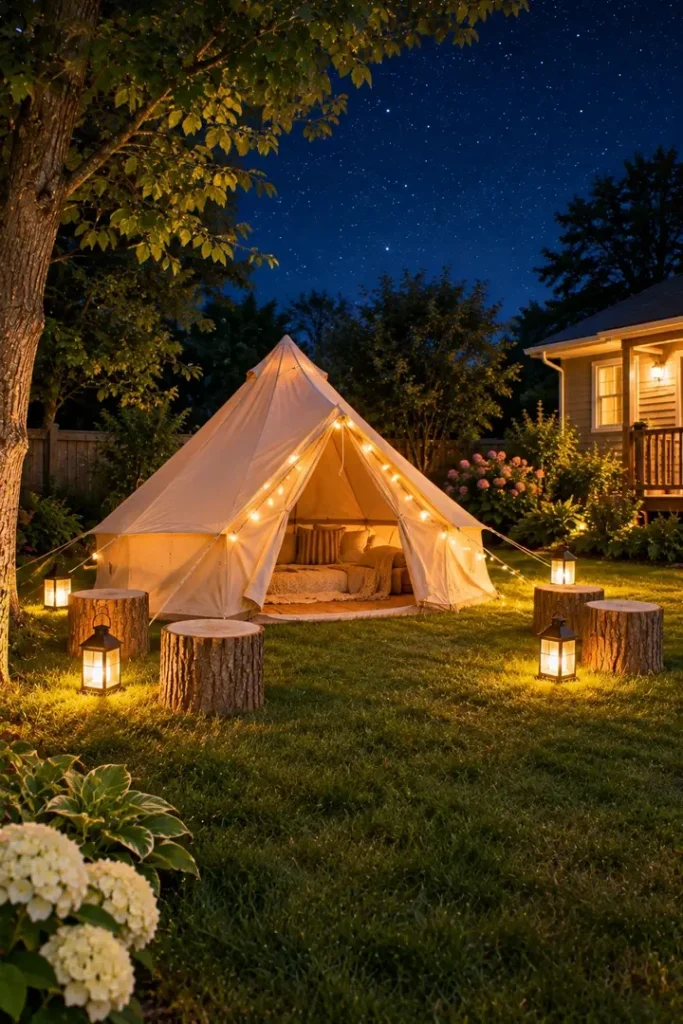
A real campsite takes hours of driving. A backyard campsite takes a tent and a flat spot. Keep a level patch of lawn clear for a canvas bell tent. Ring it with a few log stumps for seating and solar lanterns for light. Sleep out on a mild summer night, tell stories, and head inside if it rains, which is the best part. Leave the porch light on for the midnight bathroom run.
How to Lay Out a Kid Friendly Backyard by Zones
Most of the yards above share one layout. Put the parents’ seating where it sees everything. Keep active play, like swings, climbing and ball games, on soft ground in the open. Tuck messy play, like sand, mud and water, near the hose, in the shade, on gravel or pavers. Give quiet play, like hideouts, art and gardening, the calmer edges of the yard. Connect it all with a path that wheels can roll on. Then choose pieces that can change jobs as the kids grow, so the yard keeps working long after the sandbox years.
A five-minute play yard walk, once a season
Kid Friendly Backyard Questions, Answered
What do kids need in a backyard to have fun?
A place to move, a place to make a mess and a place to hide. A swing set or open lawn covers moving, a sandbox, mud kitchen or water wall covers mess, and a playhouse or bean teepee covers hiding. Add shade and a seat for you nearby. See ideas 1, 5 and 4.
What is the safest surface under a swing set?
Grass isn’t a real protective surface, because it wears thin and packs hard. A deep layer of wood chips, playground mulch or sand works much better, spread well beyond the swings in every direction. The CPSC’s home playground handbook lists depths by height. Idea 1 covers the setup.
How can I make a kid friendly backyard on a budget?
Start with the DIY projects. A mud kitchen from a pallet, a water wall from gutter pieces, a bean teepee, a music wall of thrift-store pots and a tire obstacle course all cost very little. These kid friendly backyard ideas often get more play than store-bought sets. See ideas 4, 5, 8 and 14.
How do I make a small backyard fun for kids?
Build up instead of out. Wall-mounted play panels, a fold-down table, a saucer swing and a sandbox that doubles as a bench all fit a tight yard. Idea 16 shows the layout, and ideas 8 and 12 also mount on a fence.
What plants are good for a kids’ backyard?
Choose soft, sturdy plants that bounce back, like lamb’s ear and ornamental grasses, and keep thorny or spiky plants away from play areas. Kids put things in their mouths, so check plants with your local extension office or Poison Control before planting. Idea 19 has more.
Conclusion
A backyard kids love doesn’t need to look like a playground catalog. Give them somewhere to swing, somewhere to dig, somewhere to splash and somewhere to hide, and set it all where you can watch from a comfortable chair. Start with one or two kid friendly backyard ideas that match what your kids already love, and add more as they grow. The sandbox becomes a garden bed, the playhouse becomes a shed, and the open lawn stays a field. Save this for the next rainy weekend you spend planning summer.