
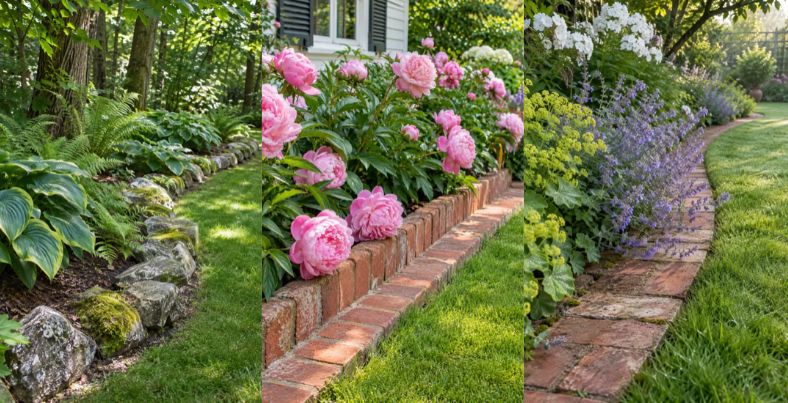
A garden can have good plants and a healthy lawn and still look a little unfinished. Most of the time, the edge is the problem. These garden edging ideas fix it with three materials that last: brick, stone and metal.
You know the signs. Grass creeps into the border, mulch washes onto the path, and the line between bed and lawn has gone soft and wobbly by July. Each material handles that in its own way. Brick feels warm and traditional, and a flat brick mowing strip lets you run the mower right along the bed. Natural fieldstone and flagstone look as if they have always been there. Steel edging, including rust-toned Corten steel, draws a crisp, nearly invisible line that suits modern yards and gravel paths.
Below are 20 edges, each set in a real garden scene. There are sunny cottage borders, shady woodland beds, front walks, driveway strips, vegetable gardens, a gentle slope and a small rock garden. Every idea names the plants that go with it and the one move that makes the edge work. You can copy any of them with materials from a landscape supply yard or a pile of salvaged brick.
Before You Edge: What Sits on Each Side
Pick your edging by what it has to separate. A lawn needs an edge set level with the grass so you can mow right over it. A gravel path needs a slim edge that sits just above the stones so they cannot roll out. A mulched bed needs something solid enough to hold soil in after heavy rain. Then think about shape. Steel, aluminum and loose stone handle curves well, and brick looks best on straight runs and gentle bends. Finally, match the material to your garden’s style.
1. Reclaimed Brick Mowing Strip Along a Cottage Border
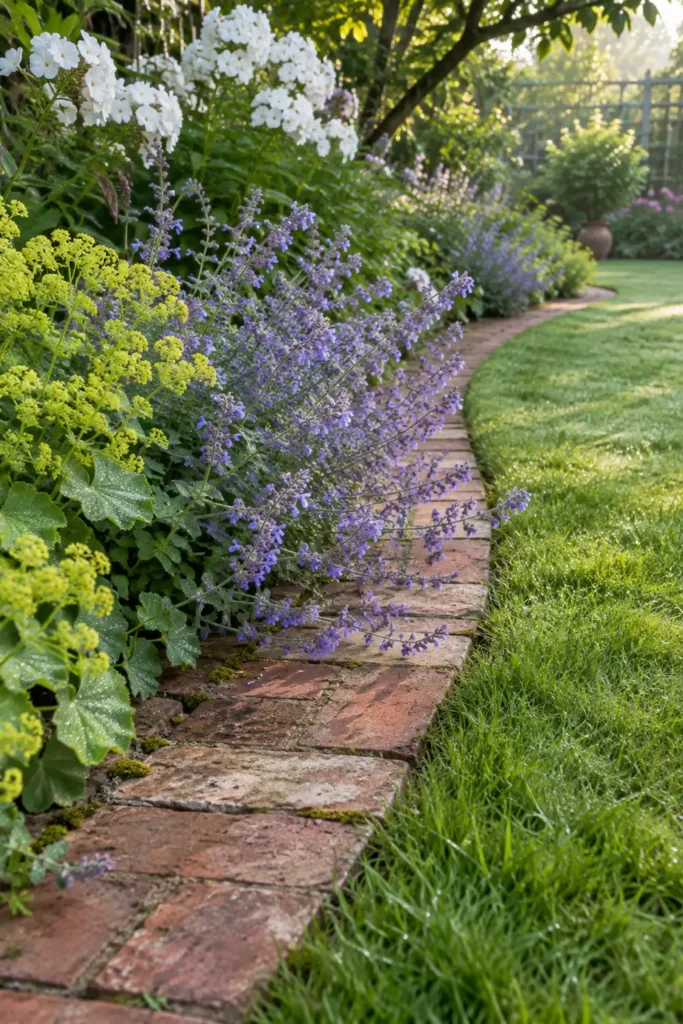
Catmint and lady’s mantle are supposed to flop. That soft, spilling habit is the whole charm of a cottage border. It is also why the lawn edge beside it fills up with flattened stems and scalped grass.
Of all the lawn edging ideas out there, a mowing strip is the quiet hero. Lay a single row of reclaimed red brick flat and level with the turf. Yes, you can mow over brick edging when it sits this low, because the mower wheel rides along the top. The plants tumble over the brick without getting chopped. The faded, uneven color of salvaged brick also keeps a loose planting from looking stiff. That is why it sits so well behind classic perennial border combinations.
Plant the look: catmint, lady’s mantle, white garden phlox at the back, a reclaimed brick strip set level with the lawn.
2. Black Steel Edging That Holds a Pea Gravel Path
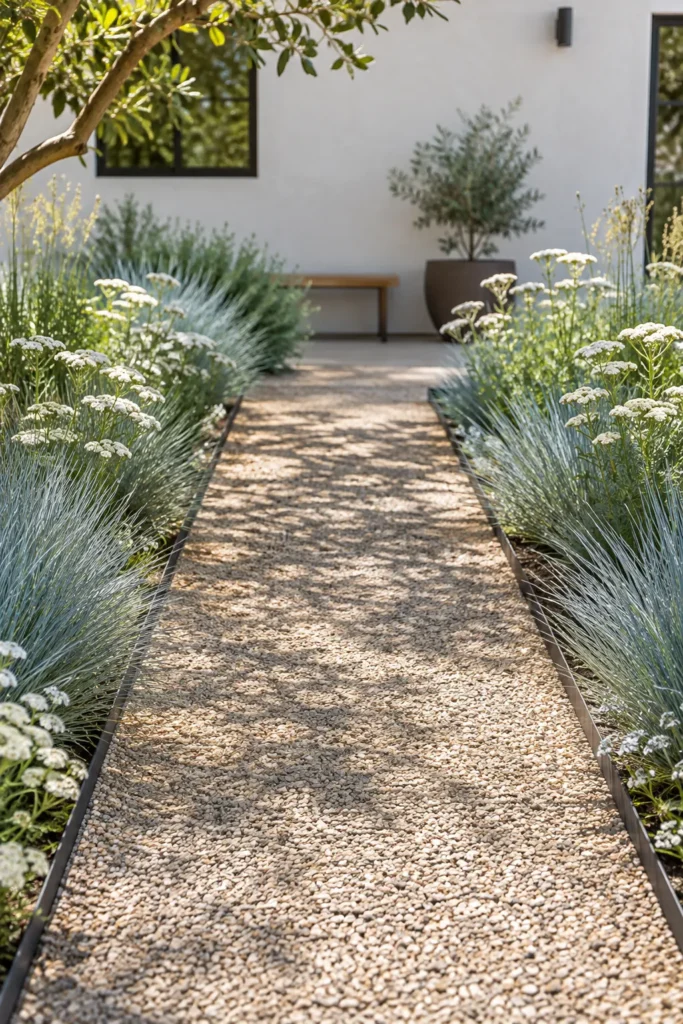
Pea gravel has one bad habit. It wanders. Kick it once and it turns up in the lawn, in the mulch, and somehow on the doormat.
A slim strip of black steel is the cure in this modern front yard. It is the kind of metal landscape edging that holds stones in a clean line while nearly disappearing. Here it runs along both sides of a buff pea gravel path. Blue oat grass and white yarrow grow right up against the steel. Their soft, airy shapes make the hard edge look even sharper.
Garden note: Steel edging handles straight runs and gentle curves well. It bends side to side, though, not up and down, so level the ground along the line first. Set the top of the strip a little above the gravel so stones cannot roll over it.
3. Mossy Fieldstone Edge for a Shady Woodland Bed
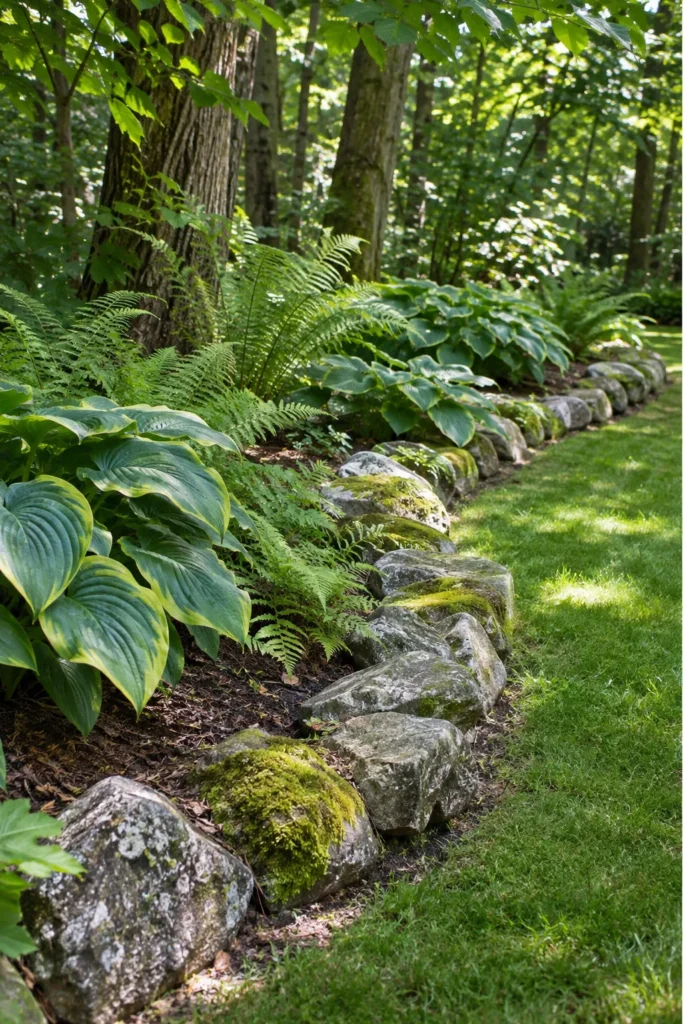
Moss on the stones is what sells it. Gray fieldstones laid in a loose line along a shady woodland bed often pick up a green coat in a damp spot. After that, the bed looks like it grew there.
Natural fieldstone is the most forgiving stone garden edging for shade, because it never asks for a perfect line. Bigger stones anchor the curves and smaller ones fill the straight stretches. Hostas and ferns lean over the top, so the stone peeks out here and there instead of marching along like a wall. The edge also stops leaf mulch from washing onto the lawn every time it rains.
Bury each stone partway into the soil. A common rule of thumb is about a third of its height. Stones that just sit on top get nudged by the mower and roll away.
4. Sawtooth Brick Edging Beside the Front Walk
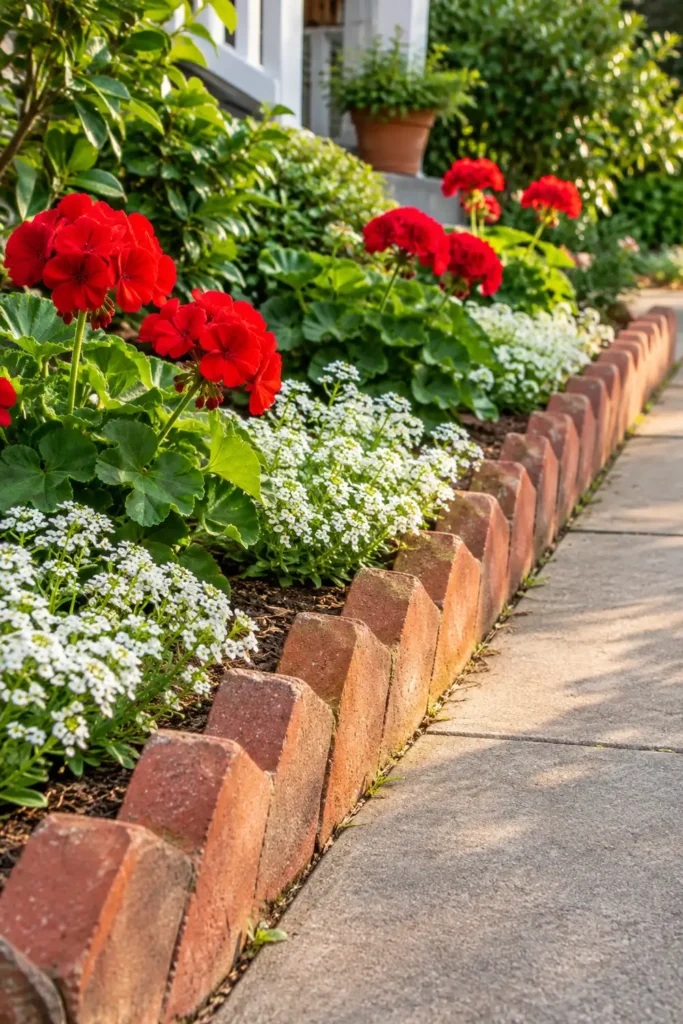
Red geraniums and white sweet alyssum want a frame with a little pattern. Sawtooth brick edging gives them exactly that. Each brick is set on end at an angle, so the tops form a row of small points along the front walk, the way you see in old Victorian gardens.
The zigzag catches late afternoon light and casts tiny shadows, which gives a narrow bed real presence from the street. Warm red brick also picks up the red of the geraniums, so the bed and its edge read as one design. Repeat the same brick in the walk, or in one of these front yard pathway ideas, and the whole entry hangs together.
Set the bricks in a sand-lined trench, all angled the same way, and check the line with a taut string as you go. A wobbly sawtooth just looks like a mistake.
5. Corten Steel Curves Through a Prairie Style Lawn
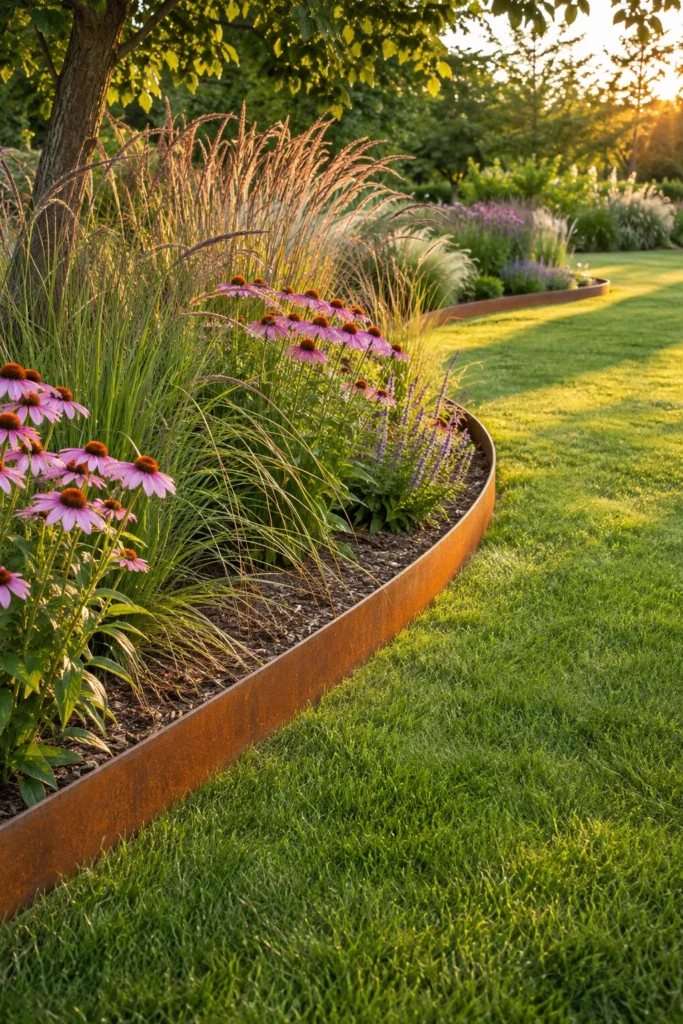
Plain steel draws a line. Corten steel draws a line and then weathers to a warm rust orange that glows beside coneflowers and little bluestem in late summer.
Here, a wide, sweeping bed cuts through a backyard lawn, and the weathered steel follows every curve. Corten bends into smooth arcs more willingly than many rigid edgings, which is why it suits loose, prairie-style planting. Leave a band of it showing above the soil. That rusty stripe is the point, and it echoes the copper tones little bluestem takes on in fall.
One honest warning: fresh Corten can stain pale stone or concrete while its rust layer forms. Keep it away from light patios.
Corten Steel vs Black Powder Coated Steel Edging
Looks like: a warm rust orange that deepens with time.
Best for: prairie, naturalistic and rustic modern gardens.
Keep in mind: it can stain pale paving while the rust layer forms.
Looks like: a thin dark line that nearly disappears.
Best for: modern front yards, gravel paths and formal lawns.
Keep in mind: scrapes from spades or mowers can expose bare metal over time.
6. Granite Cobblestone Edge for a Driveway Planting Strip
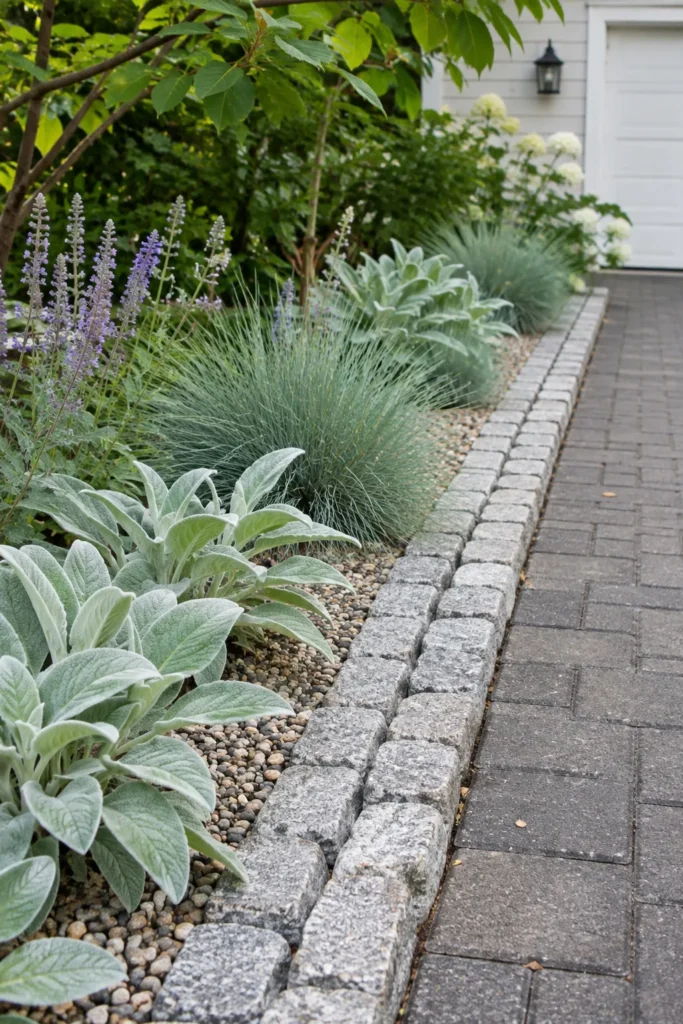
Driveway planting strips have a hard life. They bake in reflected heat, get clipped by tires and catch every bit of grit the car drags in.
A double row of gray granite cobblestones, often sold as setts, can take that beating. The heavy stones keep wheels out of the bed and gravel on the driveway side. Silver lamb’s ear and blue fescue are tough enough for the heat, and their cool foliage sits well against gray stone. The narrow strip ends up looking planned instead of leftover.
Plant the look: granite setts in a double row, lamb’s ear, blue fescue, a gravel mulch between the plants.
7. Double Row Brick Border for a Peony Bed
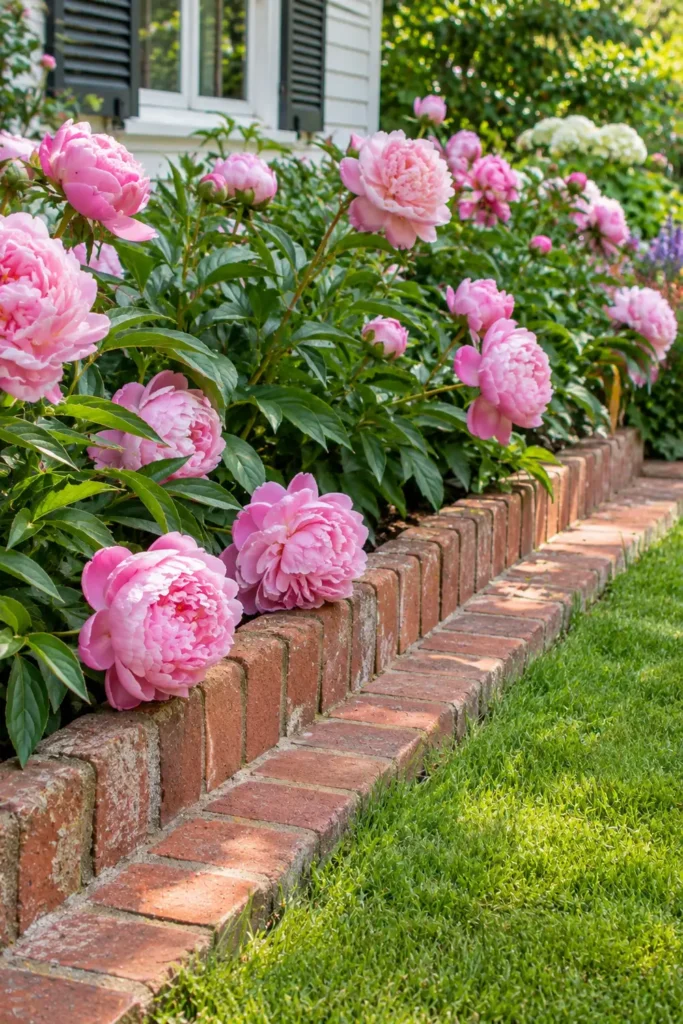
Peonies are heavy and prone to flopping onto whatever sits next to them. A double row of brick gives them somewhere to land.
The front row lies flat and level with the lawn as a mowing strip. Behind it, a second row stands upright on end, a pattern bricklayers call a soldier course. That step up forms a low curb that holds soil and mulch in place, while the flat row keeps the mower clear of the stems. Pink peonies against warm red brick in late spring is about as classic as a front border gets.
Note: Set a simple grow-through support over each peony early in spring. When the flowers open, you want them resting on the brick, not lying in the grass.
8. Galvanized Steel Edging in a Vegetable Garden
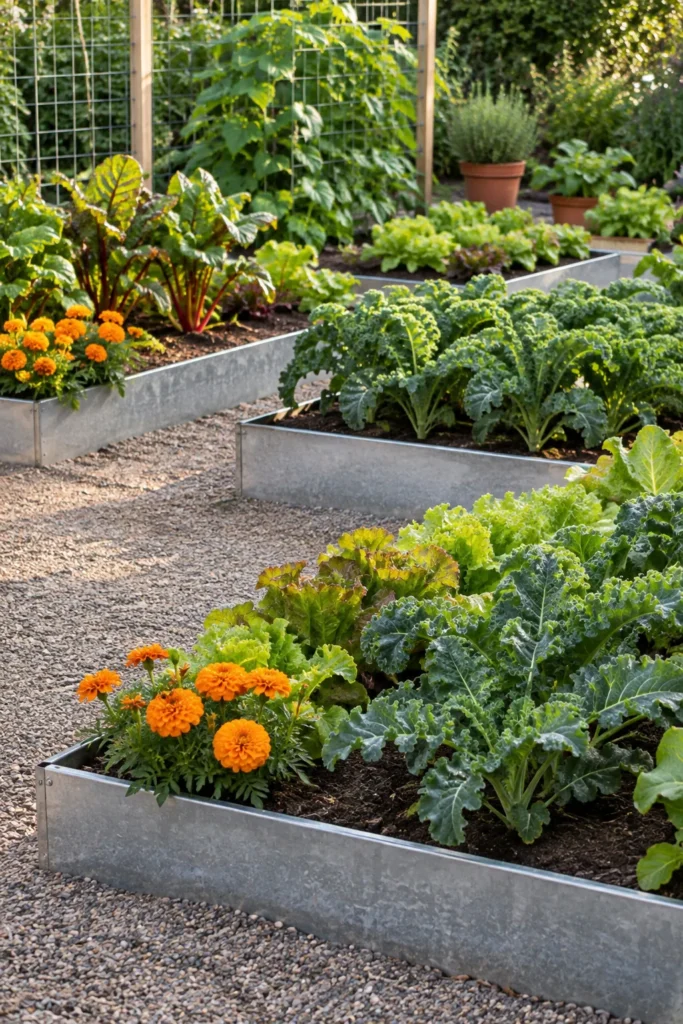
Vegetable beds do not have to be raised to look neat. Here, in-ground beds of kale, lettuce and marigolds sit inside low strips of galvanized steel, with gravel paths running between them.
The silver steel gives each bed a sharp rectangle, which makes rows and crop rotation easier to plan. It also keeps gravel out of the soil and soil out of the paths, a split you will appreciate while kneeling to harvest. The same gravel trick turns up in plenty of raised bed pathway ideas, and it works just as well between beds at ground level.
Tuck marigolds into the corners. They are cheerful in early morning light, and they mark where each bed begins so nobody steps on the young lettuce.
9. Flagstone Ledge Between a Patio and Its Planting Bed
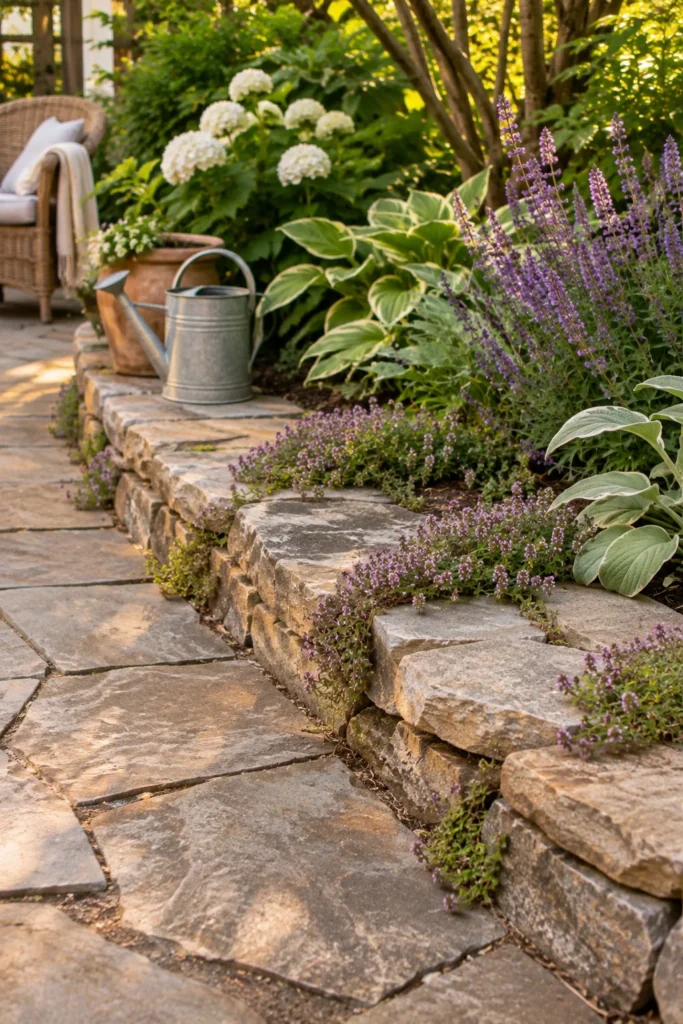
Creeping thyme in the gaps is the detail people notice first. It softens the joints between irregular flagstones laid flat along the edge of a stone patio, and it gives off a faint scent when you brush past.
Step back and the flagstone is doing a bigger job. The stones run a little past the patio paving to form a low ledge that holds the bed’s soil back and gives a watering can somewhere to sit. Because the flagstone repeats the patio’s earthy colors, the planting bed reads as part of the seating area instead of a separate zone. In warm evening light, the uneven stone glows.
Lay the flagstones on the same compacted gravel and sand base as the patio so they never rock underfoot.
10. Brick Tree Ring Around a Shade Tree
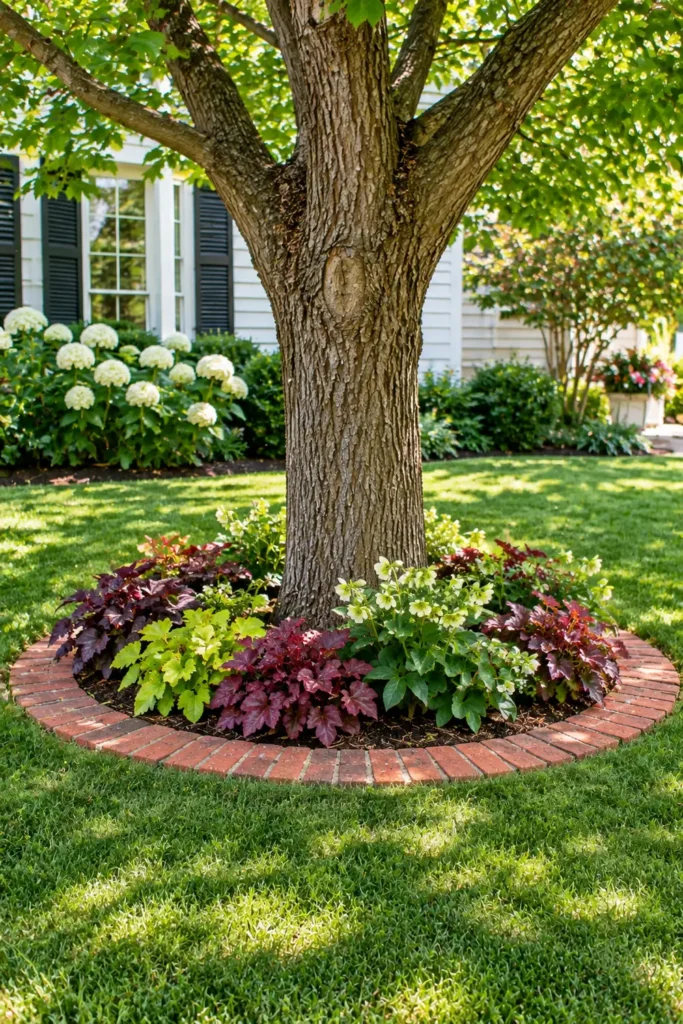
Grass struggles under a big shade tree, and mowing tight around the trunk often ends with a nicked trunk. A ring of reclaimed brick turns that bare patch into a planted circle.
Lay the brick flat in a wide circle on the front lawn. Fill it with coral bells and hellebores, both happy in the dappled light under a canopy. The round shape echoes the tree’s spread. Coral bells with plum or lime leaves keep the circle bright even after the hellebores finish flowering.
🌳 Tree Care Tip
Keep the soil inside the ring at its original level. Piling new soil or deep mulch against the trunk to make a raised bed can harm the tree, and digging deep inside the ring can cut its roots. Set the bricks shallow and plant small.
11. Flexible Aluminum Edging Around a Curved Island Bed
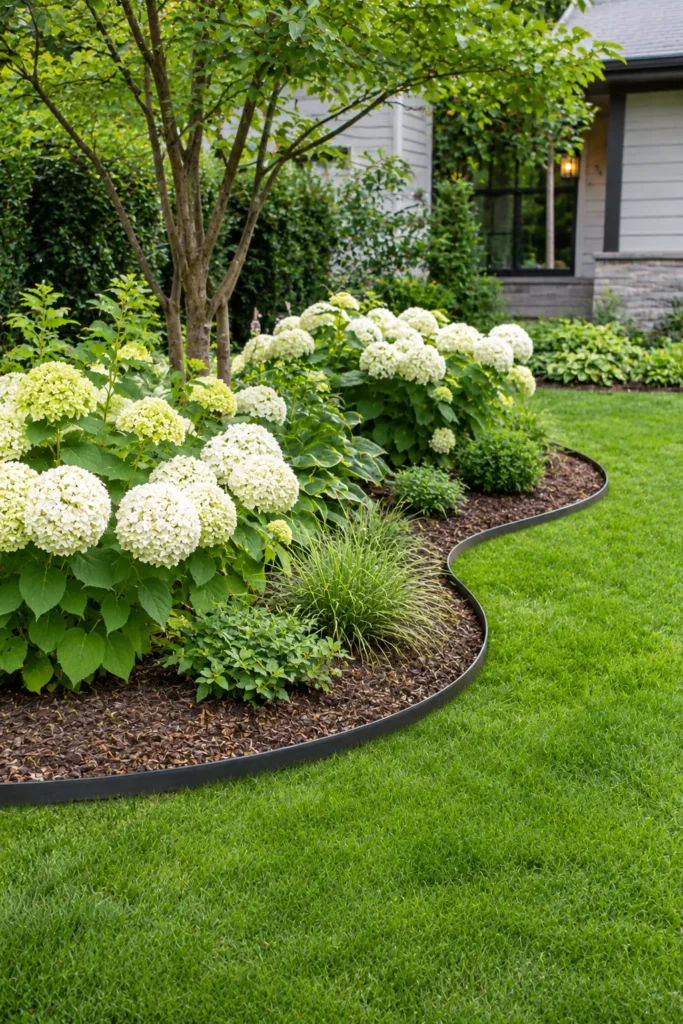
If you leave an island bed in the middle of a lawn without an edge, the grass slowly eats into its outline. In a few seasons the kidney shape turns into a blob. Put a low strip of dark aluminum around it and the curve stays exactly where you drew it.
Aluminum is light and does not rust. Flexible rolls also bend into smooth curves without kinking, which makes them a natural fit for a curved island bed of white hydrangeas. The dark finish fades into the shadow under the shrubs. On a soft, cloudy day, all you see is a clean line between green lawn and white flowers.
Lay out the curve with a garden hose and leave it there for a day. Then cut the trench.
12. River Rock Band in a Low Water Desert Yard
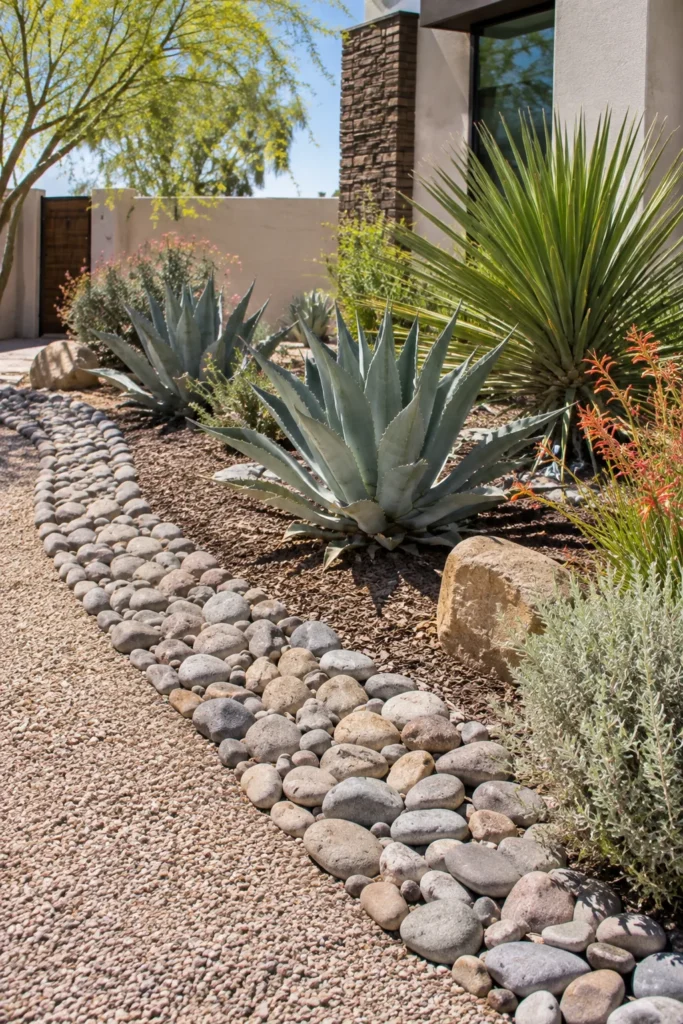
Desert front yards often use two loose materials, like crushed gravel and bark mulch. Without a divider between them, they blur into one dusty mess. A band of smooth river rock fixes the seam.
Set the rounded stones in a wide strip where the gravel meets the mulched planting bed. Their gray and tan tones link the two surfaces, and the rounded shapes play against the spiky leaves of agave and yucca. The look fits right in with other desert landscape front yard ideas that rely on stone instead of lawn. Under hard full sun, a little shine on the river rock keeps the yard from looking flat.
Plant the look: agave, yucca, a wide river rock band, crushed gravel, a mulched bed. Keep the agave well back from wherever people walk, because its leaf tips are sharp.
13. Herringbone Brick Paths Framing a Boxwood Parterre
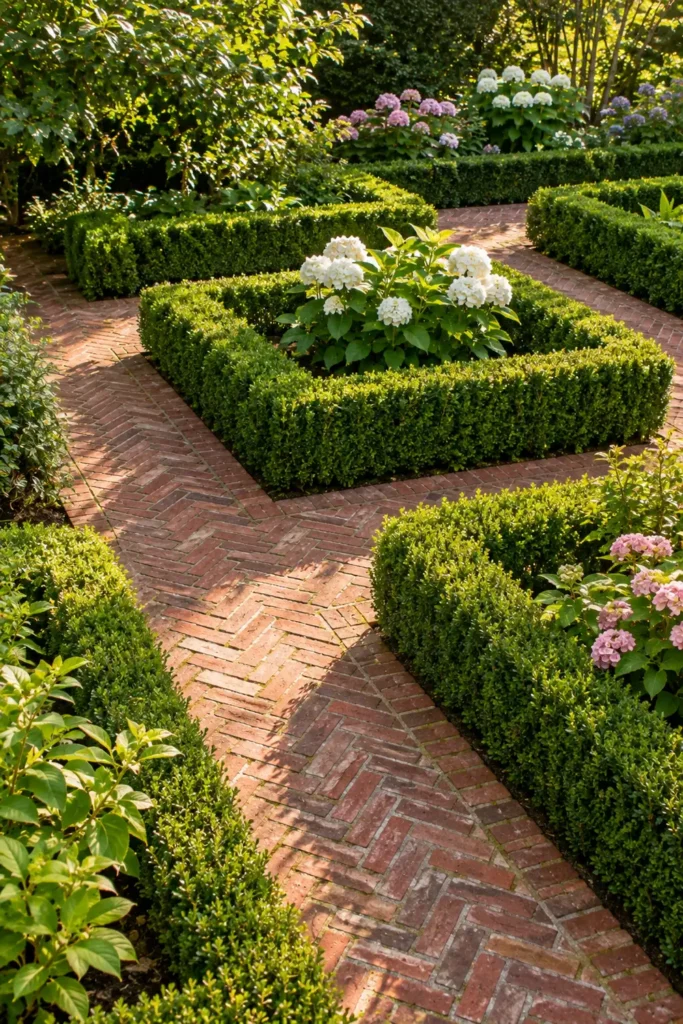
Look closely at the brick and you can see the zigzag. In this formal garden, bricks laid in a herringbone pattern form narrow paths. Those paths also edge a boxwood parterre, the clipped, geometric bed style of old European gardens.
Step back and the pattern earns its keep. The diagonal lines of herringbone bring movement to a layout that is otherwise all straight lines and right angles. The garden looks orderly without looking stiff. Early sun throws the shadows of the clipped boxwood across the brick, which doubles the geometry.
Clip the boxwood regularly through the growing season. A shaggy parterre loses its point fast.
14. Wrought Iron Hoop Edging Along a Cottage Path
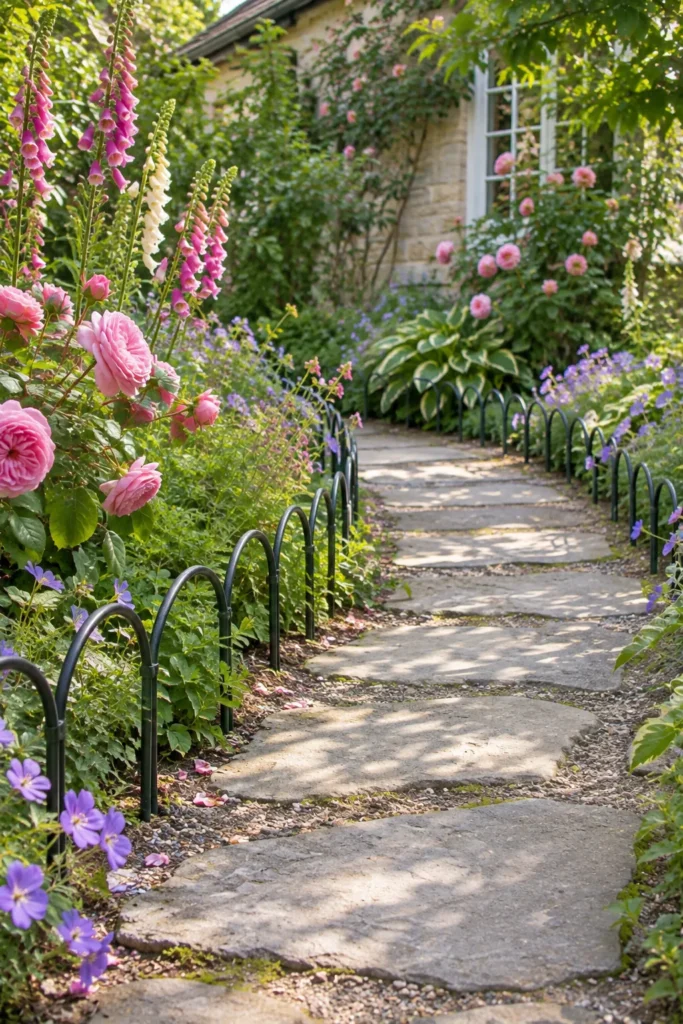
Black wrought iron hoop edging is the most old-fashioned edge on this list, and that is exactly why it suits a cottage garden. Its low loops run along a flagstone stepping stone path. They hold back roses, foxgloves and cranesbill just enough that the plants lean toward the path instead of falling onto it. In early summer, the thin black metal disappears among the stems.
Hoop edging is more decorative than practical. It will not stop creeping grass, so pair it with a cut soil edge or a buried strip of steel. Most hoop edging simply pushes into the soil, which makes it the easiest edge here to install or move. Foxgloves are toxic if eaten, so skip them where small children or pets play.
15. Knee High Dry Stacked Stone Edge for a Sunny Border
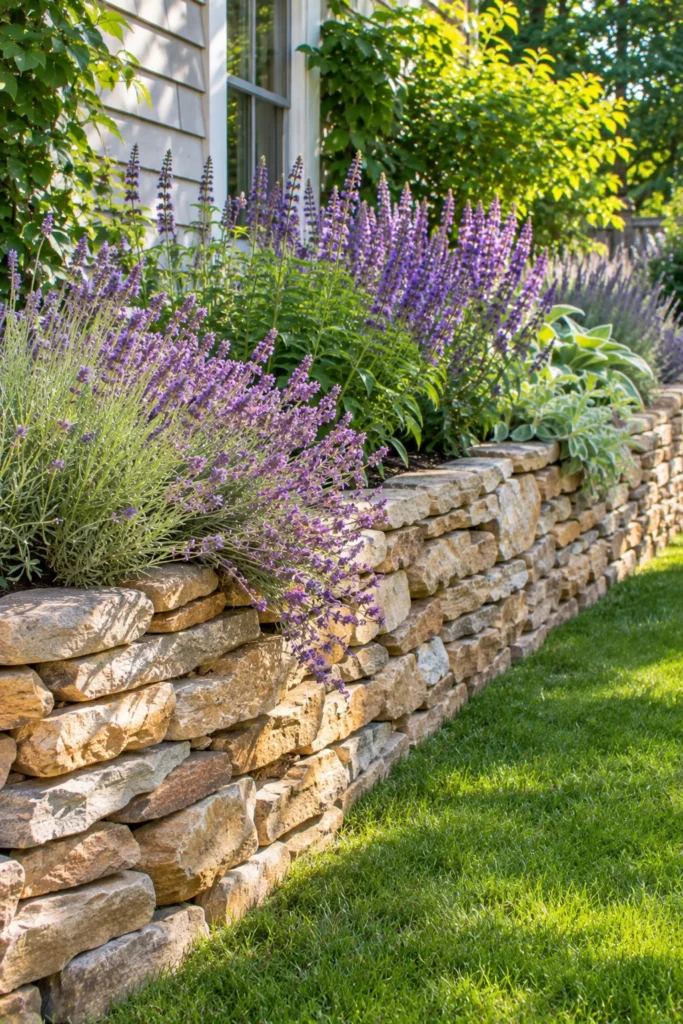
Dry stacked stone is edging with a bit of height. Here, tan stones are stacked without mortar along a sunny side yard border, with lavender and purple salvia spilling over the top in full afternoon sun.
Because there is no mortar, water drains freely through the gaps. That suits lavender, which usually wants full sun and sharp drainage. The warm stone also soaks up heat and echoes the gray-green of the lavender leaves, so the edge and the planting look like they belong together.
Garden note: Keep it low and decorative. Anything taller, or anything that holds back a real slope, is a retaining wall and needs a professional. These front yard retaining wall ideas are a better place to start for that kind of job.
16. Gabion Basket Edge Beside a Modern Patio
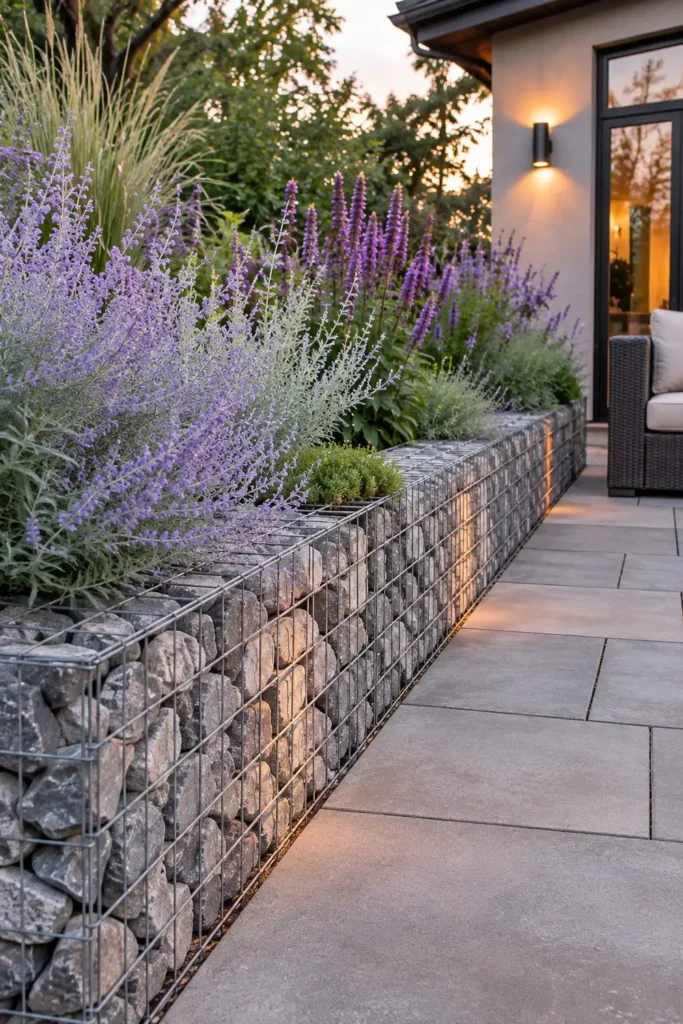
Gabions are wire mesh baskets filled with stone, so you get metal and stone in a single edge. Low, rectangular gabions along the side of a modern patio make a strong, square border. They are sturdy enough to sit on.
The grid of the steel mesh against the loose spikes of Russian sage and agastache is what makes this work. One is rigid and the other is airy, and each makes the other look better. Fill the baskets with local stone so the edge matches the rest of the yard. At dusk, the stone faces catch the last light while the purple flowers go soft and hazy.
Get the look: low rectangular gabion baskets, local gray stone fill, Russian sage, agastache, a concrete paver patio.
Filled gabions are very heavy, so set them on firm, level, compacted ground.
17. Boulder Edge in a Japanese Style Front Yard
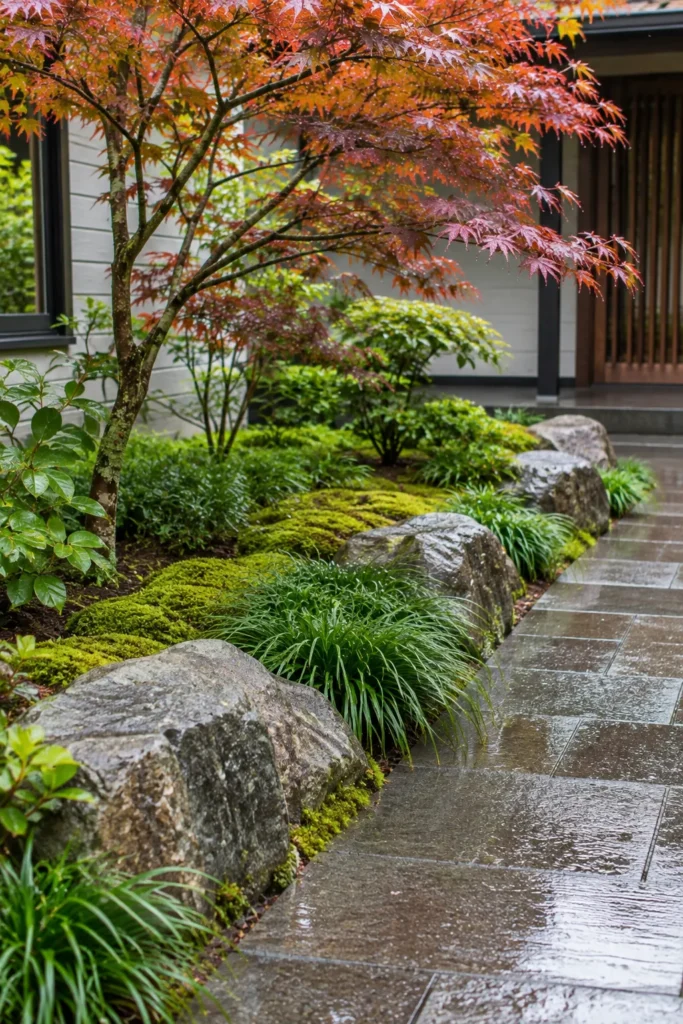
Small front yards crowded with edging, ornaments and too many plants feel busy fast. A Japanese style front yard goes the other way. Instead of a continuous edge, a few rough gray boulders sit at intervals along the bed line, with moss, mondo grass and a single Japanese maple around them.
The heavy, craggy stone makes the fine maple leaves look even more delicate. The gaps between boulders let the moss and mondo grass flow out toward the lawn, so the edge feels found rather than built. On a rainy morning, the wet stone darkens and every green around it deepens. The same restraint runs through most good Japanese front yard ideas.
Bury each boulder partway so it looks like it is rising out of the ground, not sitting on it. For big stones, have the supplier place them with a machine.
18. Salvaged Brick Dry Laid Around a Kitchen Herb Bed
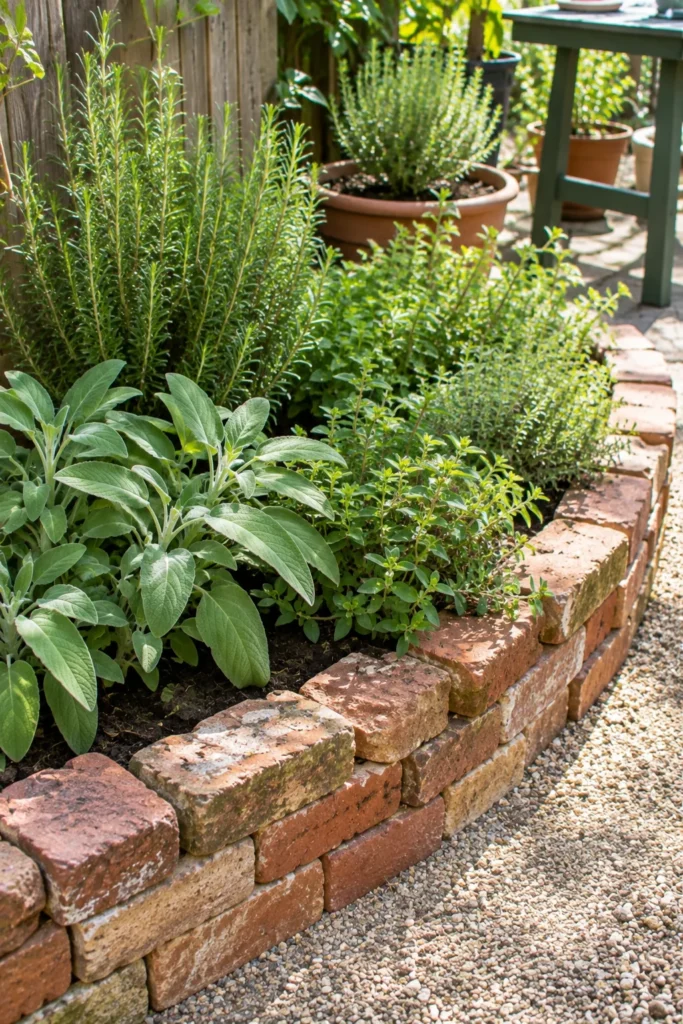
Mismatched bricks are often free for the asking after a renovation, and they make a lovely edge for a small herb bed on a budget. Here, salvaged bricks of slightly different reds and browns frame rosemary, sage and oregano in a sunny corner of a small backyard. The odd colors make the bed look older than it is.
Do you need mortar for brick edging? Not for a low edge like this. Set the bricks snugly in sand and they hold their line, and you can reset a single brick in minutes.
🌿 Garden Tip
In cold winters, freezing soil can push loose bricks upward, which gardeners call frost heave. A base of compacted gravel under the sand helps water drain away, so fewer bricks lift. Any that do can be tapped back down with a rubber mallet in spring.
19. Low Steel Edges That Terrace a Gentle Slope
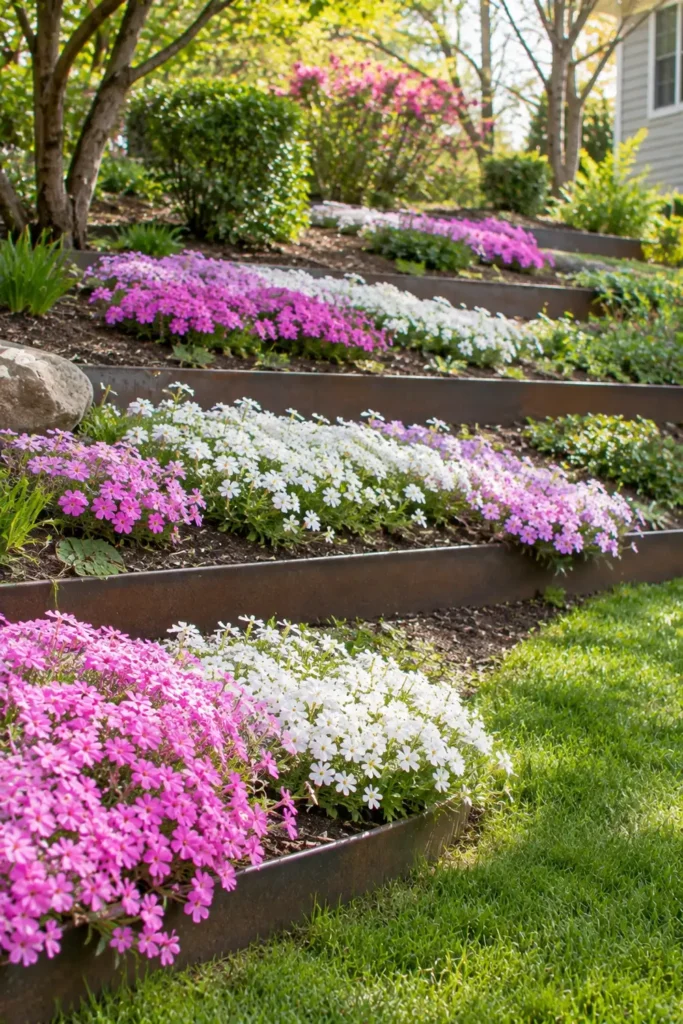
A gentle slope in a backyard can be hard to plant. Rain carries soil and mulch downhill, and plants at the top dry out first. Shallow steel edges set across the slope fix that by turning it into a series of low soil steps.
Steel works well here because it is so thin. Each terrace keeps nearly all of its planting space, and the edges read as fine dark lines instead of chunky walls. Creeping phlox spilling over each steel lip in spring softens those lines and helps hold the soil. On anything steeper than a gentle grade, ask a landscaper before you dig.
Plant the phlox close to the front of each step so it drapes over the edge. Within a season or two, the steel shows only as a shadow under the flowers.
20. Slate Set on Edge Around a Small Rock Garden
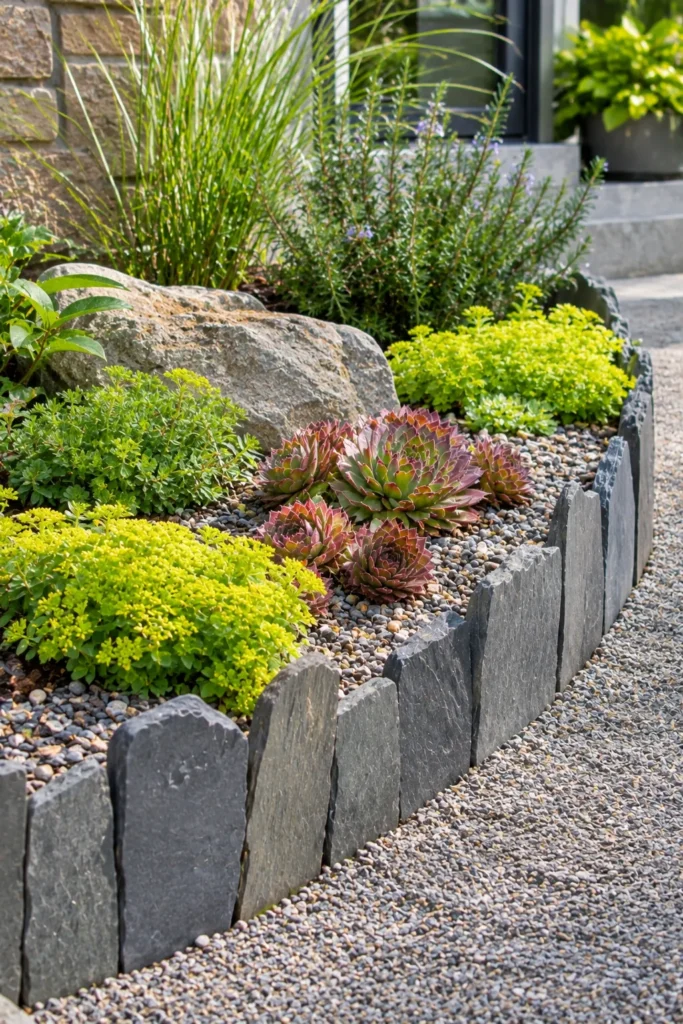
Thin gray slate pieces stand upright around this small front yard rock garden like a row of short pickets. Slate splits naturally into flat pieces, and leftover offcuts are often cheap.
The dark gray stone is the perfect foil for sedum and hens and chicks, whose green and rosy rosettes stand out against it. Stand the slate in a narrow trench and let the heights vary slightly. A perfectly even row looks manufactured, while a slightly uneven one looks handmade. On a clear, bright day, the upright pieces cast thin shadows across the gravel.
Plant the look: upright slate pieces, sedum, hens and chicks, a gravel mulch. Both plants need sharp drainage, so mix grit into the soil before planting.
How to Choose Brick, Stone or Metal Landscape Edging
Across these 20 ideas, three patterns keep coming back. Match the edge to your garden’s style first:
- Brick suits cottage and traditional gardens.
- Natural stone suits woodland, desert and Japanese styles.
- Steel and aluminum suit modern yards, gravel and curves.
Then match it to what sits on either side. Lawns want something flush that you can mow over. Gravel wants a slim edge that sits just above the stones. Mulched beds want something solid enough to hold the soil in.
Finally, set every edge partly into the ground, never just on top. That one habit decides whether an edge still looks good after a few winters.
| Edging | Looks best in | Curves | Keep in mind |
|---|---|---|---|
| Brick | Cottage, formal and traditional gardens | Good with small bricks and gentle bends | Lay it level with the lawn to mow over it |
| Natural stone | Woodland, desert, rock and Japanese gardens | Easy, since the line can stay loose | Heavy to move, and grass can creep through gaps |
| Steel and aluminum | Modern yards, gravel paths and vegetable beds | Smooth side to side, not up and down | Best at blocking grass, and Corten can stain pale paving |
Garden Edging FAQ
What edging keeps grass out of flower beds?
Steel or aluminum edging works best, because it forms one continuous barrier that creeping grass roots cannot slip through. Brick and stone look great but leave small gaps. Pair them with a sharp cut edge, or tuck a strip of metal behind them. Ideas 2, 5 and 11 all use metal this way.
Is metal edging better than brick?
Neither one wins every time. Metal draws a thin, continuous line that suits modern yards and curves, and it blocks grass well. Brick takes more effort to lay but brings warmth, pattern and an easy mowing strip. Compare ideas 1 and 2 to see which look fits your yard.
How deep should garden edging go?
It should go deep enough that grass cannot creep under it and the mower cannot knock it loose. For metal strips, follow the maker’s instructions. For brick and stone, a good rule of thumb is to bury a solid part of each piece instead of resting it on the surface, as idea 3 shows.
Does steel edging rust?
Plain steel rusts unless it is coated or galvanized. Powder coated and galvanized steel hold up well for years, and aluminum does not rust at all. Corten steel rusts on purpose, forming a stable orange surface, but it can stain pale stone while that layer forms. See ideas 5 and 8.
What edging works best for curved beds?
Flexible aluminum, Corten steel and loose natural stone handle curves most easily. Brick can curve too, but small bricks and gentle bends work far better than tight turns. Lay out the shape with a garden hose before you dig, as in idea 11.
Conclusion
A good edge rarely gets noticed, and that is the point. It holds the gravel where it belongs, keeps the lawn out of the border and gives every plant a clean line to lean against. The best garden edging ideas start with what you have. Use salvaged brick for a cottage bed, local stone for a shady corner and a slim strip of steel where the yard wants something modern. Pick one bed, edge it properly and see how much more finished the whole yard looks. If your paths need the same treatment, these garden path ideas are a natural next step.
Save this for the next time your borders need a clean line.