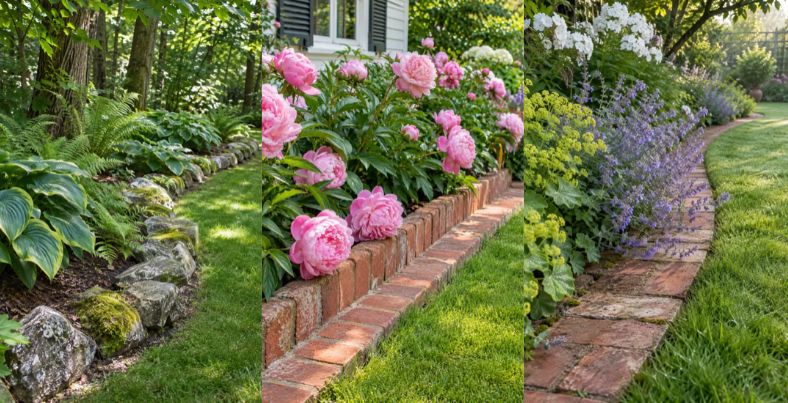
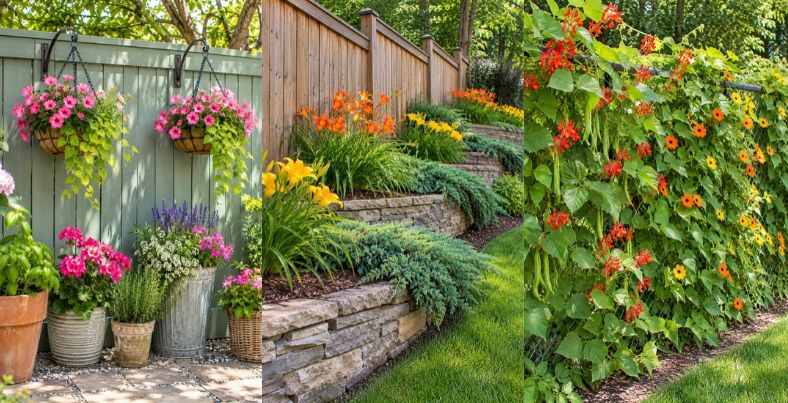
A fence does a great job of marking the edge of a yard. It just doesn’t do much for how the yard looks. These fence line landscaping ideas fix that by turning a long, flat boundary into one of the best-looking parts of the garden.
The right planting can do a lot along a fence. A layered border of shrubs and perennials softens hard boards. Climbing plants on a trellis add height and flowers without taking up ground space. An evergreen screen adds privacy all year, and a shade border full of ferns and hostas brightens a fence that never sees the sun.
Below are 17 ideas for real yards: sunny privacy fences and shady north sides, chain link and white pickets, narrow side strips and sloped lines. Each one names the plants that suit the spot and the one move that makes it work. Along the way, you’ll find how far to plant from the fence, which climbers are safe for wood, and how to stay on good terms with the neighbor on the other side.
How These Fence Line Ideas Work
Every idea here starts with two questions: how much sun does the fence get, and what do you want it to do? Sunny fences can carry layered flower borders, climbing roses, vegetables and espaliered fruit. Shady ones lean on ferns, hostas and hydrangeas. If privacy is the goal, evergreen screens and fast annual climbers come first, while pollinator borders, moon gardens and cottage pickets put color and character in front. Find the fence that looks most like yours and build from there.
1. Layered Border of Viburnum, Coneflowers and Catmint
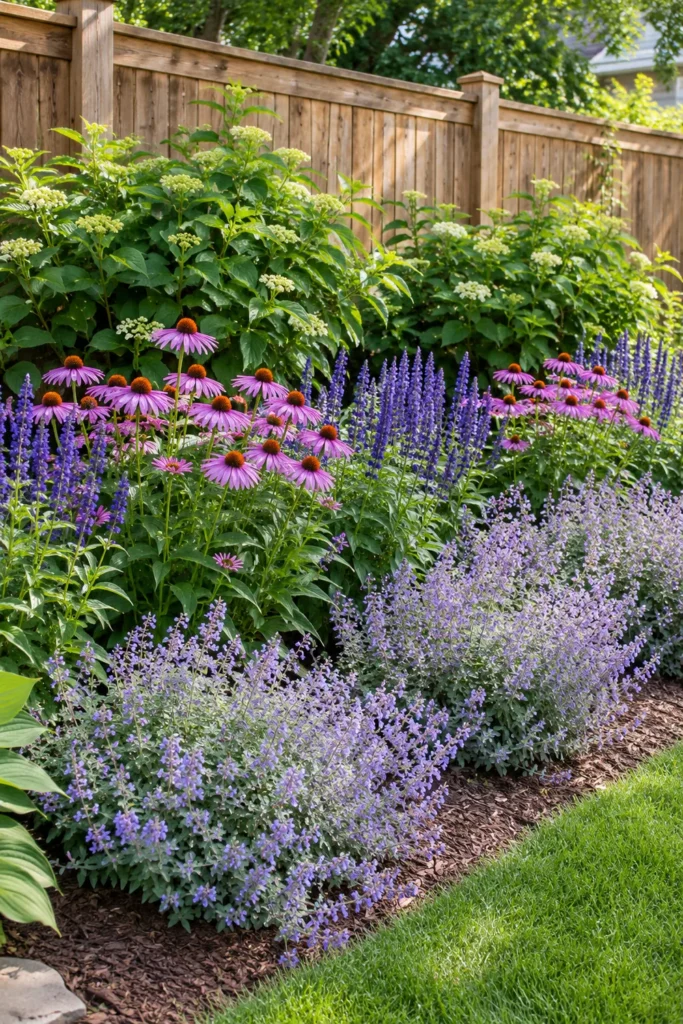
A bare privacy fence looks like a wall of boards. A layered border makes it look like the backdrop it should be. The trick is to plant in three heights, like seats in a theater, so every plant has a view.
At the back, viburnum shrubs give height, white spring flowers and berries that birds love in fall. In the middle, purple coneflowers and salvia bring summer color. At the front, soft mounds of catmint spill onto the lawn edge and hide the bare legs of the plants behind them. Each layer hides the base of the one behind it, so the fence fades into green instead of standing out.
Plant the look: viburnum at the back, coneflower and salvia in the middle, catmint along the front edge, shredded bark mulch between them.
2. Clematis and Climbing Roses on a Wire Trellis
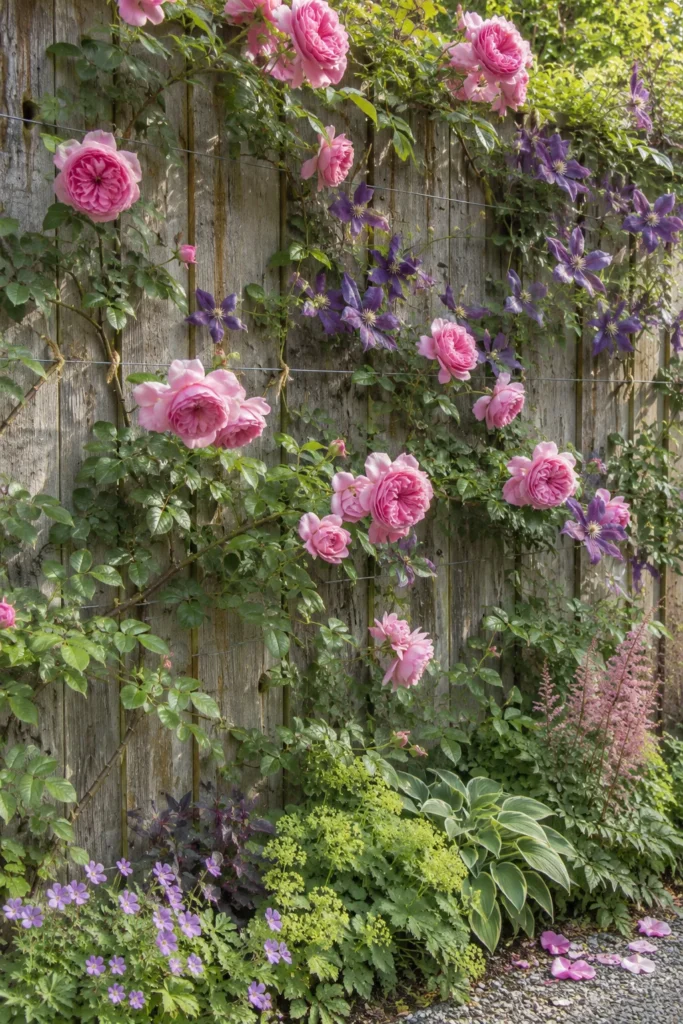
Clematis twines its leaf stalks around anything thin it can reach, which is why a set of tight horizontal wires along a gray wood fence suits it so well. Climbing roses share the same wires, though they need tying in as they grow. On their own, they lean rather than climb.
Step back and the pair work as a team in early summer. The roses give big, full blooms and the clematis threads purple or white flowers between them, so the fence looks covered in flowers without touching the boards. A rule of thumb for clematis is to keep its roots shaded and its top in the sun. A few low plants at its base do the job. For more ways to support climbers, these garden trellis ideas double as privacy screens too.
Twining Climbers vs Clinging Climbers on a Fence
Examples: clematis, climbing roses, runner beans, black-eyed Susan vine.
How they hold on: they wrap around wires or a trellis, or you tie them in.
Keep in mind: safe for wood fences, since they never grip the boards.
Examples: English ivy, climbing hydrangea, Virginia creeper.
How they hold on: they stick to surfaces with tiny roots or sticky pads.
Keep in mind: they can trap moisture and damage wood, and make painting or repairs hard.
3. Shady Fence Line With Hostas, Ferns and Hydrangea
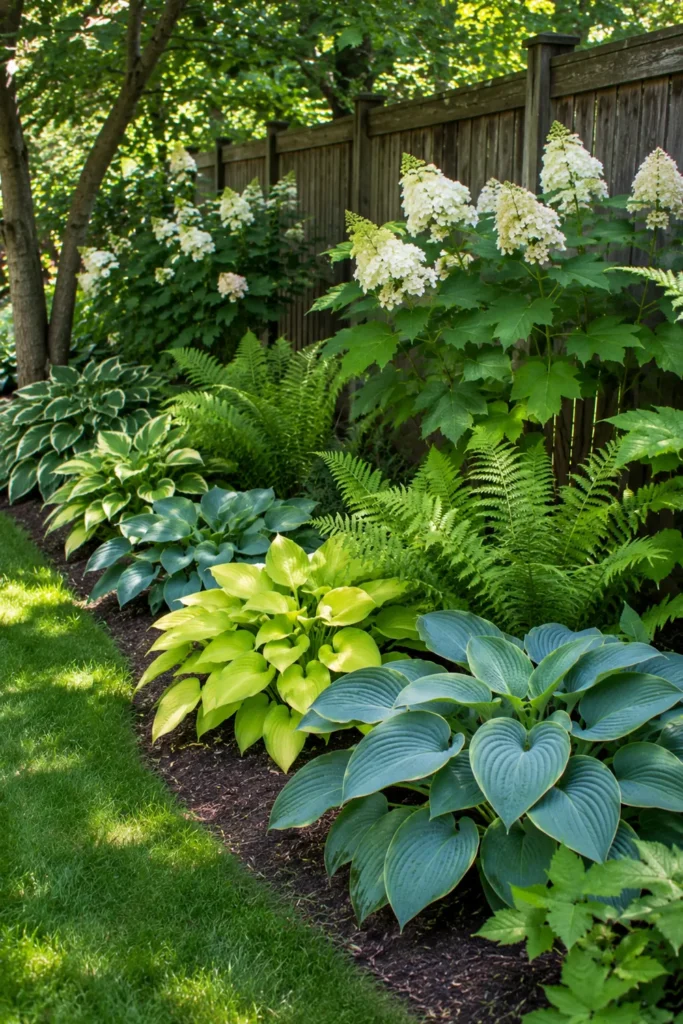
North-facing fences can stay in shade most of the day, so sun-loving flowers sulk there. Shade plants don’t. A border of oakleaf hydrangea, ferns and hostas makes a dark fence line look cool and green.
The oakleaf hydrangea gives height and big cone-shaped white flowers in summer, then its large leaves turn red and bronze in fall. Ferns add fine, feathery texture in the middle, and hostas fill the front with broad leaves in green, blue or gold. The white flowers and bright leaves bounce what light there is back off the fence, so the shady side of the yard no longer looks gloomy.
Garden note: Shade borders beside fences often sit in a dry “rain shadow,” because the fence blocks rain. Water deeply in dry spells, especially in the first year.
4. Feather Reed Grass and Russian Sage Along a Modern Slat Fence
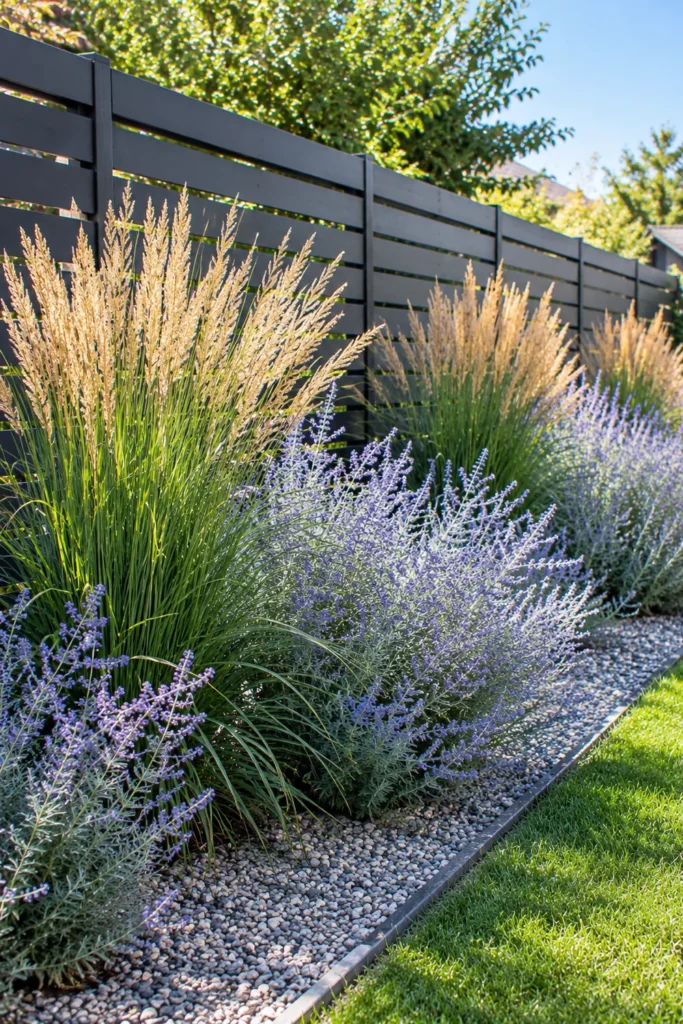
Against a black horizontal slat fence, soft plants look softer and the fence looks sharper. A wild cottage border can fight with those clean lines. Upright feather reed grass and airy Russian sage complement them instead.
Feather reed grass shoots straight up in tight clumps with tan plumes that catch the late summer light, echoing the vertical rhythm of a fence post. Russian sage forms a lavender-blue haze on silvery stems in front. Both love full sun and handle dry spells once settled. Plant them in a gravel strip and the whole border looks crisp and modern, with almost nothing to weed.
Cut both back in late winter, just before new growth appears.
5. Raised Cedar Beds of Vegetables Along a Sunny Fence
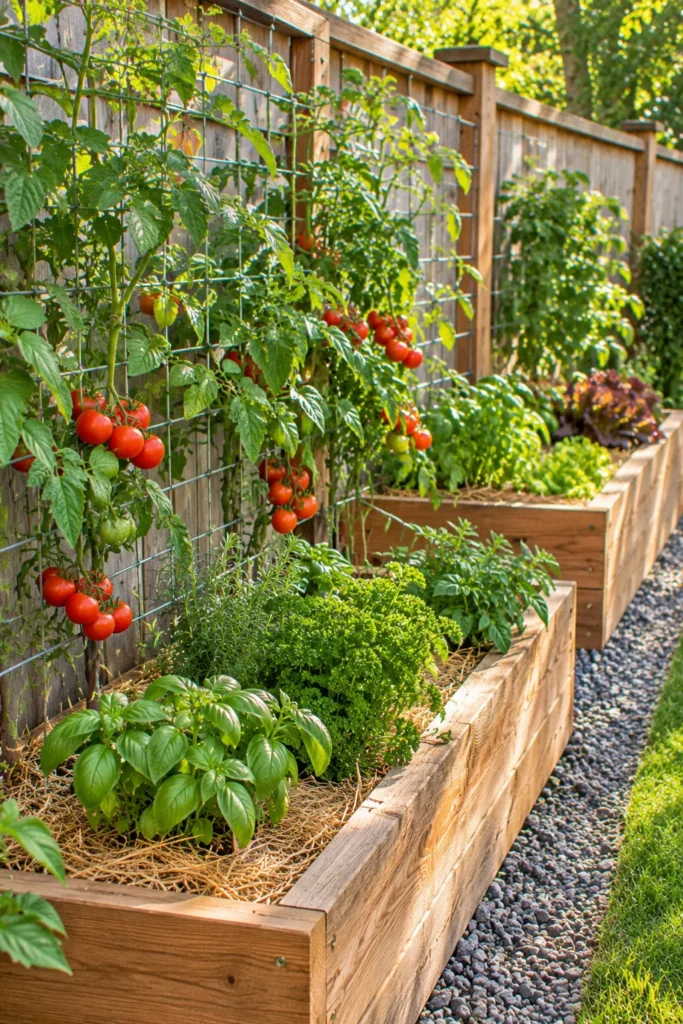
Fences soak up heat on a sunny day, and vegetables love that extra warmth. Line the base of a south- or west-facing fence with raised cedar beds, and you get a kitchen garden that uses space the yard wasn’t using anyway.
Tomatoes are tied to a trellis mounted on the fence, so they grow up instead of sprawling across the bed. Basil and parsley fill the front edge, within easy reach for picking. Cedar is a smart choice because it resists rot better than most woods. Leave a small gap between the beds and the fence so air can move, and so damp soil never sits against the fence boards.
Plant the look: two raised cedar beds, tomatoes on a fence trellis, basil and parsley in front, straw mulch on the soil.
6. Espaliered Apple Tree Against a Wood Fence
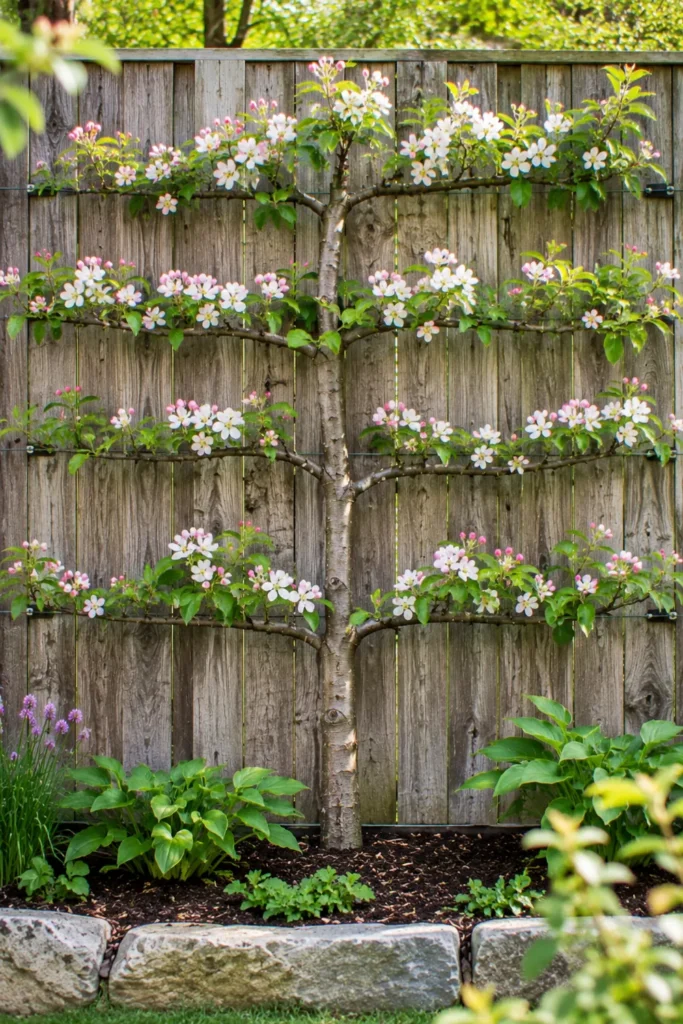
Those flat, horizontal tiers of branches are what make an espaliered apple tree so striking. Espalier is the old technique of training a fruit tree flat against a wall or fence, and it turns a plain fence into a living piece of garden art.
Widen the view and the practical side shows. Because the tree grows flat, it takes up only a narrow strip of ground but still produces apples. In spring, the tiers fill with white and pink blossoms against weathered wood. Buying a tree already started as an espalier saves years of training. Many apples also need a different variety nearby to set fruit, and these dwarf fruit trees for small spaces make good partners.
Prune in summer to keep the shape, and tie new shoots to the support wires as they grow.
7. Scarlet Runner Beans and Black-Eyed Susan Vine to Hide a Chain Link Fence
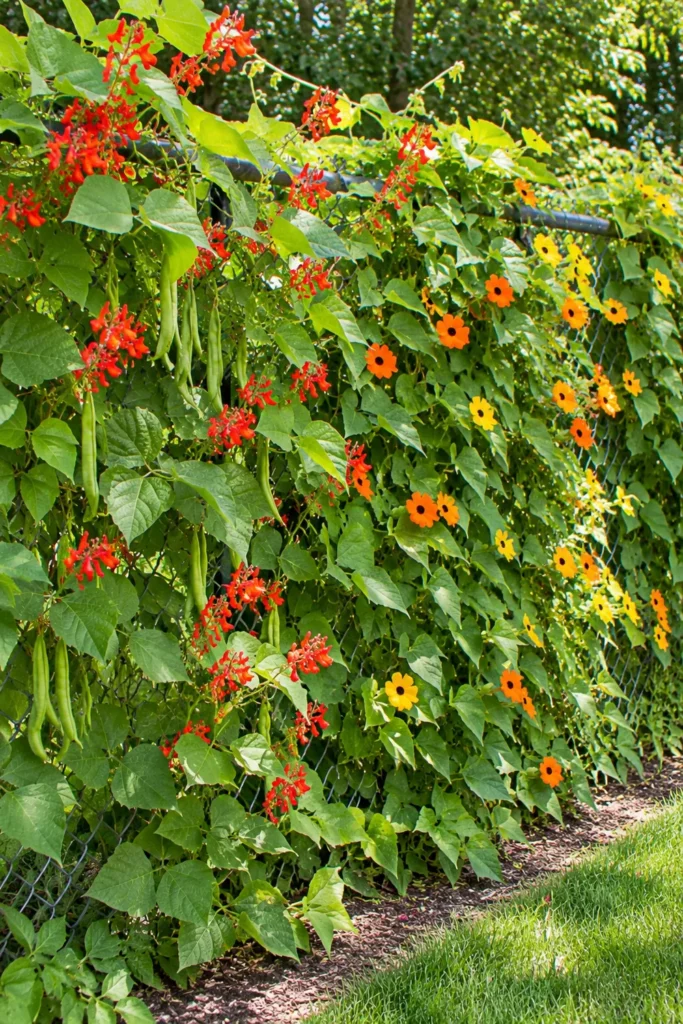
Chain link fences are practical, but nobody calls them pretty. The good news is that the open wire mesh is a perfect support for twining climbers. Annual vines grown from seed can cover it in a single summer for very little money.
Scarlet runner beans scramble up fast with bright red flowers that hummingbirds visit, followed by edible beans. Black-eyed Susan vine twines beside them with orange or yellow flowers marked by a dark center. Together, they make the chain link disappear behind a wall of leaves and color by midsummer. Sow the seeds right at the base of the fence after your last frost.
Both are annuals, so the fence will be bare again in winter. If you want year-round cover next year, plan a perennial climber for one section.
8. Staggered Arborvitae Screen Behind a Low Fence
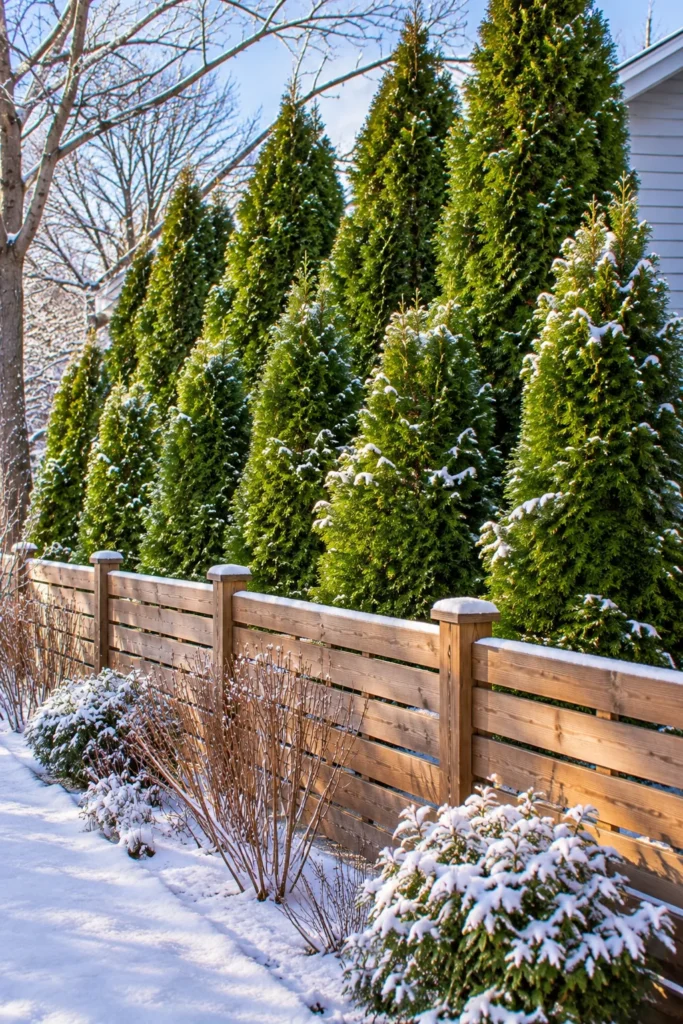
Arborvitae is one of the most popular evergreens for privacy, and for good reason. Its dense, upright growth stays green through winter, when a deciduous screen would be bare.
Plant it in a staggered double row, zigzagging the plants instead of setting them in one straight line. A zigzag screen fills in faster, looks fuller and doesn’t leave a gap if one plant fails. Behind a low fence, the evergreens add the height the fence lacks, and the fence gives the base of the screen a tidy edge. Deer like to browse arborvitae in winter, so protect young plants if deer visit your yard.
🌿 Garden Tip
Check the mature width on the plant tag before you dig. A common rule of thumb is to plant shrubs at least half their mature width away from the fence. That leaves room to reach the fence for repairs, lets air move, and keeps branches from crowding into your neighbor’s yard.
9. Clipped Boxwood Balls in a Narrow Gravel Strip
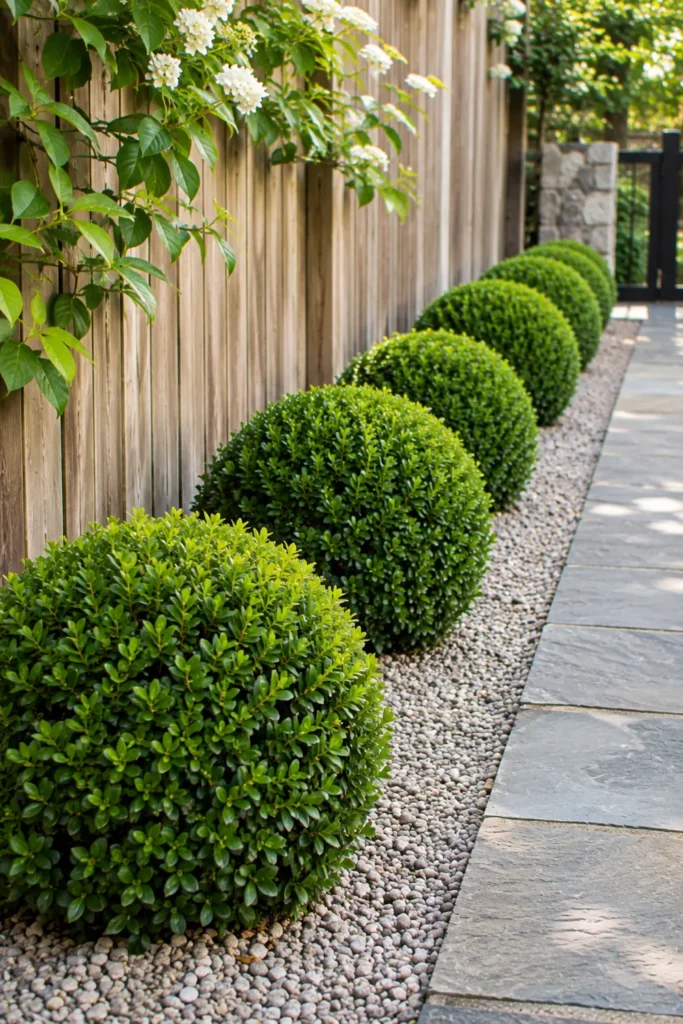
Narrow strips between a fence and a walkway are hard to plant. There’s no room for a deep border, and anything floppy blocks the path. A row of clipped boxwood balls set in pale gravel keeps the strip neat and gives it real structure.
The round, dark green shapes repeat along the fence like beads on a string, which makes a short narrow side yard feel longer and more planned. Gravel between them drains well and needs almost no care. Use the same size of ball and the same spacing all the way along. The rhythm is the whole point. These narrow garden ideas offer more ways to handle long, thin spaces.
Garden note: Boxwood blight and box tree moth are problems in some areas. If they show up near you, inkberry holly is a common swap that clips into a similar shape.
10. Native Pollinator Border With Butterfly Weed and Bee Balm
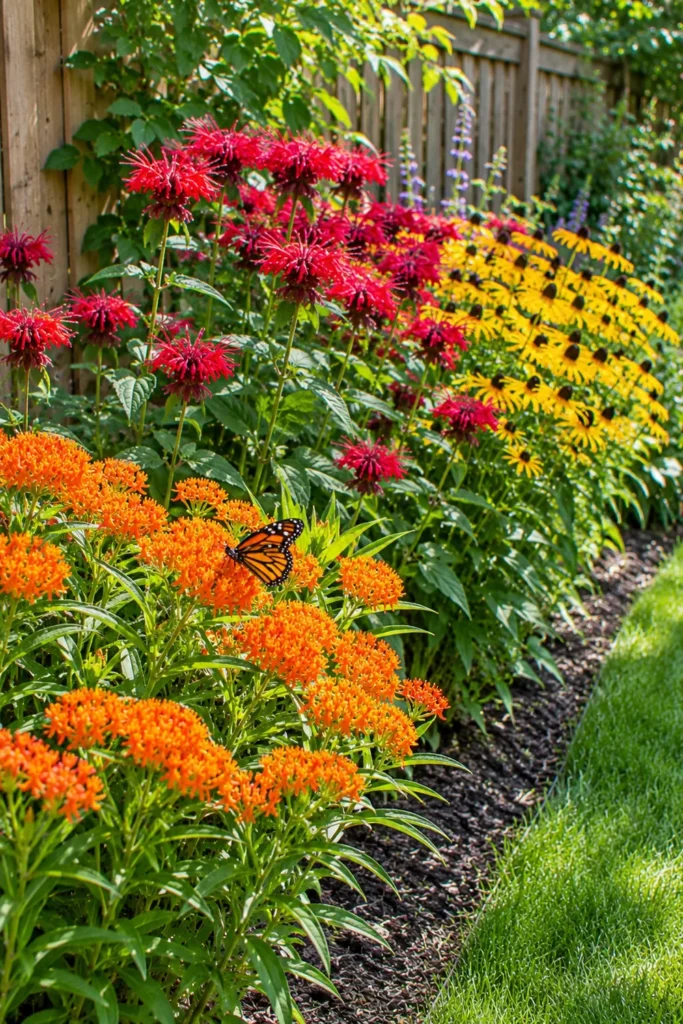
Butterfly weed glows bright orange along a sunny fence in summer, and it’s a host plant for monarch caterpillars. Paired with bee balm and black-eyed Susans, it turns a plain fence line into a busy pollinator border full of bees, butterflies and hummingbirds.
All three are tough North American natives that bloom in full sun. Bee balm adds shaggy red or purple flowers that hummingbirds love, and black-eyed Susans bring golden daisies with dark centers that last for weeks. The fence helps too. It blocks wind, so pollinators can feed in calm air. Give bee balm a little space for airflow, because crowded plants are prone to powdery mildew.
Leave the seedheads standing in fall. Goldfinches and other small birds will feed on them well into winter.
11. Painted Fence With Hanging Planters and Containers
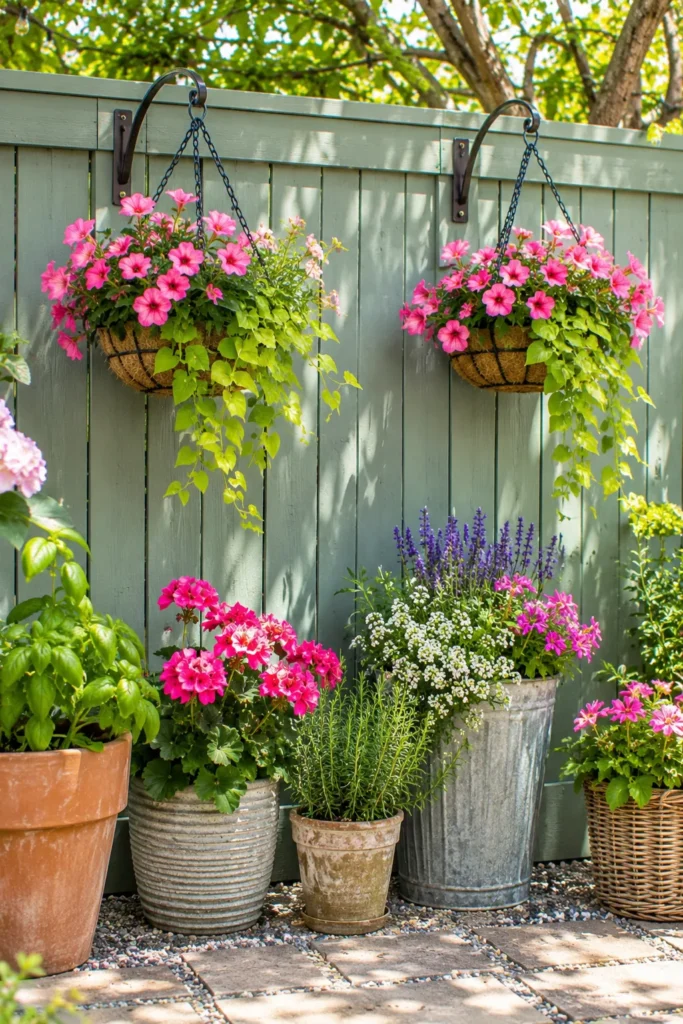
Paint is the fastest way to change how a fence line looks. A coat of soft sage green makes plain boards fade into the garden instead of standing out, and every plant in front of it looks greener.
From there, the planting can live in pots. Hanging planters on fence hooks spill petunias and trailing foliage down the boards, while a row of containers at the base holds herbs and bright annuals. The painted backdrop and the potted plants work together. You get the look of a full border with no digging, and the containers can move whenever you like. It’s one of the best low maintenance fence line ideas for a small yard on a budget.
Talk to your neighbor before painting or attaching anything to a shared fence.
Use hooks that hang over the top of the fence instead of screws where you can.
Keep planters light enough for the fence to carry when they are wet.
Screwing into a shared fence without asking first.
Letting climbers and branches grow over onto the neighbor’s side.
Piling soil or mulch against the boards, where it holds moisture and causes rot.
12. Gravel and Boulder Fence Line With Yucca for Dry Yards
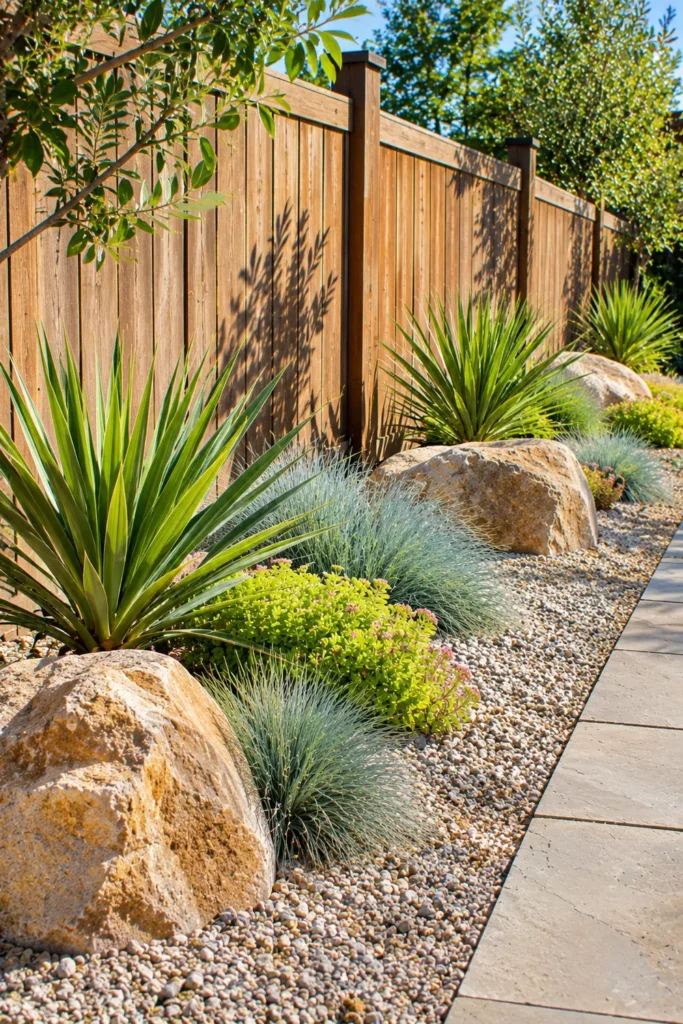
The strip along a sunny fence often gets the least water in the yard. A thirsty flower border struggles there. A gravel and boulder planting thrives, and it barely needs watering once it’s established.
A few warm tan boulders give the strip structure, and spiky yucca rises between them like living sculpture. Low mounds of blue fescue and stonecrop fill the gaps with silver-blue and green. The hard stone and soft grasses balance each other, and the gravel keeps weeds down while reflecting light up onto the fence. If you love this look, these backyard rock garden ideas take it further.
Plant the look: warm tan boulders, yucca, blue fescue, stonecrop, a gravel mulch.
13. Bench Nook Carved Into the Fence Border
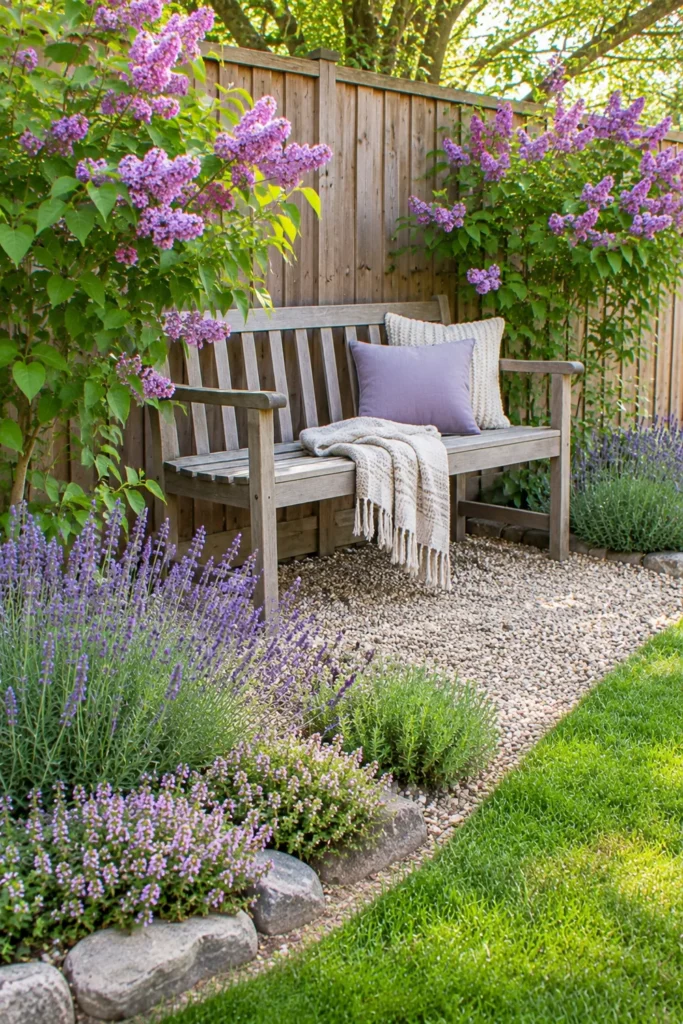
Lilac scent drifting over a bench is the payoff here. A small pea gravel pad set into the fence border, with a simple wood bench and a lilac shrub on each side, turns a long boundary into a place to sit.
Step back and the nook gives the fence line a destination. Instead of a single long stripe of plants, the border has a pause in the middle, which makes a long fence feel shorter and the yard feel bigger. Fragrant herbs like lavender and thyme at the edge of the gravel release their scent when you brush past them in spring.
Prune lilacs right after they finish flowering. They set next year’s buds soon after, so later pruning cuts off the flowers.
14. Moon Garden of White Flowers Under Fence String Lights
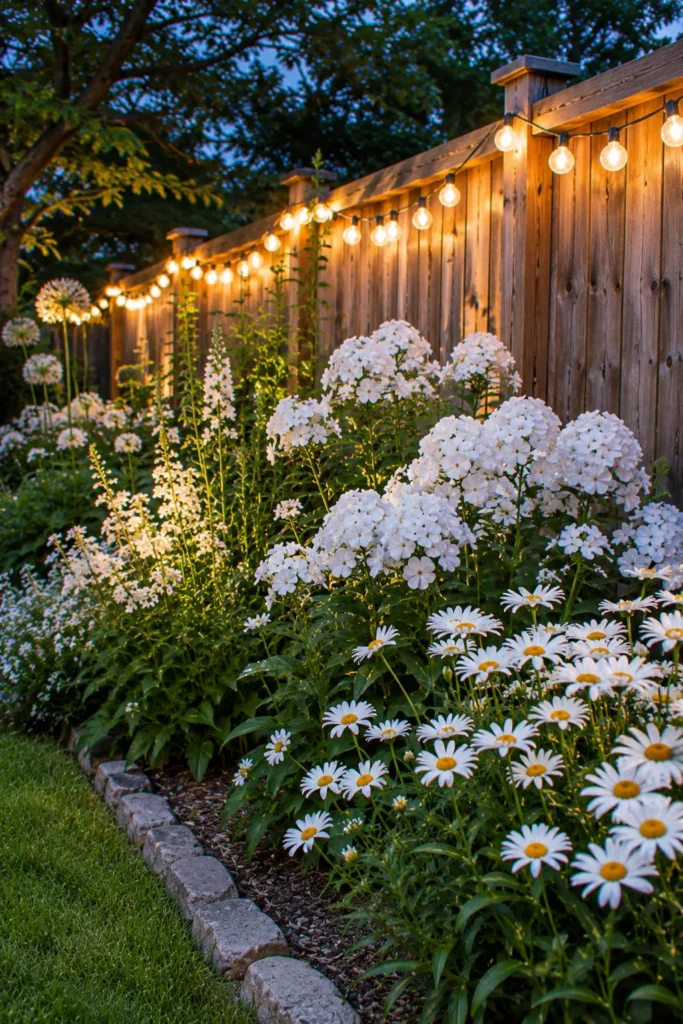
By day, white garden phlox and Shasta daisies look fresh and simple against a wood fence. At dusk, they change completely. White flowers hold onto the fading light longer than any other color, so they seem to glow after sunset.
Add a strand of string lights along the top of the fence and the effect doubles. The soft light catches the white petals, and the fence becomes the backdrop for an evening garden you actually use after work. Keep the plant palette to white and silver so nothing distracts from the glow, and plant phlox and daisies in generous drifts so they read from across the yard.
Use solar string lights, or plug outdoor-rated lights into a covered outdoor outlet. Any new wiring should be done by a licensed electrician.
15. Dog-Friendly Fence Line With a Mulch Run and Tough Shrubs
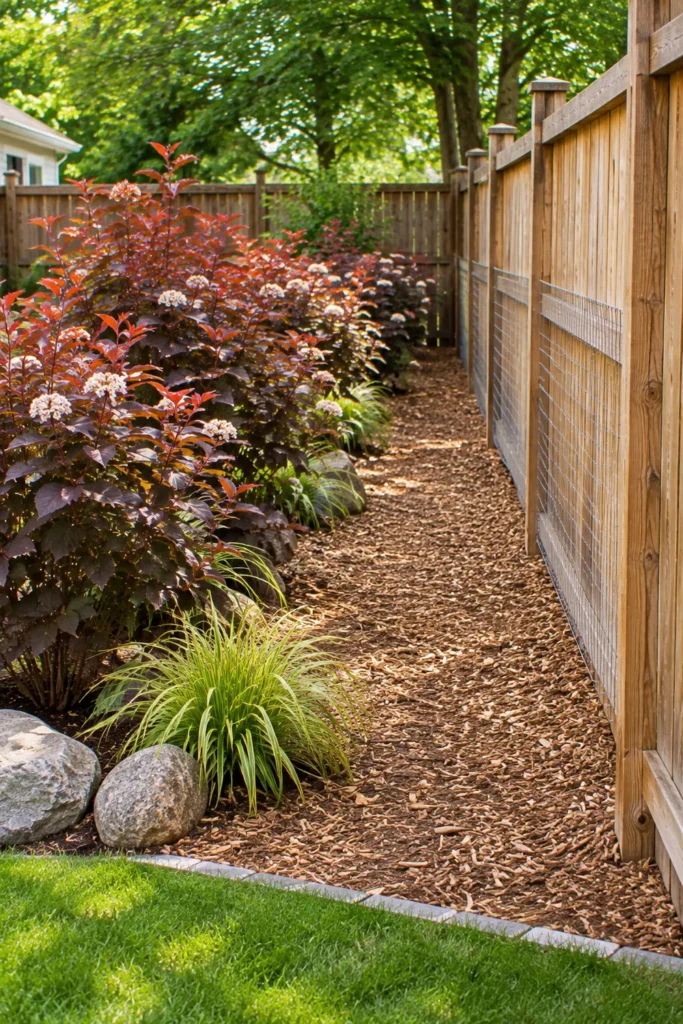
Dogs patrol fence lines. They run along them, bark at the neighbors and wear a bare track in the grass. Instead of fighting it, give them a path. A strip of wood chip mulch or pea gravel right along the fence becomes their run, and the planting moves to the yard side.
Ninebark is a good choice for that planting. It’s a tough native shrub with peeling bark and leaves in burgundy or gold, and it handles a bump or two. Set it back from the run so the dog has a clear lane, and the border stays intact. These dog run side yard ideas show more ways to keep both pets and plants happy.
Check that any plant you add is safe for dogs before you plant it.
16. Low Stone Terraces Along a Sloped Fence
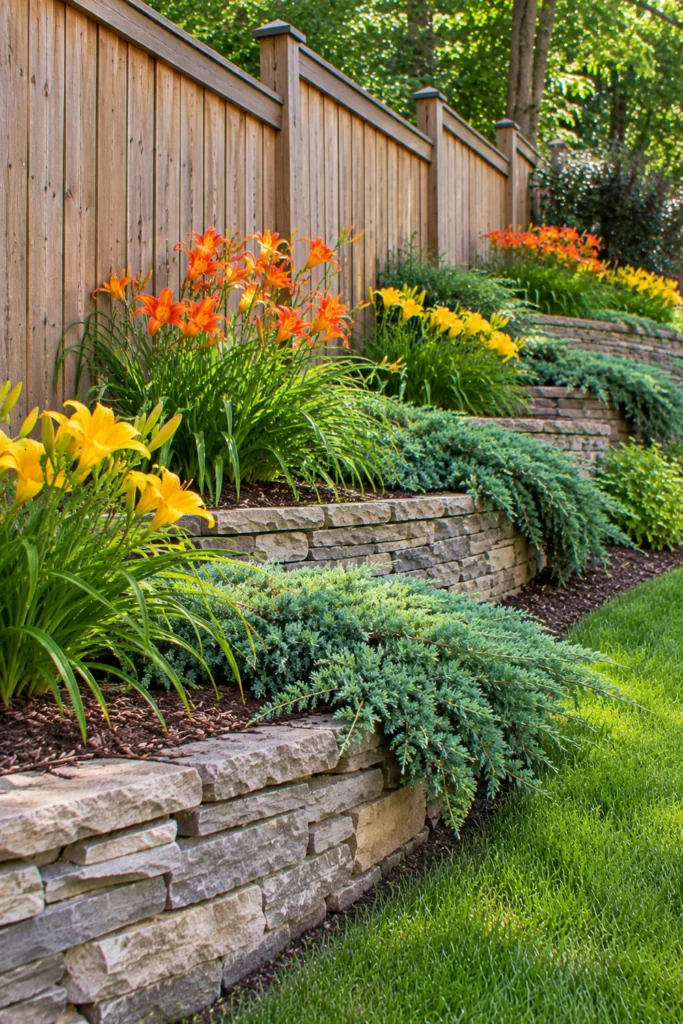
A fence running up a slope leaves a strip that’s hard to plant and harder to mow. Low stone terraces fix that. They step the ground up in shallow levels alongside the fence, so each section is flat enough to plant.
Creeping juniper spreads over the edges of the stone and helps hold the soil, while daylilies fill each terrace with summer color in orange, yellow or red. The stacked stone repeats the step of the fence panels as they climb the hill, so the slope looks designed instead of awkward. Daylilies are toxic to cats, so skip them if your cat goes outside.
Garden note: Keep each terrace wall low. Anything taller, or anything holding back a steep slope, needs a professional to design and build.
17. White Picket Fence With a Front Yard Cottage Border
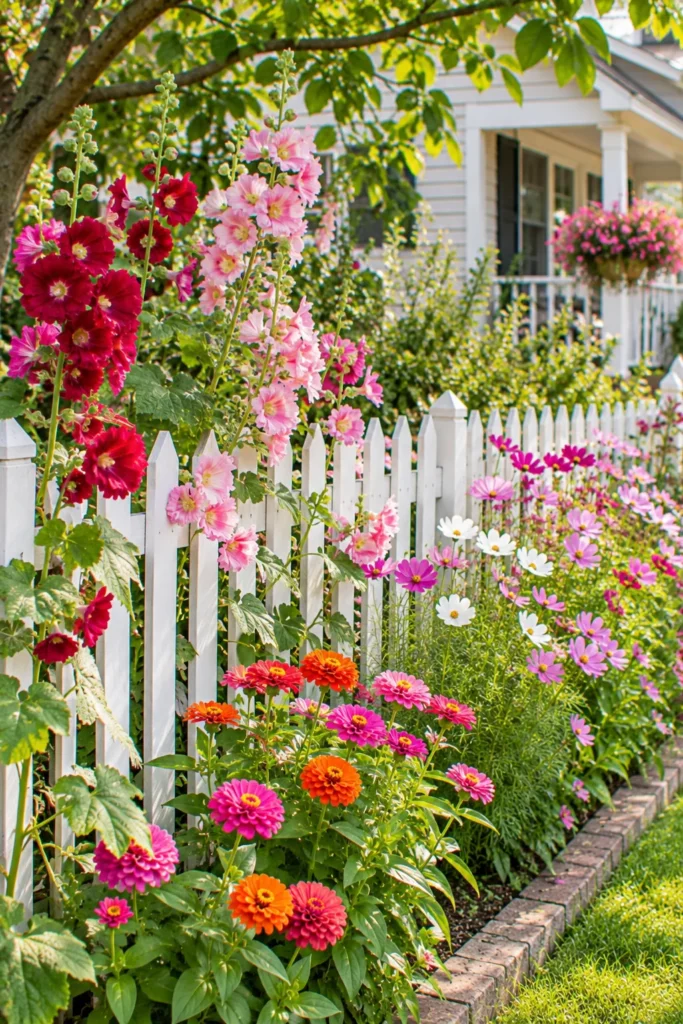
A white picket fence practically asks for a cottage garden. Tall hollyhocks lean against the pickets, while zinnias and cosmos fill the front of the border with bright summer color that spills through the gaps.
The open spacing of the pickets is what makes this work. Flowers poke through and over the fence, so the garden reads from the street as well as from the yard, which is a big boost to curb appeal. Hollyhocks also get natural support from the pickets, so you rarely need to stake them. These cottage front yard ideas show more ways to plant the space in front.
Plant the look: hollyhocks against the pickets, zinnias and cosmos in front, a narrow mulched bed, a white picket fence.
What to Plant Along a Fence Line
Every idea in this list comes back to one question: what does your fence need most? Start with the light it gets, then decide whether the job is privacy, color, food or simply something neat and easy. Plant in layers, keep a little space between the plants and the fence, and match climbers to the fence material. These pairings from the list are a good place to start.
| Fence situation | Good plants from this list | Why they work |
|---|---|---|
| Sunny fence | Viburnum, coneflower, catmint, climbing roses, butterfly weed | Long bloom season and layered height |
| Shady fence | Oakleaf hydrangea, ferns, hostas | Bright leaves and white flowers lift the shade |
| Privacy all year | Arborvitae, boxwood | Evergreen, dense and easy to shape |
| Fast cover on a budget | Scarlet runner beans, black-eyed Susan vine | Grow from seed and cover a fence in one summer |
| Dry, sunny strip | Yucca, blue fescue, Russian sage, feather reed grass | Handle heat and little water once settled |
Fence Line Landscaping FAQ
What should I plant along a fence line?
It depends on the light and the job. Sunny fences suit layered borders of shrubs and perennials, climbing roses and vegetables. Shady fences suit ferns, hostas and hydrangeas. For privacy, use evergreens like arborvitae. Ideas 1, 3 and 8 each show one of these approaches.
How far from a fence should I plant shrubs and trees?
A good rule of thumb is to plant shrubs at least half their mature width from the fence, and keep large trees much farther back. That leaves room to maintain the fence and keeps branches out of the neighbor’s yard. If branches do cross over, know the rules on trimming a neighbor’s overhanging tree.
What grows fast to cover a fence?
Annual climbers grow fastest. Scarlet runner beans and black-eyed Susan vine can cover a fence in one summer from seed. For year-round cover, clematis and climbing roses take a few seasons to fill in but come back every year. Idea 7 shows the fast annual version on a chain link fence.
How do I hide a chain link fence?
Grow twining climbers on it. The open wire mesh gives vines a perfect grip, so runner beans, black-eyed Susan vine and clematis can climb it with no extra support. Planting a layered border or an evergreen screen in front also hides it well. See ideas 7 and 8.
Can I attach a trellis to a shared fence?
Only with your neighbor’s agreement. A fence on the property line is usually jointly owned, so screwing into it or making changes should be discussed first. A freestanding trellis set just in front of the fence on your side avoids the question entirely.
Conclusion
A fence will always mark the edge of your yard, but with the right planting it doesn’t have to look like one. The best fence line landscaping ideas start with the light the fence gets and the job you want it to do. Layer shrubs and perennials for color, train climbers for height, plant evergreens for privacy, or carve out a bench nook for somewhere to sit. Leave a little room between plants and boards, and keep your neighbor in the loop. To finish the front edge of a new border, these garden edging ideas give it a clean line.
Pin this for the next time your fence needs a little love.