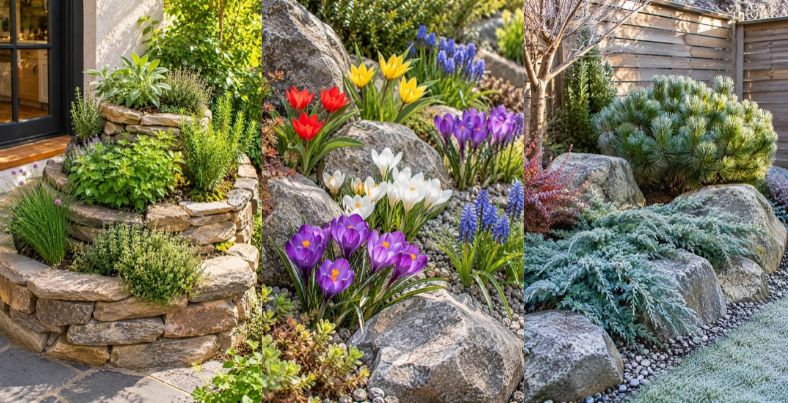
A rock garden is one of the few garden features that looks good on day one and better every year after. These backyard rock garden ideas prove it. Stones give the garden structure from the start, and the plants slowly soften the edges until the whole thing looks like it has always been there.
The best part is how many shapes a rock garden can take. Big gray boulders can turn a flat lawn into a gentle hill. River rock can carry rainwater across a soggy low spot. A handful of tiny alpine plants can live happily in a stone trough on the patio, and tough succulents can fill a sunny bed that never needs much water.
Below are 25 ideas for real backyards: sunny slopes and shady corners, small yards and big ones, modern patios and cottage beds. Each one names the stones, the plants that suit its light and soil, and the one move that makes it work. There are budget ideas built with free fieldstone too, and a few with water and lighting for evenings outside.
What Makes These Backyard Rock Gardens Work
Every rock garden in this list follows the same simple recipe: the right stone, plants that suit the light, and soil that drains fast. The sunny ideas lean on thyme, sedum, succulents and alpine plants that like it lean and dry. The shady ones swap in ferns, moss and heuchera, and the water ideas use river rock and boulders to frame a pond, a creek bed or a small waterfall. Find the scene that looks most like your own backyard, and start there.
1. Boulder Berm With Creeping Thyme and Sedum
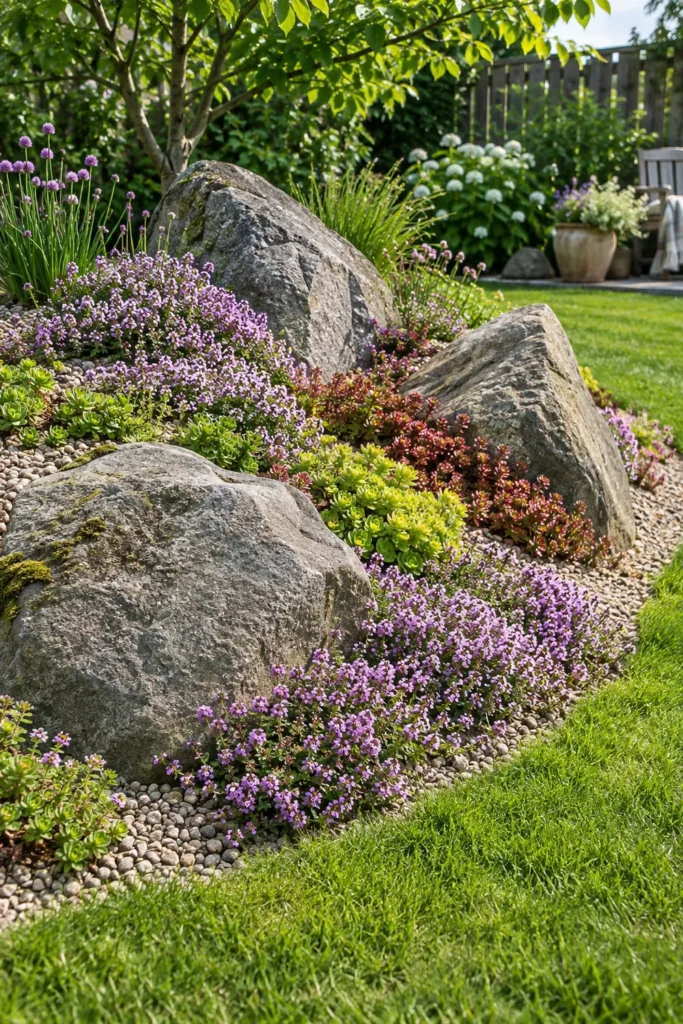
Flat yards can feel a little dull, and a berm is the quickest fix. A berm is simply a low, gently rounded mound of soil. Build one in a sunny part of the lawn, set three large gray boulders into it at different angles, and suddenly the yard has height and a focal point.
The boulders do the heavy lifting visually, while mats of creeping thyme and sedum knit between them and spill over their bases. Both groundcovers love full sun and quick drainage, which a raised berm provides naturally. Group the boulders in odd numbers and bury each one partly, so it looks like it rose out of the ground. Rocks sitting on top look dropped off by a truck.
🌿 Garden Tip
Most rock garden plants fail from wet roots, not dry ones. Build the berm or bed from a gritty mix of soil and fine gravel, and top the planting with a layer of grit or small stone. Water drains away fast, and the crowns of the plants stay dry through winter.
2. Dry Creek Bed of River Rock Through a Soggy Low Spot
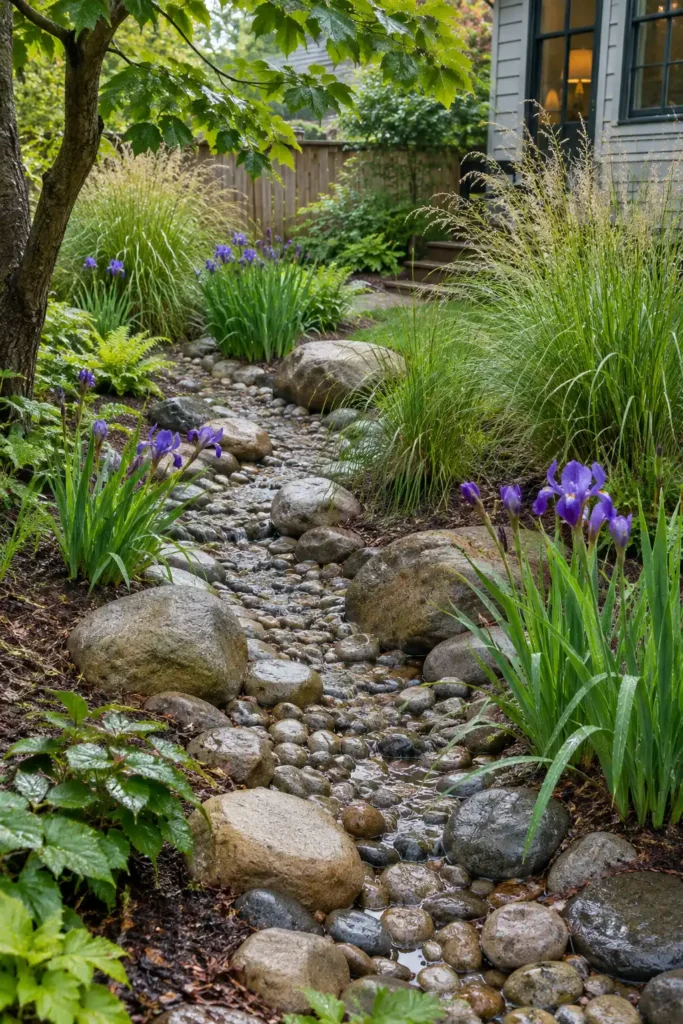
Every yard has that one spot where water sits after a storm. A dry creek bed turns the problem into a feature. It’s a shallow, winding channel lined with smooth river rock that carries runoff away when it rains and looks like a stream bed when it doesn’t.
Mix stone sizes so it looks natural. Fist-sized river rock lines the bottom, and larger stones sit at the bends where water would push hardest in a real creek. Siberian iris and switchgrass along the banks handle both wet spells and dry ones, so the edges stay green all season. For more ideas for the damp ground nearby, these plants that live in wet areas work well along the edges.
Plant the look: smooth river rock in mixed sizes, a few larger boulders at the bends, Siberian iris, switchgrass.
Always run the channel away from the house, never toward it.
3. Crevice Garden of Upright Flagstone Slabs
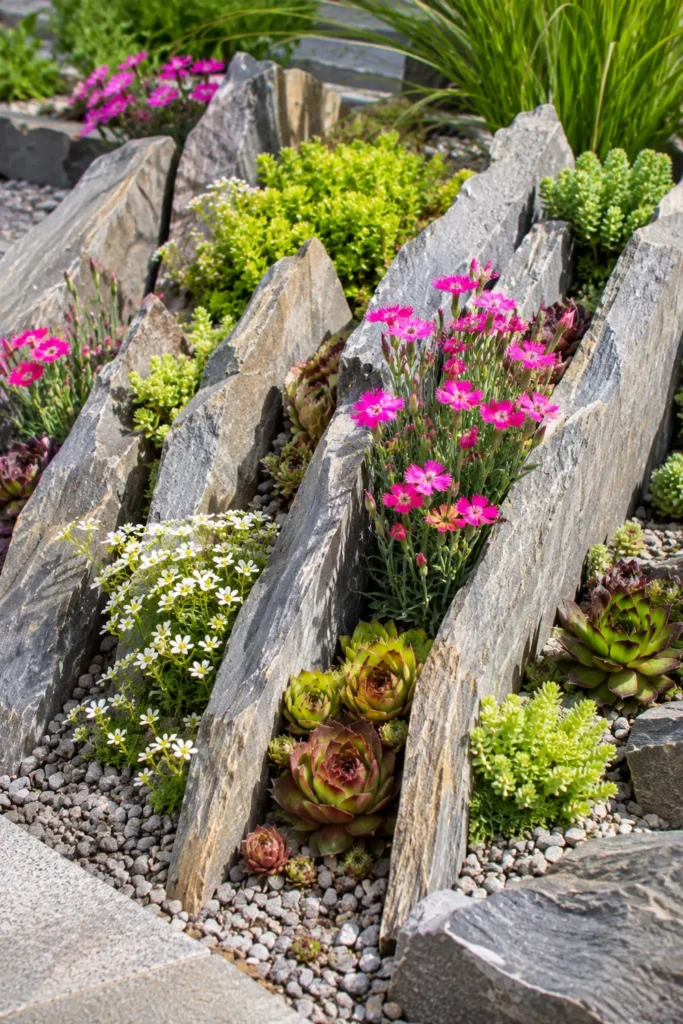
Look closely and you’ll see the plants growing in the narrow gaps between stone slabs. That’s the whole idea of a crevice garden. Flat flagstone slabs are set on edge, close together, in a bed of gravel and gritty soil, and tiny plants tuck into the cracks.
Step back and the slabs read as a striking, modern sculpture in a small backyard. The narrow crevices are where the magic happens, though. Roots run deep into the cool, well-drained space between the stones, which is exactly what hens and chicks, saxifrage and dianthus want in bright sun. A crevice garden fits a lot of plants into very little ground.
Set all the slabs at the same angle, as if they were one layer of rock pushed up from below. Random angles look messy fast.
4. Shady Rock Garden Under a Maple With Ferns and Moss
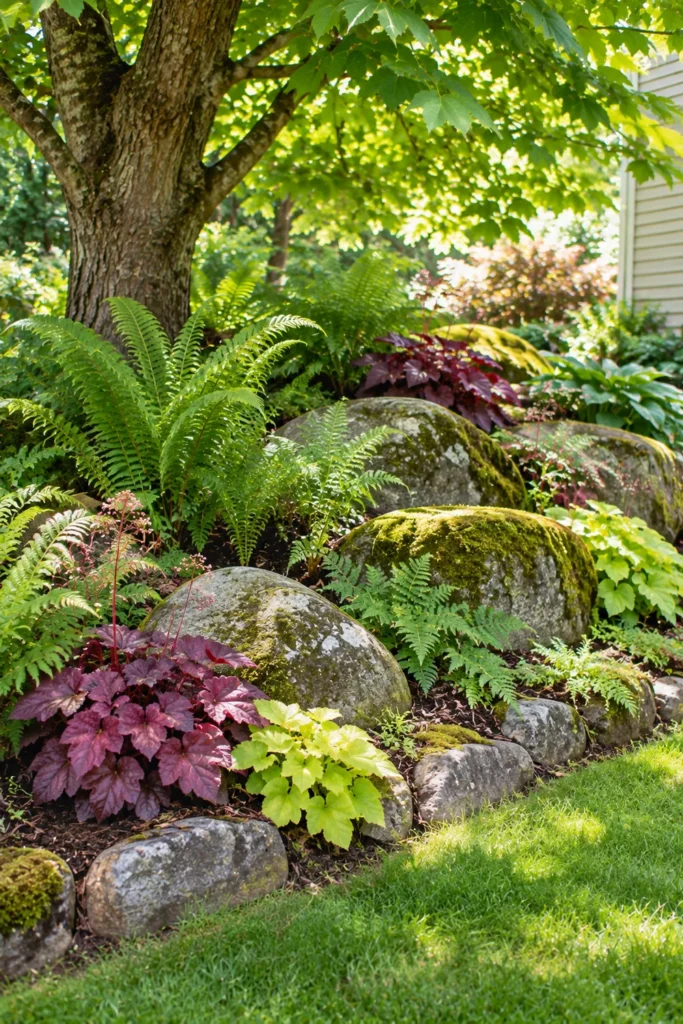
Shade rules out most classic rock garden plants, but it doesn’t rule out rock gardens. Under a big maple, mossy fieldstones set among ferns and heuchera create a cool, woodland version that looks completely at home in dappled light.
The stones keep the soil around the plants cool and moist, which ferns love. Over time, moss creeps across the stone and ties the rocks and plants together. Heuchera adds leaf color in shades of plum, lime or silver that flowers can’t manage in shade. Keep the soil layer shallow over the tree roots, and plant small so you don’t damage them.
Sunny Rock Garden vs Shady Rock Garden
Plants: creeping thyme, sedum, hens and chicks, lavender, alpine plants and succulents.
Soil: lean, gritty and fast draining.
Keep in mind: top-dress with gravel, not bark mulch.
Plants: ferns, moss, heuchera, hostas and other woodland plants.
Soil: richer and moist, but still well drained.
Keep in mind: mossy fieldstone looks more natural here than bright gravel.
5. Terraced Hillside With Natural Stone Steps
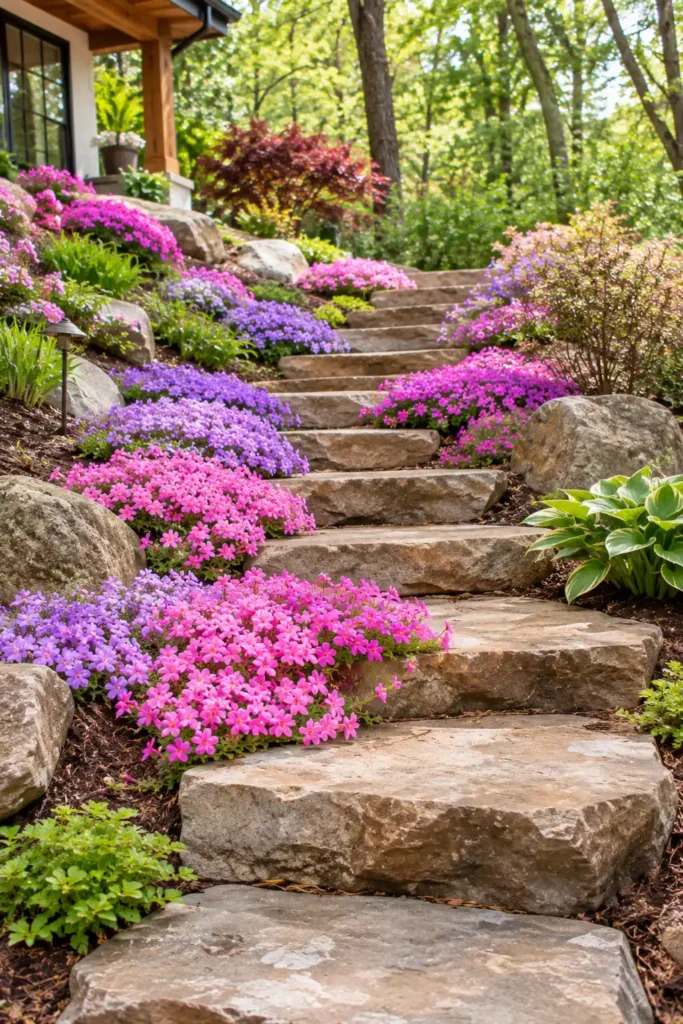
A slope is a gift for a rock garden, because the drainage is already built in. Set large, flat natural stones into the hill as steps, and plant the pockets on either side so the slope becomes a garden you can walk through.
Creeping phlox is the star here in spring. It spills over the edge of each step in sheets of pink, purple or white, softening the stone and helping hold the soil on the slope. The steps break up the hill into small, easy terraces, so planting and weeding never feel like climbing a mountain. This is one of the most useful ideas for a rock garden on a slope.
Garden note: Each step stone should sit firmly in the slope without rocking. For a steep hill, or anything that needs a tall retaining wall to hold it, bring in a professional.
6. Zen Gravel Corner With Raked Lines and Three Stones
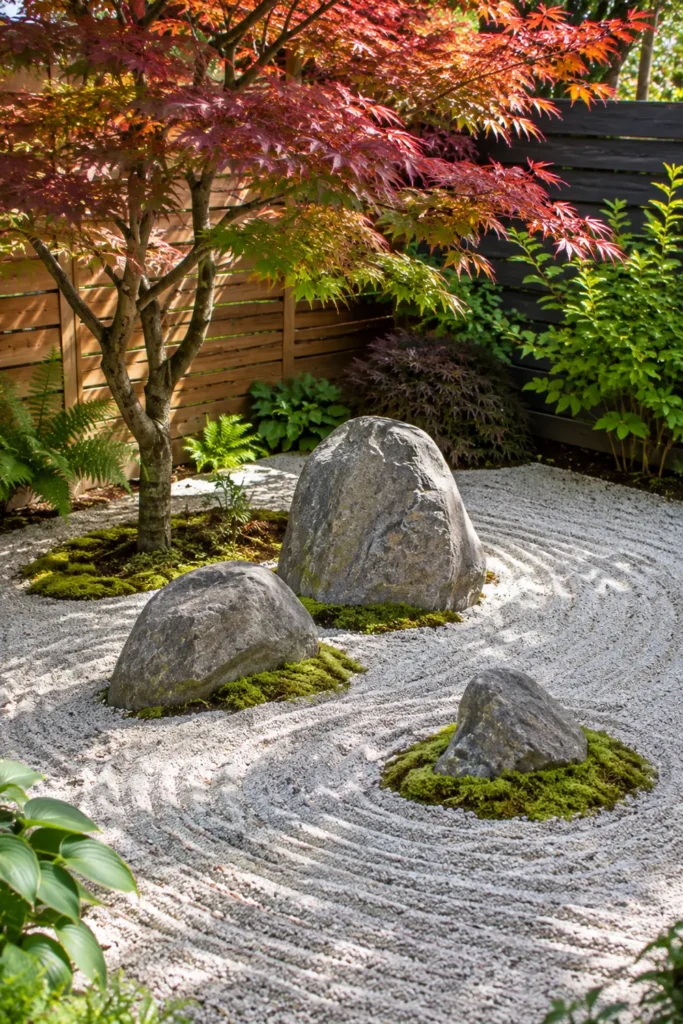
Raked gravel is all about restraint. In this small backyard corner, pale gravel is raked into smooth, flowing lines around three stones of different sizes, with a single Japanese maple giving shade and color.
The odd number of stones and the empty space between them are what make the corner feel calm. Each line in the gravel leads the eye around the rocks, as if water were flowing past islands. Keep the planting minimal. Too many plants and it stops feeling like a zen garden and starts looking like a busy bed. These Japanese front yard ideas use the same quiet approach on a bigger scale.
Plant the look: pale raked gravel, three gray stones in a loose triangle, one Japanese maple, a little moss at the base of the stones.
7. Desert Rock Garden With Agave, Yucca and Prickly Pear
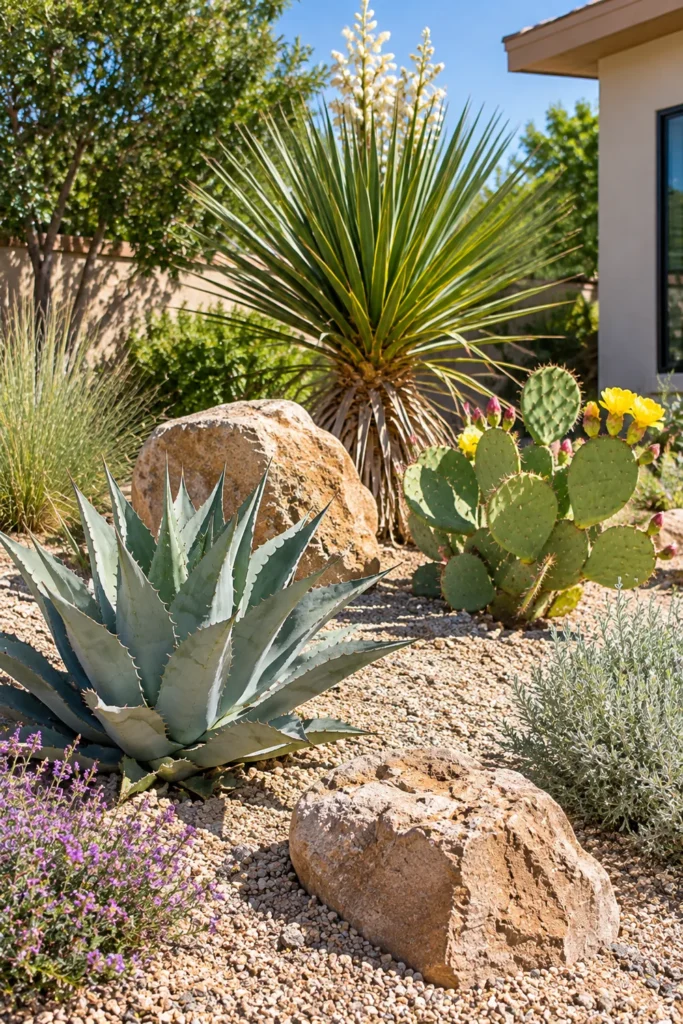
Water a desert garden like a flower border and you’ll kill it. Leave it alone through a hot, dry summer and it thrives. That is exactly why agave, yucca and prickly pear work so well in a backyard rock garden in full sun.
Set the plants among warm, tan boulders on a bed of decomposed granite, a fine, crushed rock that packs down firmly and drains fast. Each plant has its own sculptural shape. Agave grows a tight rosette, yucca rises in a spiky fountain and prickly pear stacks up in flat green pads. Spaced out among the rocks, they read like living sculpture against the stone.
Keep the spiky plants well back from paths and patios. Agave tips and prickly pear spines are sharp, and nobody wants to brush past them.
8. Alpine Trough Garden on the Patio
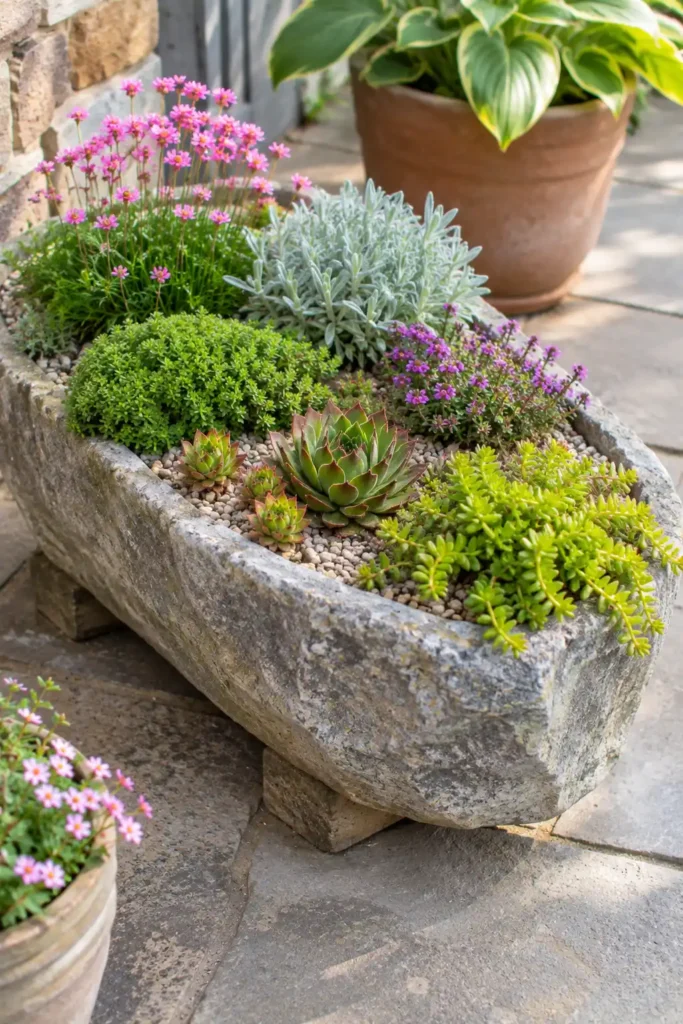
Tiny cushions of green and silver fill this stone trough on the patio, each one a different alpine plant or sedum. The trough is about the size of a large window box, but it holds a whole miniature mountain landscape.
Widen the view and it’s a smart solution for a small space. A trough garden gives alpines the perfect drainage they need without digging a bed, and it brings these small plants up closer to eye level so you can actually see them. A layer of fine grit over the surface keeps the plants dry at the base and makes their colors stand out.
Make sure the trough has drainage holes, and raise it slightly on bricks or feet so water can escape.
9. Lavender and Rosemary Mediterranean Rockery
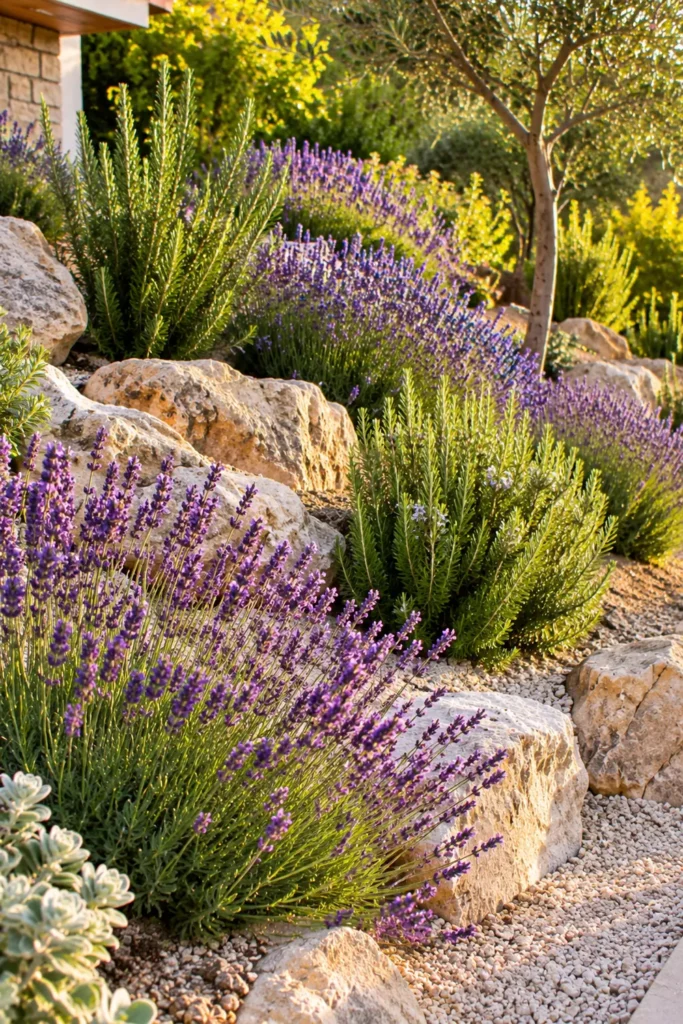
Lavender and rosemary grow wild on rocky Mediterranean hillsides. That’s why they look so natural tucked among pale limestone on a sunny slope in your backyard. At golden hour, the silvery foliage and purple lavender spikes glow against the warm stone.
Both plants need full sun and sharp drainage, so a rockery suits them better than a rich flower bed ever could. Mulch with gravel, not bark, to keep their bases dry. If you want lavender that lasts for years, these care tips for English lavender cover pruning and placement in more detail.
In cold winter areas, rosemary may not survive outdoors. Grow it in a pot you can tuck into the rockery in summer and bring inside before a hard frost.
10. Rock-Edged Pond With Water Plants
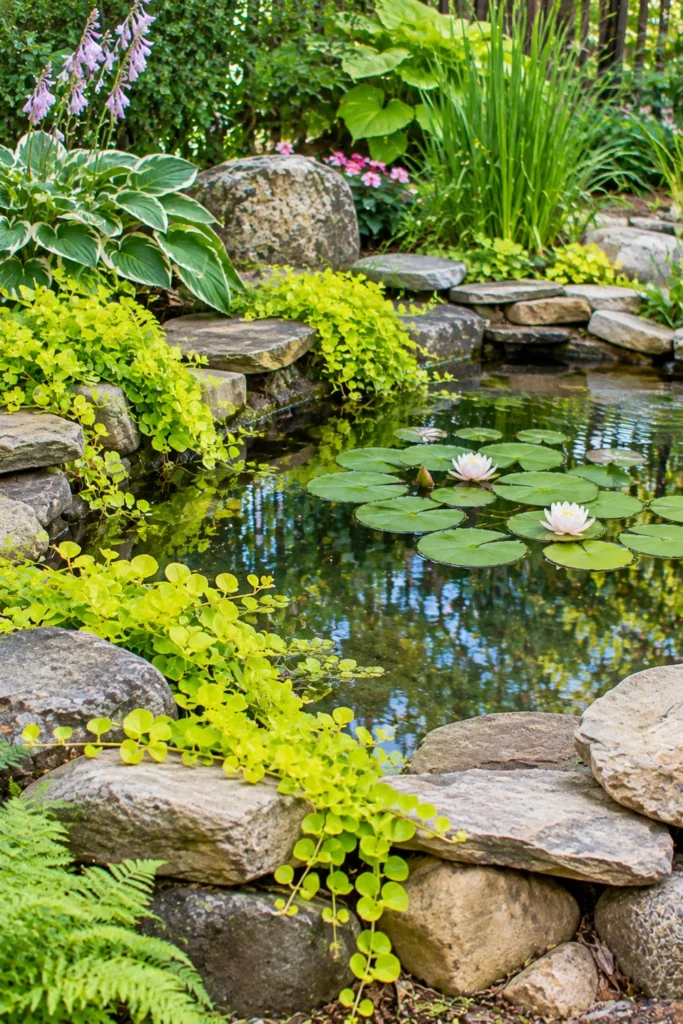
Stones make a backyard pond look natural. Without them, it can look like a liner filled with water. Here, flat stones overhang the rim to hide the edge of the liner, and creeping Jenny trails over them into the water while water lilies float on the surface.
The overhanging stones are the key detail. They cast a shadow line along the edge, so the eye never catches the liner. Mixing a few larger rocks among the flat ones makes the edge look like a real pond bank. On a calm afternoon, the still water reflects the stones and plants and doubles the view.
Garden note: Creeping Jenny spreads fast, so keep an eye on it and check local guidance before planting. Any pump or lighting for the pond should be wired by a licensed electrician.
11. Dry Stone Wall Planted With Trailing Alpines
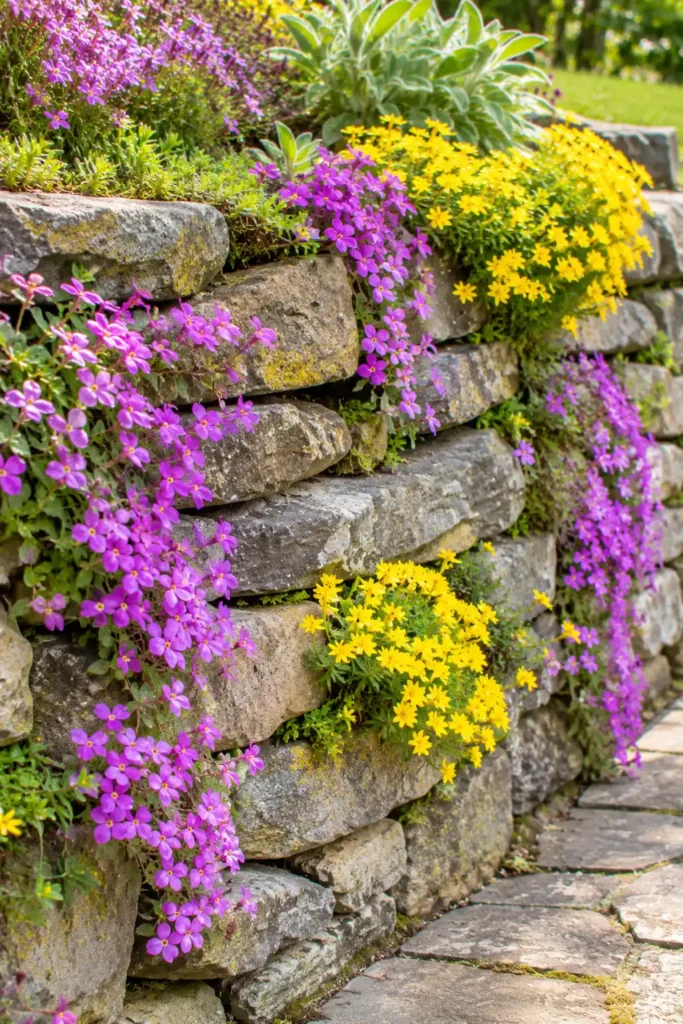
Purple and yellow flowers pour out of the cracks of this low dry stone wall in spring. The purple is rock cress, and the yellow is basket of gold. Both are tough little plants that love the sharp drainage and reflected warmth of a sunny wall.
Look at the wall as a whole and the planting turns hard stone into a soft, living edge. A dry stone wall is stacked without mortar, so the gaps between stones are open pockets of soil. That makes it a natural home for trailing alpines. Tuck small plants and a handful of gritty soil into the gaps as you build. Squeezing them in afterward is much harder.
Keep a planted wall low, around knee height. Anything taller, or anything holding back a slope, needs a professional to build it.
12. Boulder Seating Circle Around a Fire Pit
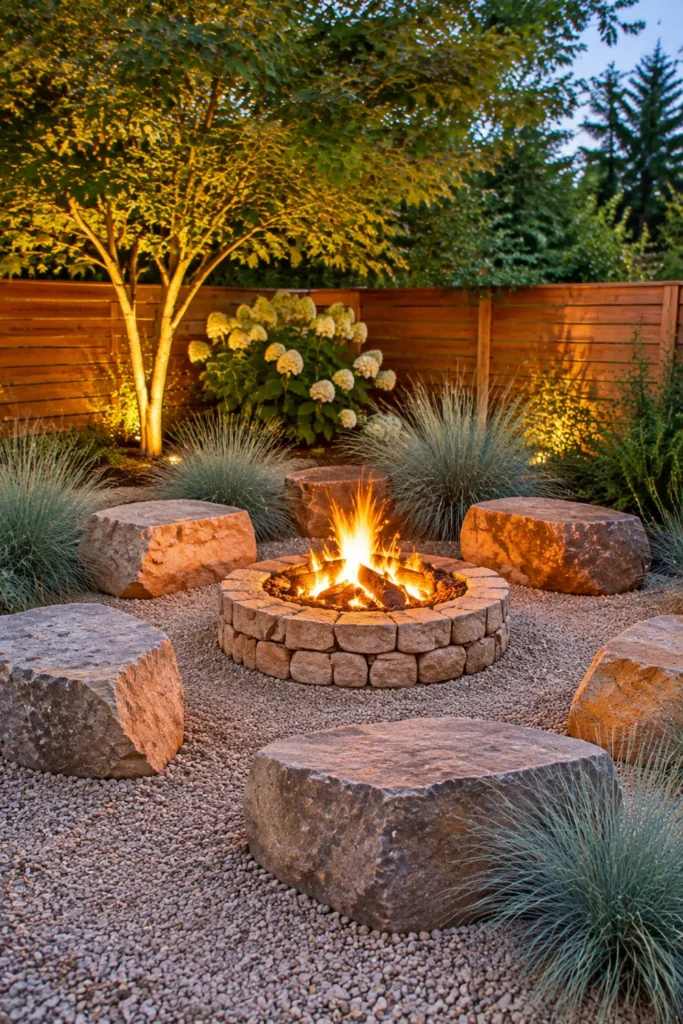
Flat-topped boulders make the most natural seats you can put around a fire pit. Set four or five in a loose circle on a gravel floor, and the fire pit area becomes part of the rock garden instead of a separate patio.
Low clumps of blue oat grass between the boulders soften the circle without crowding the seats, and the gravel ties everything together underfoot. In the evening glow, the warm firelight catches the rough faces of the stones. Pick boulders with at least one flat surface, and set them partly into the ground so they don’t rock when someone sits down. For more setups, these backyard fire pit ideas show other ways to plan the space.
Keep grasses and plants well back from the fire ring, and keep the gravel clear of dry leaves.
13. Succulent Rock Garden in a Small Backyard Bed
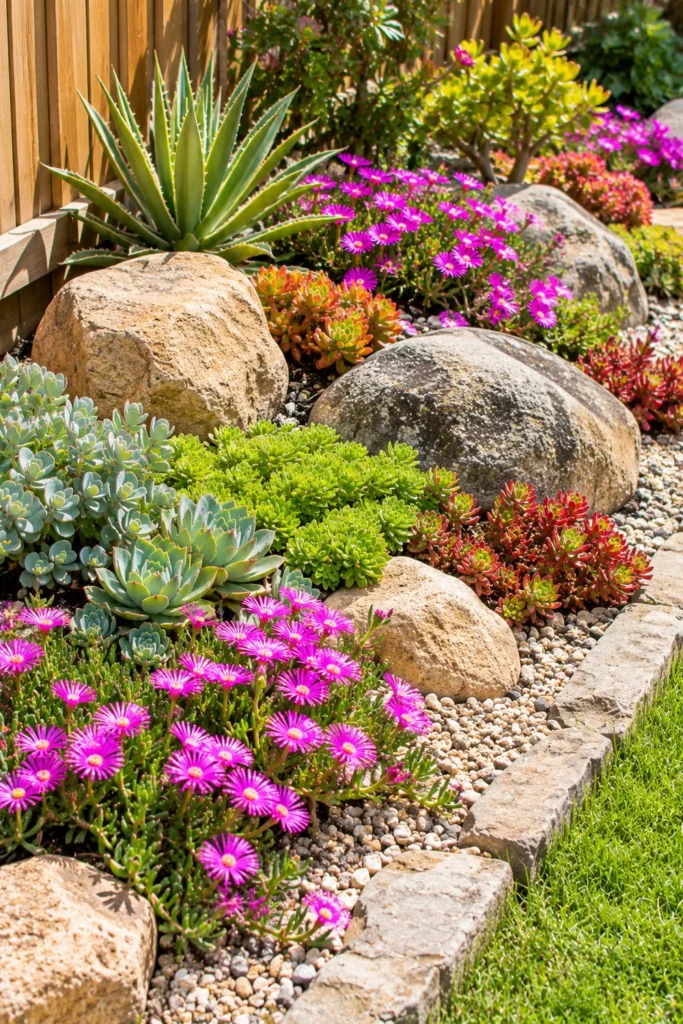
That strip along the fence that bakes in the sun all day is hard to plant. Most flowers fry there. Succulents don’t. A small bed of rounded rocks planted with hardy ice plant and stonecrop turns that hot spot into one of the brightest corners in the yard.
Hardy ice plant forms low mats covered in shiny, daisy-like magenta flowers through summer, while stonecrop adds thick leaves in green, blue-gray or red. Rounded stones set between them hold heat, keep the soil from washing away and make the low plants look deliberate. This is one of the easiest small rock garden ideas to start with.
Plant the look: rounded tan and gray rocks, hardy ice plant, stonecrop in two or three colors, a gravel top-dressing.
14. Native Pollinator Rock Garden
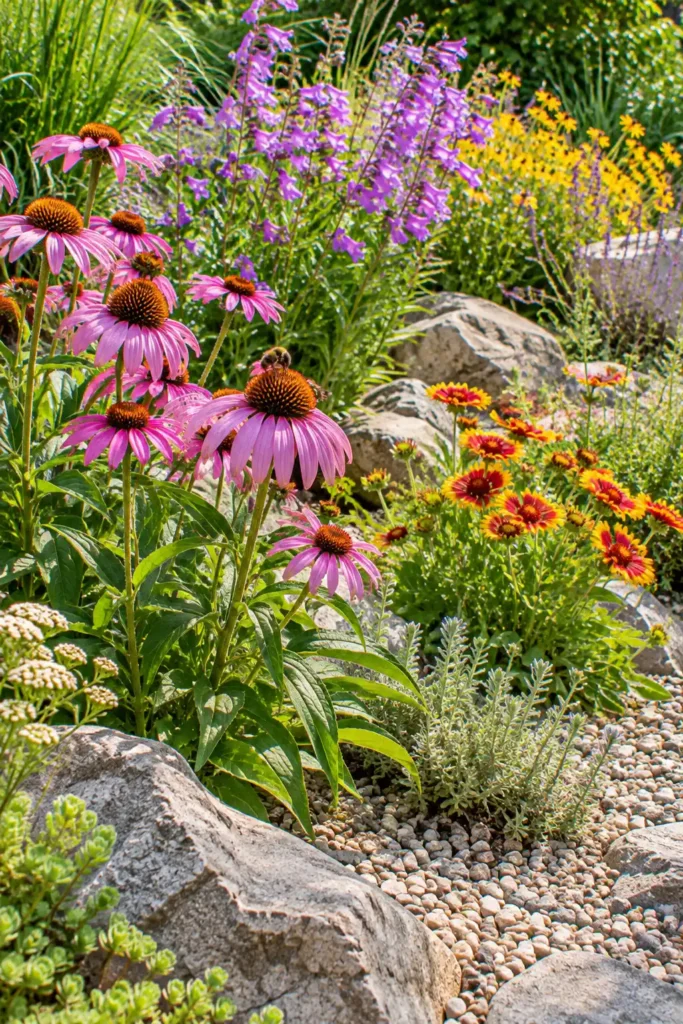
Bare soil between perennials is an open invitation to weeds. Cover it with gravel and you get a cleaner look, fewer weeds and drier conditions around the crowns of plants that like it lean. In this native pollinator rock garden, coneflower, penstemon and blanket flower rise from a gravel mulch among weathered rocks.
All three are North American natives that handle full sun and dry spells once established, and they bloom in midsummer when bees and butterflies are most active. The mix of tall coneflowers, spiky penstemon and the warm red and yellow of blanket flower gives the bed movement and color against the gray stone. Many of these drought tolerant perennials for full sun would fit right in alongside them.
Leave some seedheads standing in fall. Finches and other small birds will pick at them through the cold months.
15. River Rock Path Winding Through Grasses
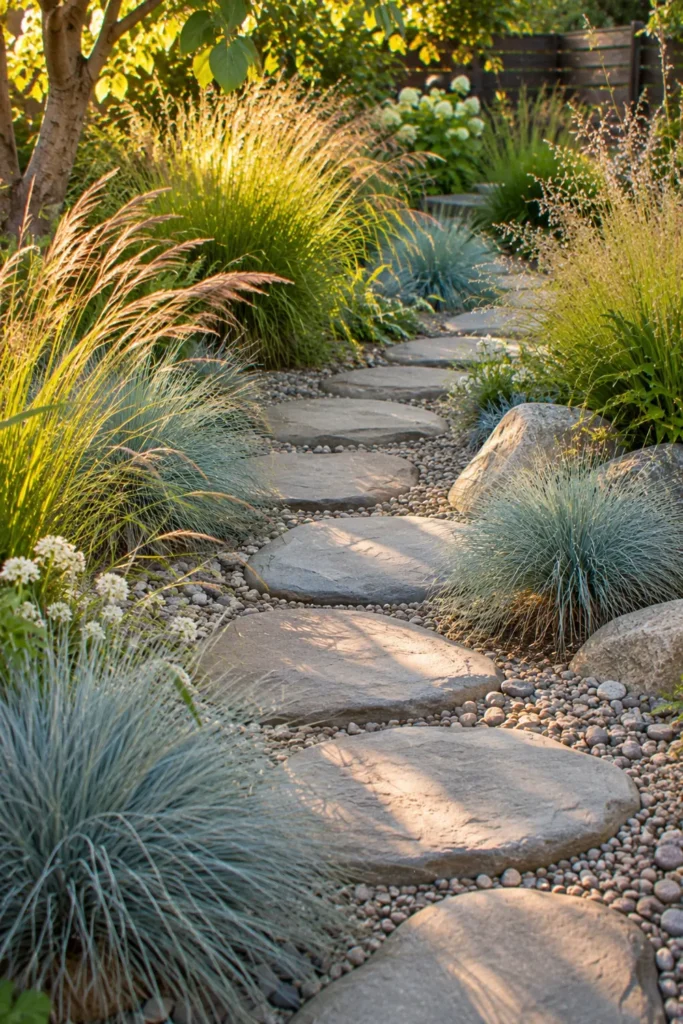
A path makes a rock garden feel like a place you walk through instead of a bed you look at. Here, large, flat river stones set into the ground wind through drifts of blue fescue and prairie dropseed.
The soft, fine texture of the grasses is what makes the hard, round stones look so good. Blue fescue forms tight, silver-blue mounds, and prairie dropseed makes arching, fine green fountains that catch the late afternoon light. Set each stone flush with the ground and about a stride apart, so walking the path feels natural instead of like hopscotch. These garden path ideas show more ways to link it to the rest of the yard.
Plant the look: large flat river stones, blue fescue, prairie dropseed, a gravel or fine bark base between the stones.
16. Rock Garden Around a Stone Birdbath
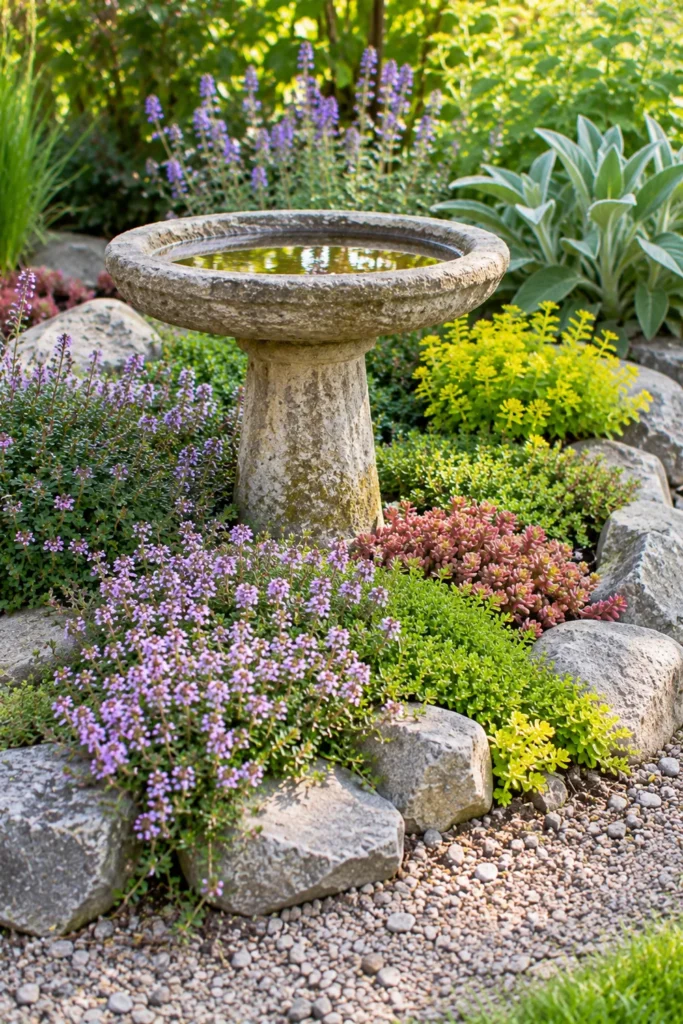
Birds know a good water source when they see one. Put a stone birdbath at the center of a small rock garden and you get a focal point for you and a daily stop for them.
Widen the view and the planting works as a frame. Low mats of creeping thyme and sedum spread out from the base of the birdbath, with a ring of medium-sized rocks between them. The short plants keep the area open, so birds can spot danger as they come in to drink. In the soft morning light, the still water and gray stone look calm and simple.
Rinse and refill the birdbath every few days. Fresh, shallow water brings far more visitors than a stale bowl.
17. Budget Rock Garden With Free Fieldstone
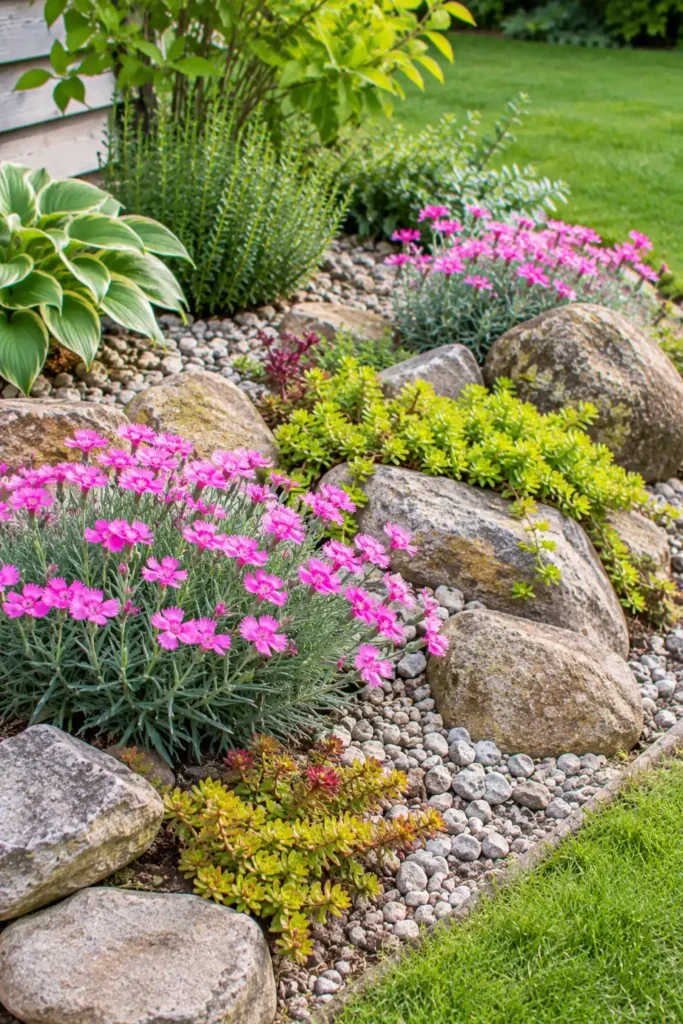
Stone is the most expensive part of a rock garden, so the cheapest one starts with rocks you don’t have to buy. Collect fieldstone from your own yard, or ask neighbors, local farmers or building sites before they haul theirs away. Then plant dianthus and creeping sedum in the gaps.
The plants are just as easy on the budget. Dianthus, also called pinks, forms tidy mounds of gray-green leaves with clove-scented flowers. Creeping sedum spreads fast from small pieces. Matching your stone to the local rock also makes the garden look natural, which is one of the smartest rock garden ideas on a budget.
Clear grass and weeds, roots included, before you place any stone.
Top-dress with a layer of gravel or grit to block weed seeds.
Pull new weeds while they are small, before they root between rocks.
Plastic sheeting under the bed, which traps water and suffocates soil.
Landscape fabric where you plan to grow spreading groundcovers.
Building over grass that is still alive, since it will grow back through.
18. Black Pebble Modern Bed With Euphorbia and Blue Fescue
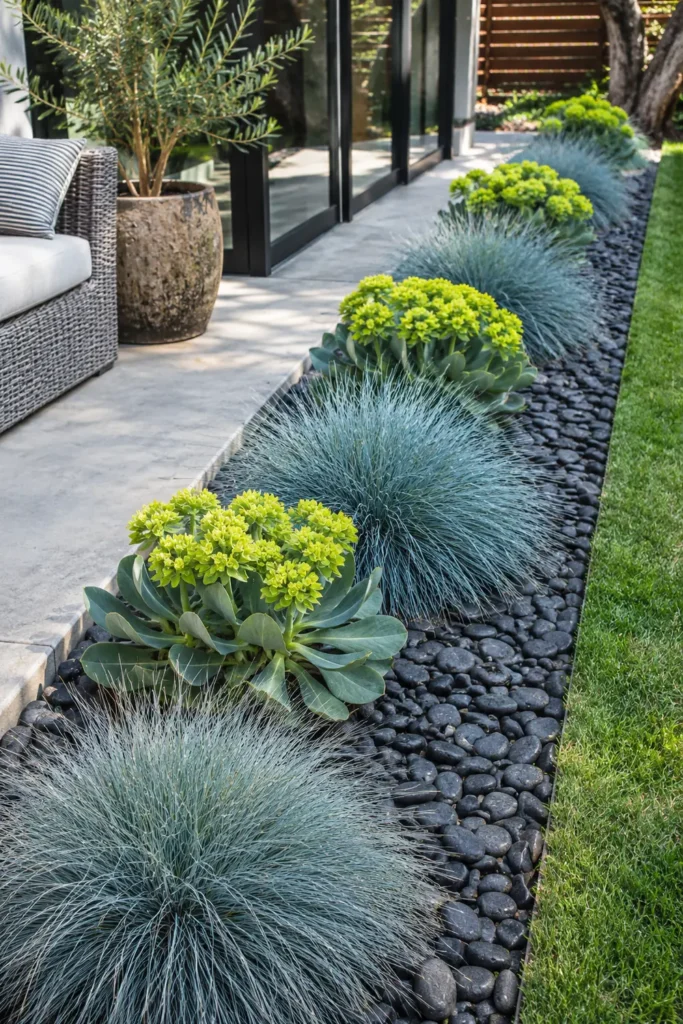
Pale gravel gives a soft, natural look. Smooth black pebbles do the opposite. They make every plant pop like it’s sitting on a dark stage, which is why this modern bed along a patio edge looks so crisp on a clear day.
Blue fescue’s silver-blue mounds and euphorbia’s chunky blue-green leaves and lime-yellow flower heads stand out sharply against the dark stone. Keep the layout simple, with plants spaced in a loose grid or repeating line, and let the black pebbles fill everything in between. Black stone also warms up fast in the sun, which these sun-loving plants don’t mind.
Wear gloves when you trim euphorbia. Its milky sap can irritate skin and eyes.
19. Boulder Waterfall on a Gentle Slope
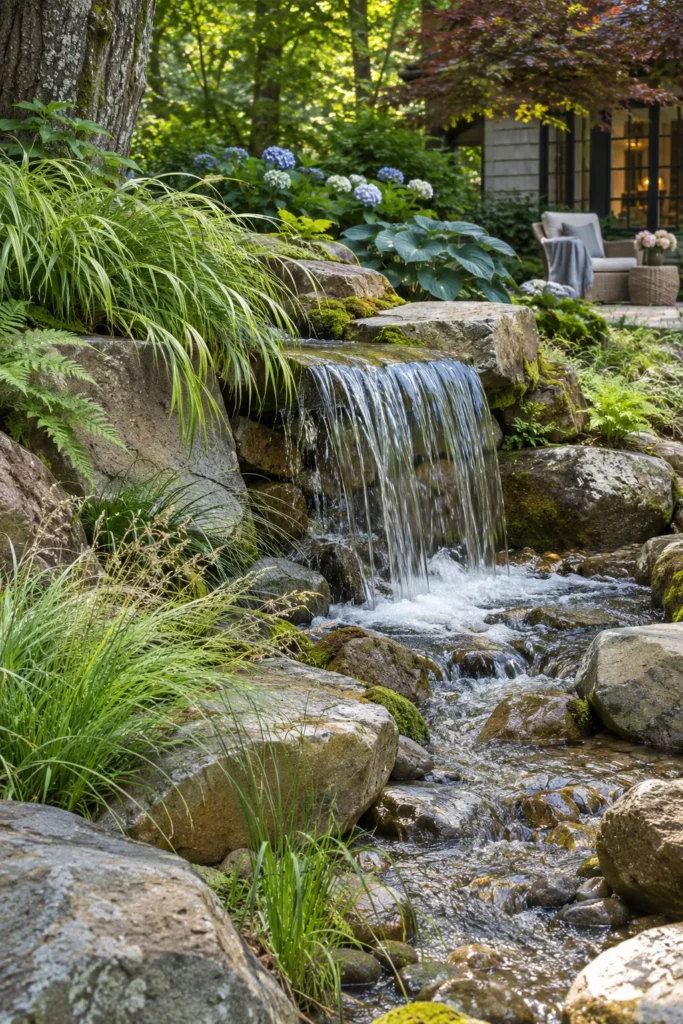
The sound of moving water changes how a backyard feels. A small waterfall made from stacked boulders on a gentle slope adds that sound and gives the rock garden a natural focal point. Japanese forest grass and sedges soften the edges.
Japanese forest grass has arching, bamboo-like blades that cascade toward the water, echoing the falling stream. Sedges add fine, grassy texture between the rocks. Both like moist soil and part shade, which suits the cool, damp zone right beside a waterfall. Placing the largest, flattest stone at the lip makes the water fall in a clean sheet. These water feature ideas show other ways to frame it with stone.
Garden note: The pump that runs the waterfall needs power. Have a licensed electrician install an outdoor outlet or run the wiring, and never put DIY extension cords near water.
20. Stone Spiral Herb Garden Near the Kitchen Door
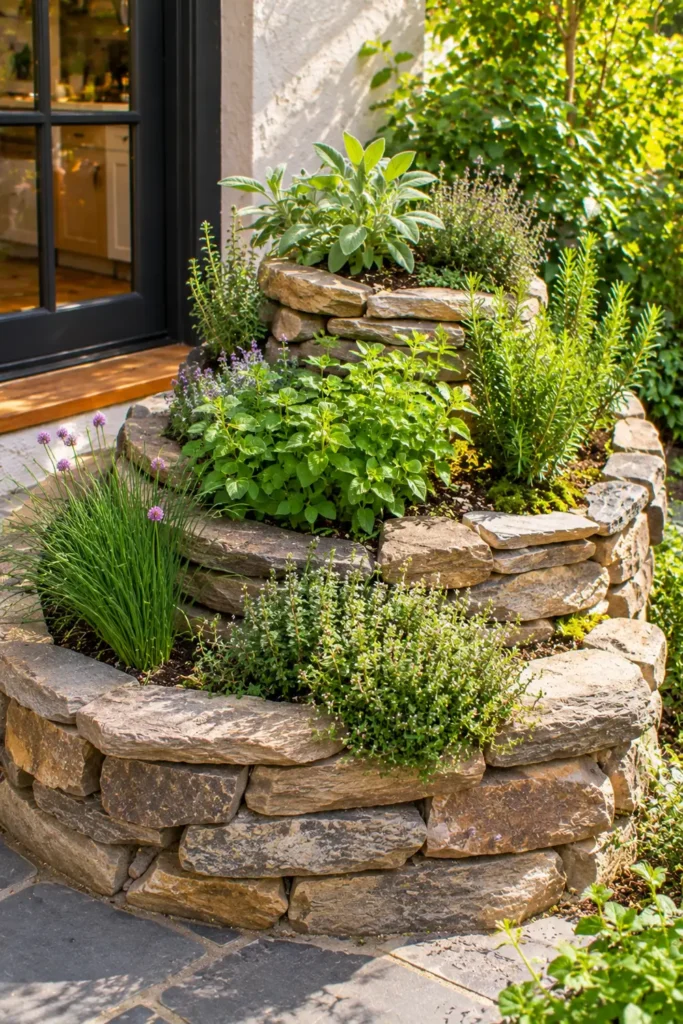
An herb spiral is a coil of stacked stone that rises in the middle, with soil filling the spiral like a shell. Built near the kitchen door in a sunny spot, it packs a whole herb garden into a small circle and puts every plant within easy reach.
The shape creates different growing conditions in one bed. The top of the spiral stays dry and sunny, so thyme, oregano and sage go up high. Water drains down to the base, where the soil stays moister, so chives sit at the bottom. The stacked stone also soaks up warmth during the day, which these Mediterranean herbs enjoy.
Plant the look: flat stacked stones in a rising spiral, thyme, oregano and sage near the top, chives at the base.
21. Corner Rockery With Dwarf Conifers
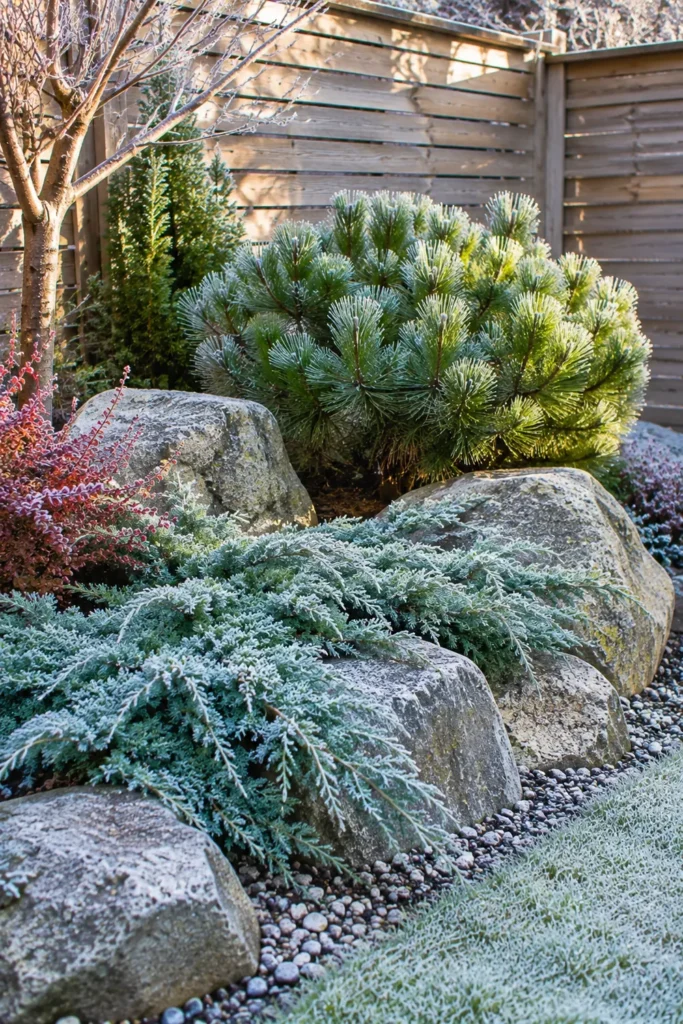
On a frosty winter morning, the needles of a dwarf mugo pine catch the light while the rest of the garden sleeps. That’s the reason to build a rock garden around dwarf conifers. They give it shape and color in the season when most plants disappear.
Step back and the corner reads as a small, rugged mountain scene. A dwarf mugo pine sits behind a few large rocks, and creeping juniper spreads low across the stones in front, its blue-green branches flowing over the edges like water. The mix of an upright form and a creeping one gives the corner height and width. Both plants handle full sun and well-drained soil, and both stay green all year.
Check the plant tag for the mature size. “Dwarf” conifers grow slowly, but some still get bigger than you’d expect after ten years.
22. Gravel Garden of Ornamental Grasses Along the Fence
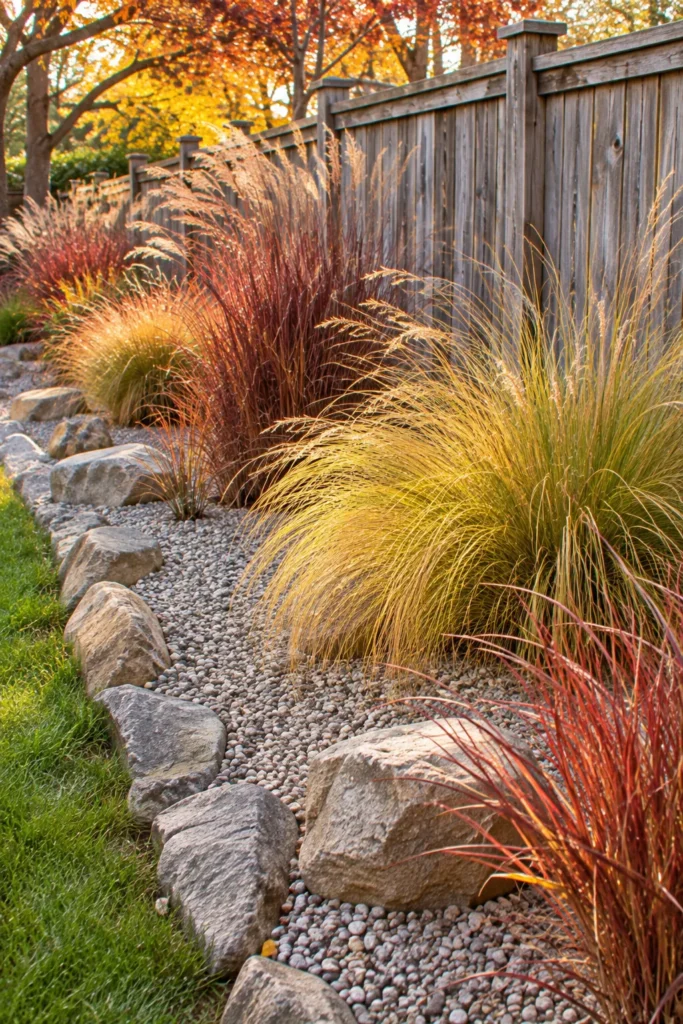
A long fence line can feel flat and empty, and a strip of lawn beside it is a pain to mow. A gravel garden of ornamental grasses solves both problems. Pea gravel replaces the grass, and drifts of little bluestem and prairie dropseed soften the fence.
These two grasses shine in fall. Little bluestem turns shades of copper and red, and prairie dropseed glows gold and orange. Against the gray gravel and a weathered wood fence, the warm colors look rich in low autumn light. Plant them in drifts of three or five instead of one of each, so the bed reads as a planned planting, not a collection.
Cut the grasses back in late winter, just before new growth starts, and leave them standing until then for winter interest.
23. Rock Garden Lit at Night
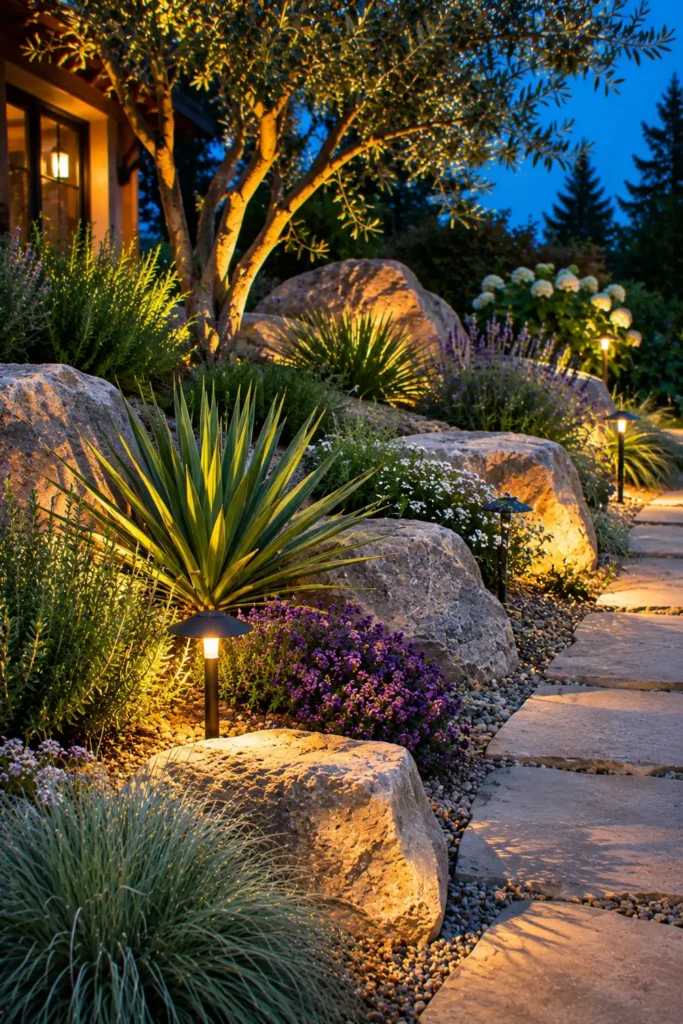
Low path lights tucked among boulders and yucca change a rock garden completely after dark. The light skims across the rough faces of the stones, throws long shadows from the spiky yucca leaves and makes the garden feel like an outdoor room at dusk.
Aim lights up at the textured side of a boulder or the base of a plant instead of straight out at eye level. That way, you see the glow and not the bulb. Solar path lights are the easiest place to start, since they need no wiring at all. These outdoor lighting ideas for a backyard cover more ways to layer the light.
Garden note: For hardwired or low-voltage systems, have a licensed electrician handle the power supply and any connections to the house.
24. River Rock and Boulder Border Along the Patio Edge
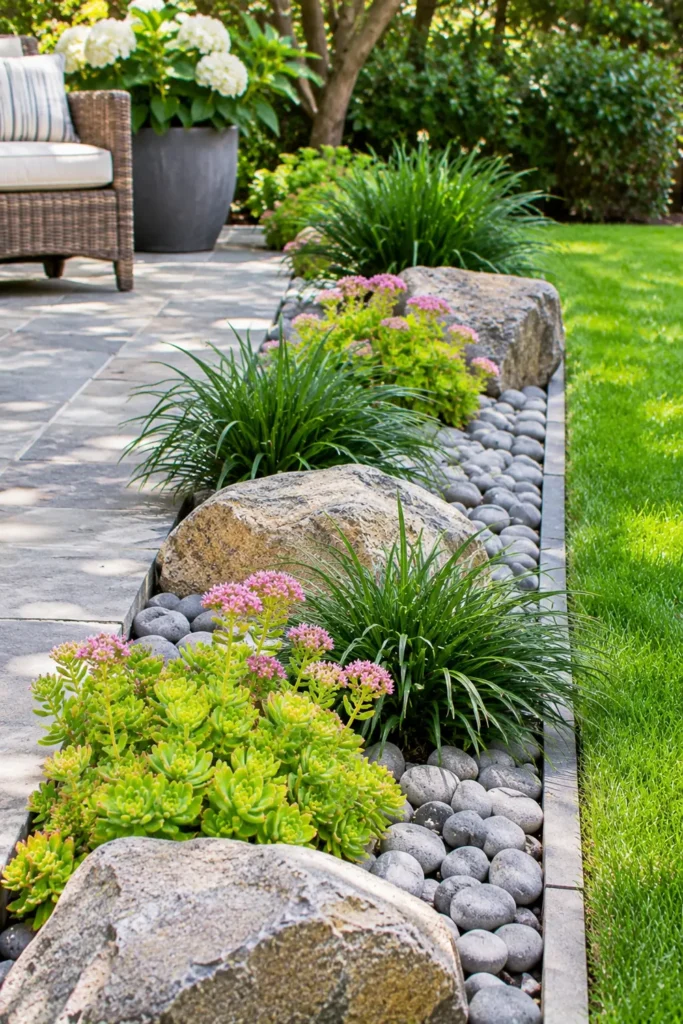
Where the patio ends and the lawn begins is often the messiest spot in a yard. A neat border of river rock and a few low boulders cleans up that edge, while sedum and mondo grass add soft green texture.
Compare it to a strip of mulch and the difference is clear. River rock doesn’t wash onto the patio after rain or need topping up every spring, and the low boulders give the border structure at midday when the light is harsh. The fine, dark green blades of mondo grass and the plump leaves of sedum make the rounded stones look smoother by contrast. Clean, straight edges keep the border looking modern.
Use the same color stone as the patio pavers, or one shade darker, so the border and patio read as one design.
25. Spring Bulb Rock Garden With Crocus and Species Tulips
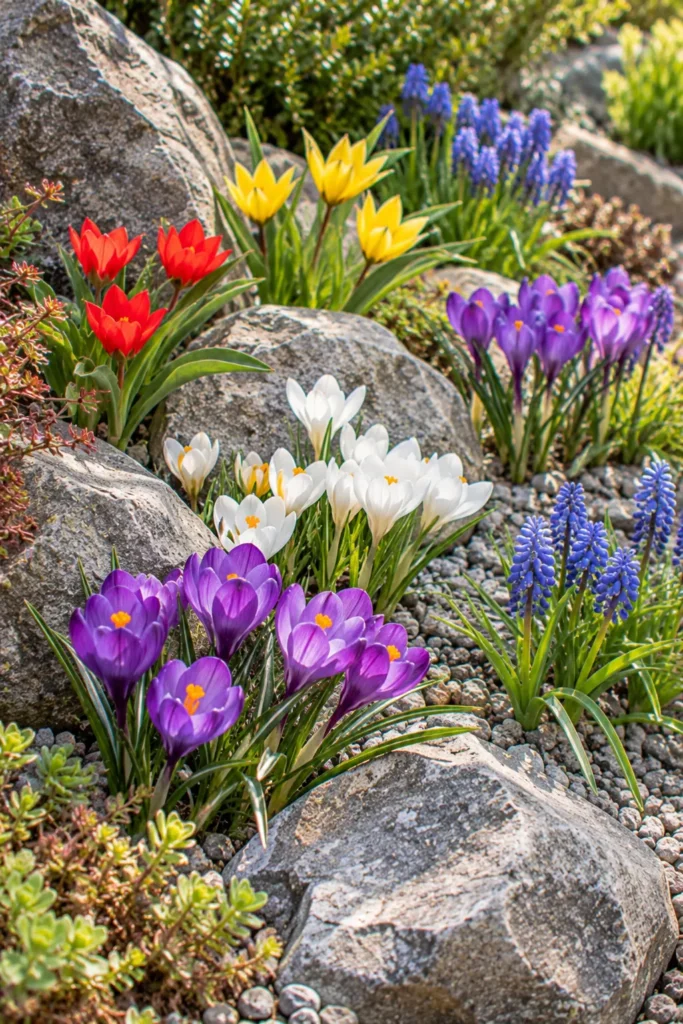
Fall is the time to plant this one. Small spring bulbs tucked between rocks in autumn turn a sleepy rock garden into the first color show of the year. Crocus open first, followed by small species tulips and grape hyacinth.
Small bulbs suit rock gardens better than tall hybrid tulips. They stay in scale with the stones and low plants, and many of them like the sharp drainage and warm, sunny pockets between rocks. Species tulips are also more likely to come back year after year than big hybrid types. Plant bulbs in loose clusters, not single lines, so they look natural when they bloom.
Plant the look: crocus in purple and white, small species tulips in red and yellow, grape hyacinth, gray rocks and gravel.
Grape hyacinth spreads by seed and offsets, so expect more of it each spring.
How to Build a Rock Garden That Lasts
Every idea in this list comes down to the same three choices. First, choose the right site. Full sun and good drainage suit most rock garden plants, and a slope or a raised berm helps water drain away. Second, choose the right soil. A gritty mix of soil and fine gravel keeps roots from sitting wet. Third, choose stone that fits your yard, and set it partly into the ground so it looks natural. Mix sizes, group boulders in odd numbers, and finish with a layer of gravel or grit.
| Rock type | Looks like | Best use in a rock garden |
|---|---|---|
| Boulders | Large, rugged stones with strong shapes | Focal points, berms, seating, waterfalls |
| River rock | Smooth, rounded stones in gray and tan | Dry creek beds, paths, patio borders |
| Gravel and grit | Small loose stone in many colors | Top-dressing, zen gardens, gravel gardens |
| Flagstone | Flat, layered slabs | Crevice gardens, steps, pond edges |
| Fieldstone | Weathered local stone, often mossy | Budget gardens, shade gardens, dry stone walls |
| Decomposed granite | Fine, sandy crushed rock that packs firm | Desert gardens and walkable surfaces |
Backyard Rock Garden FAQ
What plants grow best in a rock garden?
Low, tough plants that like sun and sharp drainage do best. Creeping thyme, sedum, hens and chicks, dianthus, creeping phlox and alpine plants are classics. Hot, dry yards suit succulents, and these succulent rock garden ideas show more. In shade, use ferns, moss and heuchera instead.
How do you build a rock garden?
Pick a sunny spot, then clear the grass and weeds. Build up a mound or bed of gritty, fast-draining soil. Set the largest rocks first, burying each one partly, then fill in with smaller stones. Plant between the rocks and finish with a layer of gravel or grit.
Do you need landscape fabric under a rock garden?
Not always. Fabric can help under pure gravel areas, but it gets in the way where groundcovers need to spread and root. Weeds can also grow in soil that collects on top of it. Clearing weeds thoroughly first and top-dressing with gravel works well for most planted rock gardens.
Can you have a rock garden in the shade?
Yes. A shady rock garden uses different plants and slightly richer soil. Mossy fieldstone, ferns, heuchera and hostas all look natural among rocks in dappled light. Idea 4 shows a shady version under a maple tree, and idea 19 uses shade-loving grasses beside a waterfall.
Do rock gardens need much water?
Once established, most rock gardens need very little water, which is a big part of their appeal. Water new plants regularly for their first season while roots settle in. After that, many sunny rock garden plants only need water during long dry spells, and desert plants need even less.
Conclusion
The best backyard rock garden ideas start with the stone you have and the light you get. A sunny slope wants thyme, sedum and alpines. A shady corner wants mossy fieldstone and ferns. A hot, dry strip wants succulents and gravel. Get the drainage right, mix your stone sizes and set the rocks into the ground, and the garden will look more natural every year. If you love working with stone, these front yard ideas with rocks carry the same look out to the street.
Pin this for the next time you’re planning a weekend project in the yard.