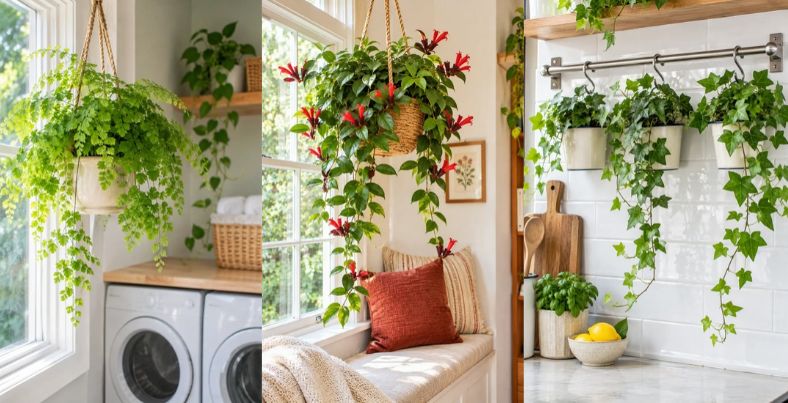
Every houseplant collection eventually runs out of floor. The windowsills fill up, the shelves get crowded, and the only space left is the air above your head. That is where these indoor hanging plant ideas come in.
A hanging plant does more than save room. Trailing houseplants draw the eye up, soften hard corners and make a plain window look finished. A golden pothos spilling out of a macrame hanger can do more for a living room than a new rug.
Below are 25 ideas, each one a single plant in a single room. There are picks for bright windows and dim corners, steamy bathrooms and busy kitchens, a studio apartment and a stair landing. Each entry names the plant, the hanger that suits it and the light it needs, so you can match the idea to your own space. Along the way you’ll find no-drill options for renters, notes on which plants are safe around pets, and honest advice about the few plants that hate being moved.
Before You Hang: Light, Weight and Watering
Before you choose a plant, check three things about the spot. First, how much light does it get? A bright window, a steamy bathroom and a dim corner each suit different plants. Second, what will hold the weight? A wet pot is much heavier than a dry one, so heavy plants need a hook in a ceiling joist, while light ones can go on a tension rod or a floor stand. Third, how will you water it? Hang it where you can reach it easily, or plan to take it down to the sink.
1. Golden Pothos in a Cream Macrame Hanger by the Living Room Window
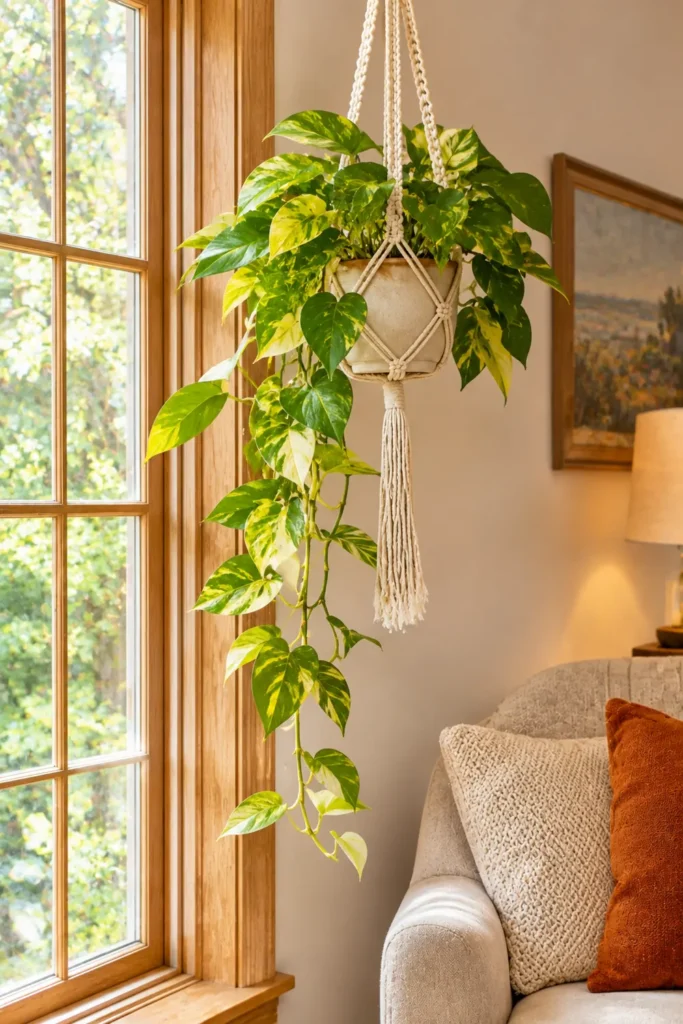
Golden pothos is the plant most people start with, and there is a reason it never gets old. Its heart-shaped leaves, marbled with butter yellow, trail happily in bright indirect light and forgive the odd missed watering.
Hang it in a cream cotton macrame hanger a little to one side of a living room window, not right against the glass. The soft knots and the warm oak window frame make the green and gold leaves glow, and the vines have room to fall without blocking the view. When they get too long, snip the ends and propagate the pothos cuttings to fill a second pot.
Pothos is toxic to cats and dogs if chewed, which is one more good reason to keep it up high.
2. Boston Fern Hanging Above a Bathtub
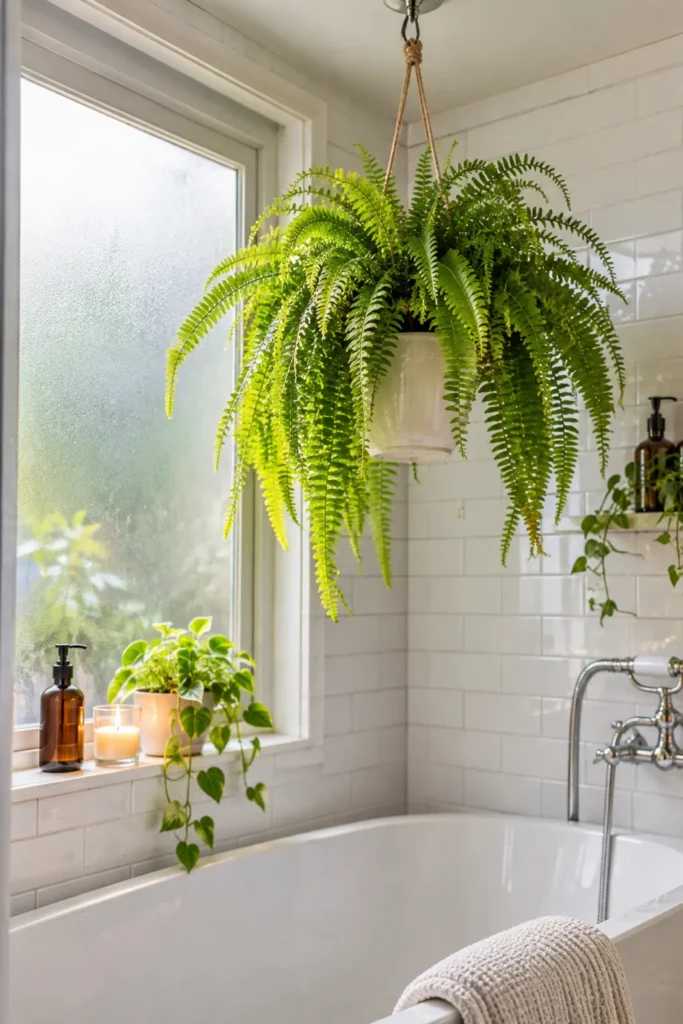
Boston ferns crisp up fast in dry rooms. A bathroom fixes that. The steam from a daily bath or shower gives the fern the humidity it wants, and soft daylight through a frosted window gives it the bright, gentle light it needs.
Here, a full fern sits in a white glazed hanging pot on a ceiling hook above the tub. Its arching fronds soften all that hard white tile, which is why ferns are among the best hanging plants for bathrooms. Hang it where steam reaches but the shower spray does not.
A wet fern in a ceramic pot is heavy, so screw the hook into a ceiling joist or use a rated anchor. Boston fern is widely listed as safe for cats and dogs.
3. Spider Plants on a Tension Rod Across the Kitchen Window
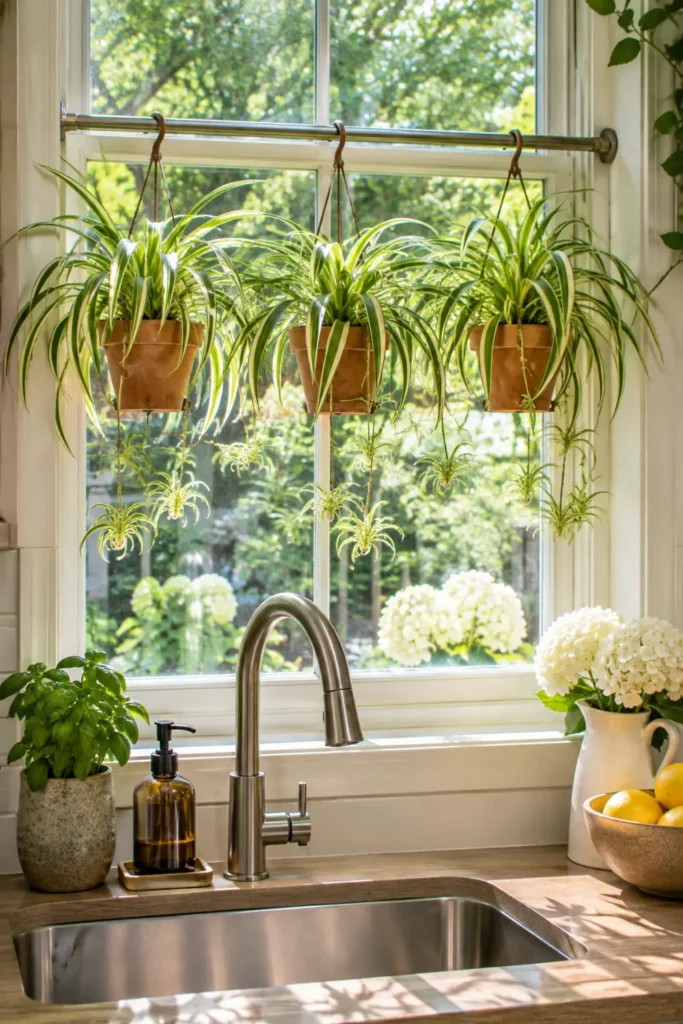
Renters, this one is for you. A tension rod wedged inside a kitchen window frame needs no drilling, and a few S hooks turn it into a hanging rail. Three spider plants in small terracotta pots hang along it, catching the morning light over the sink.
Spider plants are some of the easiest indoor hanging plants to keep alive, and they put on a show once settled. They send out arching stems tipped with baby plantlets that dangle below the pots. Keep the pots small and light, because a tension rod holds far less than a ceiling hook, so check the weight its packaging lists.
Ceiling Hook vs No Drill Tension Rod
Best for: large ferns, ceramic pots and any plant that gets heavy when watered.
Renter friendly: only if your lease allows small holes.
Keep in mind: screw it into a joist or use an anchor rated for the weight.
Best for: small, light pots inside a window frame or alcove.
Renter friendly: yes, it leaves no holes.
Keep in mind: it can slip under heavy loads, so stay within its listed weight.
4. Staghorn Fern Mounted on a Walnut Board in the Dining Room
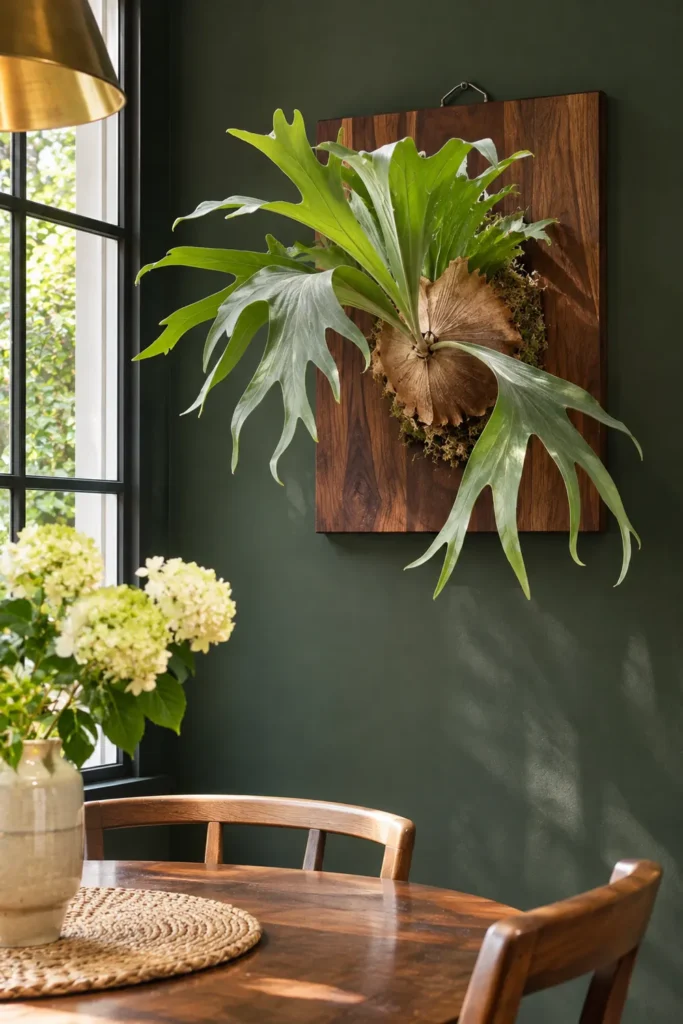
Those antler-shaped fronds are what stop people mid-sentence at dinner. A staghorn fern grows naturally on trees, not in soil. That means you can mount it on a dark walnut board and hang it on the wall like a piece of art.
Seen from across the room, the setup makes sense. A deep green dining room wall and the dark wood make the silvery green fronds stand out, and the board keeps the plant flat against the wall instead of swinging into the room. Hang it near a bright window, out of direct afternoon sun, at about eye level, the way you would hang a painting.
To water, take the board down and soak the root ball in the sink until it feels heavy. Let it drip dry before you hang it back up.
5. String of Pearls in a Leather Strap Hanger Over a Sunny Desk
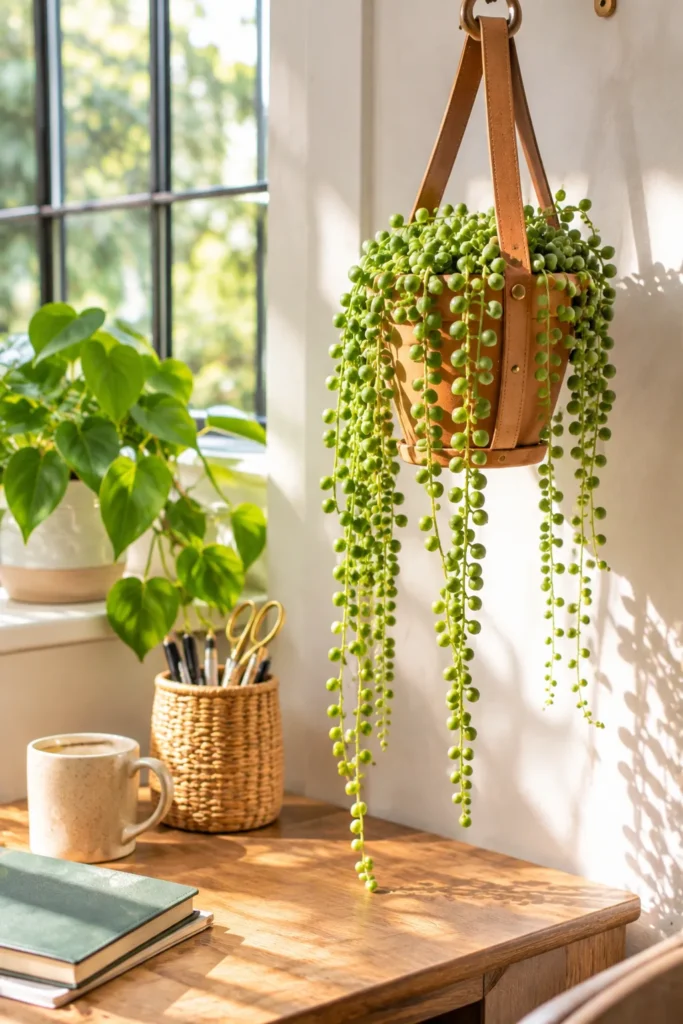
In a dim corner, string of pearls thins out and looks sad. Near a bright window, it fills its pot with long strands of round green beads that hang like a bead curtain.
That’s why it belongs in a home office with good light, hung from a tan leather strap hanger beside the desk. A small terracotta pot matters here. Terracotta dries out faster than glazed pots, which suits a succulent that rots if its soil stays wet. The warm clay and leather also pick up the wood of the desk, so the corner feels pulled together.
Hang it to the side of your workspace, not over the keyboard, so watering never drips on anything. Keep it out of reach of curious animals too, since string of pearls can be toxic to pets.
6. Heartleaf Philodendron Trailing Down a Tall Bookshelf
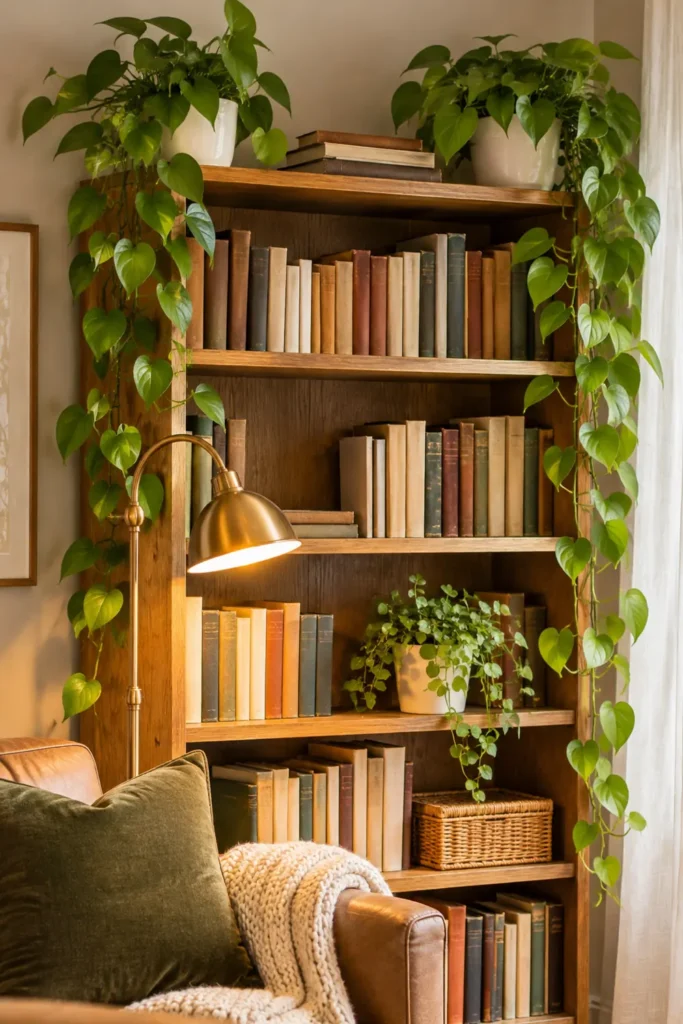
Not every hanging plant needs a hook. Set a heartleaf philodendron on the top shelf of a tall oak bookshelf and let it do the hanging for you.
Its glossy, heart-shaped leaves trail down the sides of the shelf and frame the books, which softens all those hard rectangles. It also handles medium to low light, so it suits a reading nook lit mostly by a lamp. Use two pots at opposite top corners and the vines frame the shelf evenly. Like pothos, it is toxic if pets chew it, so keep the vines trimmed above nose level.
Get the look: an oak bookshelf, two heartleaf philodendrons in matte white pots, a brass reading lamp, a stack of well-worn books.
7. Air Plants in Glass Globes at a Bedroom Window
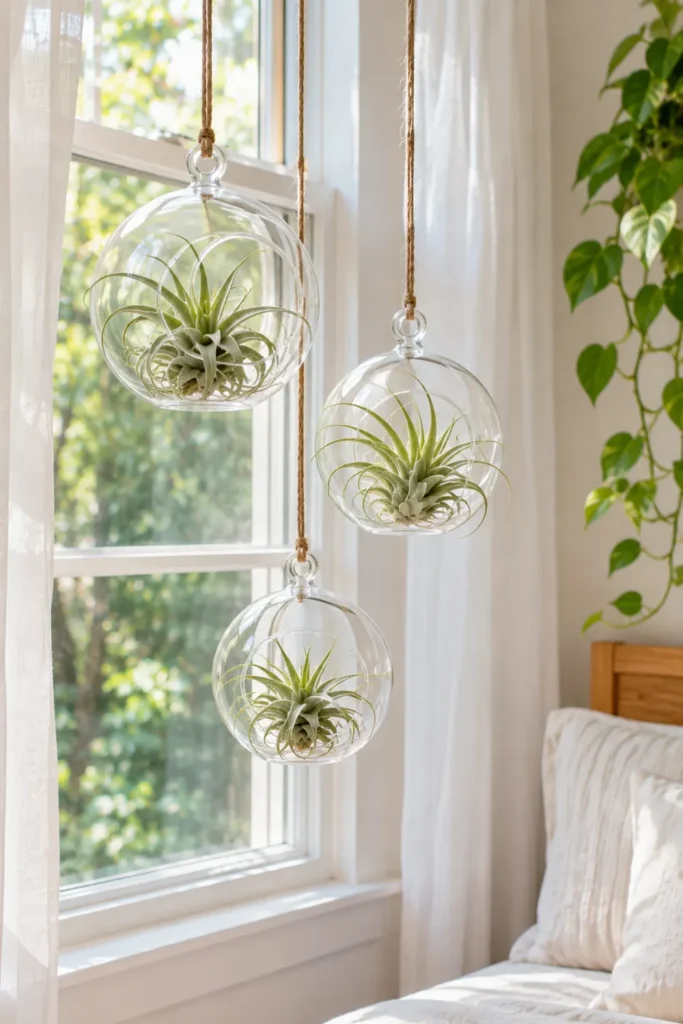
Air plants need no soil at all, which makes them the lightest hanging plants you can grow. Here, a handful of them sit in clear glass globes hung at three heights in a bright bedroom window.
The clear glass lets light reach the plants from every side, so their silvery, spiky leaves look like they are floating in the window. The airy white room keeps the focus on their shapes.
Styling note: Hang the globes at uneven heights in an odd number, and choose open globes over sealed ones. To water, take the plants out, soak them in water and shake them dry. Then put them back. A wet air plant sitting in a closed globe can rot.
8. Hoya in a Rattan Basket in the Sunroom
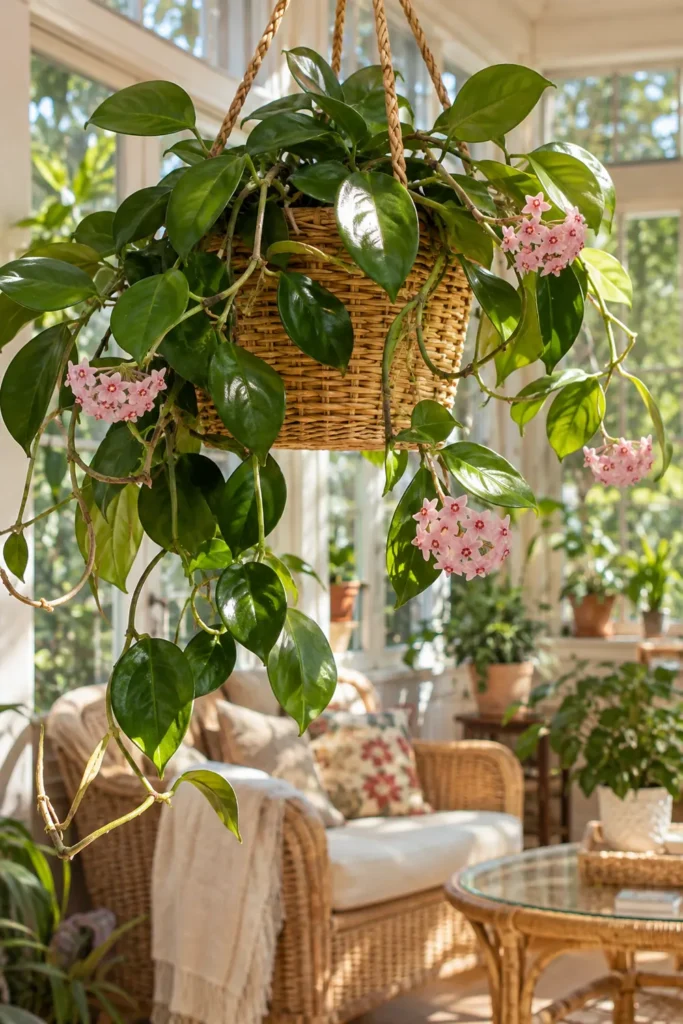
Hoya, often called wax plant, earns its name with thick, glossy leaves that look almost polished. Give it the bright light of a sunroom and it may produce round clusters of pink, star-shaped flowers that look like they were made from sugar.
A rattan hanging basket with a plastic liner suits its long, ropy stems, and the cane picks up the wicker furniture and warm light of the room. Hoyas tend to bloom best when their roots are a little snug, so resist moving yours to a much bigger pot. Leave the old flower stalks in place after the blooms fade, because new flowers often grow from the same spots.
🌿 Garden Tip
The easiest way to water a hanging plant is to take it down. Water it at the sink, let it drain until the dripping stops, then hang it back up. If you water it in place, use a pot with a built in saucer or a liner so water never lands on the floor or furniture below.
9. Christmas Cactus Hanging in the Entryway for Winter Color
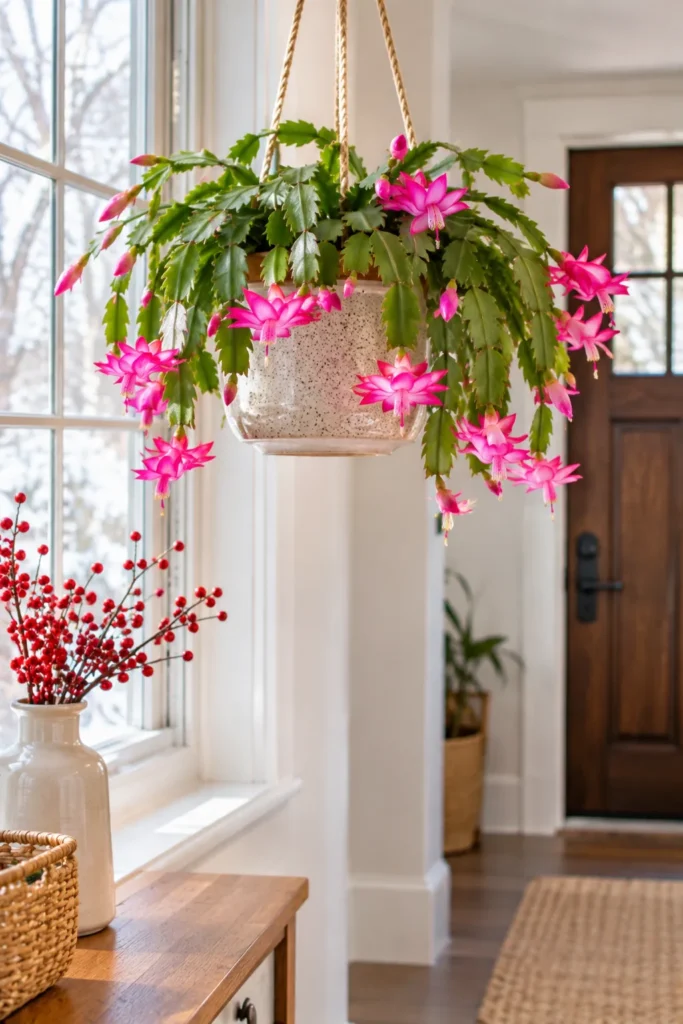
Entryways look bare in winter, and a Christmas cactus in bloom is a cheerful fix. Its flat, segmented stems arch naturally over the edge of a hanging pot, and in the darker months it covers the tips with pink flowers. A speckled ceramic hanging pot near a bright entryway window shows the arching shape best.
It is also widely listed as safe for cats and dogs, so it works in pet homes where many trailing plants do not.
Garden note: Once buds form, leave the plant where it is. Moving it or putting it in a cold draft from the front door can make it drop its buds. Hang it on the window side of the entryway, away from the door. For the rest of the year, these Christmas cactus care basics keep it ready to bloom again.
10. Swiss Cheese Vine in a Black Metal Hanger on the Stair Landing
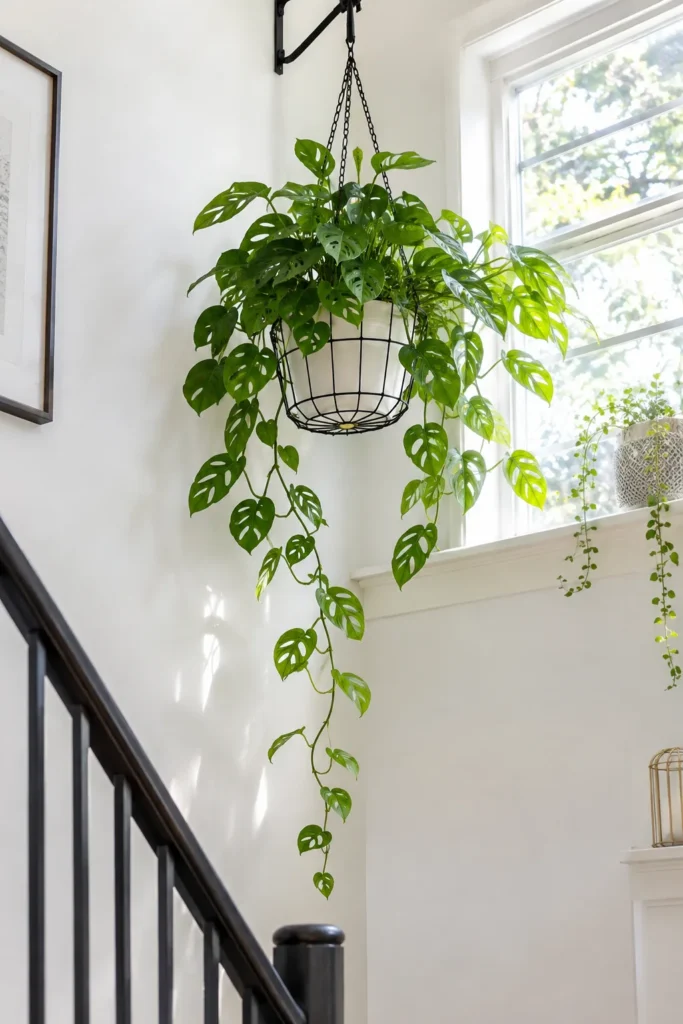
The holes in its leaves are the whole charm. Swiss cheese vine has oval leaves dotted with natural openings, and those gaps let light through, so even a big plant looks airy instead of heavy.
That makes it a smart pick for a stair landing, where a solid mass of leaves could feel crowded. A black metal wire hanger repeats the line of the stair railing, and the deep green leaves stand out against a white wall in bright indirect light from the landing window. Hang it high enough that no one brushes it on the way up, and close enough to the window to keep the growth full. Swiss cheese vine is toxic to pets if chewed.
Get the look: a black wire hanging planter, a Swiss cheese vine in a white pot, a white wall, a bright stair landing window.
11. Three Tier Jute Hanger With String of Hearts and String of Turtles
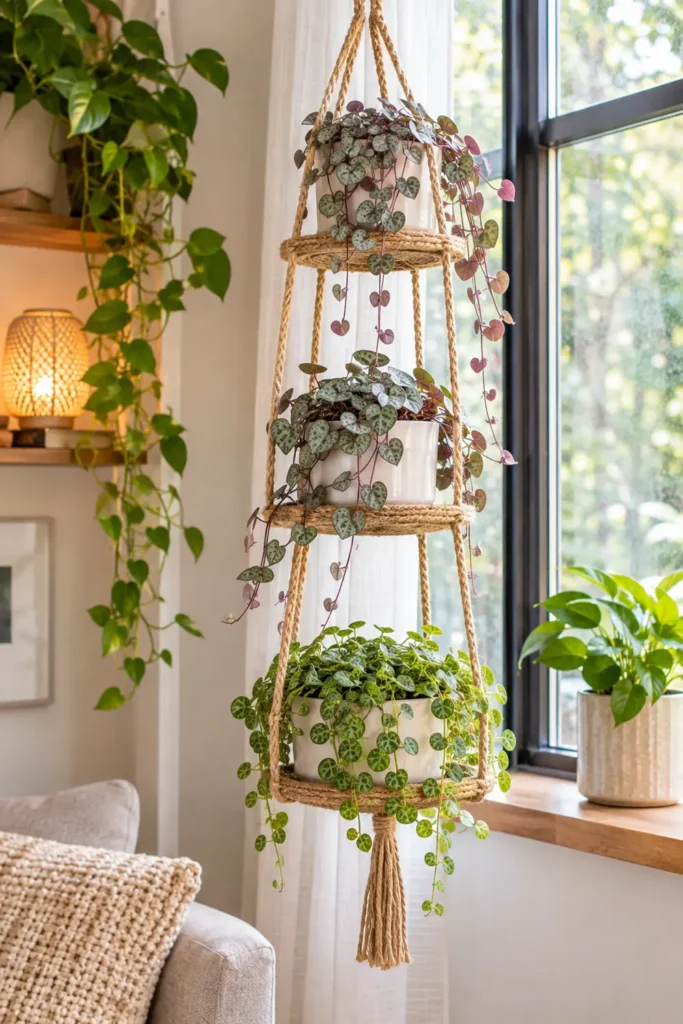
These two trailing succulents share a love of bright, indirect light and soil that dries out between waterings. That makes them easy roommates in a three tier jute macrame hanger at a studio apartment window. String of hearts sends down thin purple stems lined with small, silvery heart-shaped leaves. String of turtles stays shorter, with tiny round leaves patterned like little turtle shells.
Stacking the pots in one hanger gives a small apartment a full column of green while using one hook and almost no floor. The fine hearts above and the chunkier turtles below keep the eye moving down the hanger. For longer strands, here is how growing string of hearts plants works best.
Turn the hanger every week or two so every side gets its share of light.
12. English Ivy on a Kitchen Rail With S Hooks
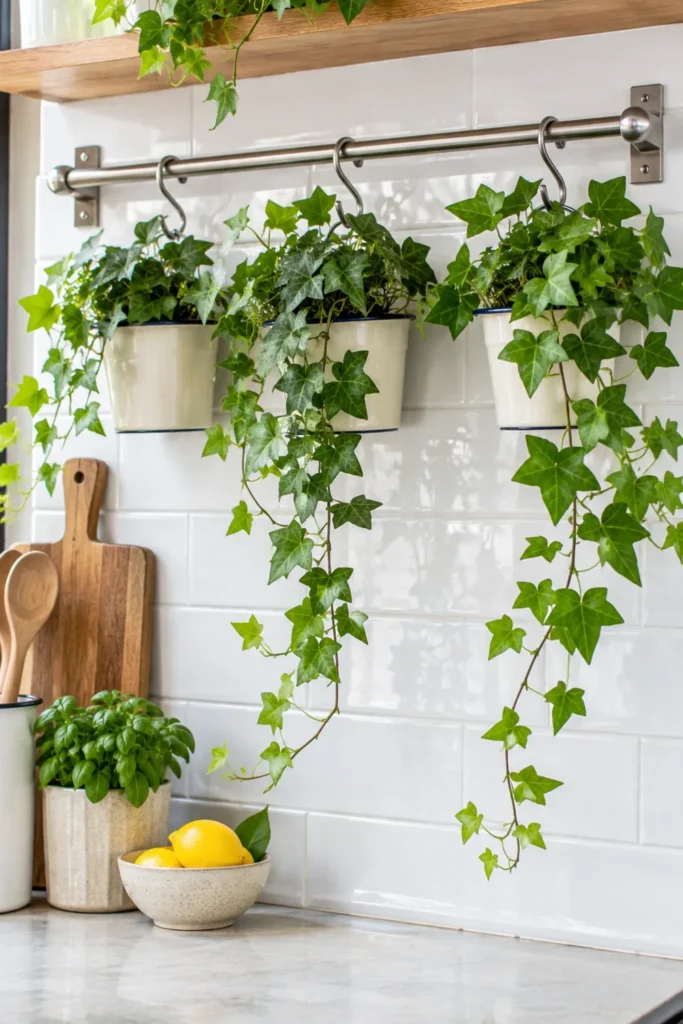
Kitchen counters fill up fast, so put the plants on the wall instead. A slim steel rail along the backsplash, the kind meant for utensils, holds small enamel pots on S hooks. English ivy trails from each one.
Ivy likes a cool, bright spot, which many kitchens offer away from the stove. The deep green, pointed leaves look sharp against white tile, and the rail keeps them off the counter where you prep food. Rinse the leaves under the tap now and then. Warm, dry air invites spider mites, and a quick shower keeps them away.
English ivy is toxic to pets if eaten. It can also be invasive outdoors in parts of the US, so keep this one inside.
13. Inch Plant in a White Ceramic Hanger Beside a Linen Bed
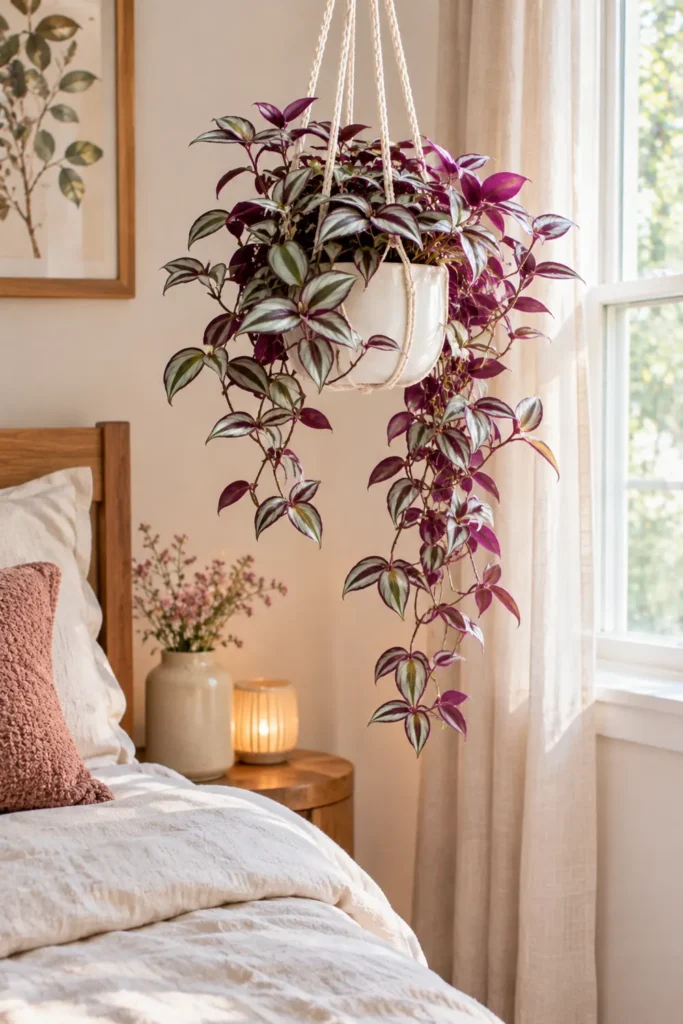
In bright, indirect light, an inch plant shows off leaves striped in purple and shimmering silver. In a dim corner, those stripes fade and the stems stretch out thin. The difference is so big that light is the only thing to plan for with this one.
Here, it hangs from a white ceramic hanger beside the bed, near an east window that gets soft morning light. The purple and silver look rich against pale linen bedding, and the white pot keeps the corner calm. Hang it to the side of the bed, not over it, so watering never drips on the pillows. Pinch off the stem tips every few weeks to keep the plant full.
14. Rhipsalis on a Driftwood Branch Hanger in a Boho Living Room
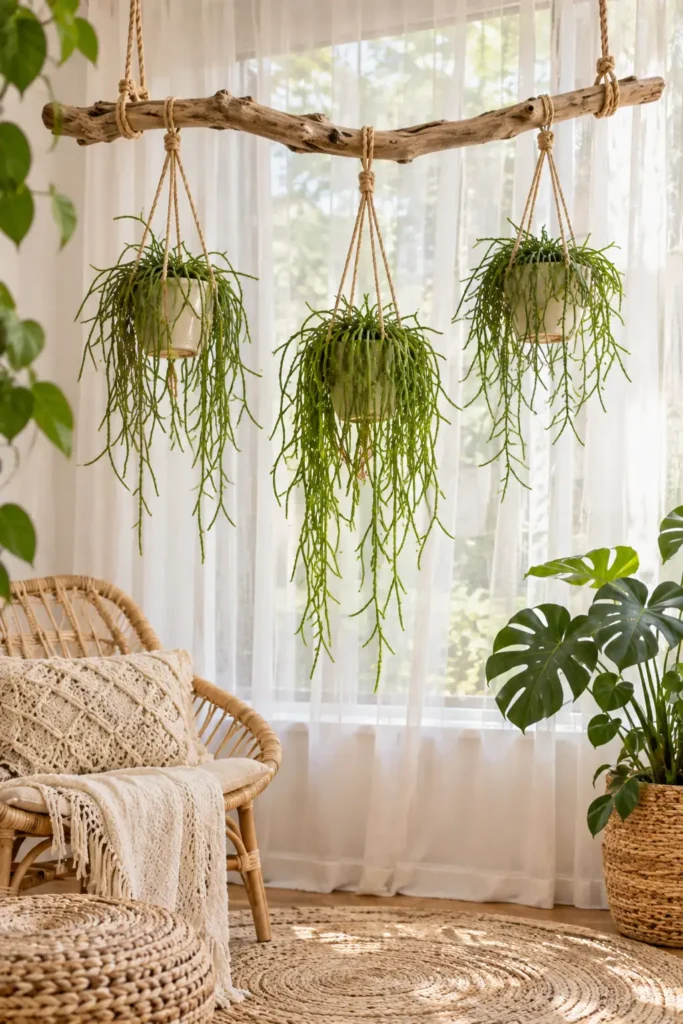
A bleached driftwood branch hung on two ropes is the star of this window. Three small pots of rhipsalis, also called mistletoe cactus, hang from it at different points.
Step back and the pairing makes sense. Rhipsalis is a jungle cactus with long, thin, pencil-like stems and no sharp spines, so it falls in soft green cascades that echo the pale, twisty wood. A jute rug and woven cushions finish the relaxed boho feel. Unlike desert cacti, rhipsalis likes filtered light and a bit more water. A window with a sheer curtain suits it well.
Hang the branch from two hooks, one near each end, so it stays level once the pots are watered.
15. Maidenhair Fern in a Humid Laundry Room
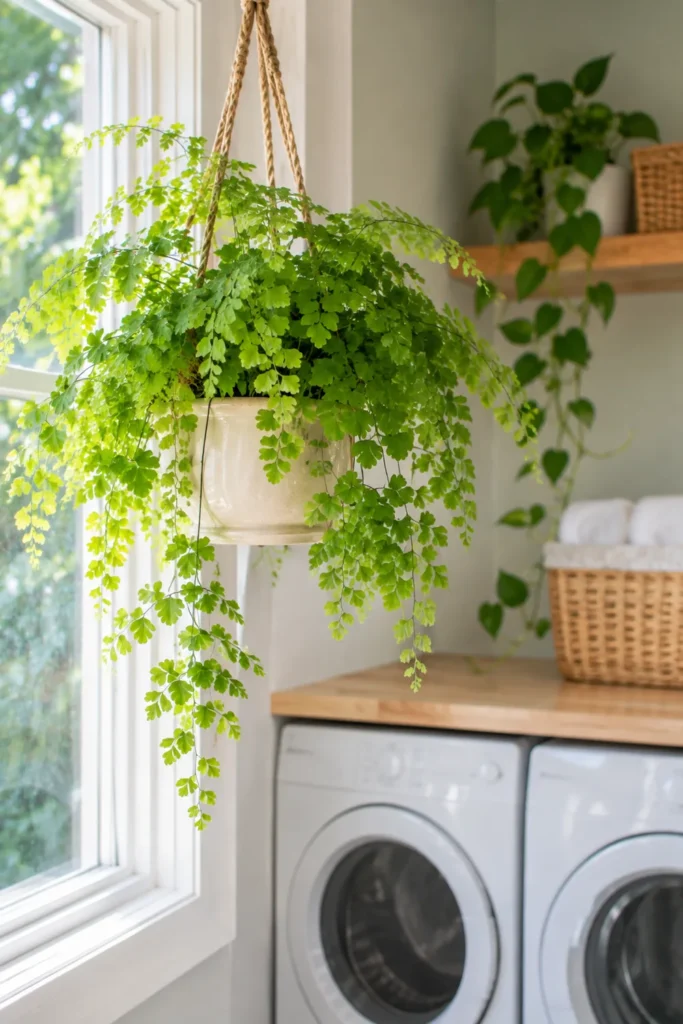
Maidenhair fern has a reputation as a diva, and it has earned it. Its fine black stems and fan-shaped leaflets look almost like lace, and they crisp up the moment the air or the soil gets dry.
A laundry room with a window is a surprisingly good fit. The washer and dryer add warmth and humidity, and the soft window light suits the fern. A hanging ceramic pot keeps the delicate fronds away from baskets and elbows.
Garden note: Never let a maidenhair dry out completely. Check the soil often and water when the top just starts to feel dry. Learning to water houseplants without overwatering is the skill that keeps this fern happy.
16. Lipstick Plant Above a Window Seat
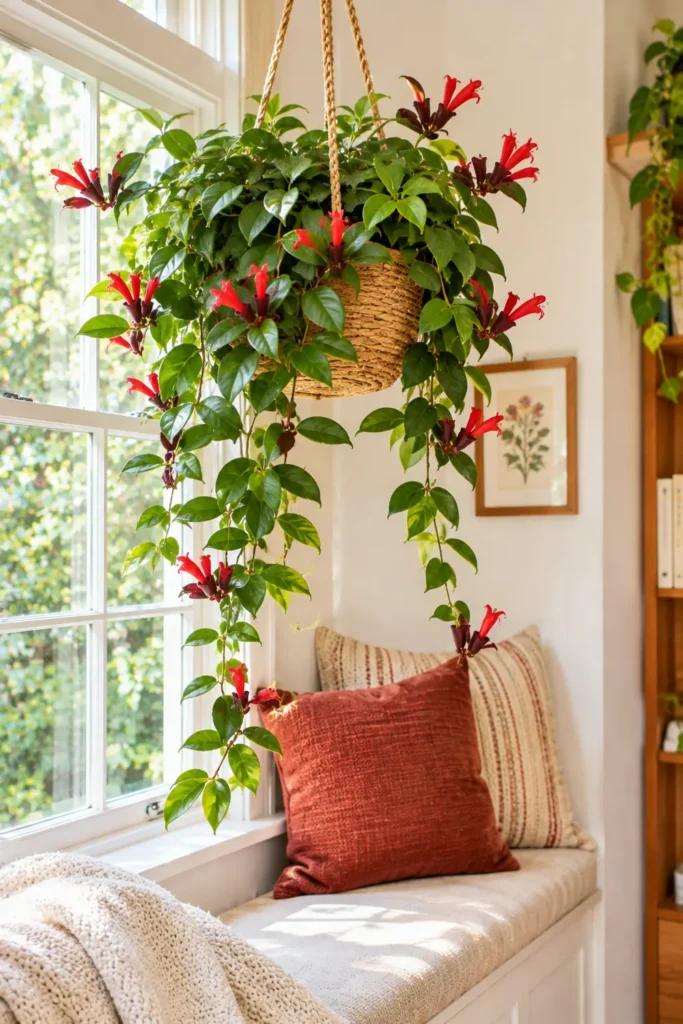
Red tubular flowers poke out of dark maroon buds like lipstick rising from its tube, which is exactly how this plant got its name. The rest of the year, the lipstick plant trails glossy, deep green leaves on long stems.
Hung in a woven basket above a window seat, it frames the view and puts the flowers at eye level for anyone curled up with a book. The bright, indirect light of a window seat is what it needs to bloom well. In a dim room it stays leafy but shy.
Trim the longest stems after flowering to keep the plant from looking leggy.
17. Kokedama Moss Balls Over a Dining Nook Window
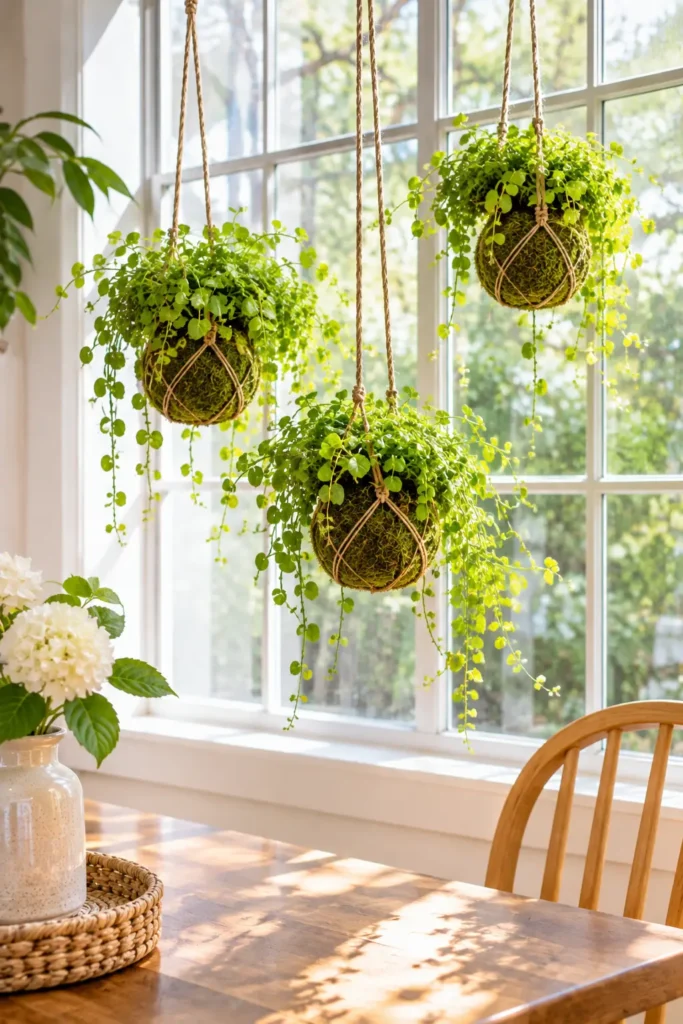
Kokedama is a Japanese way of growing plants in a ball of soil wrapped in moss and tied with string. No pot is needed, which makes it one of the most charming hanging planter ideas for a small dining nook. Here, three moss balls planted with baby’s tears hang on strings at staggered heights in the window.
The tiny round leaves of baby’s tears form soft green mounds over the moss, so each ball looks like a little floating hill. Against natural wood and a simple window, they read as living sculpture. To water, dip each ball in a bowl of water until the bubbles stop. Let it drip over the sink before you hang it back.
Get the look: three moss ball kokedama, baby’s tears, natural twine, a bright dining nook window, a plain wood table.
18. Rabbit’s Foot Fern in a Wire Basket in a Guest Bathroom
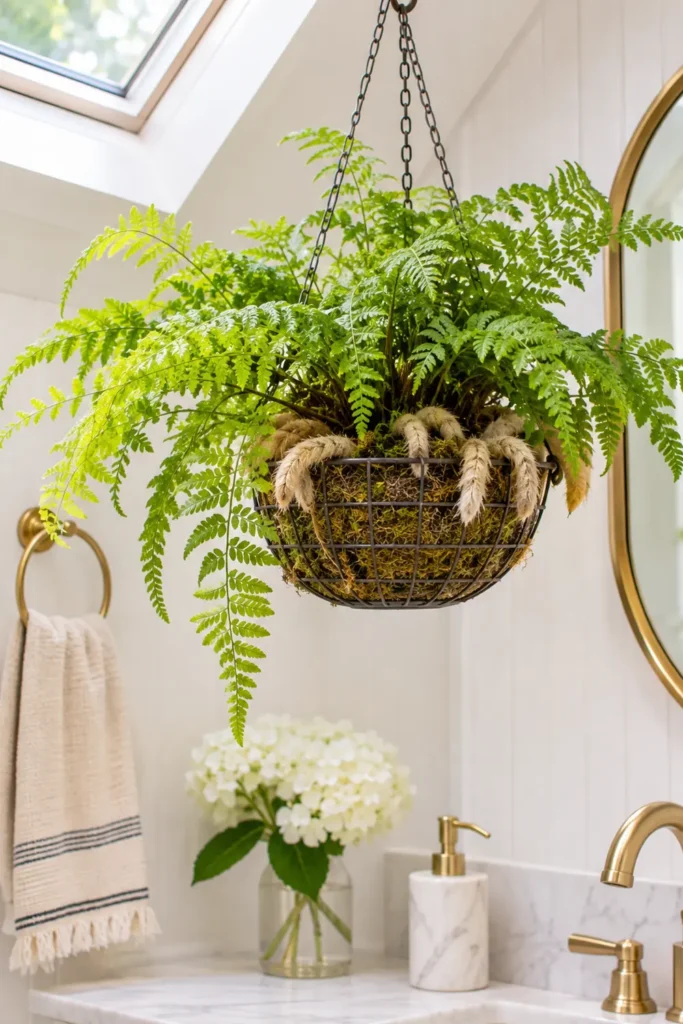
Guest bathrooms often get forgotten, but one with a skylight is a gift for ferns. A rabbit’s foot fern in a moss-lined wire basket makes the room feel looked after, and it asks for little in return.
The fun is in the fuzzy, light brown rhizomes, the creeping stems that crawl over the basket edge like small furry paws. Above them sits a cloud of lacy green fronds. The wire basket lets those rhizomes spill out where you can see them, and the skylight’s soft light keeps the fronds full.
Never bury the furry rhizomes in soil. They want to sit on top, and covering them can make them rot.
19. Satin Pothos on a Wall Bracket in a Low Light Bedroom Corner
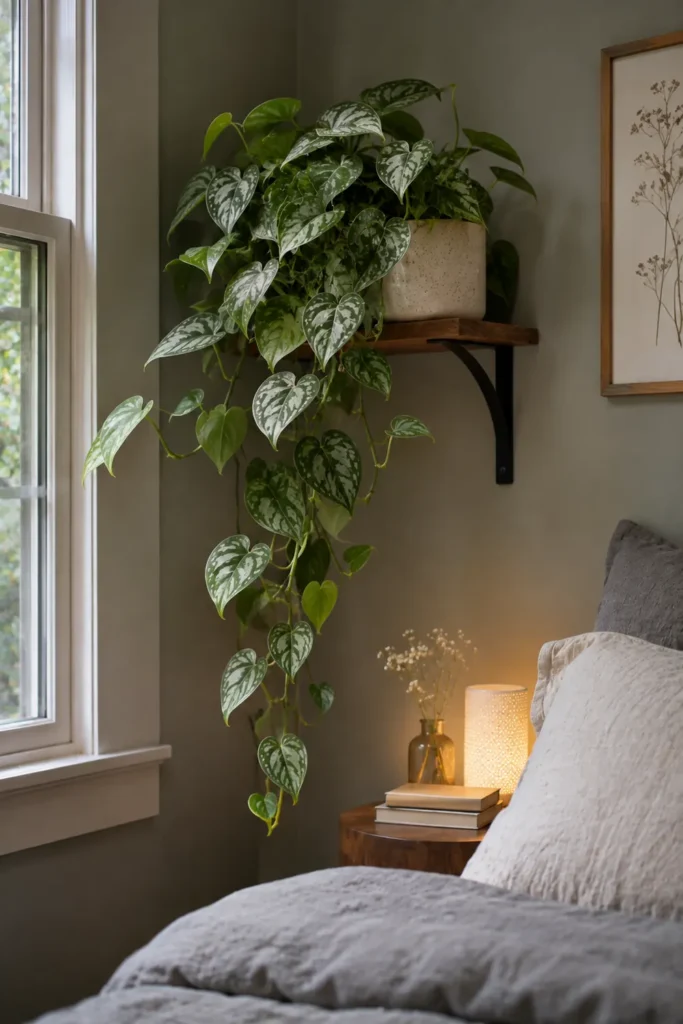
Silver splashes on matte, dark green leaves catch what little light a north-facing bedroom offers. That’s why satin pothos glows even in a dim corner. Despite the name, it is not a true pothos, but it trails just as easily.
Mounted on a simple wall bracket, it fills a corner that would otherwise sit empty. It is a reliable pick among hanging plants for low light, along with other indoor plants that thrive in low light. The silvery markings pick up the soft gray tones of the bedding, so the plant looks like it was chosen to match the room.
Curling leaves are its way of asking for water, so water when you see them curl.
20. Arrowhead Vine on a Pulley Hanger Under a High Ceiling
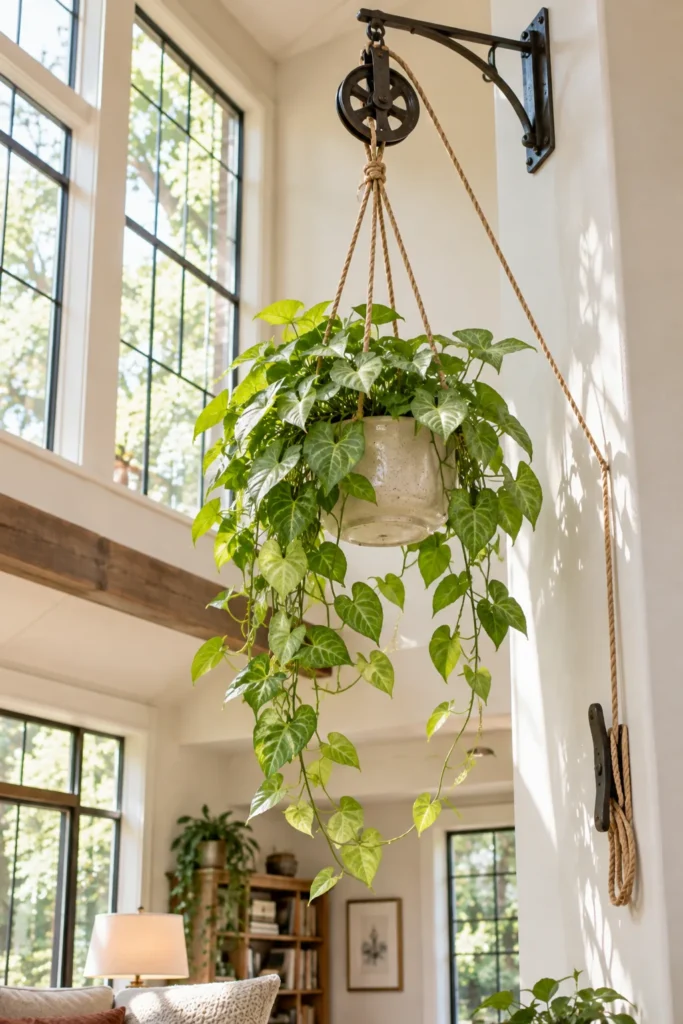
Watering a plant that hangs near a high ceiling usually means a ladder. A cast iron pulley hanger solves that. You lower the plant, water it, let it drain and raise it back up.
In a double-height living room with tall windows, an arrowhead vine in a hanging pot on a pulley fills the empty air above head height. Its arrow-shaped leaves trail and climb in bright indirect light, and the dark iron pulley adds a bit of old warehouse character. Arrowhead vine is toxic to pets if chewed, so keeping it high helps.
Screw heavy hooks into a ceiling joist or use an anchor rated for the weight.
Plan for the weight of the pot after watering, not when it is dry.
Choose lightweight pots and potting mix for anything hung high.
Hanging heavy pots from drywall alone, without an anchor.
Hanging plants at head height over walkways or doorways.
Hanging plants directly over beds, sofas or electronics.
21. Goldfish Plant in a Hanging Pot Beside a Home Office Shelf
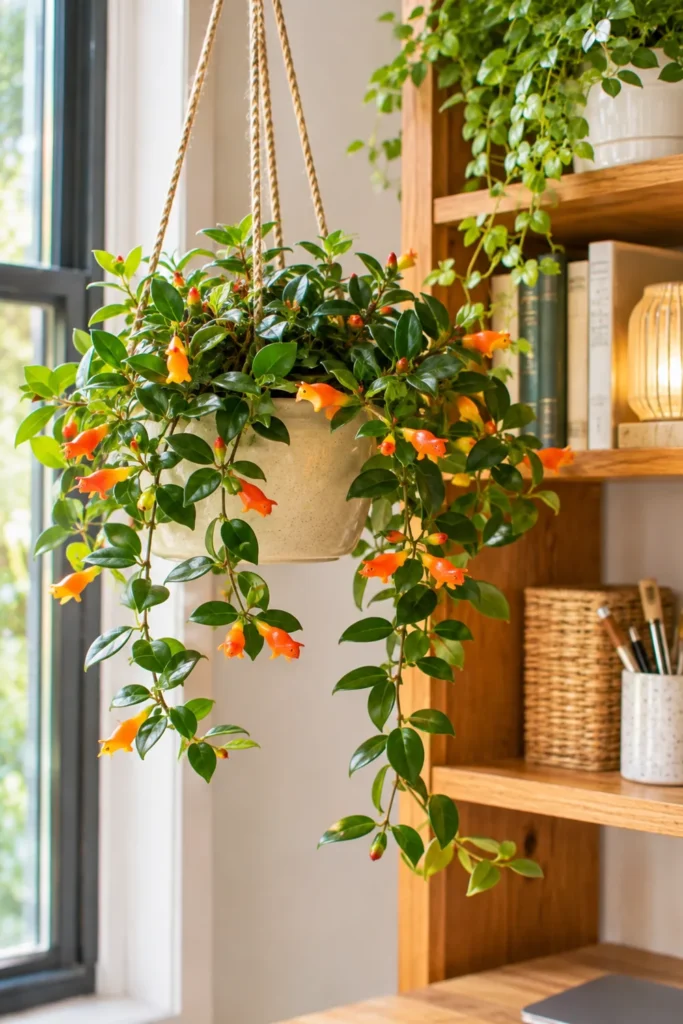
Goldfish plant gets its name from its flowers. They are small, puffy orange tubes that really do look like tiny goldfish swimming among glossy, dark green leaves.
Hung in a simple ceramic pot beside a warm wood shelf in a home office, it gives a work corner something cheerful to look at between calls. The orange flowers pop against the dark leaves, and the honey tones of the wood shelf pick up that orange so the corner feels planned. It blooms best in bright, indirect light, so keep it near the window side of the room.
Keep the soil evenly moist but never soggy. A plant that stays too wet drops leaves fast.
22. Ceiling Rod of Hanging Plants as a Studio Room Divider
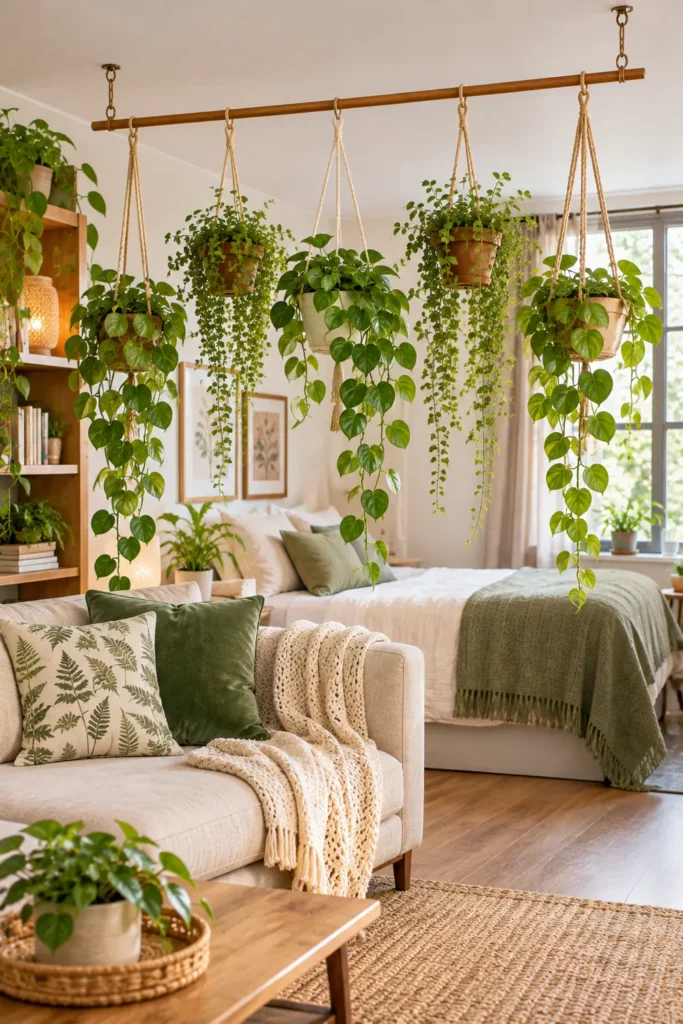
A studio apartment has no walls between the bed and the sofa, and a solid screen can make a small room feel smaller. A row of hanging plants does the job without blocking the light.
Here, a slim wooden rod hangs from two ceiling hooks between the sleeping and living areas, with hanging pots spaced along it. Trailing jade peperomia, with its small, round, thick leaves, alternates with creeping fig, which has tiny leaves that grow fast. Together they form a soft green screen you can see through, so the room still feels open. It is one of the easiest ways to use room divider plants in a rental.
Run the rod on the window side of the room if you can, because both plants want bright, indirect light. Check your lease before adding ceiling hooks.
23. Bird’s Nest Fern Above a Kitchen Island
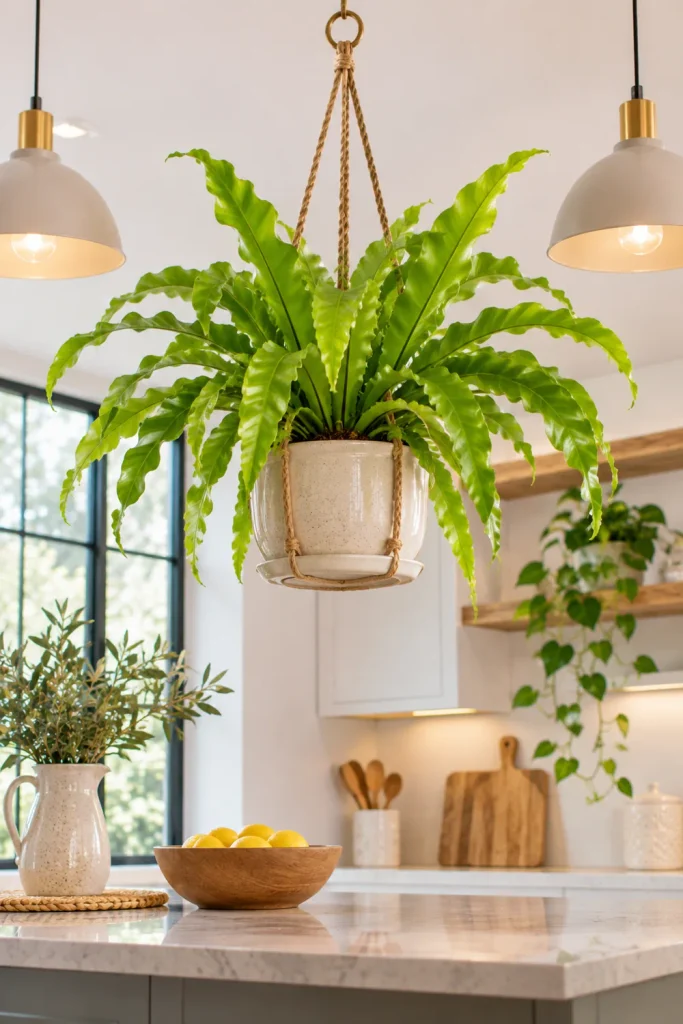
Look up from the counter and you see a rosette of wavy, apple-green fronds spreading out from the center like a fountain. Bird’s nest fern does not trail the way most hanging plants do. Seen from below, though, that open rosette is just as striking.
Widen the view and the spot makes sense. A hanging planter with a built-in drip saucer hangs between two pendant lights over a kitchen island. Steam from cooking keeps the air humid, which this fern likes. Its smooth, glossy fronds also contrast nicely with a matte stone countertop. Hang it with a little space around the pendants so the fronds never touch the lights.
Water the soil around the edge of the plant, not into the center of the rosette. Water that collects in the middle can rot the new growth.
24. Burro’s Tail Where Nobody Brushes Past
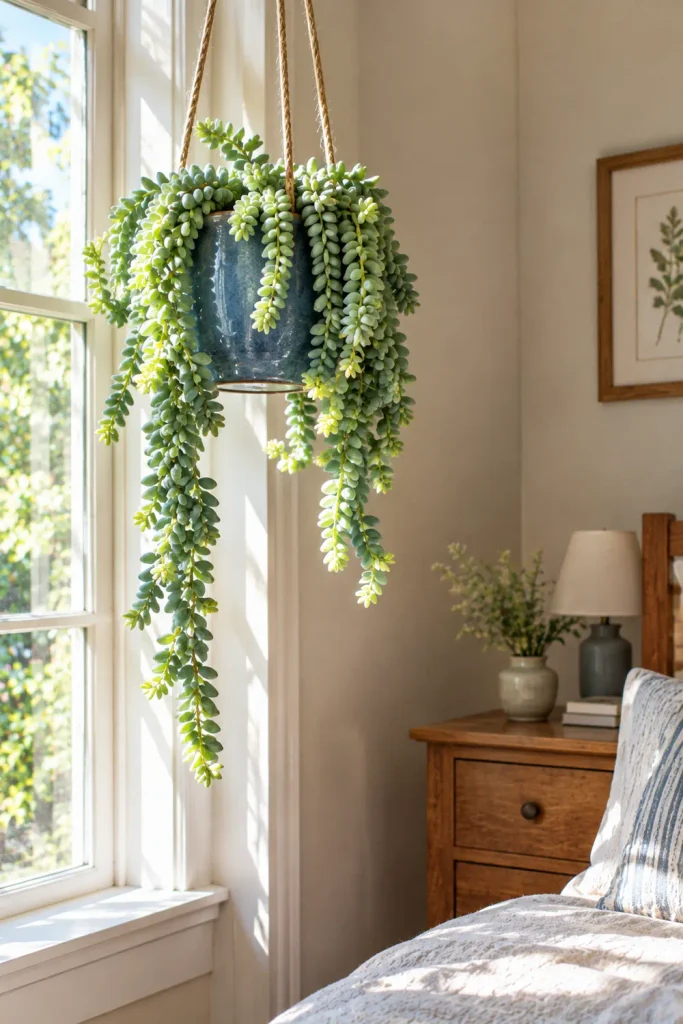
Burro’s tail is gorgeous and fragile in equal measure. Its thick, dangling stems are covered in plump, blue-green leaves, and those leaves fall off at the slightest bump.
So the trick is placement. A sunny window corner of a guest room, where no one walks past every day, lets the tails grow long without getting knocked. A glazed blue hanging pot repeats the cool blue-green of the leaves, and bright light keeps the stems full and tightly packed.
Garden note: Fallen leaves are not a loss. Set them on dry potting mix and many will root into new plants. These donkey tail succulent ideas cover more ways to grow and show it off. Water only when the soil is fully dry.
25. Floor Standing Plant Hanger Beside the Sofa
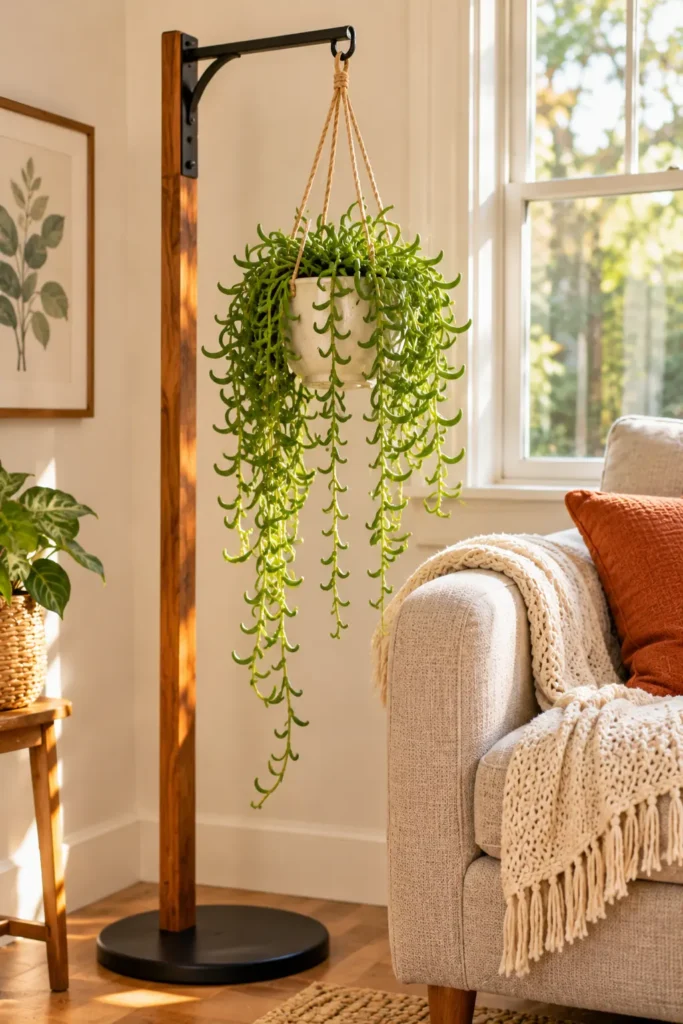
Not allowed to drill, and no window frame wide enough for a tension rod? A floor standing plant hanger is the answer. It is a stand with a hook at the top that holds a hanging pot, with no hardware in the wall or ceiling at all.
Here, a wood and black metal stand sits beside the living room sofa, near a window with afternoon light. It holds a hanging pot of string of bananas. The long strands of curved, banana-shaped leaves grow faster than string of pearls and are a little more forgiving of the odd mistake. The slim stand and soft strands make the sofa corner feel finished without crowding it.
Get the look: a wood and metal plant stand with a top hook, string of bananas in a white hanging pot, a linen sofa, warm afternoon window light.
How to Choose the Right Indoor Hanging Plants for Your Light
Light decided almost every pairing in this list, so start there.
- Bright windows: trailing succulents like string of pearls, burro’s tail and string of bananas, plus flowering hangers like hoya and lipstick plant.
- Bathrooms, kitchens and laundry rooms: ferns and other humidity lovers.
- Dim corners: heartleaf philodendron and satin pothos.
Next, match the hanger to the weight. Use ceiling hooks for heavy, wet pots, and tension rods or floor stands for light ones. Then hang everything where watering is easy and no one bumps it.
| Your light | Good picks from this list | Hanger idea |
|---|---|---|
| Bright window | String of pearls, burro’s tail, string of bananas, hoya, lipstick plant | Leather strap hanger, rattan basket, floor stand |
| Bright and humid | Boston fern, maidenhair fern, rabbit’s foot fern, bird’s nest fern | Glazed pot on a ceiling hook, wire basket |
| Medium light | Golden pothos, spider plant, English ivy, Swiss cheese vine | Macrame hanger, tension rod, kitchen rail |
| Low light | Heartleaf philodendron, satin pothos | Top of a bookshelf, wall bracket |
Indoor Hanging Plants FAQ
What are the easiest indoor hanging plants?
Golden pothos, spider plant and heartleaf philodendron are the most forgiving. They handle a range of light, bounce back from a missed watering and root easily from cuttings. Ideas 1, 3 and 6 show each one in a real room setting.
Which hanging plants do well in low light?
Heartleaf philodendron and satin pothos cope best with dim rooms. Golden pothos also manages, though its leaves lose some of their yellow marbling. No plant grows in true darkness, so a low light corner still needs some daylight. Ideas 6 and 19 both work in dim corners.
How do you hang plants from the ceiling without drilling?
Use a tension rod inside a window frame or alcove, a ceiling rod hung from existing fixtures, or a floor standing plant hanger. All three leave no holes. Keep the pots light, because no-drill options hold less weight than a hook screwed into a joist. See ideas 3 and 25.
Which hanging plants are safe for cats and dogs?
Spider plant, Boston fern and Christmas cactus are widely listed as non-toxic to cats and dogs. Pothos, philodendron, English ivy and string of pearls are not, so keep those well out of reach. For more pet-friendly options, see these cat safe hanging plants, and check any new plant before you bring it home.
Do hanging planters need drainage holes?
Yes. Without drainage, water collects at the bottom and the roots rot. Look for hanging pots with a drainage hole and a built-in saucer. You can also keep the plant in a plastic nursery pot inside a decorative hanger and take it down to water at the sink.
Conclusion
The best indoor hanging plant ideas start with one question: what light does this spot get? Answer that and the rest follows. Put a fern above the tub, a string of pearls by the sunny desk, a satin pothos in the dark bedroom corner and a pothos in a macrame hanger by the living room window. Pick the hanger to match the weight, hang it where watering is easy, and you’ll use space you never noticed you had. If you’re new to houseplants, these easy houseplants for beginners make good companions for your first hanging pots.
Pin this for the next time your shelves run out of room.