

A front lawn asks for a lot: water all summer, mowing every weekend, and a brown patch the minute you leave town. Succulents ask for sun, good drainage, and to be left alone. These 18 front yard succulent garden ideas put that trade to work in the part of the yard everyone sees.
Some are big moves, like a blue agave anchored with boulders, a river rock dry creek bed, or stacked stone terraces on a slope. Others are small: terracotta pots on the steps, a stonecrop ribbon along the walkway, a planted mailbox. Every idea names the plants, the stone, and the layout, so you can copy it with a few nursery pots or a full lawn swap.
Most succulent yards online come from places that never freeze. This list doesn’t assume that. There are options for cold winters, clay soil, rainy climates, and renters who can’t dig. You’ll also find the spacing and drainage advice that keeps the plants alive past the first season.
QUICK YARD CHECK
What is your front yard up against?
1. Blue Agave, Boulders, and Pea Gravel on the Corner
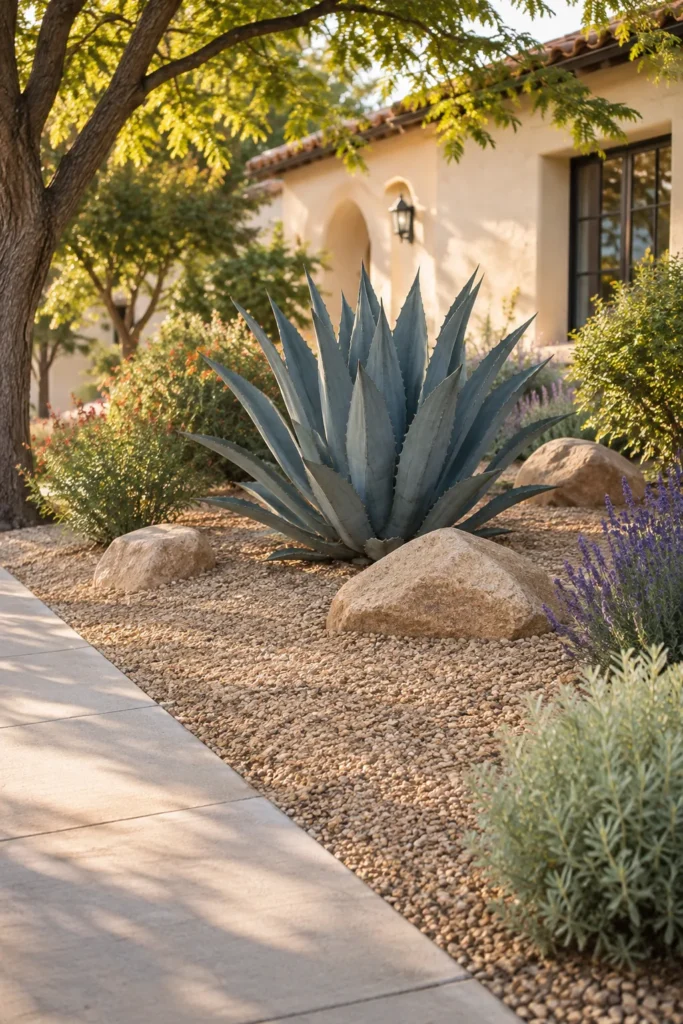
Every good succulent front yard landscaping plan needs one plant that reads from across the street. A big blue agave does that job on its own. Set it at the corner of the yard, flank it with three tan boulders sunk partway into the soil, and spread warm pea gravel around the whole group.
The boulders give the agave weight, so it looks planted on purpose instead of dropped off by a delivery truck. The gravel pulls rock and plant into one shape and keeps the base of the agave dry, which is exactly how it likes to live.
Planting note: Agaves grow much wider than they look in the nursery pot, and the leaf tips are sharp. Plant for the full grown size, and keep it well back from the sidewalk and the path to the door so nobody brushes past a spine.
2. A Terracotta Pot Cluster on the Front Steps
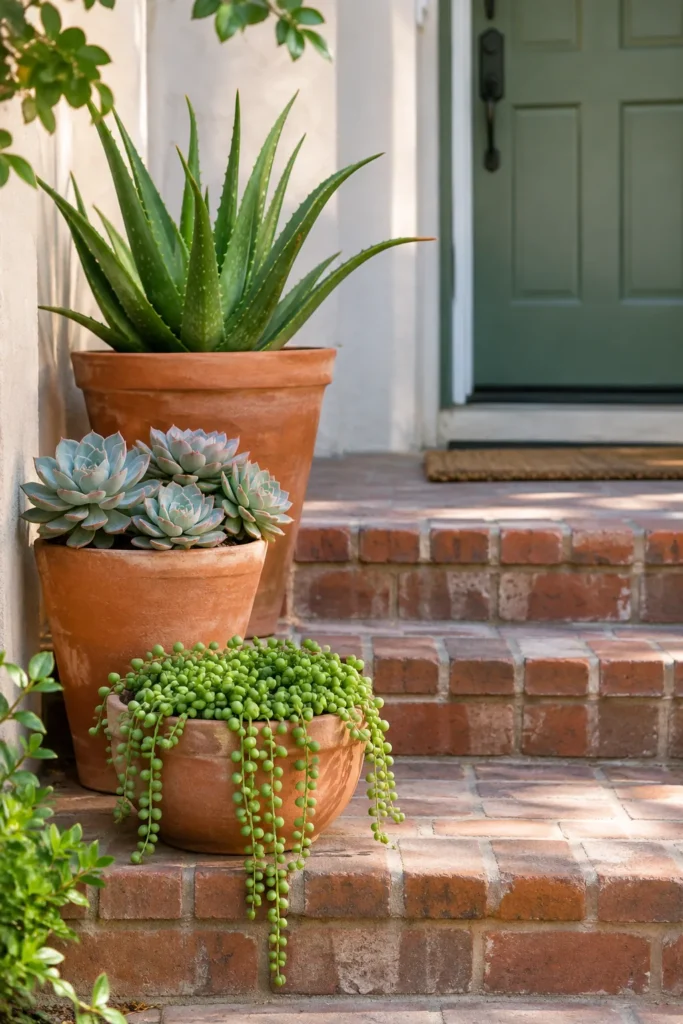
Front steps are the first thing a guest climbs, and a group of terracotta pots turns them into a greeting. Stick to three or five pots in graduated heights. Put an upright aloe in the tallest, blue-gray echeveria in the middle one, and string of pearls spilling over the rim of a low bowl. Stagger them up one side so the walkway stays clear.
Terracotta is porous, so the soil dries faster than in glazed ceramic. That suits succulents, and it makes pots the smart route in rainy climates where in-ground beds stay soggy. A drainage hole in every pot is not optional.
Get the look: three terracotta pots in stepped sizes, an upright aloe, blue-gray echeveria, string of pearls, and fast-draining cactus mix.
3. Color-Blocked Drifts of Echeveria and Blue Chalk Sticks
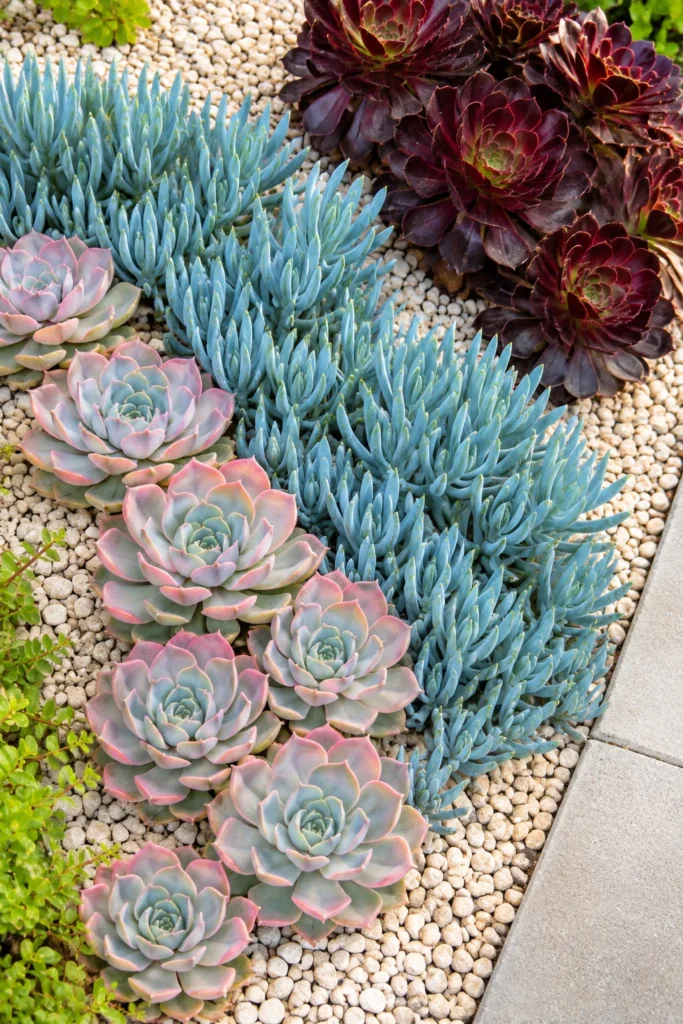
Plant one of everything and a bed looks like a sampler box. Plant seven of the same rosette together and it looks like a design.
Here, that means a sweep of blue chalk sticks, a drift of pink-tinged echeveria, and a pocket of deep burgundy aeonium. Each gets its own block of color. From the curb, the eye reads shapes, not single plants, so blocks carry farther than polka dots ever will.
Lay the drifts in loose, curving bands instead of straight rows, and let the edges blur a little where they meet. Pale gravel between them keeps each color clean.
Cold winters? Hens and chicks and stonecrop come in reds, greens, and golds, and they handle frost that would finish off an echeveria.
4. A River Rock Dry Creek Bed Through the Succulents
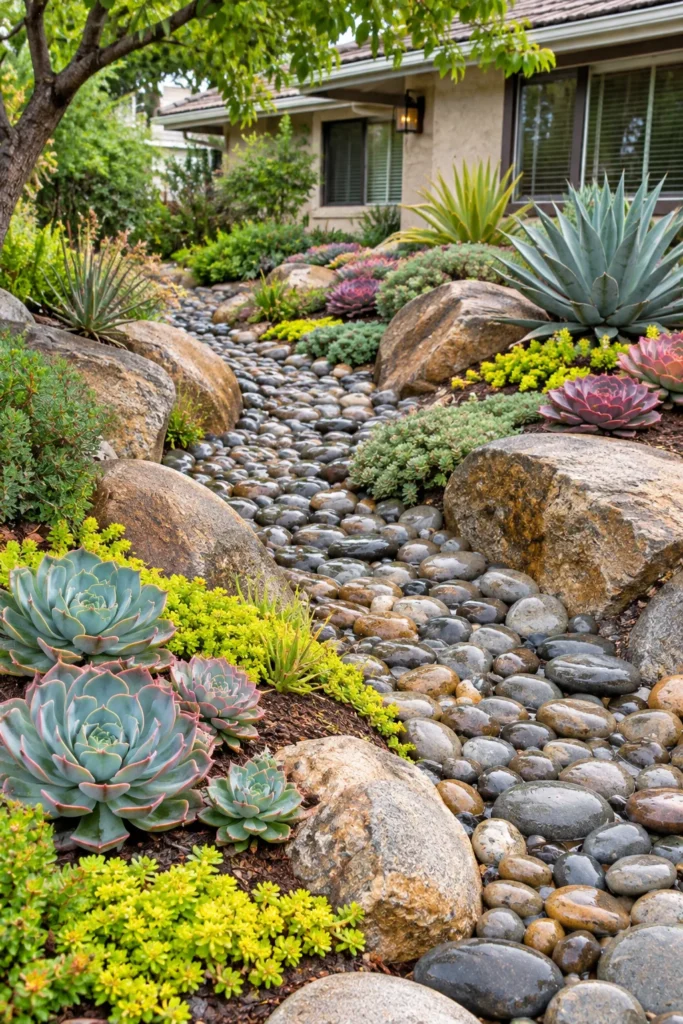
Rain that sheets off the roof and driveway has to go somewhere, and in a succulent bed it usually heads straight for the roots. A dry creek bed gives it a route.
Dig a shallow, winding channel across the yard and line it with smooth gray river rock. Set a few bigger boulders along the banks the way stones sit in a real stream. Tuck low stonecrop and clumping rosettes along the edges a little up the slope, so their roots stay above the wet line. That’s the same tough, low-water mix that carries most succulent rock garden ideas.
The creek moves storm water, the plants stay dry, and from the street the bed looks shaped by weather rather than drawn on paper. Slope the channel away from the house. If runoff is heavy, have a landscaper check the grading first.
5. A Stonecrop Ribbon Along the Front Walkway

The seam where a flagstone walkway meets the bed is usually bare dirt and weeds. Fill it with low stonecrop instead, in chartreuse and coppery red, and that hard edge turns soft.
The ribbon runs the full length of the path from the sidewalk to the front door. It works as a guide line, pulling the eye toward the entry. As it spreads, the stonecrop knits into a mat dense enough to crowd out most weeds, which is the whole reason it beats loose mulch here.
Keep it to the edges and the gaps between stones at the sides. Stonecrop shrugs off a stray foot but not a daily stampede, so the center of the walk stays clear stone.
6. Hens and Chicks and Stonecrop for a Cold-Winter Front Yard
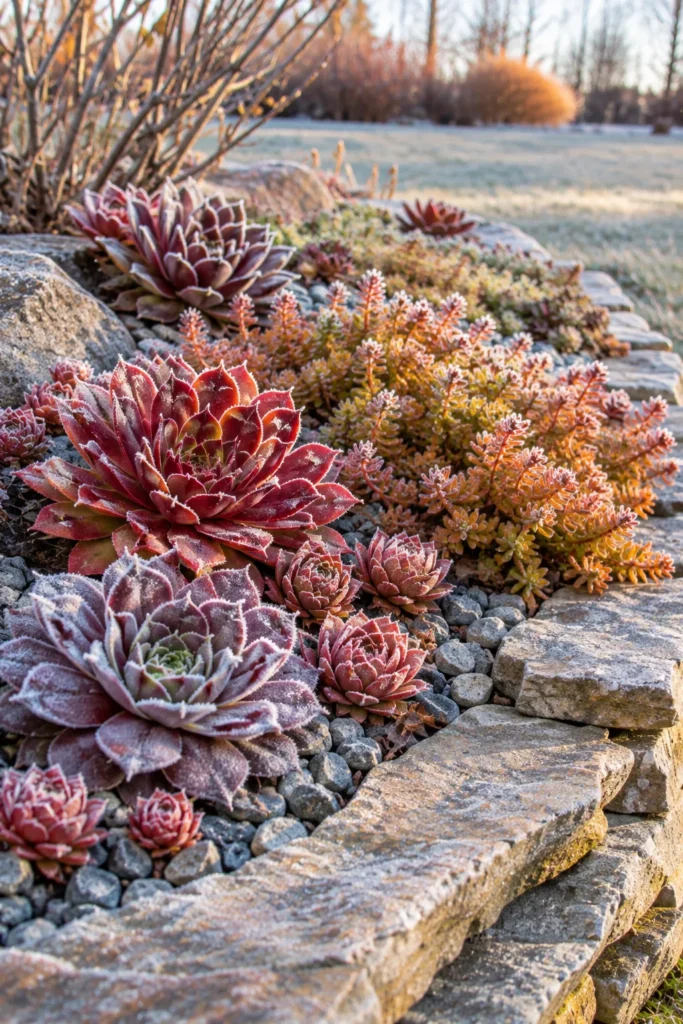
Most succulent front yard photos come from places where it never snows. Hens and chicks and many stonecrops are the exception. They can stay in the ground through freezing winters, and many deepen to red, bronze, and purple once the nights turn cold.
Plant them in a sunny bed with gritty soil and a gravel top layer, and tuck a few against a low stone edge where they catch reflected warmth. In November, the rosettes hold their color while the rest of the yard goes brown, which is when the bed earns its spot.
Winter wet does more damage than cold, so drainage matters more than shelter. A bed that drains fast and sits a little high is what keeps them coming back each spring.
| Usually handles frost | Bring in or cover before frost |
|---|---|
| Hens and chicks | Echeveria |
| Most stonecrops | Aeonium |
| Some agaves, so check the plant tag | String of pearls |
| Blue fescue grass, as a companion | Most aloes and blue chalk sticks |
7. Pink Muhly Grass, Aloe, and Agave Along a Sunny Driveway
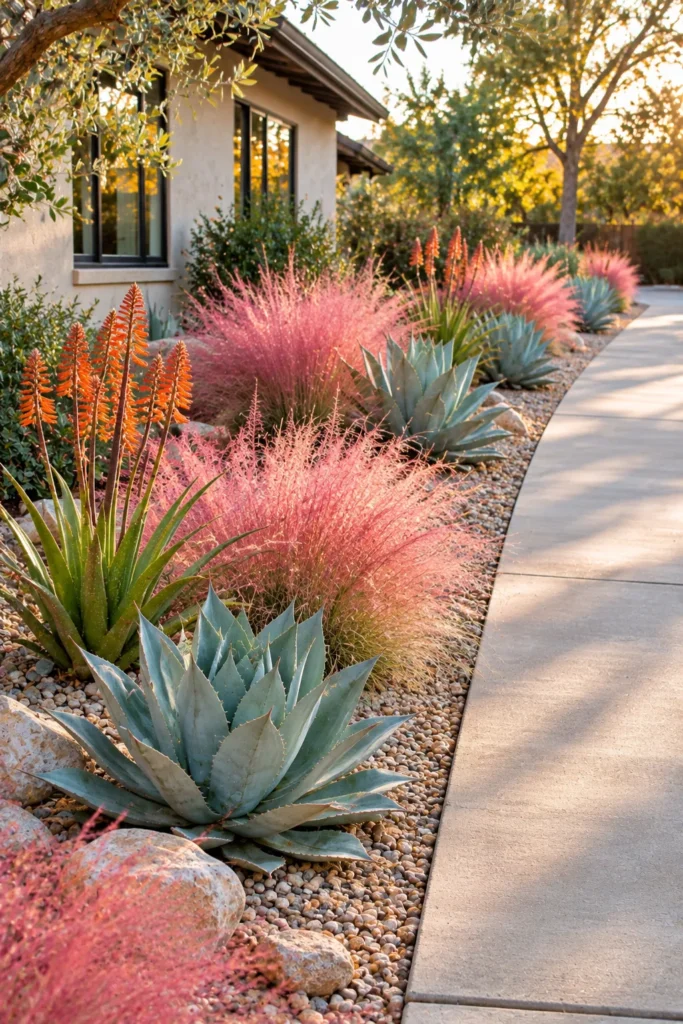
A concrete driveway soaks up sun all afternoon and throws the heat back at whatever grows beside it. Succulents can take it.
Run a long strip of gravel along the driveway edge. Plant rosettes of agave and clumps of orange-flowering aloe in a loose zigzag, then fill the gaps with pink muhly grass. The grass is the secret. Its fall plumes turn the stiff, sculptural succulents into something that moves in the wind, so the whole drought tolerant front yard looks alive instead of staged.
Styling note: Repeat the same three plants down the full length of the drive rather than adding new ones every few feet. Repetition is what makes a long, narrow strip look planned. In a cold-winter yard, swap the aloe for blue fescue and hardy yucca.
8. A Succulent Window Box Under the Front Window
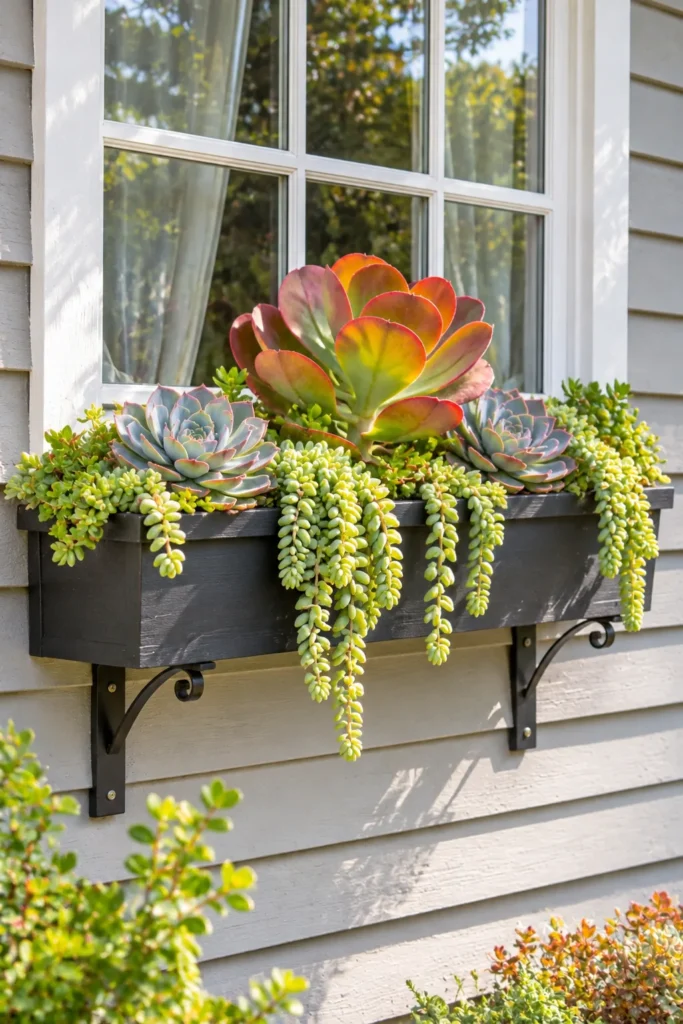
No room for a bed? A window box gives a small front yard succulent garden a spot at eye level, right where people look when they walk up.
Use the old container formula of thriller, filler, and spiller. Put an upright paddle plant in the center for height, fill around it with blue-gray echeveria, and let donkey’s tail trail over the front edge. The trailing stems soften the box and the wall below it. Their leaves pop off at a touch, so plant them where nobody brushes past. These donkey tail succulent ideas cover how to keep the strands long and full.
Pick a window that gets several hours of direct sun. Planted boxes get heavy, so hang them on sturdy brackets.
You will need: a window box with drainage holes, cactus mix, paddle plant, echeveria, donkey’s tail.
9. The Spilled Terracotta Pot of Hens and Chicks
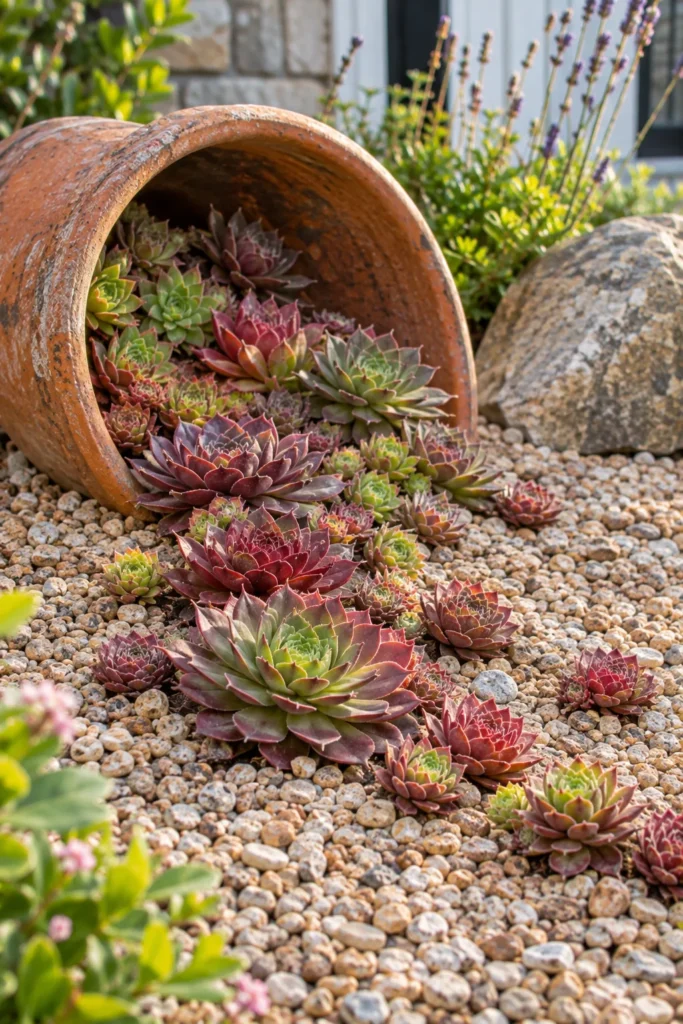
Tip a big terracotta pot on its side, bury the lower lip a few inches in the bed, and let hens and chicks pour out of the mouth in a widening river across the gravel. It’s a small joke, and it works. Neighbors slow down to figure out whether it was planned.
The trick is to keep the spill looking natural. Pack the rosettes tight inside the pot, then space them farther apart as the river runs out, so it reads like plants tumbling loose. Hens and chicks make offsets that fill the gaps on their own within a season or two.
No spare pot? An old concrete birdbath planted with the same rosettes does a similar job.
10. Gravel and Low Succulents in the Parkway Strip
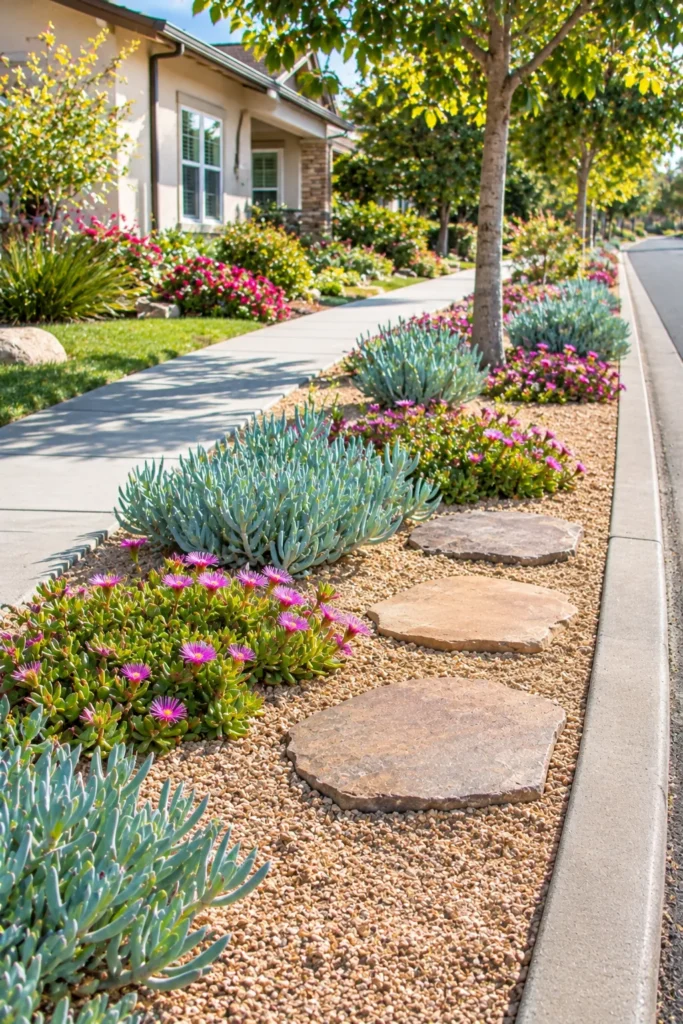
That narrow strip between the sidewalk and the curb is the hardest grass in the yard to mow and the first to brown in summer. Replace it, and the front yard suddenly looks bigger.
Strip out the sod completely, because grass left under gravel finds its way back. Top the strip with decomposed granite, plant low ice plant and blue chalk sticks in loose clusters, and set a few flat stepping stones near the curb where car passengers climb out. Keep anything spiny out of this strip, since people walk through it.
It’s one of the easiest low maintenance front yard landscaping moves, and these succulent garden landscape ideas carry the same no-mow approach into the rest of the yard. Many cities set rules for what can grow by the curb, so check yours before you dig.
11. A Mailbox Bed of Small Agave, Sedum, and Stone
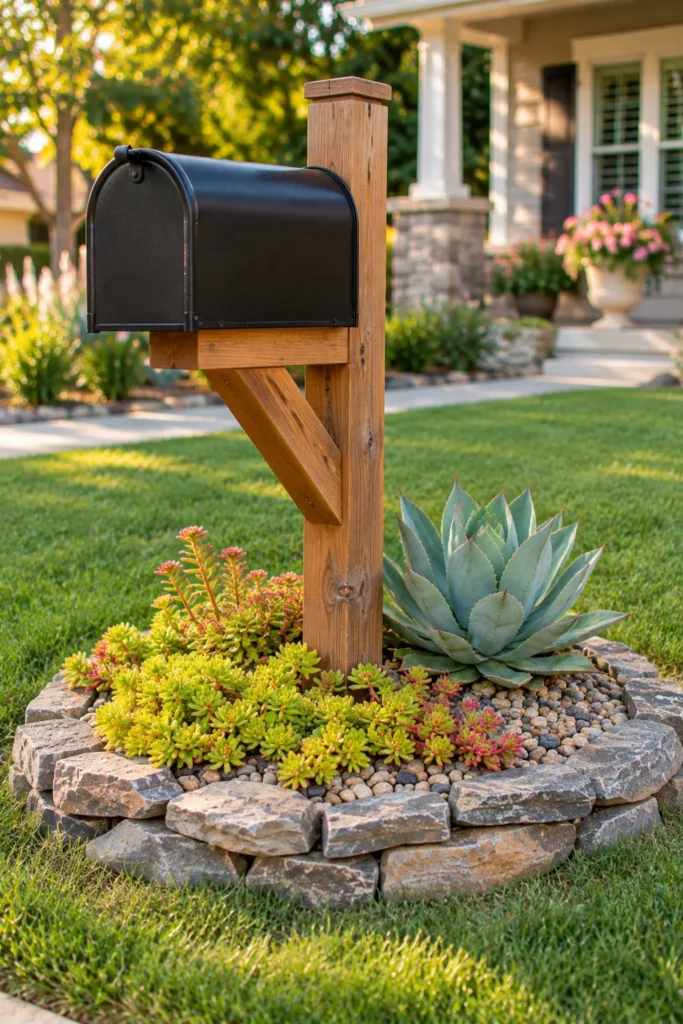
A bare mailbox post on a patch of lawn looks like a utility pole. Ring the same post with stone and plants, and it looks like part of the garden.
Edge a small circle around the post with flat fieldstone and fill it with gravel. Plant creeping sedum around the base, and add one compact agave on the side facing the house. That way the sharp tips sit away from the hand that reaches for the mail.
The whole bed takes a weekend and a handful of plants. It also sits exactly where every driver, walker, and delivery person looks first, which makes it one of the cheapest curb appeal fixes in this list.
12. A Raised Concrete Block Bed for Heavy Clay Soil
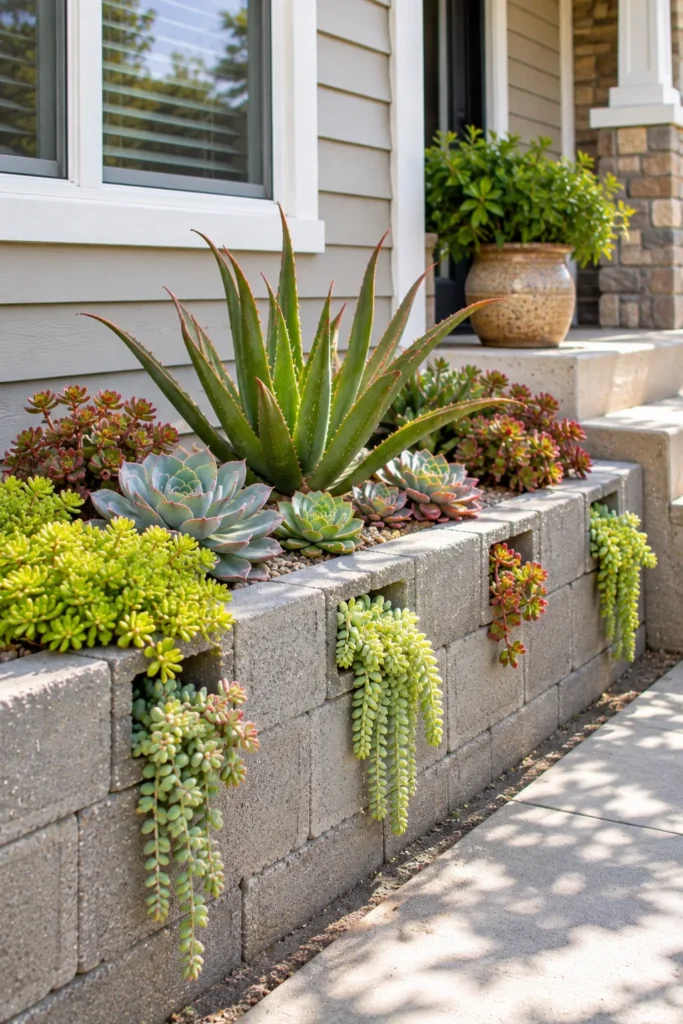
Heavy clay holds water like a sponge, and succulent roots sitting in wet clay rot fast. Raising the bed solves it.
Stack plain concrete blocks two rows high along the front of the house, beside the porch, and fill the bed with a fast-draining mix of soil and grit. Plant an upright aloe as the centerpiece, low rosettes around it, and trailing succulents in the open holes of the blocks so they spill down the gray face. The blocks warm up in the sun and the bed dries out quickly after rain, which is the point.
Planting note: Water deeply, then wait until the soil is fully dry before watering again. In many yards, established beds need little beyond rain except in long dry spells. More succulents die from too much water than too little.
13. Succulents and Pebbles Ringing a Front Yard Tree
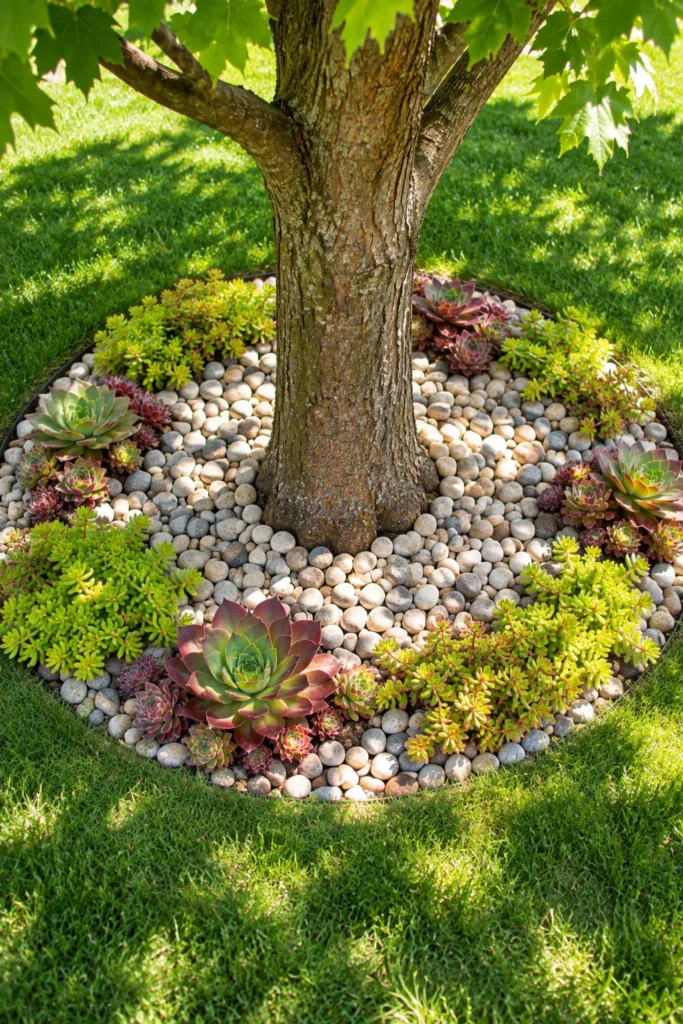
Pale river pebbles circle the trunk where a ring of shredded mulch used to sit. Small clusters of stonecrop and hens and chicks are tucked into pockets along the outer edge.
The planting follows the light. Close to the trunk, where shade and roots are heaviest, it’s pebbles only. Farther out, where dappled sun reaches the ground, the rosettes take over and creep into the gaps over time. Pick the stonecrops sold for part shade, and plant in shallow pockets rather than digging deep among the tree roots.
Keep the pebbles a hand’s width away from the bark. A tree trunk wants air at its base, not a pile of stone or soil against it.
14. Small Nursery Pots Spaced for Mature Size
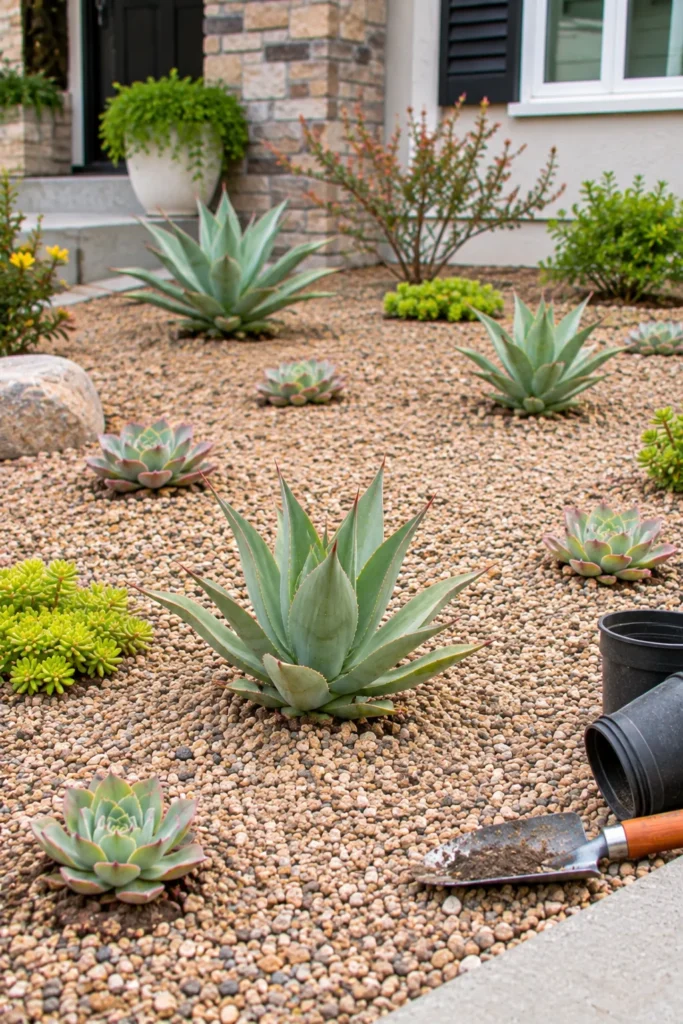
Big succulents cost big money, and a whole front yard of them can run into the price of a used car. The budget route is patience.
Buy small nursery pots, ask neighbors for cuttings, and plant at the spacing on the tag, not the spacing that looks full today. That matters most with agave. A small one sold beside the checkout can grow several feet across, and crowded agaves end up hacked back or pulled out. Fill the open ground with gravel for now, so the bed looks finished even while it’s sparse. If you want to multiply what you have, these beginner succulent propagation ideas turn one plant into a dozen.
Expect it to look thin the first season and full within a couple of years.
15. Repeating Agaves in a Modern Gravel Front Yard
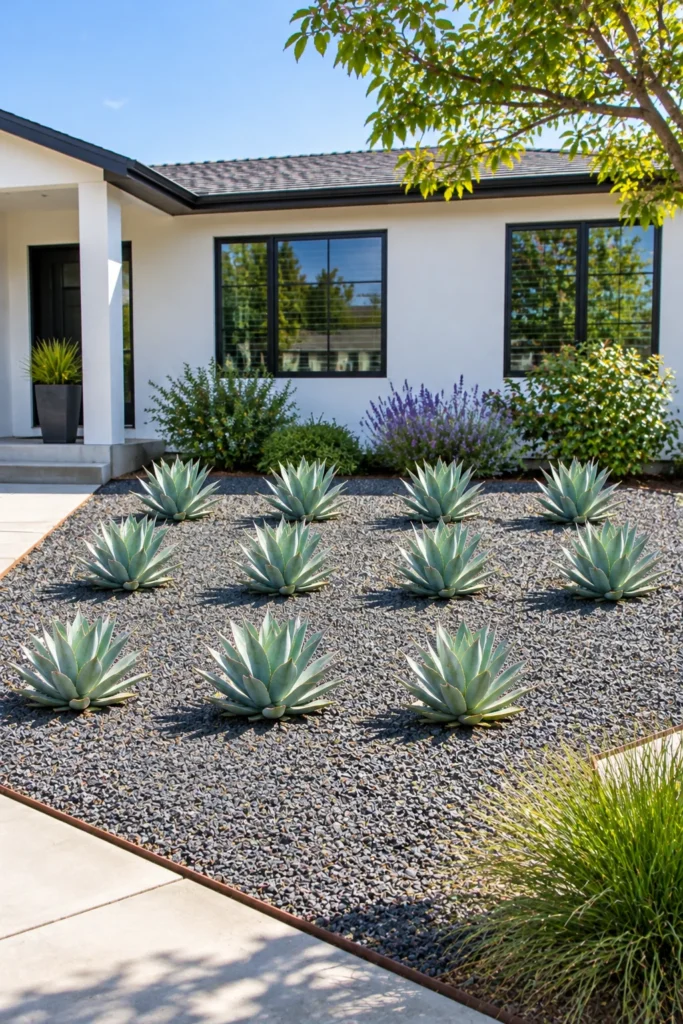
Mix twelve kinds of plants in front of a modern house and it looks fussy. Plant the same agave twelve times in an even grid, and it looks like architecture.
The setup is simple: charcoal gravel edged with straight metal edging, and identical blue-gray agaves set in rows at the same spacing. It sits in front of a white stucco wall with dark window frames. Sameness is the design. Each rosette echoes the next, and the clean grid matches the flat lines of the house.
Buy every agave at the same size so the rhythm holds as they grow, and set the front row well back from the walk.
16. Galvanized Trough Planters for a Rental Front Yard
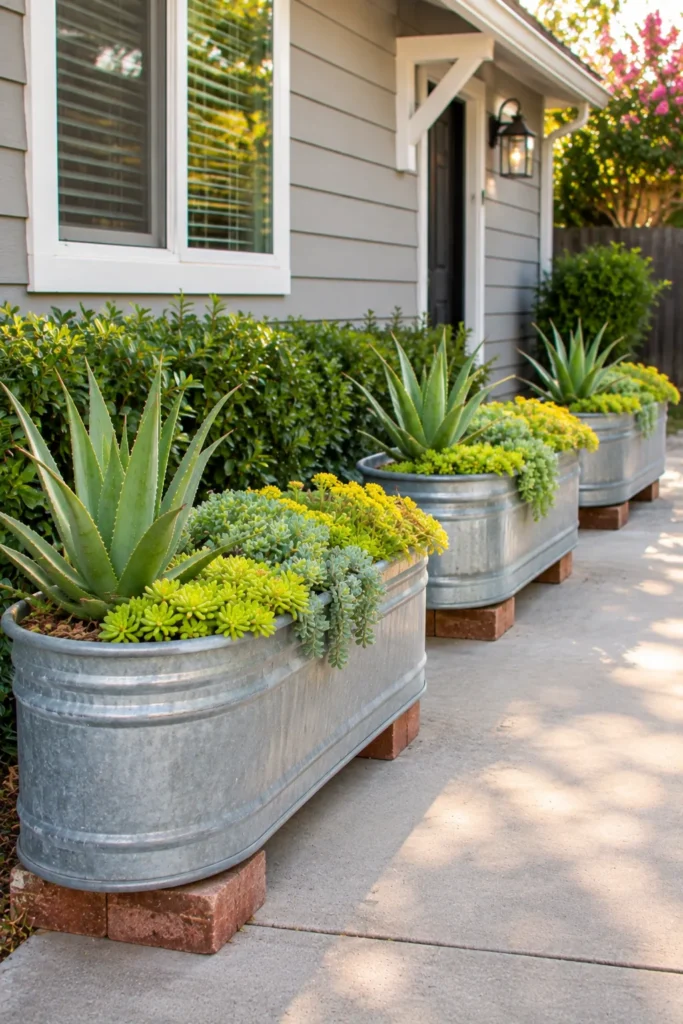
Renting usually means you can’t dig up the yard. Galvanized metal troughs get around that, and they move with you when the lease ends.
Line two or three long troughs along the edge of the driveway or the front of the house. Drill drainage holes in the bottoms, fill them with cactus mix, and plant upright aloe at one end and spreading sedum through the rest. Raise each trough on bricks or pot feet so water drains freely and doesn’t leave rust rings on the concrete. In a hot climate, metal heats fast in full afternoon sun, so a spot with some late-day shade is kinder to the roots.
Get the look: galvanized troughs, bricks for risers, cactus mix, aloe, sedum. For more portable options, browse these succulent container ideas.
17. Solar Path Lights and an Uplit Agave at Blue Hour
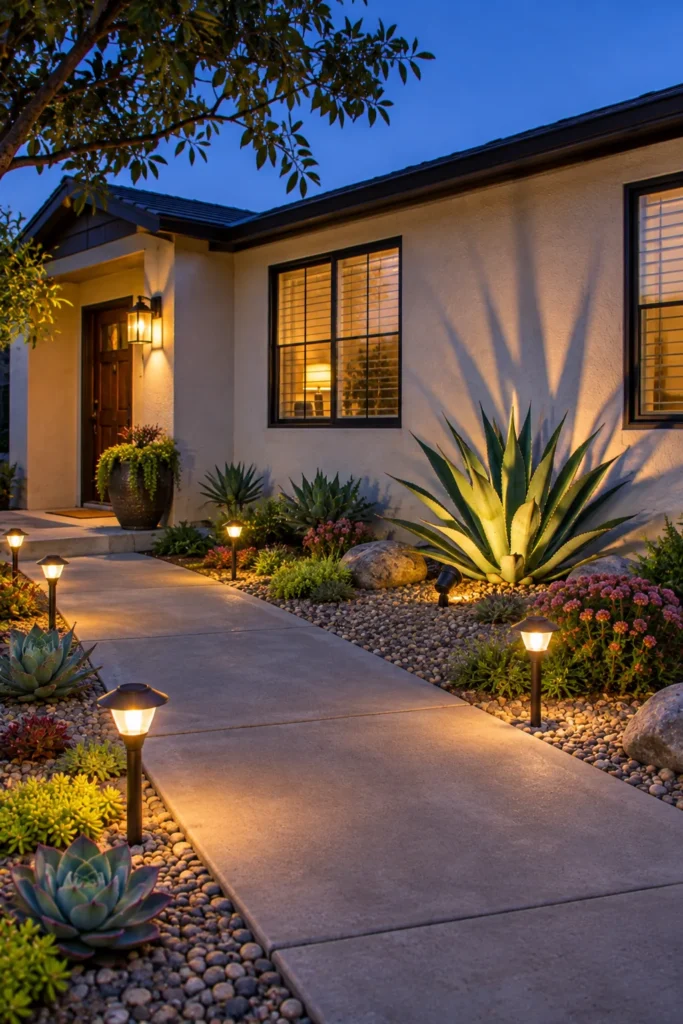
After dark, most front yards disappear. A succulent yard has some of the best silhouettes on the street, so give them light. Run solar path lights down both sides of the front walkway, and aim a single uplight at the biggest agave so its leaves throw a spiky shadow across the house wall.
Lighting note: Light the plant, not the sky. Tilt the uplight so the beam grazes the leaves and stops at the wall, never into a window. Solar fixtures need a full day of sun to glow all evening. Any hardwired low-voltage system is a job for a licensed electrician. A lit path also shows guests exactly where the spiny plants are.
18. Stacked Stone Terraces with Trailing Succulents on a Sloped Front Yard
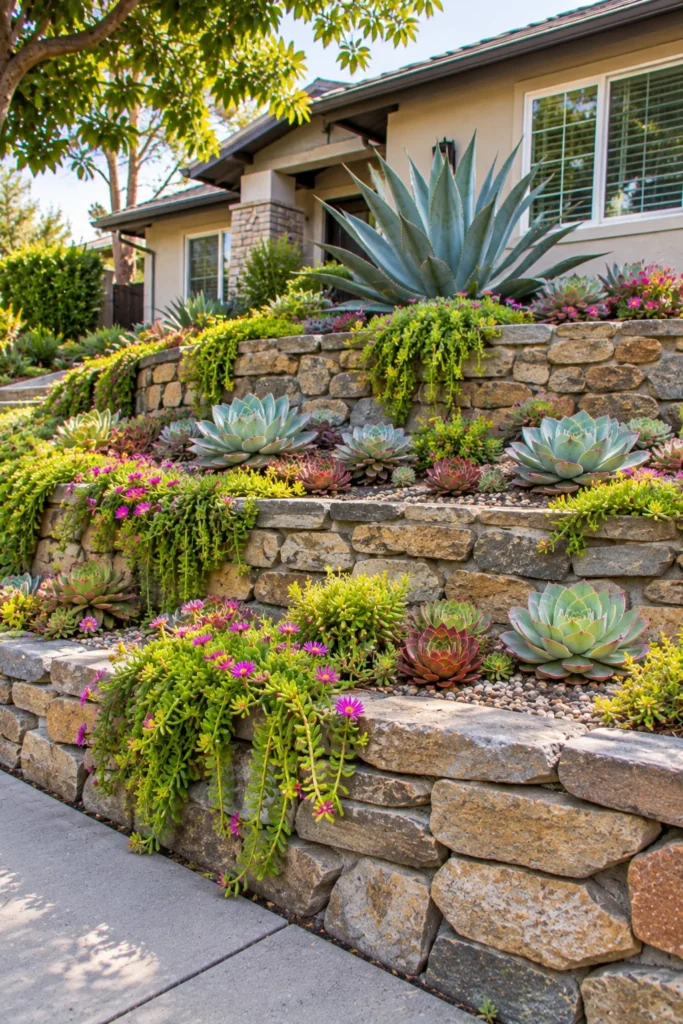
A steep front slope is where soil washes away and mowing gets risky. Terraces turn it into the best feature on the block.
Break the slope into two or three low, level steps edged with stacked fieldstone. Plant an agave or a cluster of upright aloe on the top tier as the anchor, rosettes in the middle, and trailing ice plant along each edge so it spills over the stone. Tuck hens and chicks into the gaps between stones, where the rock holds warmth and drains fast. From the street, the tiers read as one cascade from the house down to the sidewalk.
Build note: A knee-high row of dry-stacked stone is a weekend project. Anything taller, or anything holding back serious soil, is a job for a landscape professional.
How to Plan Succulent Front Yard Landscaping That Lasts
Look past the specific plants, and almost every idea above runs on the same few moves.
- Start with one anchor the street can see: a big agave, a boulder group, or a cluster of pots.
- Plant the supporting cast in drifts and repeat them, because repetition reads as design from the curb.
- Cover every bit of open soil with gravel instead of bark mulch.
- Build for water: fast-draining soil, raised beds where the ground stays wet, and spacing that leaves room for each plant at full size.
Get those four right and the specific plants are just a matter of taste.
The front yard formula
Front Yard Succulent Garden FAQ
Should I use gravel or mulch around succulents?
Use gravel. Bark mulch holds moisture against the base of the plants, which invites rot. Gravel drains fast, keeps the crowns dry, slows weeds, and makes the bed look finished. Pea gravel, decomposed granite, and river rock all work. Ideas 1, 10, and 15 show three different gravel looks.
How do I replace my front lawn with succulents?
Remove the grass completely first, roots and all, because turf left under gravel grows back through it. Then loosen compacted soil and improve its drainage, set any boulders, plant, and top-dress with gravel. Starting with small nursery pots keeps the cost down, as idea 14 shows.
How often should I water a front yard succulent garden?
Water deeply, then let the soil dry out completely before watering again. New beds need more regular water while the roots settle in. Once established, many front yard succulent gardens get by on rain except during long dry spells. Overwatering kills more succulents than drought does.
Can succulents survive winter outside?
Some can. Hens and chicks and most stonecrops handle freezing winters in the ground, and some agaves do too, so check the plant tag. Echeveria, aeonium, most aloes, and string of pearls need to come indoors or be covered. Wet winter soil is a bigger threat than cold, so drainage matters most.
Can I grow succulents in clay soil or a rainy climate?
Yes, if you lift them out of the wet. A raised bed filled with a gritty, fast-draining mix keeps roots dry after rain, and terracotta pots dry out faster than the ground. A dry creek bed can also carry runoff away from plantings. Ideas 4 and 12 both do this.
Conclusion
A succulent front yard doesn’t have to happen all at once. Start with one anchor, like a corner agave or a cluster of pots by the door, and add a drift or a gravel strip each season as the budget allows.
The rules stay the same wherever you begin: sun, fast drainage, gravel instead of mulch, and enough room for every plant to reach full size. Get those right and the yard holds its curb appeal through summer heat, winter rain, and the weeks you forget it exists.
Pick the idea that fits your climate and your lease, and save this list for your next trip to the garden center.