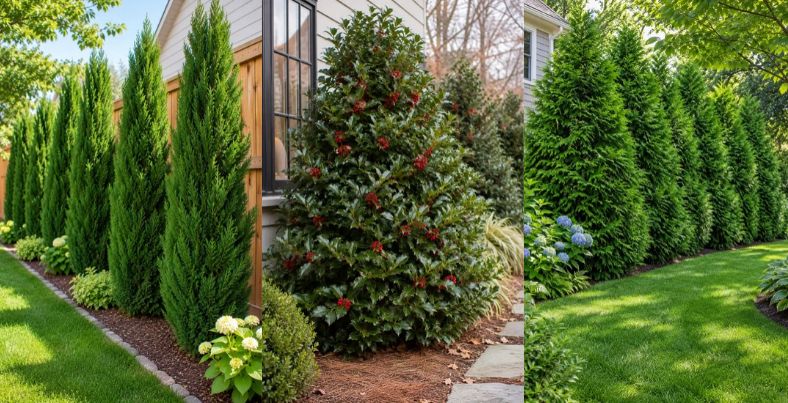
A new fence takes a weekend. A new screen of trees can take years, unless you choose the right trees. These fast growing trees for privacy are the ones that fill in quickly, block the view of a neighbor’s deck or a busy street, and keep doing it for decades.
Speed is only half the story, though. The best privacy tree for your yard depends on how tall and wide it gets, whether it stays green in winter, how much sun it needs and which USDA hardiness zone it grows in. A tree that shoots up fast but outgrows the space, catches every disease going or spreads into the neighbor’s yard isn’t a good privacy tree at all.
Below are 20 trees that balance fast growth with a long, healthy life. Each entry covers what the tree looks like, how fast and how big it typically grows, the light and zones it suits, and one tip for planting it well. You’ll also find which popular privacy trees to be careful with, and why mixing a few different trees makes a screen that lasts.
How the Trees on This List Were Chosen
Every tree here grows faster than most, provides real screening, and holds up as a long-term part of the yard. Most are evergreens, like arborvitae, juniper, cypress, pine, spruce, holly and cedar, because they block the view all year. A few are deciduous trees like river birch and dawn redwood, which grow incredibly fast and screen well from spring to fall. There are narrow picks for small yards, big trees for open space, warm-climate choices for the South, cold-hardy ones for the North, and one for shade. Find the trees that match your space and zone, and plan a mix of two or three.
1. Green Giant Arborvitae (Thuja ‘Green Giant’)
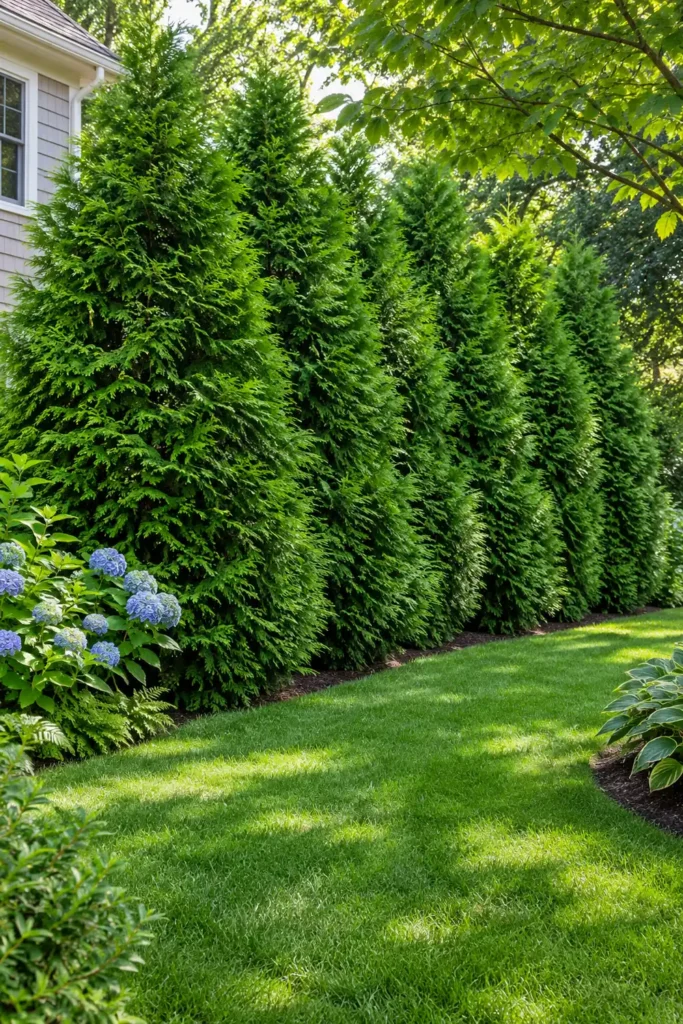
Green Giant arborvitae is the tree most people picture when they think of a fast privacy screen. It forms a tall, dense, cone-shaped column of soft, rich green foliage that stays green through winter, and young trees can add a couple of feet or more a year once established.
It’s popular for good reason. It fills in fast, takes full sun or light shade, and is less of a deer magnet than many other arborvitae. It is still a big tree, though, so give it room to spread. Green Giant has also become so common that disease can sweep through a long row of it, especially when the trees are stressed. Plant it alongside other trees rather than on its own.
🌿 Garden Tip
Don’t plant a long screen of just one kind of tree. If a disease or pest hits that tree, you can lose the whole screen at once. Mix two or three species from this list in a staggered row, and a problem with one won’t leave a gap all the way along.
Quick facts: Evergreen conifer | Full sun to part shade | Regular water while young | Typically 40 to 60 feet tall, 12 to 20 feet wide | Green all year | Tall screens, property lines, windbreaks | Hardiness: USDA zones 5 to 7
2. Eastern Red Cedar (Juniperus virginiana)
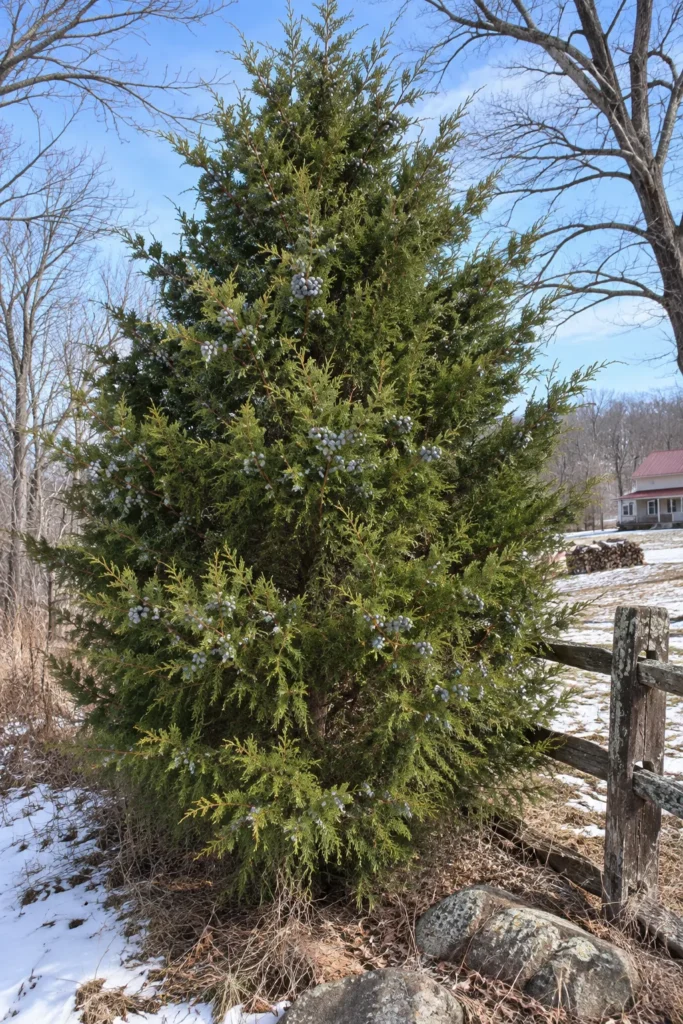
Eastern red cedar is one of the toughest native evergreens in North America. It grows into a dense pyramid of fine, scaly green foliage, and female trees carry dusty blue, berry-like cones that cedar waxwings and other birds love in winter.
It handles poor soil, heat, cold, wind and drought once established, which makes it a reliable screen for exposed yards and rural property lines. Its dense branches also give birds year-round shelter, so a row of red cedars doubles as wildlife habitat. Like most junipers, it wants full sun to stay full.
One thing to check before planting: eastern red cedar hosts cedar-apple rust, a disease that spreads between junipers and apple or crabapple trees. Keep it well away from any apples you grow.
Quick facts: Evergreen conifer | Full sun | Drought tolerant once established | Typically 30 to 40 feet tall, 8 to 20 feet wide | Green all year, blue berry-like cones in winter | Windbreaks, rural screens, wildlife hedges | Hardiness: USDA zones 2 to 9
3. Nellie R. Stevens Holly (Ilex ‘Nellie R. Stevens’)
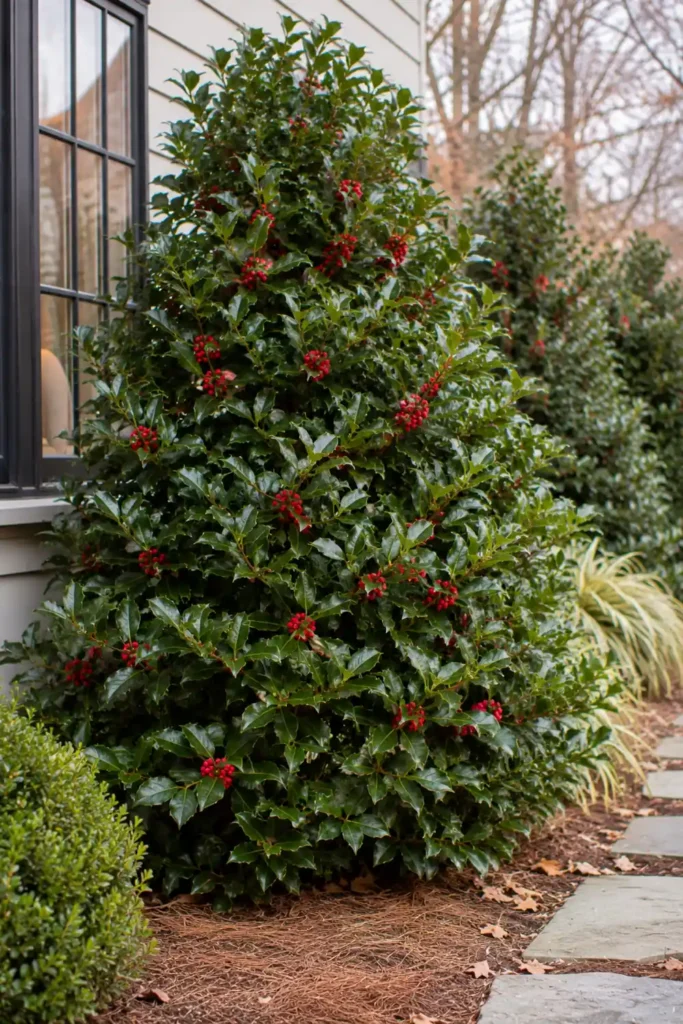
Most hollies grow slowly, but Nellie R. Stevens holly is the exception. It forms a broad, dense pyramid of glossy, dark green leaves with only a few spines, and in fall and winter it can carry bright red berries.
Because it grows faster than most hollies and stays dense from top to bottom, it makes a beautiful, formal-looking screen that never looks bare at the base. It handles full sun or part shade and takes pruning well, so you can keep it as a tall hedge or let it grow into a small tree. The glossy leaves also catch the light, so the screen looks rich and polished even in the middle of winter.
Give it a few feet more space than you think it needs. It gets wider than many people expect.
Quick facts: Evergreen broadleaf tree or large shrub | Full sun to part shade | Regular water, good drainage | Typically 15 to 25 feet tall, 8 to 12 feet wide | Glossy leaves all year, red berries fall and winter | Formal screens, hedges, foundation corners | Hardiness: USDA zones 6 to 9
4. Eastern White Pine (Pinus strobus)
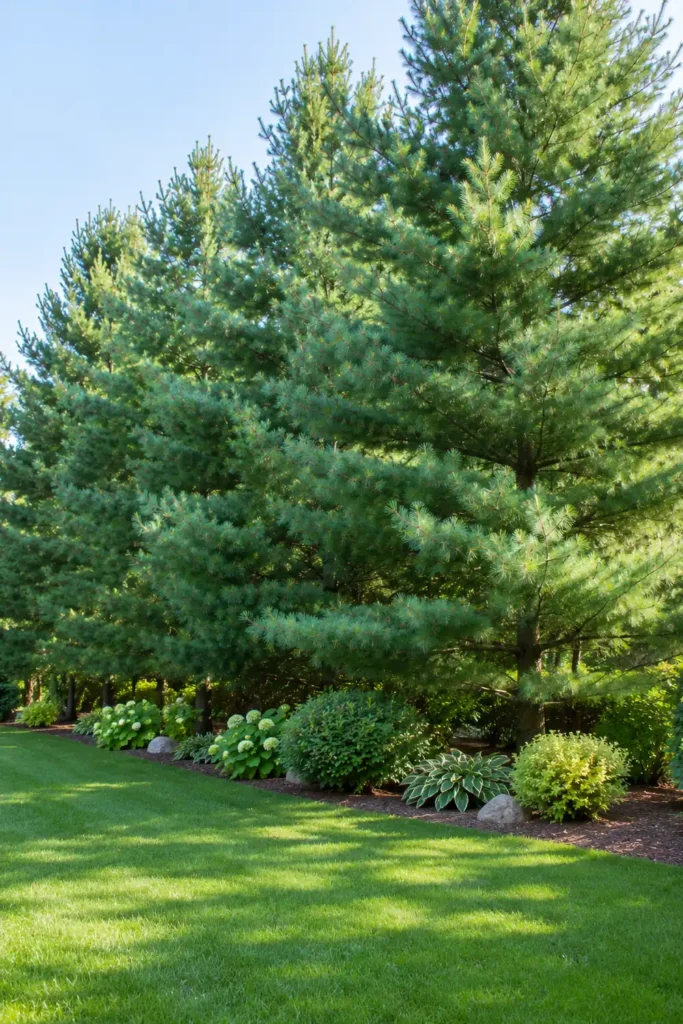
Eastern white pine is soft in every sense. Its long, flexible, blue-green needles grow in bundles of five, and the whole tree has a feathery, gentle look unlike stiffer pines.
It’s also one of the fastest growing evergreens for big northern yards, and young trees fill in quickly. Keep in mind that it can grow very large and tends to drop its lower branches as it ages, so the screen can thin out at eye level over time. Planting shrubs in front fixes that. It’s also sensitive to road salt, so avoid planting it along salted roads. Heavy wet snow and ice can bend or snap its branches, and these tips on whether to break ice off trees help you protect it after a storm.
Quick facts: Evergreen conifer | Full sun | Regular water, good drainage | Typically 50 to 80 feet tall, 20 to 40 feet wide | Green all year | Large yards, windbreaks, rural screens | Hardiness: USDA zones 3 to 8
5. Arizona Cypress (Cupressus arizonica)
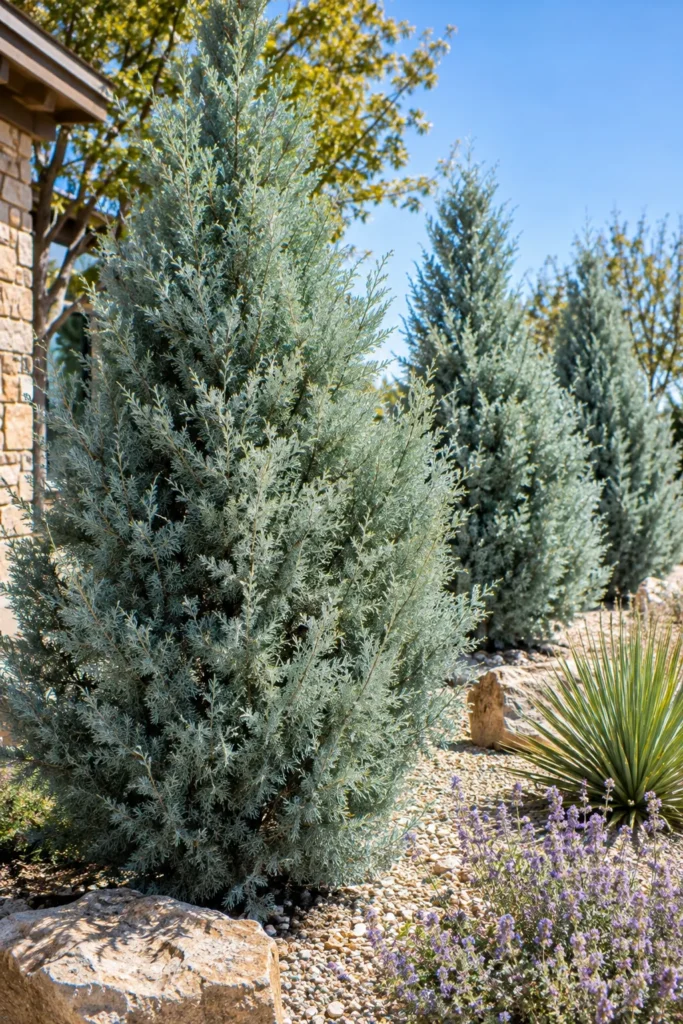
Hot, dry yards are hard on most privacy trees. Arizona cypress shrugs it off. This evergreen grows into a neat pyramid of aromatic, blue-gray foliage that looks almost silver in strong sun.
It’s one of the trees extension experts often suggest instead of Leyland cypress, because it fills in fast with fewer disease problems in the right spot. That right spot is full sun and well-drained soil. Arizona cypress hates wet feet, and soggy ground can kill it. The blue-gray color also makes a striking backdrop for green shrubs and flowers in front of it.
Water young trees regularly for the first year or two, then let them rely mostly on rainfall.
Quick facts: Evergreen conifer | Full sun | Drought tolerant once established, needs good drainage | Typically 30 to 40 feet tall, 15 to 25 feet wide | Blue-gray foliage all year | Hot, dry yards, windbreaks, Leyland alternative | Hardiness: USDA zones 7 to 9
6. Wax Myrtle (Morella cerifera)
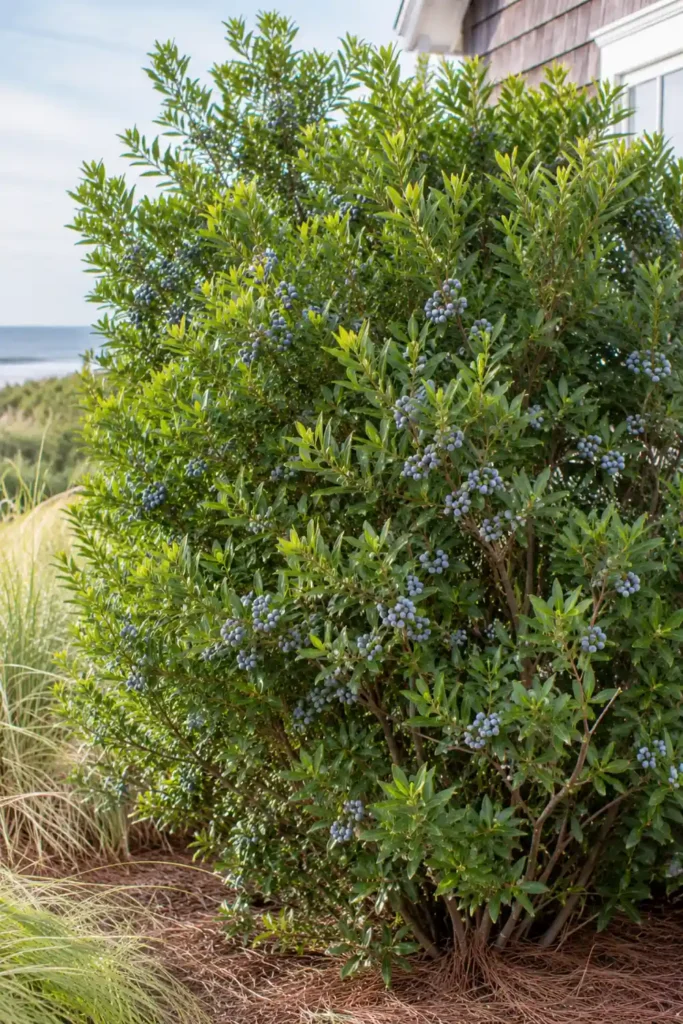
Wax myrtle is one of the fastest native evergreens for warm climates, and it fills a gap quickly. It grows as a large, multi-stemmed shrub or small tree with narrow, olive-green leaves that smell spicy when crushed.
Female plants carry small, waxy, gray-blue berries that birds eat through winter. Wax myrtle handles both wet and dry soil, sun or part shade, and salt spray, so it’s a strong choice for coastal yards and the Southeast. Prune it as a hedge or let it grow loose and natural.
It can spread by suckers and its branches can break under heavy ice, so give it room and check it after winter storms.
Quick facts: Evergreen broadleaf shrub or small tree | Full sun to part shade | Tolerates wet and dry soil | Typically 10 to 20 feet tall and wide | Aromatic leaves all year, berries in winter | Coastal yards, informal screens, wildlife hedges | Hardiness: USDA zones 7 to 10
7. Norway Spruce (Picea abies)
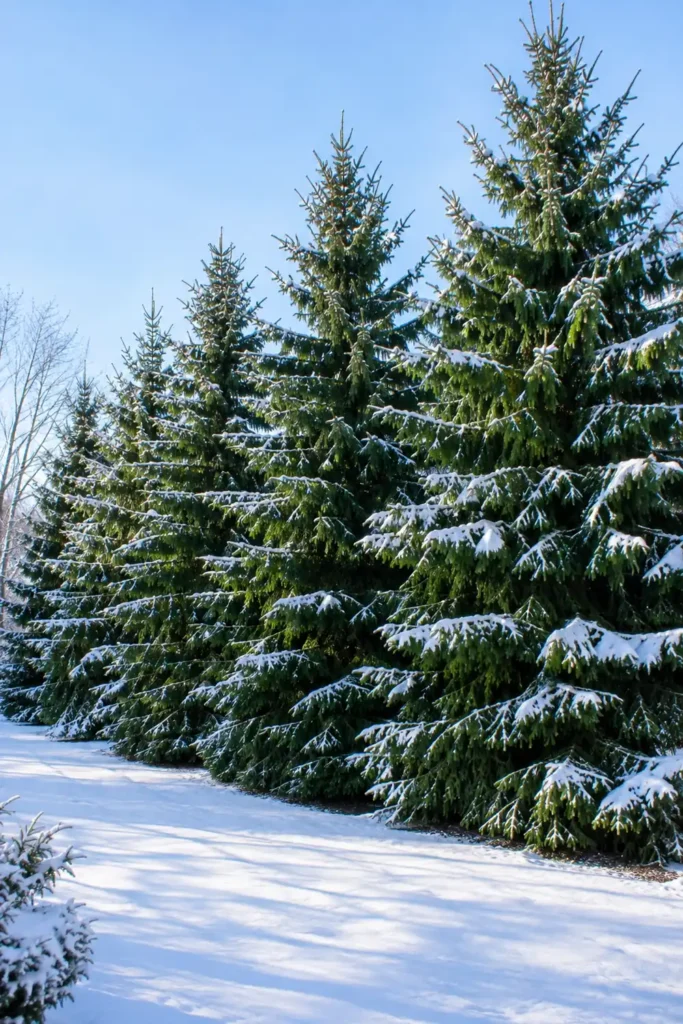
In cold climates, Norway spruce is one of the fastest and toughest evergreens you can plant. It forms a tall, dense pyramid of dark green needles, and as it matures, its side branches develop graceful drooping branchlets that give it a soft, layered look.
It handles cold winters, wind and heavy snow well, which is why it’s a classic windbreak tree on farms and large properties. It grows faster than most spruces, especially when young, and keeps its lower branches longer than many pines, so the screen stays full near the ground. It’s a big tree, though, so it needs space to spread and a spot well away from the house.
Plant it in full sun. In shade it grows thin and loses its density.
Quick facts: Evergreen conifer | Full sun | Regular water, good drainage | Typically 40 to 60 feet tall, 25 to 30 feet wide | Green all year | Cold climates, windbreaks, large property lines | Hardiness: USDA zones 3 to 7
8. Clumping Bamboo (Bambusa multiplex)
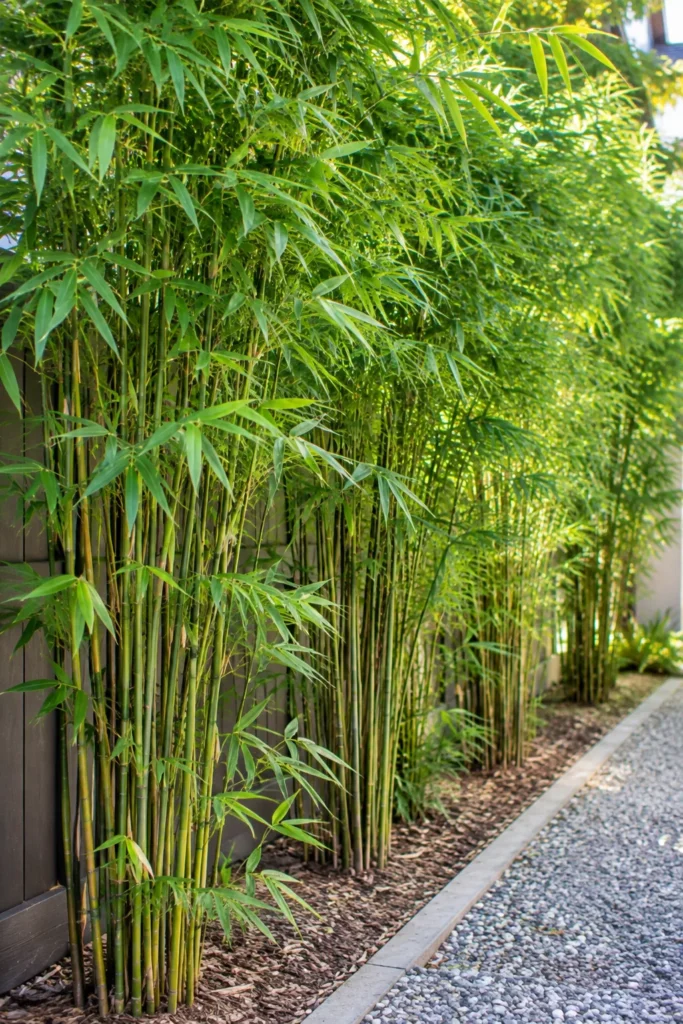
Bamboo grows faster than almost anything on this list, and the right kind makes a light, airy screen that rustles in the breeze. Clumping bamboo, often called hedge bamboo, grows in tight, upright clusters of slender green canes topped with narrow leaves.
The key word is clumping. Clumping bamboo expands slowly from the base and stays where you plant it. Running bamboo spreads underground, can be very hard to remove, and is regulated in some areas. If you inherit a running patch, these tips on how to control invasive plants can help.
📝 Quick note: Before you buy bamboo, check that the label clearly says clumping. Running bamboo spreads underground and is often what gets bamboo its bad reputation with neighbors.
Quick facts: Evergreen grass | Full sun to part shade | Regular water | Typically 10 to 25 feet tall, depending on type | Green canes and leaves all year | Narrow side yards, modern screens, warm climates | Hardiness: USDA zones 8 to 11
9. Japanese Cryptomeria (Cryptomeria japonica)
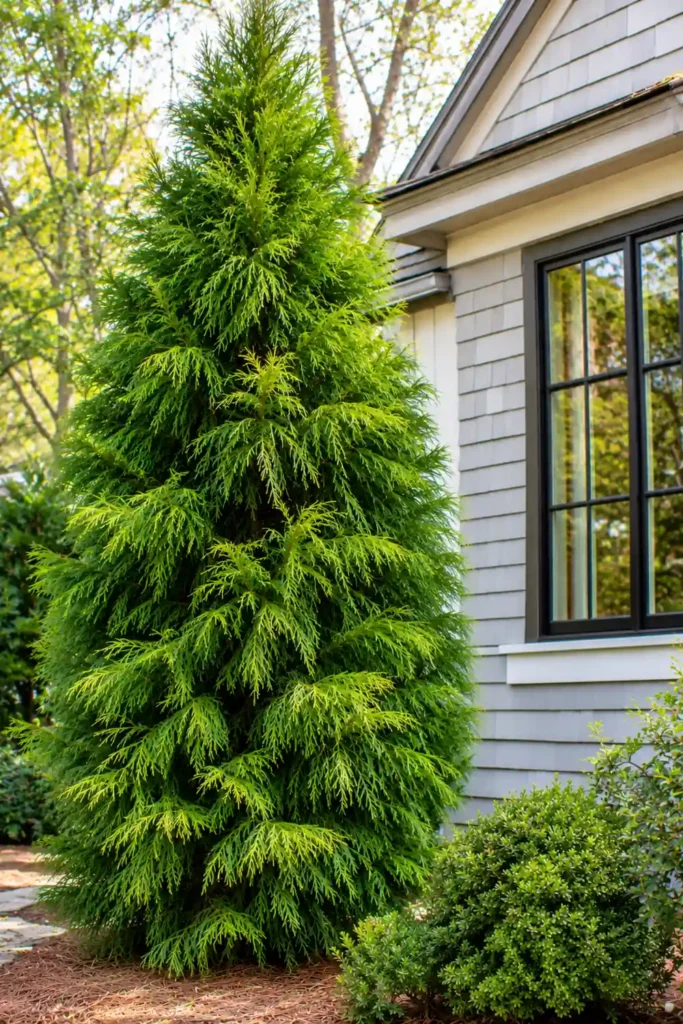
Japanese cryptomeria looks softer than most conifers. Its short, curved needles spiral around long, rope-like branchlets, so the whole tree has a fluffy, textured look, and its reddish-brown bark peels in long strips.
It’s another tree extension experts often recommend in place of Leyland cypress. It grows fast when young, forms a tall, narrow pyramid and handles full sun or part shade in moist, well-drained soil. In cold winters, the needles of some trees take on a bronze tint, which turns green again in spring. Planted in a staggered row with another evergreen, it makes a screen with real character.
Water during dry spells, especially in summer. Cryptomeria looks its best with steady moisture.
Quick facts: Evergreen conifer | Full sun to part shade | Steady moisture, good drainage | Typically 50 to 60 feet tall, 20 to 30 feet wide | Green all year, sometimes bronze in winter | Tall screens, Leyland alternative, mixed evergreen rows | Hardiness: USDA zones 6 to 9
10. Emerald Green Arborvitae (Thuja occidentalis ‘Smaragd’)
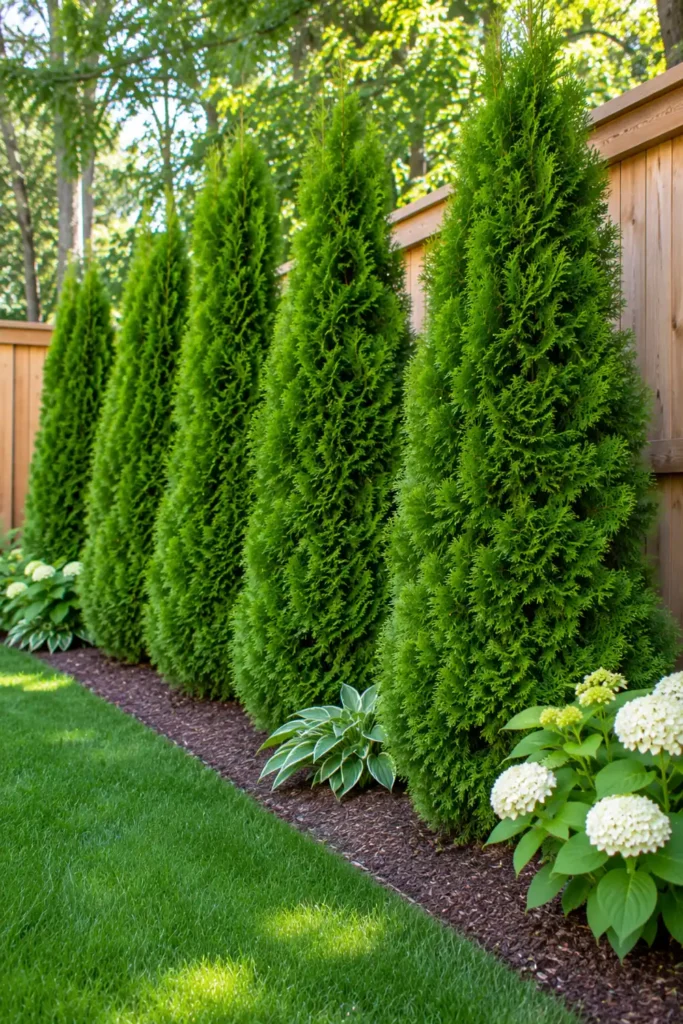
Emerald Green arborvitae is the narrow, tidy choice. It grows into a slim, dense column of bright green foliage that stays only a few feet wide, so it fits where wider trees won’t.
It grows more slowly than Green Giant, so plant larger trees if you want quick results. In exchange, it never takes over a small yard. A row of Emerald Green is a classic choice among privacy trees for small yards, along a fence or a narrow side strip. These narrow garden ideas show how to plant tight spaces like that.
Deer love American arborvitae. If they visit your yard, protect young trees with netting in winter.
Quick facts: Evergreen conifer | Full sun to part shade | Regular water while young | Typically 12 to 15 feet tall, 3 to 4 feet wide | Bright green all year | Small yards, fence lines, narrow side yards | Hardiness: USDA zones 3 to 7
11. Southern Magnolia (Magnolia grandiflora)
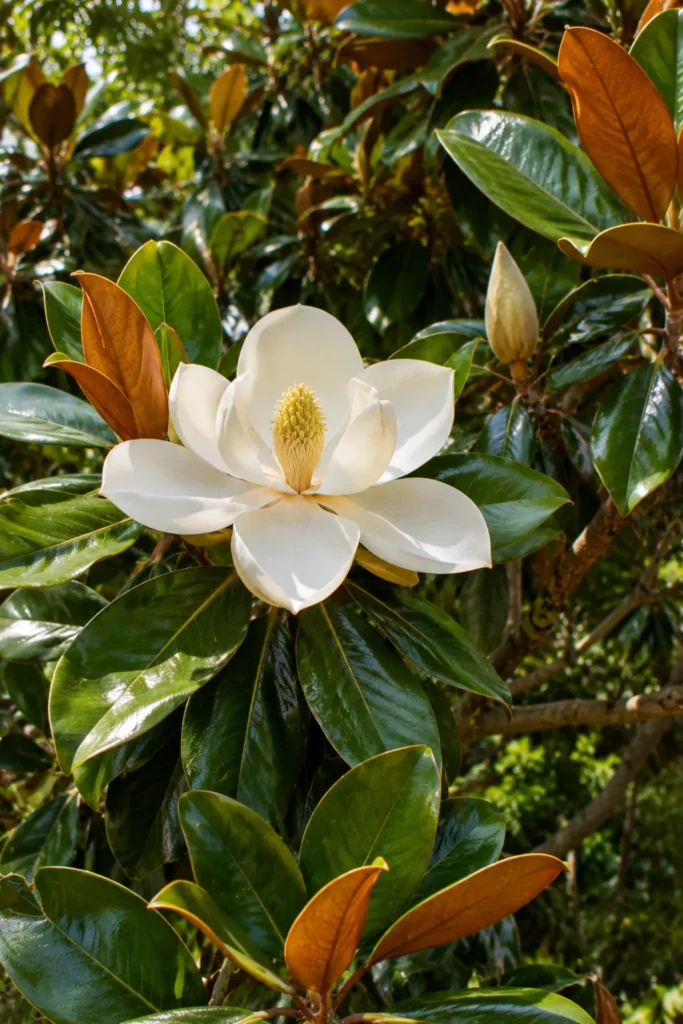
Southern magnolia is the most glamorous tree on this list. Its large, leathery leaves are glossy dark green on top and often a rusty, suede-like brown underneath, and in late spring and summer it opens huge, creamy white flowers with a lemony fragrance.
Its dense, evergreen canopy screens well all year, and in warm climates it grows faster than its stately look suggests. The full-size tree gets very big, so it suits large yards. Compact selections stay much smaller for tighter spaces. Southern magnolia drops old leaves throughout the year, and its roots sit close to the surface, so plant it where leaf litter won’t bother you and nothing needs to grow right underneath.
Plant it in full sun to part shade for the best flowers.
Quick facts: Evergreen broadleaf tree | Full sun to part shade | Regular water, good drainage | Typically 60 to 80 feet tall, 30 to 40 feet wide, compact forms much smaller | Glossy leaves all year, fragrant flowers late spring to summer | Large yards, Southern gardens, specimen screens | Hardiness: USDA zones 7 to 9
12. Spartan Juniper (Juniperus chinensis ‘Spartan’)
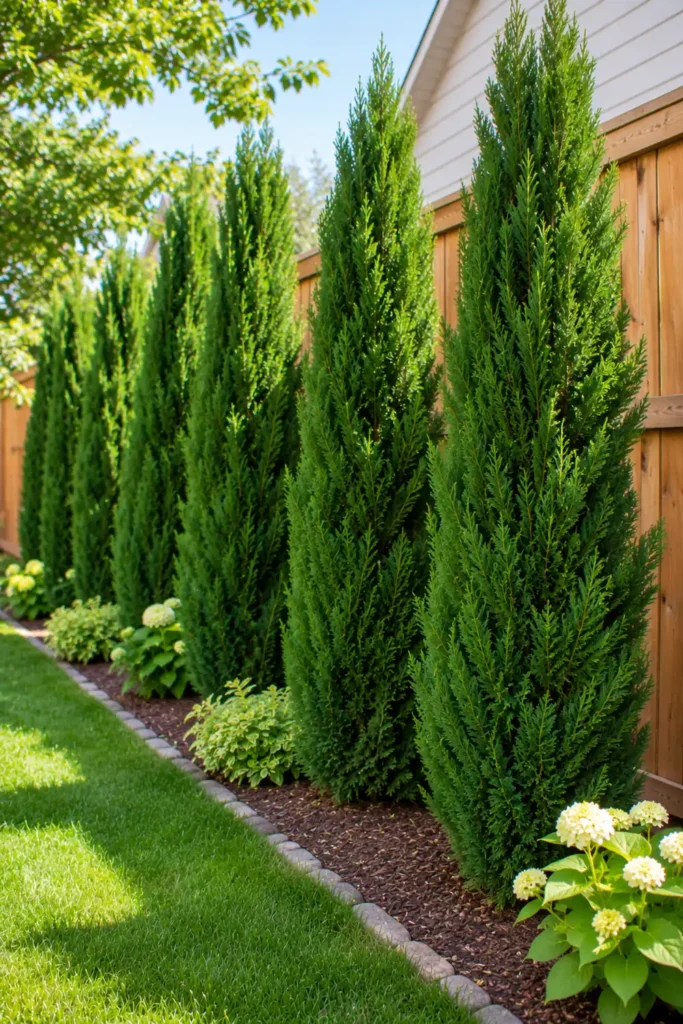
Spartan juniper is one of the best narrow evergreens for a tight space. It grows into a dense, upright column of dark green, scale-like foliage that stays slim and holds its shape with almost no pruning.
It loves full sun and handles heat, wind and dry soil once established, so it’s a strong choice for a hot, sunny fence line or a narrow strip between houses. Its stiff, slightly prickly foliage isn’t a favorite with deer, which tend to leave most junipers alone. For more plants that hold up to browsing, see these deer resistant shrubs.
Space it so the trees just touch at maturity. Crowded junipers lose their lower foliage.
Quick facts: Evergreen conifer | Full sun | Drought tolerant once established | Typically 15 to 20 feet tall, 3 to 5 feet wide | Dark green all year | Narrow yards, sunny fence lines, hot spots | Hardiness: USDA zones 4 to 9
13. River Birch (Betula nigra)
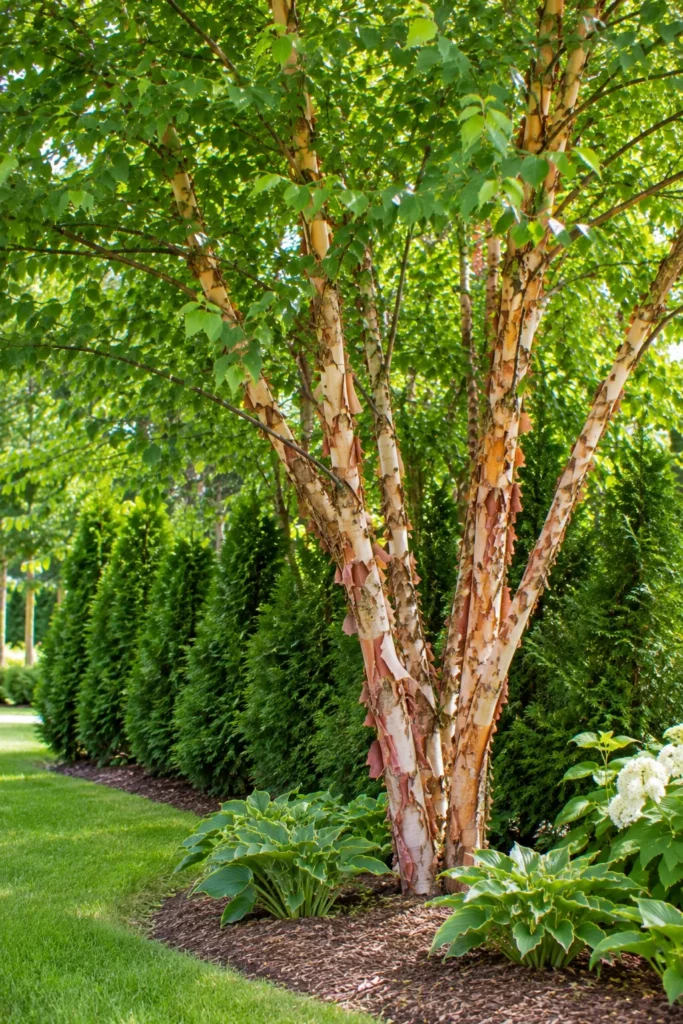
River birch is a deciduous tree, so it only screens from spring to fall. Few trees grow faster, though, and its peeling bark in shades of cinnamon, salmon and cream makes it a beauty in winter too.
This native tree often grows with several trunks, which gives it a full, natural shape that screens well in summer. It handles wet soil better than most trees and resists the borers that trouble white birches. Planted behind a row of evergreens, it adds height quickly while the evergreens fill in below.
Evergreen vs Deciduous Privacy Trees
Privacy: all year, including winter.
Examples: arborvitae, juniper, cypress, holly, magnolia.
Keep in mind: a dense row can shade out lawn and plants behind it.
Privacy: spring to fall only.
Examples: river birch, dawn redwood.
Keep in mind: they let winter sun through, which suits patios and south-facing windows.
Quick facts: Deciduous tree | Full sun to part shade | Moist soil, tolerates wet spots | Typically 40 to 50 feet tall, 25 to 35 feet wide | Peeling bark all year, leaves spring to fall | Wet yards, summer screens, mixed rows | Hardiness: USDA zones 4 to 9
14. Italian Cypress (Cupressus sempervirens)
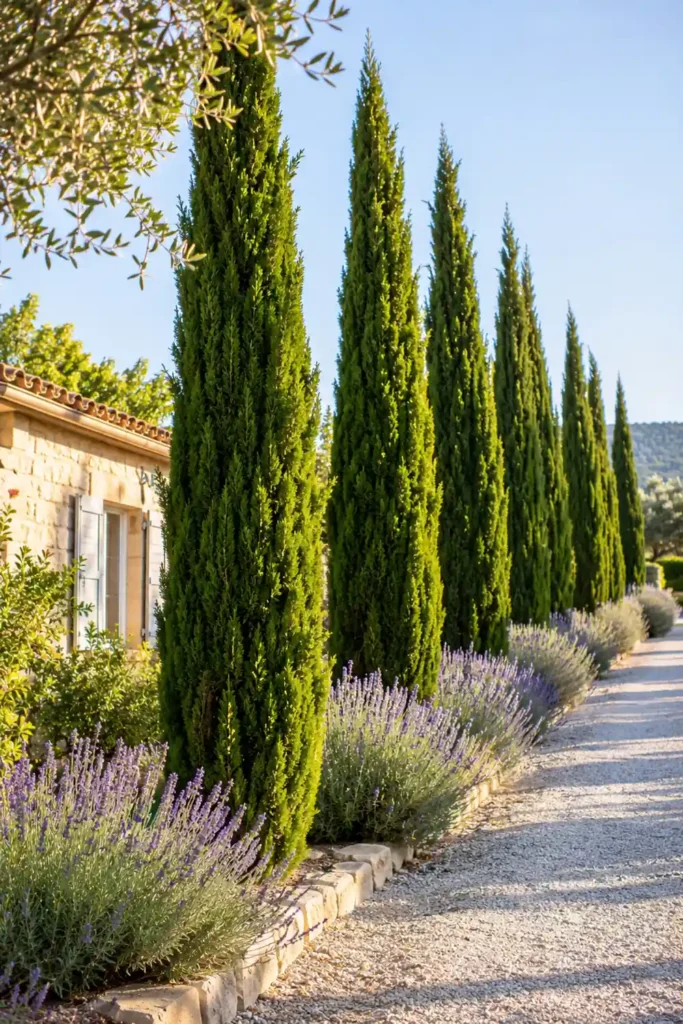
Italian cypress is the tall, pencil-thin evergreen of Mediterranean postcards. It grows into a dark green spire, very tall and very narrow, and a row of them gives a yard instant formal structure.
It thrives in hot, dry summers and full sun, and it needs well-drained soil. Heavy, wet clay and humid air can cause root and fungal problems. Because it’s so narrow, it suits long, thin spaces where a wide tree won’t fit, such as a driveway edge or a side yard. It pairs naturally with gravel, olive trees and lavender in these Mediterranean front yard details.
Plant a few more trees than you think you need. Each one is so slim that gaps show easily.
Quick facts: Evergreen conifer | Full sun | Drought tolerant once established, needs good drainage | Typically 40 to 60 feet tall, 5 to 10 feet wide | Dark green all year | Hot, dry yards, formal rows, driveways | Hardiness: USDA zones 7 to 10
15. Skip Laurel (Prunus laurocerasus ‘Schipkaensis’)
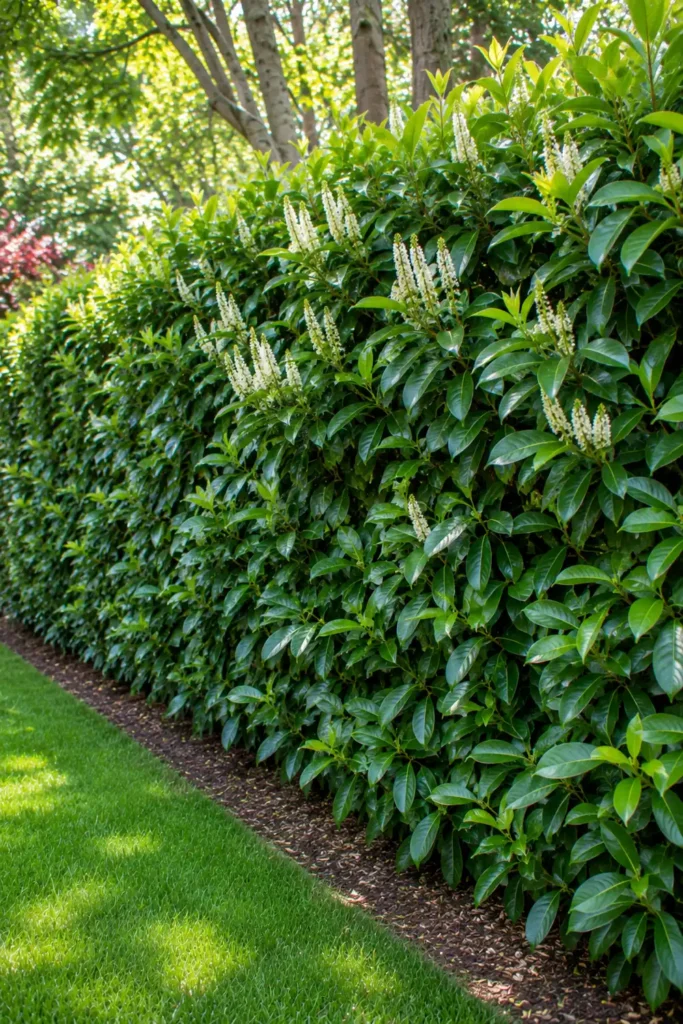
Skip laurel makes one of the densest evergreen hedges you can grow. It forms a wall of glossy, dark green leaves from top to bottom, and in spring it sends up spikes of small white flowers followed by dark fruit.
It grows fast, handles sun or quite a bit of shade, and takes pruning well, so it’s a favorite for tall hedges in the eastern US. There are two important cautions. Cherry laurel, the species skip laurel comes from, is listed as invasive in parts of the Pacific Northwest, so check local guidance before planting there. Its leaves and seeds are also toxic to people and pets if eaten.
Prune after it flowers in spring to keep it tidy without losing next year’s blooms.
Quick facts: Evergreen broadleaf shrub or small tree | Full sun to part shade | Regular water, good drainage | Typically 10 to 18 feet tall, 5 to 7 feet wide | Glossy leaves all year, white flowers in spring | Tall hedges, shaded property lines | Hardiness: USDA zones 6 to 8
16. Deodar Cedar (Cedrus deodara)
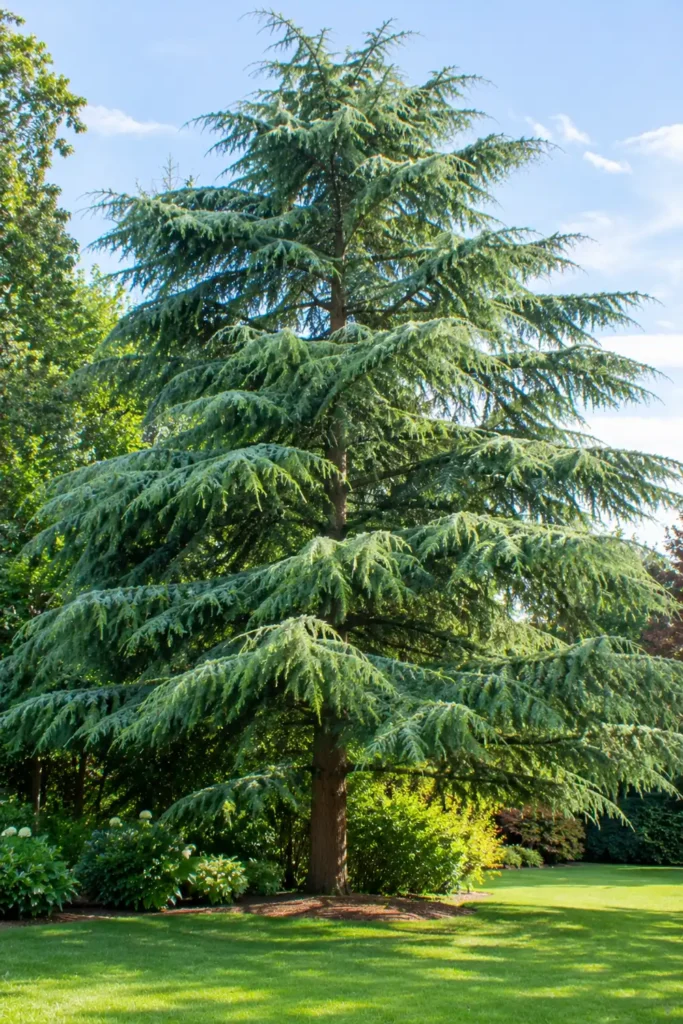
The drooping branch tips of deodar cedar give it a soft, graceful look that few large evergreens can match. Its needles grow in clusters along the branches, in shades from soft green to silvery blue-green.
Young trees grow fast and branch densely, which makes deodar cedar a good choice for screening, as long as you have room. It eventually becomes a very large, wide tree, so it suits big yards, long property lines and rural lots rather than small suburban spaces. Give it full sun and well-drained soil, and it will reward you with decades of graceful screening.
Plant it well away from the house and power lines. Its mature spread is wider than most people plan for.
Quick facts: Evergreen conifer | Full sun | Moderate water, good drainage | Typically 40 to 70 feet tall, 20 to 40 feet wide | Soft needles all year | Large yards, long property lines, specimen screens | Hardiness: USDA zones 7 to 9
17. Sweet Viburnum (Viburnum odoratissimum)
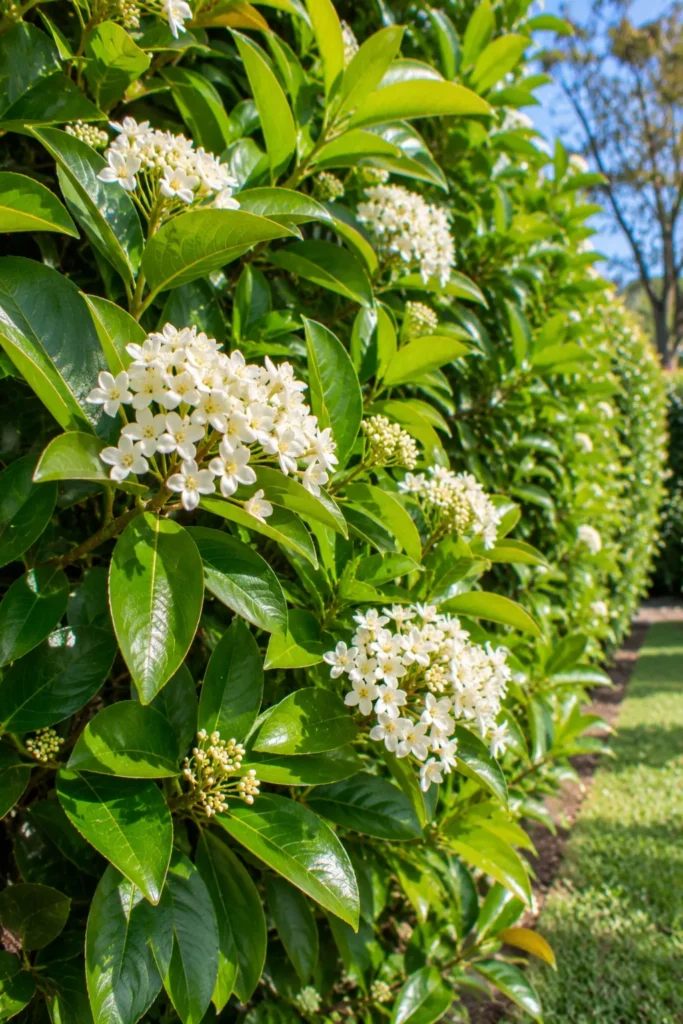
Sweet viburnum grows fast in warm climates and makes a full, glossy screen with very little fuss. Its large, bright green leaves shine in the sun, and in spring it opens clusters of small, fragrant white flowers, followed by red fruit that ripens to black.
It handles sun or part shade and takes pruning well, so you can keep it as a tall hedge or let it grow into a small tree. Its bright, glossy leaves make a cheerful backdrop for flowering plants in front. For more on growing viburnums well, this guide on how to grow viburnum in the garden and in pots covers planting and care.
Prune just after flowering to keep next year’s blooms.
Quick facts: Evergreen broadleaf shrub or small tree | Full sun to part shade | Regular water | Typically 10 to 20 feet tall, 8 to 15 feet wide | Glossy leaves all year, fragrant flowers in spring | Warm climate hedges, tall screens | Hardiness: USDA zones 8 to 10
18. Eastern Hemlock (Tsuga canadensis)
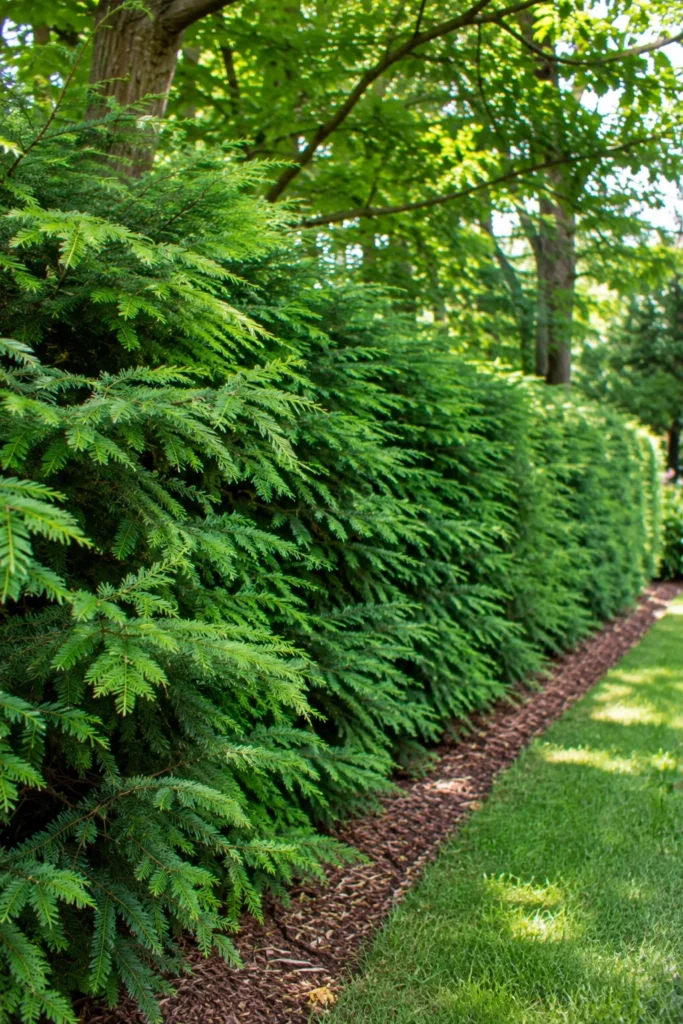
Most privacy trees want full sun. Eastern hemlock is one of the few evergreens that handles shade well, which makes it a valuable option for a shady property line. It has short, flat, soft needles and gently drooping branches that give the tree a graceful, layered look.
It grows at a moderate pace rather than a fast one, but it can be sheared into a dense, elegant hedge and keeps its lower branches in shade where other conifers thin out. It likes cool, moist, well-drained soil and doesn’t handle drought, heat or harsh winds.
Hemlock woolly adelgid, a small insect that leaves white, cottony tufts under the needles, is a serious problem in much of the East. Check with your local extension office before planting.
Quick facts: Evergreen conifer | Part shade to shade | Steady moisture, good drainage | Typically 40 to 70 feet tall, 25 to 35 feet wide, smaller when sheared | Soft needles all year | Shady property lines, cool climates, sheared hedges | Hardiness: USDA zones 3 to 7
19. Dawn Redwood (Metasequoia glyptostroboides)

Dawn redwood is one of the fastest growing trees you can plant in a temperate yard. It’s an unusual conifer that drops its needles in fall. Its soft, feathery, bright green needles turn orange-bronze before they fall.
Because it loses its needles, it screens only from spring to fall, but it shoots up so quickly that it gives height and privacy faster than almost anything else. It forms a narrow, pyramid shape with a buttressed trunk, and it likes moist soil, even handling wet spots. It’s a very tall tree, so it needs open space and suits big yards and long property lines best.
Plant evergreens in front of it for winter privacy, and let the dawn redwood handle the height.
Quick facts: Deciduous conifer | Full sun | Moist soil, tolerates wet spots | Typically 70 to 100 feet tall, 15 to 25 feet wide | Feathery green in summer, orange-bronze in fall | Large yards, wet ground, fast height | Hardiness: USDA zones 5 to 8
20. Western Red Cedar (Thuja plicata)
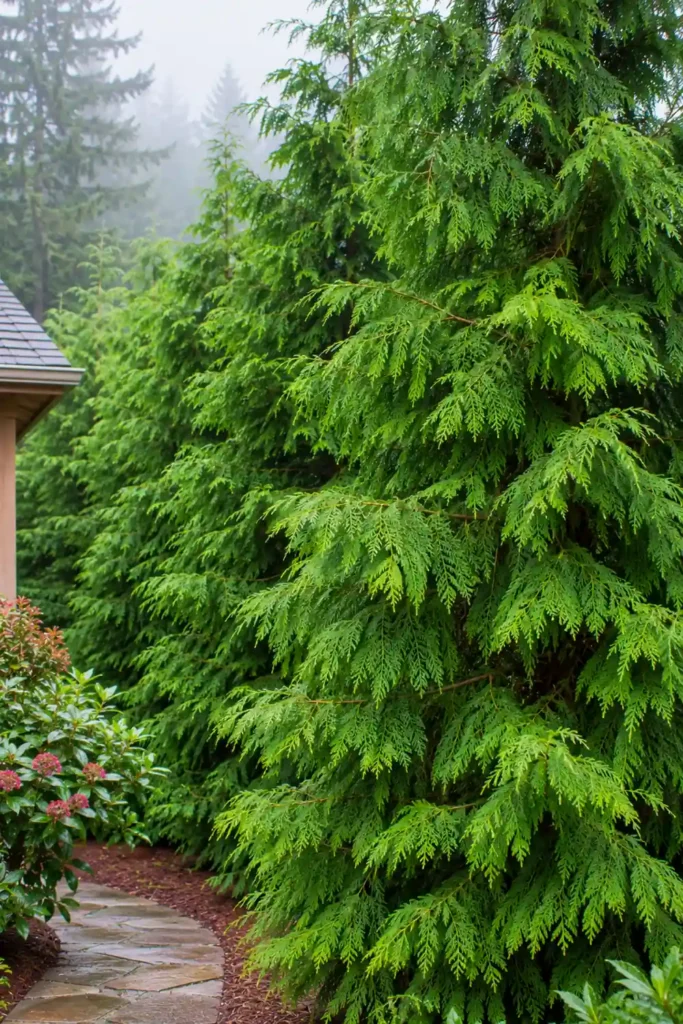
Western red cedar is a large, long-lived native evergreen of the Pacific Northwest. Its flat, glossy sprays of scale-like foliage droop gracefully from the branches and smell fresh and spicy when brushed.
In cool, moist climates, it grows quickly and forms a tall, dense screen that keeps its lower branches. It tolerates more shade than many conifers and does well in rainy regions. It struggles in hot, dry summers, so it suits cooler parts of the country better than the South. It also grows very big, so it suits large yards and rural property lines.
Deer like to browse its foliage, so protect young trees in winter if deer are common.
Quick facts: Evergreen conifer | Full sun to part shade | Steady moisture | Typically 50 to 70 feet tall, 15 to 25 feet wide | Green all year | Cool, moist climates, large screens, Pacific Northwest yards | Hardiness: USDA zones 5 to 7
How to Plant a Privacy Screen That Lasts
The best screens on this list follow the same plan. Choose trees that fit your zone, light and space at their full mature size, not their size in the pot. Mix two or three species, and plant them in a staggered row instead of a straight line, so the screen fills in faster and one disease can’t wipe it out. Space trees based on their mature width, keep them back from the house and property line, and water deeply through the first two summers while roots settle in.
| Your yard | Good picks from this list | Why they fit |
|---|---|---|
| Small or narrow yard | Emerald Green arborvitae, Spartan juniper, Italian cypress, clumping bamboo | Tall but slim, so they fit tight spaces |
| Large yard, tall screen | Green Giant arborvitae, Norway spruce, eastern white pine, deodar cedar | Fast, big and dense |
| Hot, dry climate | Arizona cypress, Italian cypress, eastern red cedar | Handle heat and drought once settled |
| Warm, humid or coastal | Wax myrtle, sweet viburnum, southern magnolia, Nellie R. Stevens holly | Glossy evergreens that thrive in Southern heat |
| Shade | Eastern hemlock, skip laurel, western red cedar | Stay fuller than most conifers in lower light |
| Wet ground | River birch, dawn redwood, wax myrtle | Tolerate soggy spots that kill many evergreens |
Privacy Trees FAQ
What is the fastest growing tree for privacy?
Among evergreens, Green Giant arborvitae and wax myrtle are some of the fastest. Clumping bamboo and dawn redwood grow even faster but screen differently. Hybrid poplar is also very fast, but it tends to be short-lived and prone to problems, so it’s a poor long-term choice.
How far apart should you plant privacy trees?
A common rule of thumb is to space trees at about half to three quarters of their mature width, so they touch or overlap as they grow. A staggered double row fills in faster than a single line. Planting too close looks good at first, but crowded trees compete and are more prone to disease.
Is Leyland cypress a good privacy tree?
It grows very fast, but extension experts often advise against it. Leyland cypress is prone to cankers and other diseases, especially when crowded or stressed, and it often lives only a couple of decades. Green Giant arborvitae, Arizona cypress and Japanese cryptomeria are common alternatives.
What privacy trees grow in shade?
Eastern hemlock is the best evergreen for shade on this list. Skip laurel and western red cedar also handle part shade better than most conifers. Most fast privacy trees, including arborvitae, junipers and cypresses, need full sun to stay dense.
How far from a house or property line should you plant privacy trees?
Plant at least half the tree’s mature width away from the house, fence or property line, and keep large trees farther back. That keeps roots and branches off structures and out of the neighbor’s yard. If branches do cross over, know the rules on trimming a neighbor’s overhanging tree.
Conclusion
The best fast growing trees for privacy are the ones that suit your yard at full size, not just in the first few years. Match each tree to your zone, light and space. Mix two or three kinds in a staggered row, give them room to spread, and water them well while they settle in. Do that, and the screen you plant this season will keep your yard private for decades. If space is tight, these side yard privacy ideas show more ways to screen narrow spots.
Pin this for the next time you’re planning a living privacy fence.