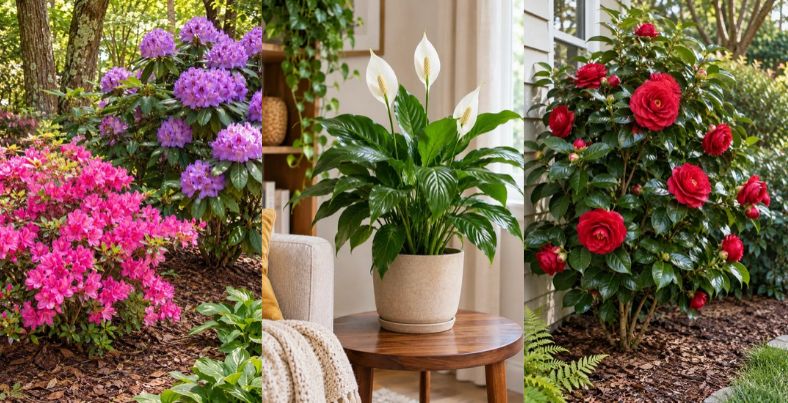
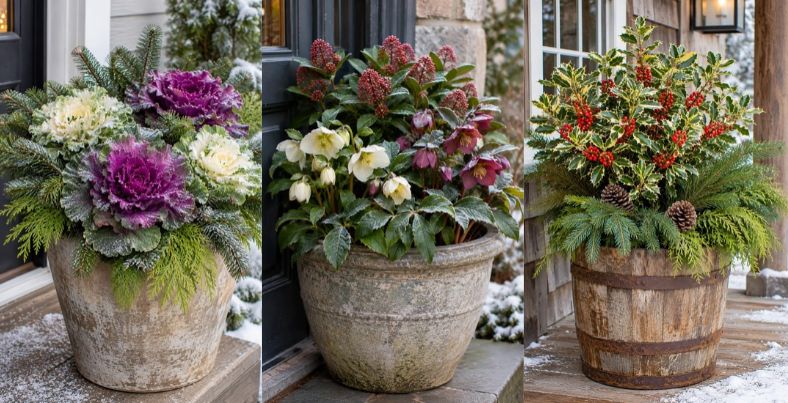
Summer flowers are long gone, the mums have browned, and the pots by the front door are suddenly the saddest thing on the porch. These winter porch pot ideas fix that, and they last long after the holiday decorations come down.
Most winter pots are built the same way. Cut evergreen boughs like fir, pine and cedar give a full, green base. Tall branches such as red twig dogwood or birch poles add height. Berries, pinecones and magnolia leaves bring color and texture. Live dwarf conifers and winter-flowering plants are another route, and they keep growing right through the cold months.
Below are 23 ideas for real porches: grand urns and small steps, snowy northern porches and milder southern ones, holiday pots and the quiet weeks after. Each one names the greens and plants that suit it and the one move that keeps it looking fresh. The last few ideas take you into late winter and spring, so your pots never sit empty. Late November is the right time to start, while the soil in your pots is still soft enough to hold stems.
How These Winter Porch Pots Last
Every pot in this list relies on the same simple approach: tough greens, a solid base and a little care when the weather warms. Cut evergreens like fir, white pine, cedar and spruce hold their color for weeks in cold air, and tall stems of dogwood, birch or curly willow give each pot its shape. Living conifers, hellebores and kale keep growing, while dried hydrangeas, eucalyptus and pinecones never fade. The ideas move from holiday pots through the post-holiday weeks to late winter pansies and spring bulbs, so pick the stage you’re at and start there.
1. Classic Fir, Cedar and White Pine Pot With Red Twig Dogwood
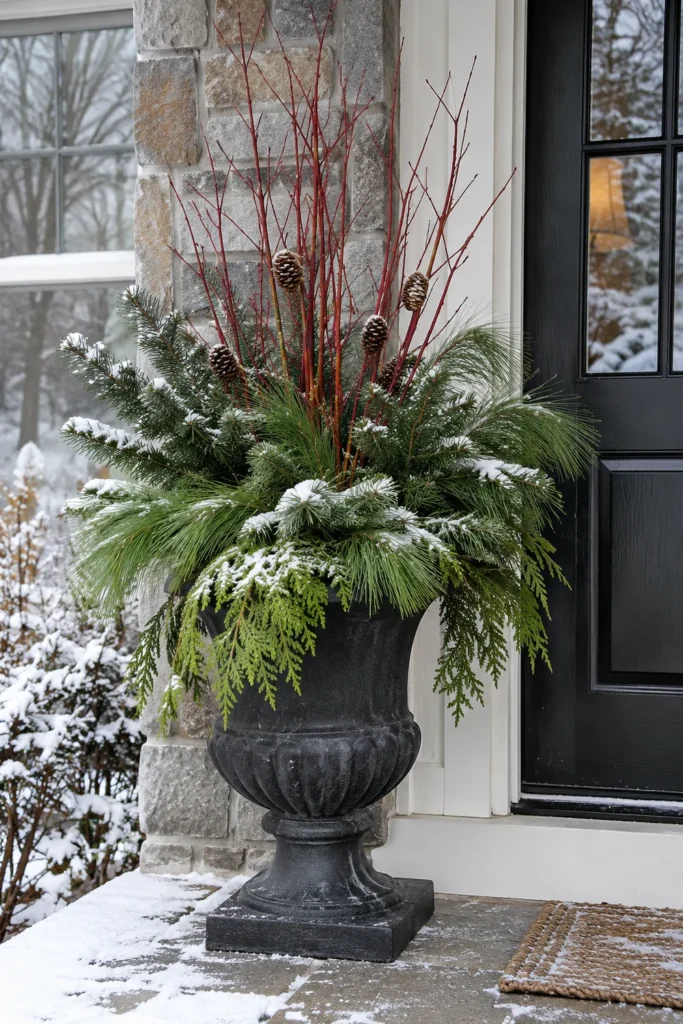
Fraser fir, cedar and white pine are the backbone of a classic winter porch pot, and for good reason. All three hold their color for weeks outdoors, and each brings a different texture: stiff, dark fir, soft, long-needled white pine and flat, drapey cedar sprays.
Here, a black urn by the front door holds all three, with tall red twig dogwood stems rising from the center. Think of it as thriller, filler and spiller. The dogwood is the thriller, fir and pine fill the middle, and cedar spills over the rim. Pinecones wired onto a few branches add a natural finishing touch. On a snowy morning, the bright red stems are the first thing you see from the street.
🌿 Garden Tip
Build your pot while the soil is still soft. Recut each stem end, push it deep into moist soil and firm it in, then water well. Once the soil freezes, it locks the stems in place for the rest of winter. Water again whenever the soil thaws, and if you use an anti-desiccant spray on the greens, follow the product label.
2. Dwarf Alberta Spruce Pair Flanking the Front Door
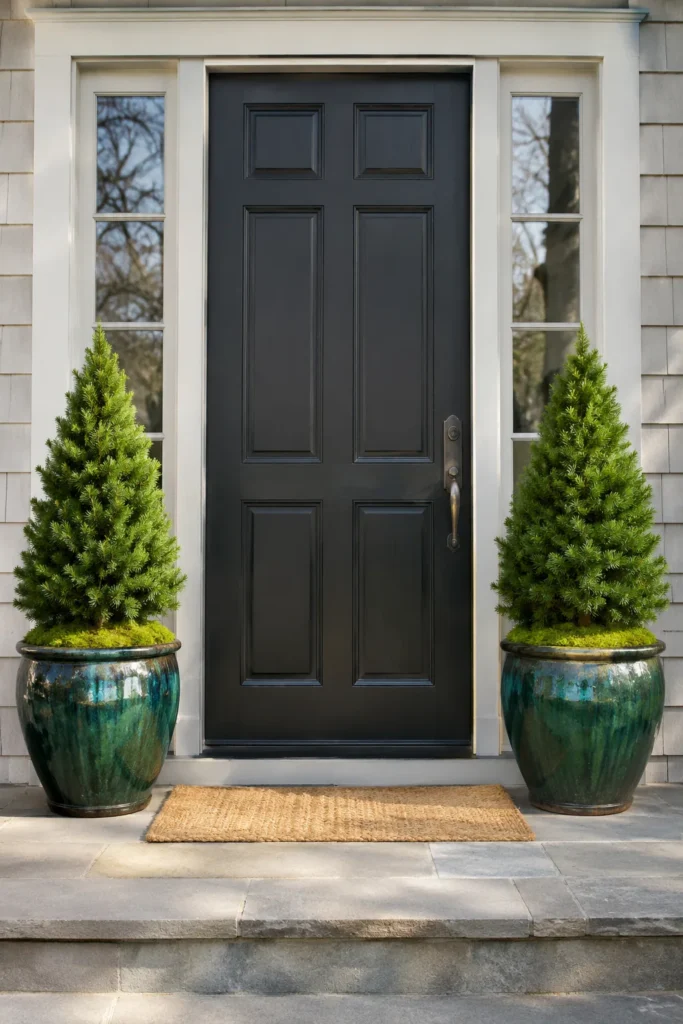
Cut greens slowly fade by late winter, but a living conifer stays green and keeps growing. A pair of dwarf Alberta spruce in glazed pots on either side of the front door gives the entry instant symmetry and stays fresh all season.
The dense, cone-shaped spruces look like small Christmas trees, so they work during the holidays with a few ornaments and look just as good undecorated in February. A top-dressing of green moss around their base hides bare soil. Potted roots are more exposed to cold than roots in the ground. A large pot helps, and so does choosing a plant hardy to a colder zone than yours. To decide what to do with them next winter, see whether potted plants need to come indoors for winter.
Cut Greens vs Living Evergreens in Porch Pots
Best for: big, full arrangements with mixed textures, branches and berries.
Lasts: weeks to months in cold weather, fading by late winter.
Keep in mind: set stems before the soil freezes and refresh tired greens in February.
Best for: clean, simple pots that look good all winter and beyond.
Lasts: all season, and can be planted in the garden in spring.
Keep in mind: roots in pots are exposed to cold, so use large pots and water when the soil thaws.
3. Birch Poles and Magnolia Leaves in a Cream Planter

Those bronze, suede-like undersides of magnolia leaves are what make this pot so warm. The glossy green tops and the soft brown backs give two colors from one stem, and magnolia holds up well outdoors as a cut green.
Widen the view and the white birch poles take over. Three poles of different heights stand upright at the back of a cream planter, their papery white bark echoing the pale pot. Magnolia stems fill in around them, with a few sprigs of fir for depth. The white, cream and bronze palette suits a modern farmhouse porch and feels wintry without any red at all, which means it still looks right in February.
Group the birch poles in odd numbers, and set the tallest at the back so the pot reads well from the walkway.
4. Winterberry and Boxwood in a Galvanized Tub
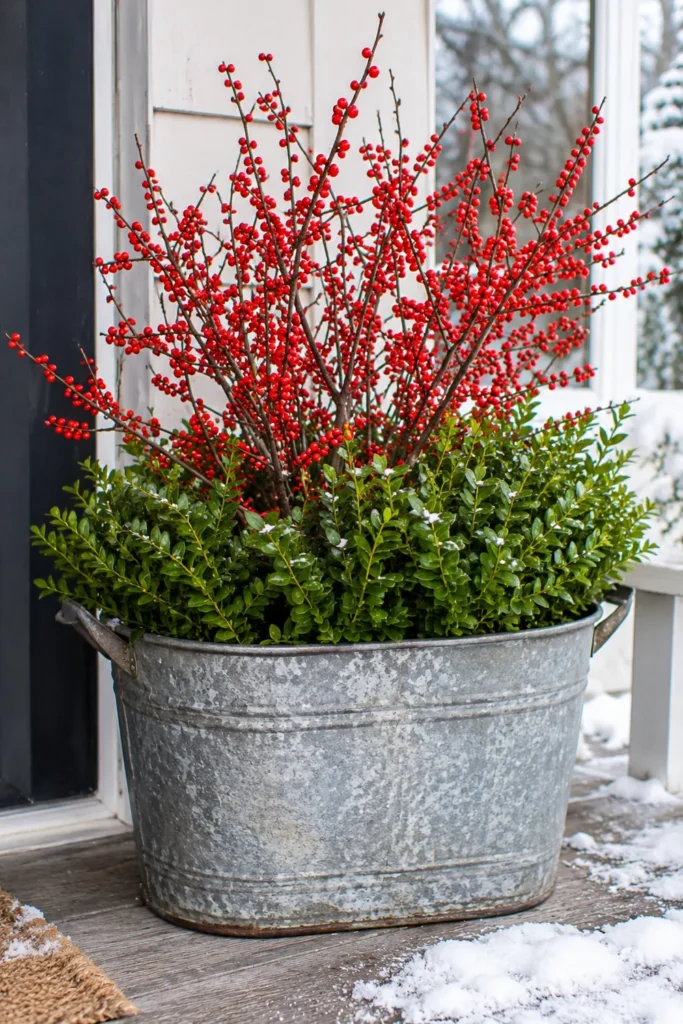
Bare branches can look lifeless. Bare branches covered in bright red berries look like the best part of winter. Winterberry is a holly that drops its leaves in fall but keeps its berries, so cut stems give you clusters of red on clean, dark branches.
Compare it with a pot of greens alone and the difference jumps out. In a galvanized tub on gray porch boards, the red berries glow against the cool metal, and sprigs of boxwood around the base add a fresh green collar. The pot reads as festive in December and cheerful in January. If robins or cedar waxwings find your porch in late winter, they may strip a few berries, which is a show in itself.
Place the tub where you’ll see it from inside, so you can watch the birds if they come.
5. Silver Dollar Eucalyptus, White Pine and Frosted Pinecones
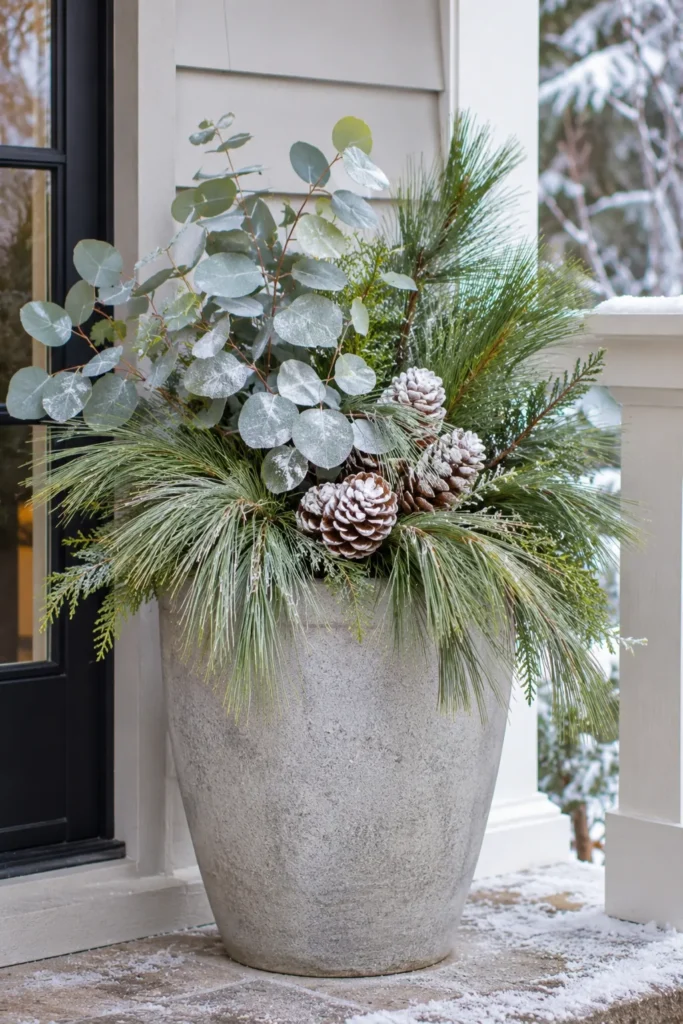
Silver and white is the most wintry palette you can choose, and it never looks like leftover Christmas. Silver dollar eucalyptus, with round, silvery-blue leaves, is the star here, because preserved eucalyptus holds its color all winter long.
Long, soft white pine needles fill out the pot behind it, and frosted pinecones nestle among the stems, tipped in white like a dusting of snow. Many white pine cones naturally carry a whitish crust of hardened sap, and a dry-brushed touch of white paint gives the same look. In soft winter light, the pale colors catch every bit of brightness on a gray day.
Get the look: preserved silver dollar eucalyptus, white pine boughs, frosted pinecones, a pale gray or white planter.
6. Hellebores and Skimmia for a Mild Winter Porch

Most flowers give up in winter, but hellebores are just getting started. Their nodding, cup-shaped blooms in white, pink or plum open in late winter, often while frost is still on the ground. Paired with skimmia, which carries clusters of red flower buds all winter, they make a living pot that actually blooms in the cold.
Both plants prefer shade, which makes them a natural fit for a shaded front entry where conifers might struggle. This combination works best where winters are mild. In colder areas, potted roots can freeze solid, so move the pot to a sheltered spot or protect it. These tips for protecting plants from frost help on the coldest nights.
Garden note: Hellebores are toxic to pets and people if eaten, so keep the pot out of reach of curious dogs.
7. Variegated Holly in a Wooden Barrel With Cut Greens

Holly has been a winter favorite for centuries, and a variegated one, with cream-edged leaves, brightens a porch even on the darkest days. Planted in a wooden barrel, it gives the pot a living center that stays glossy and green all season.
Tuck cut fir and cedar around the base of the holly for a fuller look, and add a few pinecones to the soil. The cream leaf edges pick up the pale tones of weathered wood, so the barrel and plant look made for each other on a rustic porch. Only female holly plants bear berries, and most need a male plant nearby to set them. Check the tag if you want red berries.
Drill drainage holes in the barrel if it doesn’t have them. Water sitting in a frozen barrel can crack the staves.
8. Ornamental Kale With Evergreen Boughs for Early Winter
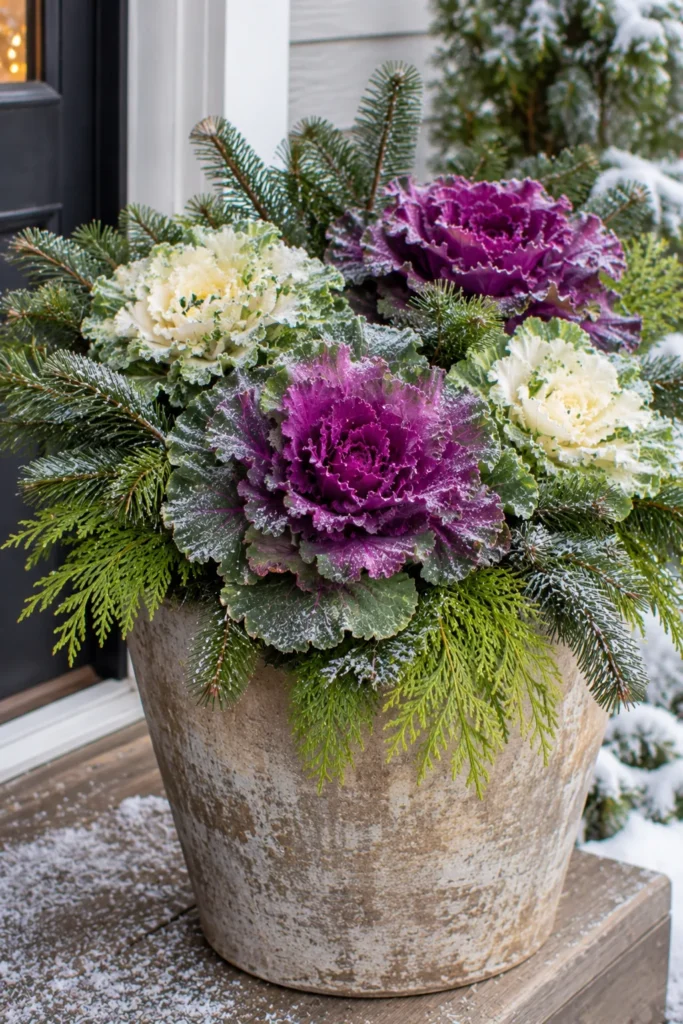
The purple and cream centers of ornamental kale actually deepen in color after the first frosts, which is why it’s such a smart bridge between fall and winter. Its ruffled rosettes look like oversized flowers just when everything else has faded.
Step back and the pot shows its full plan. Kale holds the center, and evergreen boughs of fir and cedar are tucked around it, so the pot already looks wintry. Kale usually lasts into early winter, until a hard freeze turns the leaves soft. When that happens, pull it out and fill the gap with more greens, and the pot carries on through winter. If you’re still working on your fall planters, these fall planter recipes with ornamental kale make a good starting point.
9. Tall Stone Urns With Curly Willow and Blue Juniper
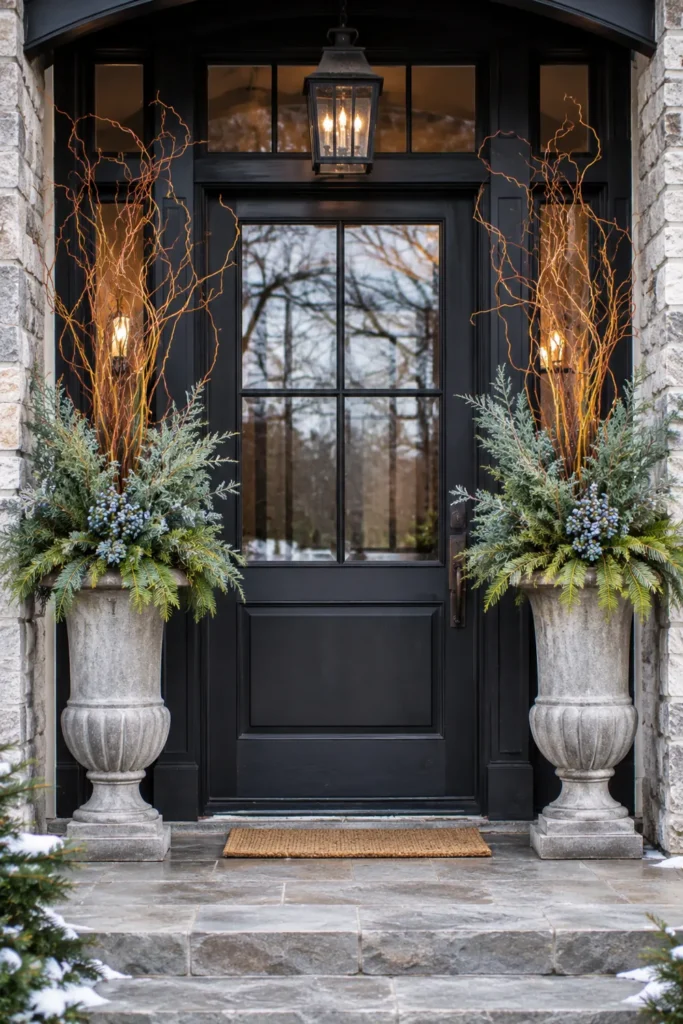
Big entries need big pots. A pair of tall stone urns on either side of a grand front door sets the scale, and the arrangements inside need to match. Curly willow does that job, with twisting, corkscrew branches that rise high above the rim.
Below the willow, blue juniper adds dusty blue berry-like cones and fine, prickly foliage, and fir fills the base. The wild, twisting willow contrasts with the solid, formal urns, so the pots feel dramatic but not stiff. Stone urns are also heavy and frost-resistant, which means they stay put in wind and handle a hard winter. For more ways to dress a front door, these front yard entrance ideas carry the look down the walk.
Styling note: Repeat the same arrangement in both urns, and stand the willow at the same height. Symmetry is what makes a grand entry look intentional.
10. Spruce Tips in Galvanized Buckets Up the Porch Steps
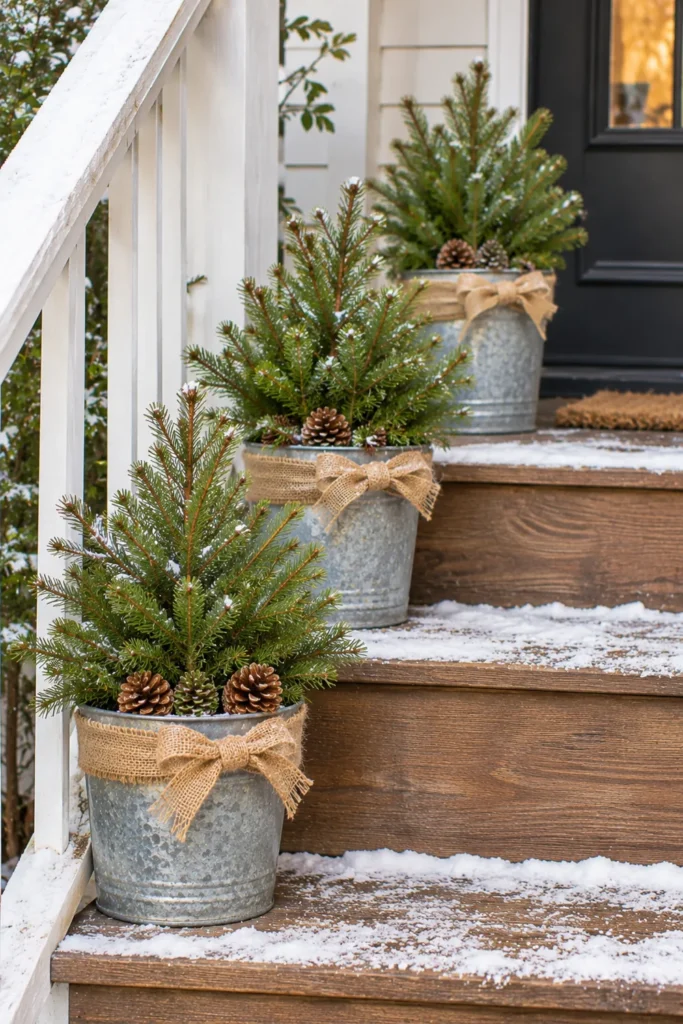
Small porches don’t have room for big urns, but porch steps do. Three small galvanized buckets set on alternating steps, each filled with spruce tips, bring winter greenery all the way up to the door without crowding anything.
Spruce tips are the tops of young spruce trees, often sold at garden centers in winter. Each one stands upright like a tiny tree, so a single tip in each bucket looks complete. A strip of burlap tied around each bucket adds a soft, rustic finish. Keep the buckets to one side of the steps so the walkway stays clear and safe in snow and ice.
Get the look: three small galvanized buckets with drainage holes, spruce tips, a few pinecones, burlap ribbon.
11. Modern Black Planter With an Arborvitae Spire and Gold Branches

Black and gold looks sharp on a modern porch, and it doesn’t rely on a holiday color scheme. A tall black planter holds a single narrow arborvitae, its upright, column shape repeating the clean lines of the house.
Step back and the gold branches do the styling. A handful of twigs, spray-painted gold, fan out at the base of the arborvitae and catch the porch light in the evening. The dark pot makes the green look deeper and the gold look brighter, so the whole thing reads as polished without being fussy. Because the arborvitae is alive, the pot still looks right after the holidays. Pull the gold branches in January if you want a simpler look.
Water the arborvitae whenever the soil isn’t frozen. Living evergreens in pots dry out in winter wind faster than you’d think.
12. Woodland Pot of Moss, Mini Evergreens and Birch Bark
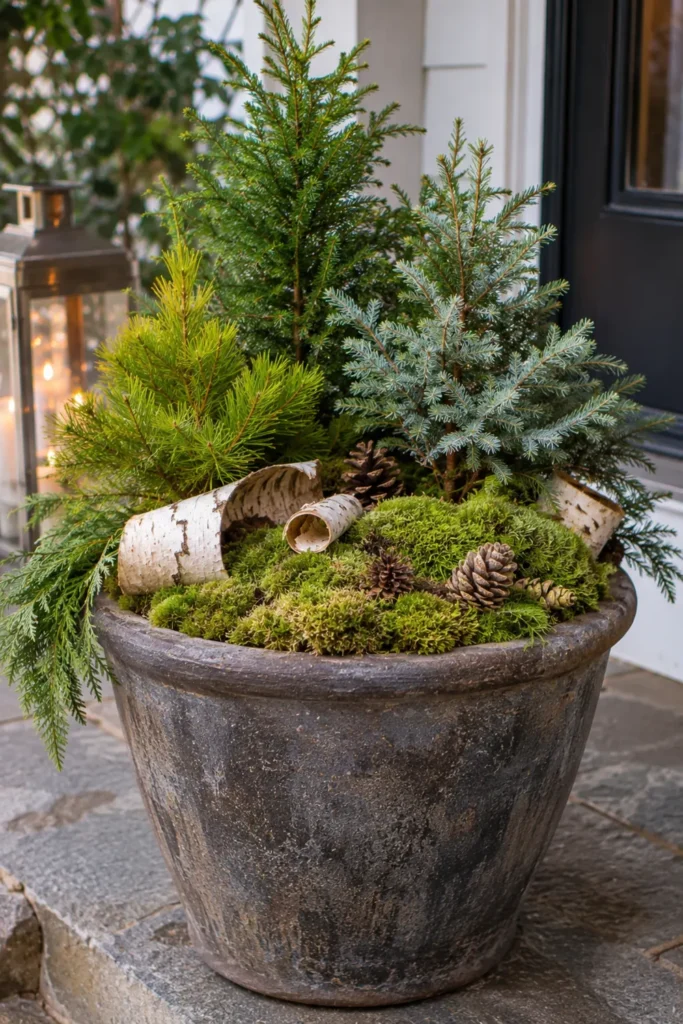
Moss is the quiet hero of this pot. A carpet of green moss covers the soil, and small evergreens rise out of it like a tiny forest, with curls of birch bark and a few pinecones scattered at their feet.
Seen close up, it looks like a slice of the forest floor brought to the front door. The small scale suits a narrow porch or a spot right beside the door where people will see it up close. Keep the pot out of harsh afternoon sun, and give the moss a drink on mild days so it stays green. For more of this look in the garden, these woodland garden ideas work beautifully in a shady yard.
In spring, plant the small evergreens out in the garden and start again next fall.
13. Lighted Porch Pot With Battery Fairy Lights
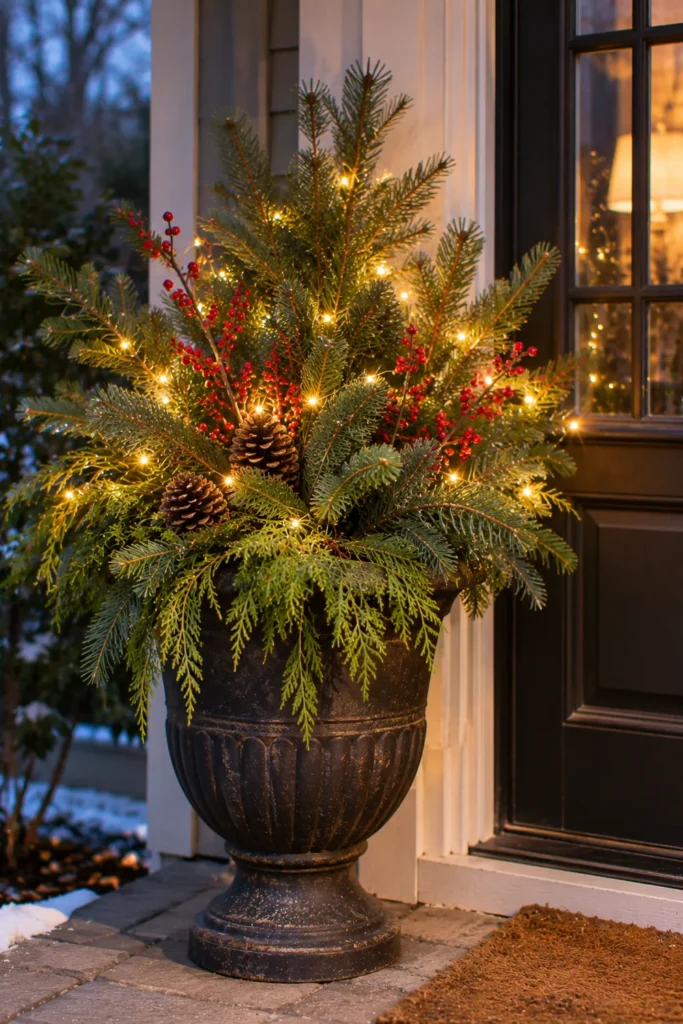
By day, this is a simple pot of fir and cedar. At dusk, it glows. A strand of warm white battery fairy lights wound loosely through the greens turns the pot into a soft lantern by the front door.
The lights matter most in the darkest weeks of winter, when you leave for work and come home in the dark. The warm glow picks up the texture of the needles and makes the porch feel lived in. Choose outdoor-rated battery lights with a built-in timer, so they switch on at dusk and off at bedtime without any cords across the walkway.
Tuck the battery pack deep into the greens or under the rim, where rain and snow can’t reach it.
14. Farmhouse Burlap Pot With Cedar and Cotton Stems
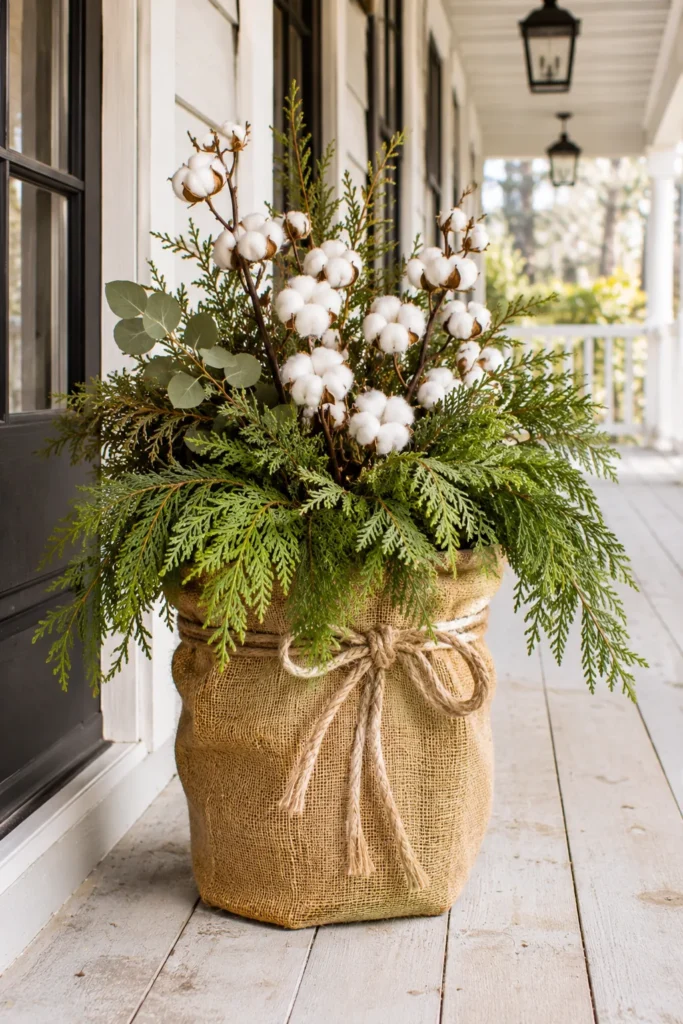
Terracotta and some glazed pots can crack in winter when wet soil freezes and expands inside them. That’s one reason this farmhouse pot is wrapped in burlap. The burlap adds a soft, rustic look and a light layer of protection around the planter.
Inside, cedar sprays drape over the rim and fluffy white cotton stems rise from the center, giving a natural white-and-green palette that suits a covered farmhouse porch. Cotton stems are dried, so they need a spot under the roof. Rain and snow turn them soggy and gray fast.
Choose frost-proof pots such as fiberglass, resin, thick concrete or stone.
Keep drainage holes open so water can escape.
Raise pots slightly on pot feet so they never sit in standing water.
Leaving unglazed terracotta full of wet soil outdoors in freezing weather.
Saucers under outdoor pots, where water collects and freezes.
Pots with no drainage hole at all.
15. Low Bowl of Wintergreen and Pinecones on the Steps
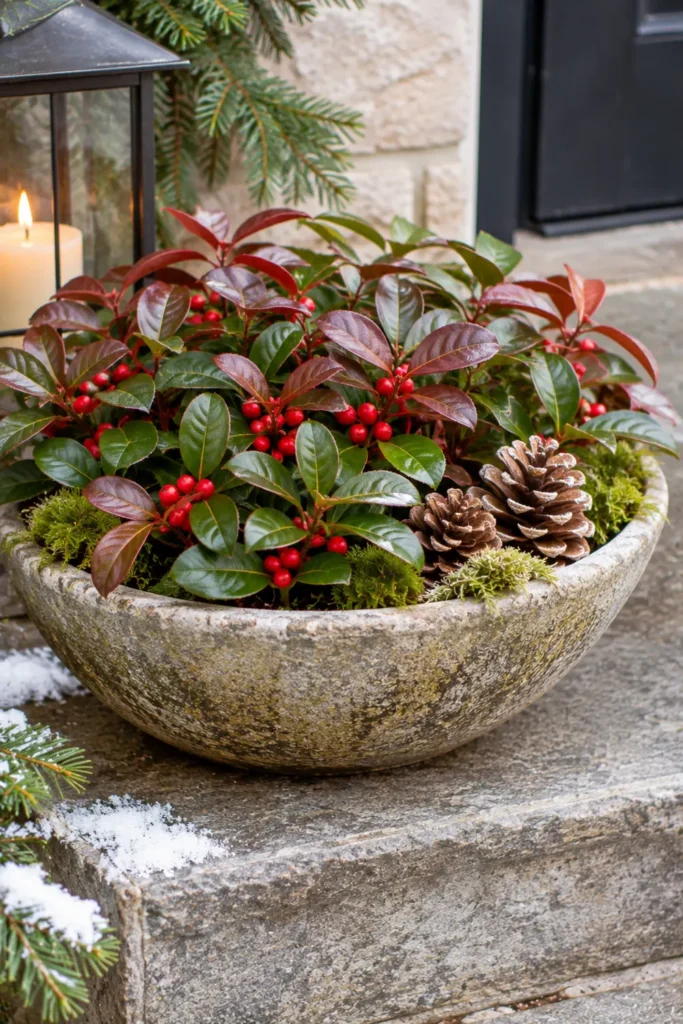
Wintergreen is a tiny evergreen groundcover with glossy leaves that turn bronze-red in the cold and bright red berries that hang on through winter. A low, wide bowl of it sitting on a porch step looks like a miniature winter landscape.
The small size is the point. Wintergreen stays only a few inches tall, so a shallow bowl holds a whole patch of it, with pinecones scattered among the plants. The red berries and burgundy leaves give the step a pop of holiday color that still looks natural in late winter. Set the bowl to the side of the step, out of the walking path.
Plant the look: a low, wide stone or concrete bowl, wintergreen plants, a few small pinecones, a little moss at the edges.
16. After the Holidays: Same Pot, Bows Off, Natural Cones On
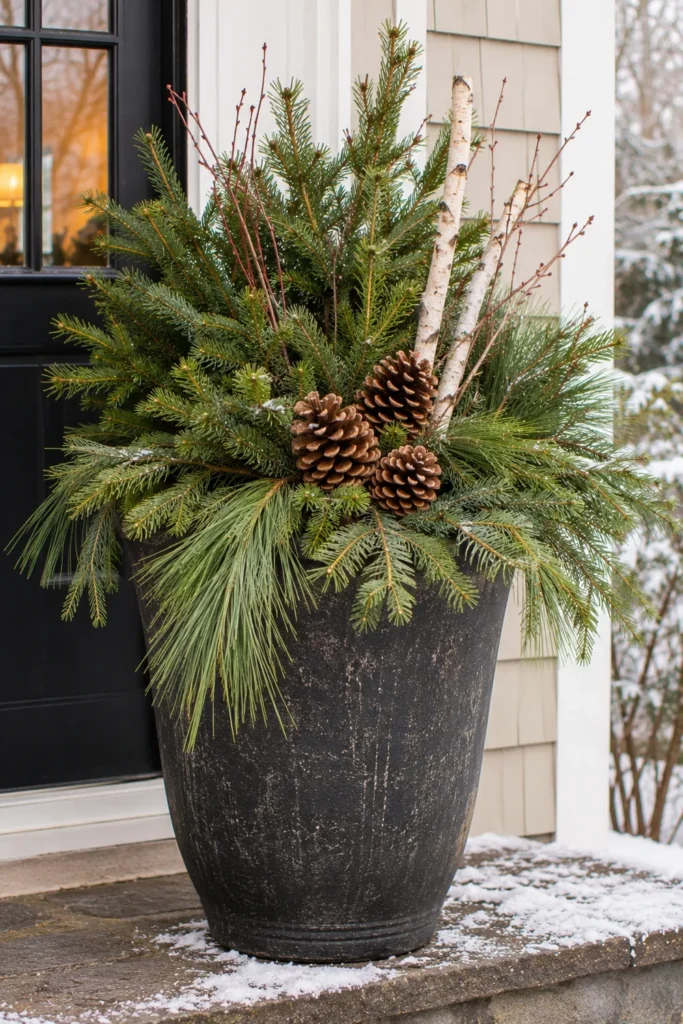
The red bows and shiny ornaments that look so right in December can feel tired by mid-January. You don’t need a new pot. You just need a quick swap.
Before, the pot holds fir, red ribbon and glass ornaments. After, the ribbon and ornaments come out, and natural pinecones, a few birch twigs and extra white pine go in. The base of greens stays exactly the same, but the pot now reads as winter instead of Christmas. If your fir looks tired, recut fresh branches from your Christmas tree before it goes to the curb. These ways to repurpose Christmas tree trimmings give the branches a second life.
Pull any greens that have browned, then push new stems into the soil wherever there’s a gap.
17. Dried Hydrangea Heads and Fir Under a Covered Porch
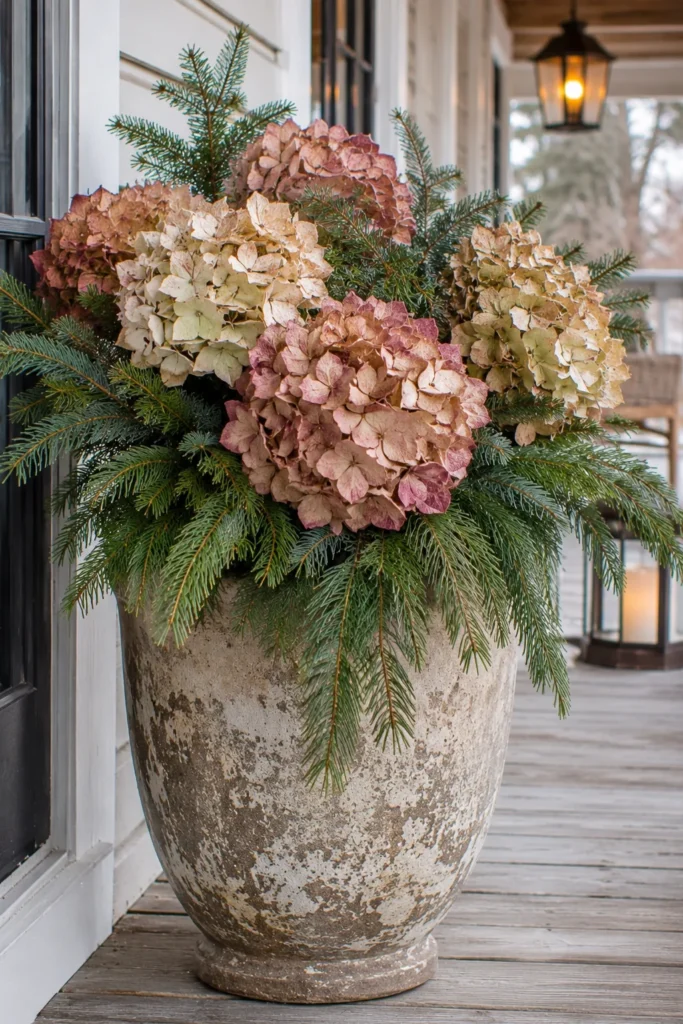
Hydrangea heads left on the shrub through fall dry to soft, papery shades of antique pink, green and cream. Cut them before the winter rains spoil them, and they make one of the prettiest winter pot fillers there is.
Step back and the pot reads soft and vintage. The dried blooms nestle among dark fir branches, and the faded pinks and greens sit against the deep green needles like old roses. It’s a great way to use what’s already growing in the garden. Dried hydrangeas need shelter, though, because snow and rain turn them brown. Save this pot for a covered porch.
Cut hydrangea heads when they feel papery and dry to the touch on the shrub. Picked too early, they wilt instead of drying.
18. Blue Spruce and Juniper in a Cool Blue Palette
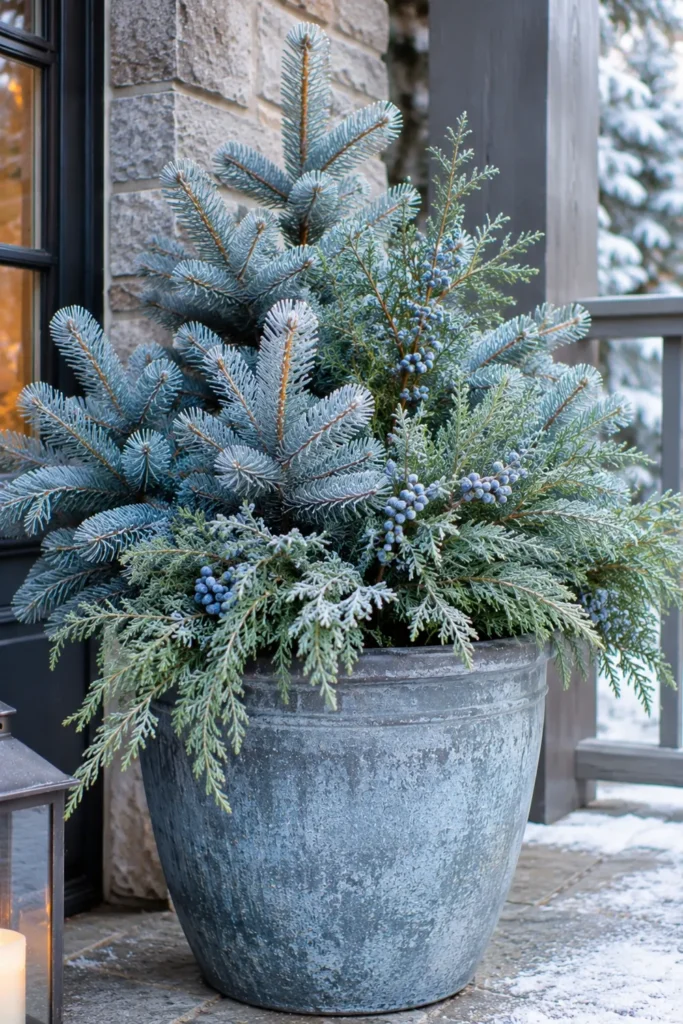
Blue spruce boughs have a silvery-blue color unlike any other evergreen. Paired with blue juniper and set in a gray-blue pot, they make a winter planter that looks icy and calm instead of traditional red and green.
The stiff, upright spruce gives the pot structure, while softer juniper sprays fill in around it, dotted with dusty blue berry-like cones. A gray-blue pot ties the palette together, and in icy morning light, the frosted blues look almost silver. The single color family makes the pot feel designed instead of thrown together.
Styling note: Pick one accent color family and stick to it. Blues with silver, or reds with green, always look calmer than a pot that tries every color at once.
19. Long Railing Planter of Greens and Berries
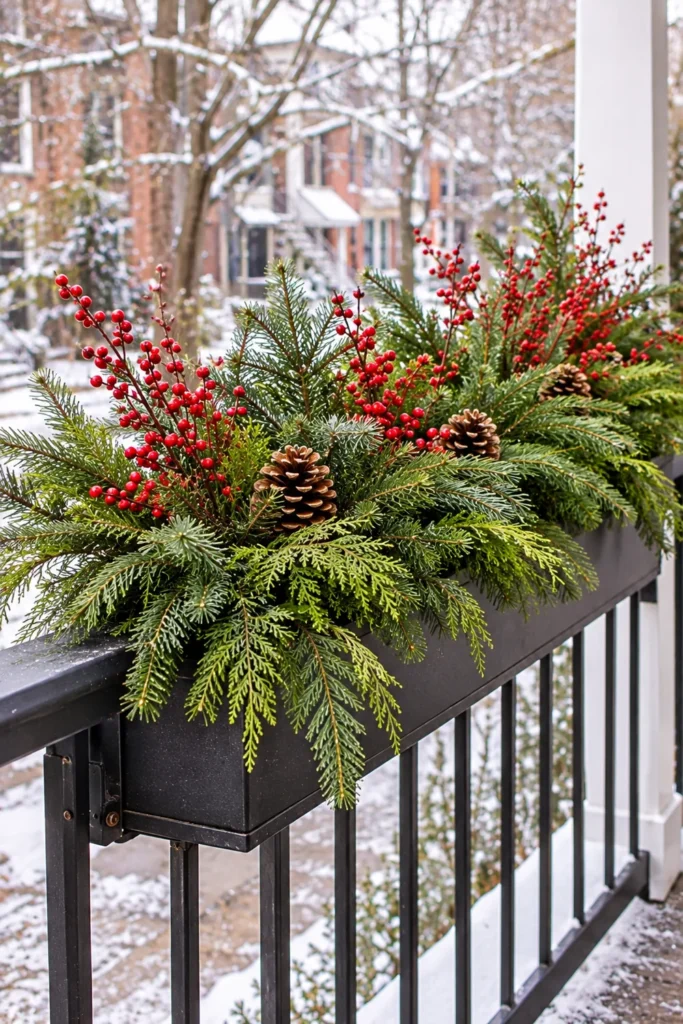
No room for floor pots on a small apartment porch or balcony? A long railing planter fixes that. It hangs on the rail, takes no floor space and holds a full winter arrangement in one long box.
Fill it with fir and cedar along its length, and add red rose hips or berry stems for color, so the railing reads as festive from the street. The long shape spreads the greenery across the whole rail instead of crowding one corner. Make sure the planter is secured firmly to the rail and isn’t too heavy once wet. These railing planter setups for a narrow balcony show more ways to plant it through the year.
Get the look: a long railing planter with drainage holes, fir and cedar boughs, red rose hip or berry stems, a few small pinecones.
20. Gold-Leaved False Cypress to Brighten a Gray Winter
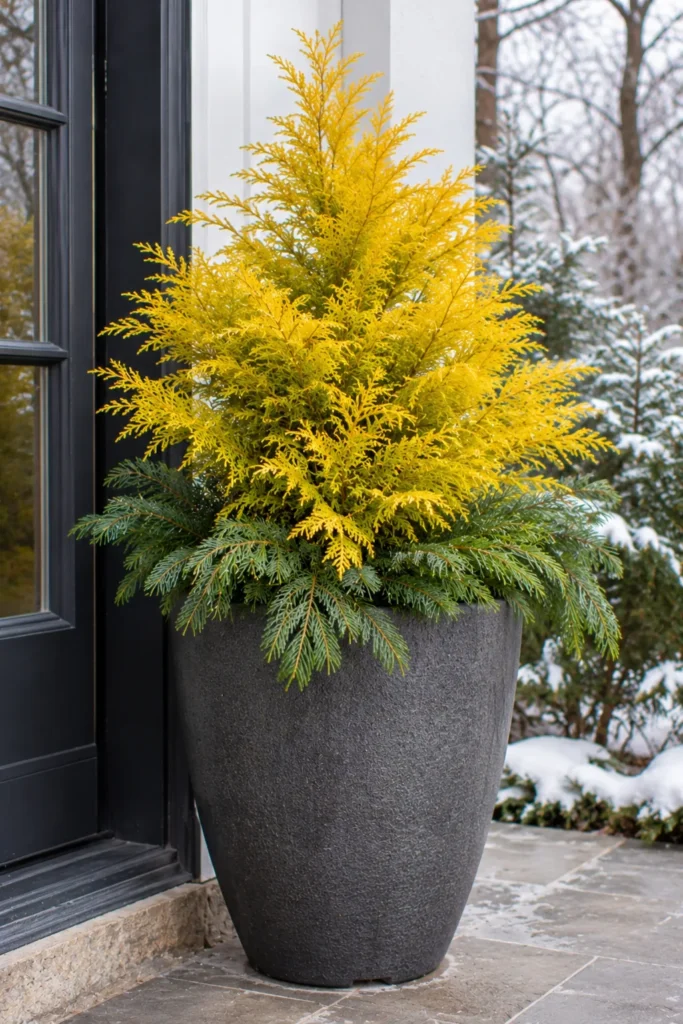
Gray winter days can make a porch look flat. A gold-leaved false cypress fixes that with soft, feathery foliage in bright golden yellow. It glows even under an overcast sky.
Planted in a charcoal pot, the gold looks even brighter, and the living plant stays colorful all winter without any cut greens to refresh. A few sprigs of dark fir tucked around the base deepen the contrast, so the gold seems to light up the whole entry.
Garden note: Like any potted conifer, it needs water whenever the soil thaws. In spring, you can plant it in the garden, where it keeps its golden color year after year.
21. Budget Pot From Your Own Yard Clippings
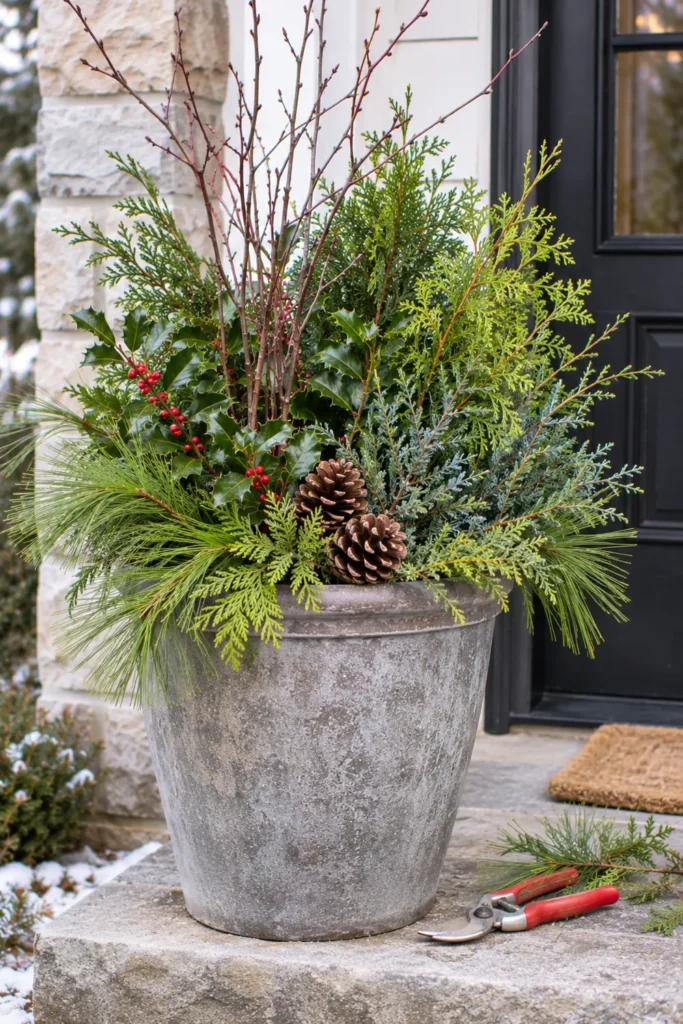
Bundles of cut greens from the garden center add up fast, especially if you’re filling more than one pot. The cheapest winter porch pot uses what’s already growing in your yard. Clip a few branches from your own evergreen shrubs, and a full planter can cost almost nothing.
Look around and you’ll likely find more than you expect: arborvitae, juniper, yew, holly, boxwood and pine all hold up well as cut greens. Add bare twigs from deciduous shrubs for height, and pinecones collected from the lawn. Harvesting this way also gives your shrubs a light winter trim. A good rule of thumb is to never take more than a third of any one plant. These shrubs you can prune in December are a smart place to start.
Cut from the back or inside of each shrub, so the gaps don’t show from the street.
22. Late Winter Refresh With Pansies Tucked Into the Greens
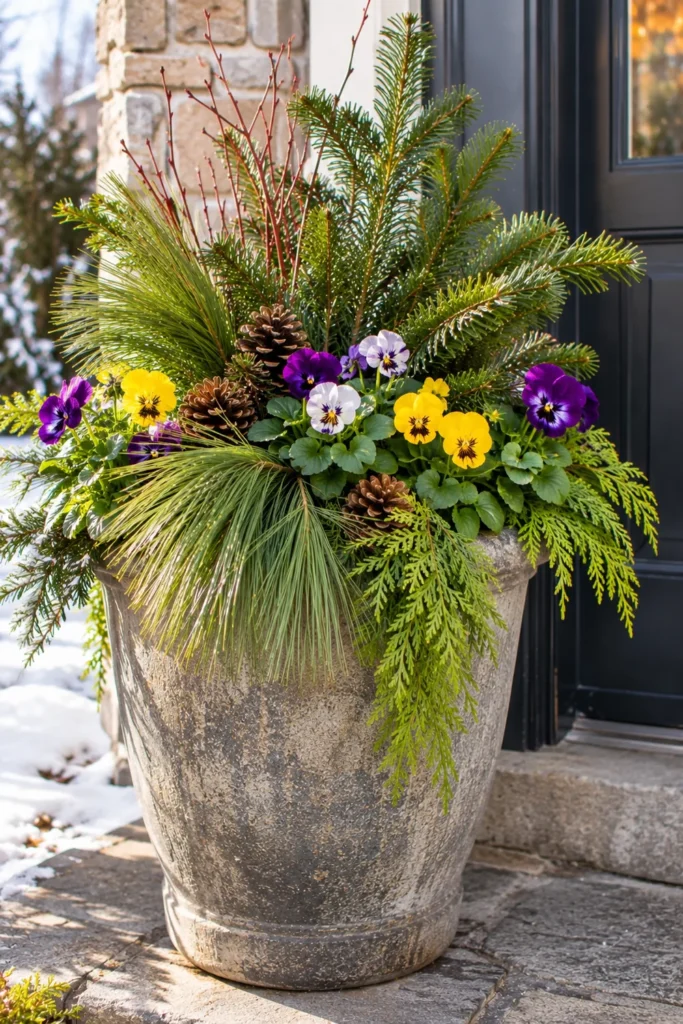
By February, even the best winter pot starts to look tired. Some greens have browned, the berries are gone and the whole thing needs a lift. Pansies are the easy fix.
Pull out any faded stems, then tuck small pansy plants into the gaps, right among the remaining fir and pine. Their cheerful faces in purple, yellow and white bring color back to the porch weeks before spring arrives, and they handle cold nights and light frosts surprisingly well. In very cold areas, wait until the hardest freezes have passed. These winter container gardening ideas show more cold-tolerant plants to try.
Pansies bloom best on mild, sunny days. Deadhead faded flowers to keep new buds coming.
23. Spring Bulb Pot Hidden Under Winter Greens
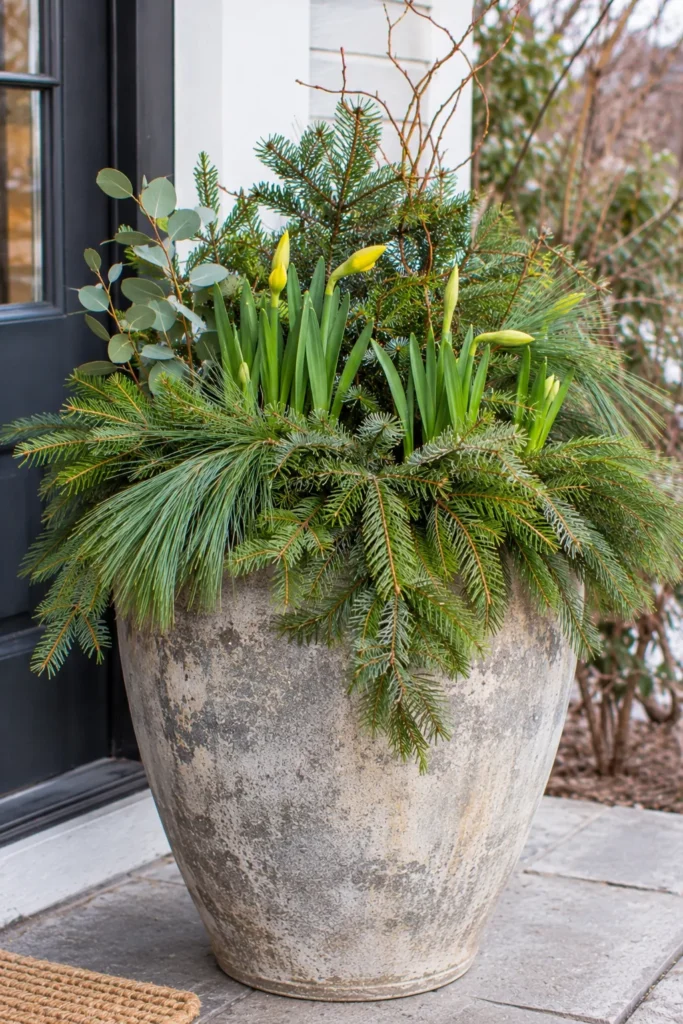
The longest-lasting winter porch pot is the one that turns into a spring pot on its own. Plant tulip or daffodil bulbs deep in a large pot in fall, then fill the top with cut greens for winter. No one will know the bulbs are there until spring.
As the weather warms and green shoots poke through, lift the winter greens out a few at a time. The bulbs grow up through the space, and the pot goes from fir and pinecones straight to spring flowers without ever sitting empty. Use a large, frost-proof pot, because more soil protects the bulbs from freezing solid. In very cold areas, move the pot against the house or into a sheltered corner during the coldest weeks.
Plant the look: a large frost-proof pot, tulip or daffodil bulbs planted deep, fir and white pine on top, a few pinecones. Daffodil bulbs are toxic to pets if dug up and eaten.
How to Make Winter Porch Pots Last Until Spring
Every pot on this list follows the same simple routine. Build it early, before the soil freezes, and choose greens that hold up in the cold. Set stems deep, water whenever the soil thaws, and use frost-proof pots with drainage holes. Then plan for the season. Take the holiday trim off after New Year’s, refresh tired greens in February, and let pansies or spring bulbs take over as the weather warms. That’s how a winter pot lasts all the way to spring.
The long-lasting winter porch pot checklist
Winter Porch Pots FAQ
Which evergreens last longest in outdoor pots?
Fir, white pine, spruce, cedar, arborvitae, yew, holly, boxwood and magnolia all hold up for weeks in cold weather. Fir and white pine are among the most reliable, and boxwood and magnolia keep their shape well. Ideas 1, 3 and 21 use several of these together.
Do winter porch pots need watering?
Yes, whenever the soil isn’t frozen. Cut greens stay fresher in moist soil, and living evergreens in pots can dry out fast in winter wind. Water deeply on mild days. Once the soil freezes solid, you can stop until the next thaw.
Will terracotta pots crack in winter?
They can. Unglazed terracotta absorbs water, and when wet soil freezes inside it, the pot can crack or flake. Frost-proof pots such as fiberglass, resin, thick concrete and stone are safer choices. Whatever the material, keep the drainage holes open and skip the saucers.
When should you make winter porch pots?
Late fall is best, after the summer annuals finish and before the soil in your pots freezes. Soft, moist soil holds stems firmly. Once it freezes, the stems are locked in for winter. If the soil is already frozen, a pot of fresh potting mix or a block of floral foam works too.
What can you put in porch pots after Christmas?
Keep the evergreen base and swap out the holiday trim. Remove red bows and ornaments, then add natural pinecones, birch twigs, winterberry or eucalyptus. In February, pull any faded greens and tuck in pansies. Ideas 16 and 22 show both swaps.
Conclusion
Bare pots don’t have to be part of winter. The best winter porch pot ideas start with sturdy greens and a frost-proof container, and they change a little through the season. Build them before the soil freezes, take the holiday trim off after New Year’s, and let pansies and spring bulbs take over as the days warm. Do that, and the pots by your front door look fresh from the first frost to the first daffodil. For more festive combinations, these outdoor Christmas planter ideas are worth a look too.
Save this for the next time your porch pots need a winter makeover.